Mission Date: July 17, 1943
HAMBURG, AERO ENGINES
100th BG Mission #: 7
Mission Summary
ON THIS DAY July 17,1944
With no combat missions flown on July 15 and July 16, a formation practice mission planned for the 16th had tragic consequences for another of the 349th Squadron’s original crews. Twenty-five year-old pilots Woodrow Barnhill and Carl F. Hudson were in taxi position in ‘Flak Shack,’ a fortress that had been piloted by Major Veal and Barnhill on the Le Bourget mission two days earlier. An experienced pilot, Barnhill had been the ‘A' flight commander of the 349th Squadron. Loaded up with a light gas load and no bombs, ‘Flak Shack’ took off but within thirty-seconds at just 200 feet, two engines were believed to have failed and the B-17 was seen to make a hard bank to the right, disappearing behind the trees at the end of the runway. Crashing into the earth, those standing by “saw a huge flame bellow up.” Barnhill, CP Carl Hudson, NAV Winifred Rucker, TTE Peter Contos, ROG Edward Johnson and WG Newton Harris had all been killed. Believed to have been seated toward the back at take-off, three crew survived: BTG Frank Opala, WG Vincent Noel and TG Peter Russell. Within twenty-two days of the 100BG flying its 1st combat mission, the 349th had already lost four of its original nine crews.
On July 17, a “Maximum Effort” was ordered for the 4th Division under Field Order #24, and the ground crews were readying twenty-four B-17s for the 100th’s next mission.
At 0300 hours, twenty-four crews at Thorpe Abbotts had been awakened and were seated in the briefing room. As the target map was revealed, they were briefed on their long range mission to Germany with both a primary and secondary target at Hamburg. Any target of opportunity in the area would be a last resort target.
The 4th Division would be flying two efforts that morning, with the 402nd and 401st Combat Wings in the main effort headed to Hamburg. A “secondary effort” with the target of Amsterdam would be flown by two newly operational B-17 Groups, the 385th and the 388th Bomb Groups, forming the 403rd Combat Wing and flying their first missions. On the route out to the targets, the secondary effort would follow the main effort by forty-five minutes, with “the turn south into the Dutch coast and on into Amsterdam acting as a diversion to the main effort which continued straight ahead.”
The 402nd Combat Wing would lead the Division’s main effort, with the 95th leading and the 100BG flying second and 1000 feet below. The 401st wing would follow, made up of the 96BG in the lead, followed by the 94BG.
Due to the route in and out by sea, orders called for all B17s to be loaded with an extra six hundred gallons of extra fuel. The S-2 Officer reviewed the turns to be made after bombs away: a turn to the left from the target to the rally point, followed by a sharp left turn and another right turn to avoid the heavy anti-aircraft guns expected at Hamburg.
Taxiing into position on the runway, the men awaited the signal to begin take-off. At 0550 hours, loaded with ten 500 lb GP bombs, the B-17s began rumbling down the runway with three of the assigned B-17s failing to take off: Sam Turner had been unable to take off due to a run away engine during preflighting. ’Stymie’ flown by Ernest Kiessling, had a left tire blow out on take-off causing Kiessling to ground loop his aircraft and Roy Claytor flying in ‘Alice from Dallas’ failed to take off due to an oxygen leak.
With the remainder of the B-17s up, the 100BG assembled into the group formation and then joined with the 95BG to form the 402nd wing formation as planned. Division assembly was to occur at 2000 feet at Swartham, but by Cromer, a good formation had not been accomplished due to the groups being too spread out.
After leaving the English coast, Division headquarters moved zero hour by thirty minutes and the 95BG took the formation on a 180 degree turn back to England to lose some time, resuming the original course on the new time schedule.
Bad weather however over the North Sea and into Germany caused the Division leader to ultimately abandon the mission “after turning back on the first left of the feint” twenty miles from the mouth of the Elbe River. With the mission recalled at 0955 hours, the formations headed back to England over the North Sea.
Attacking out of the cloud cover, the main effort’s formations encountered enemy fighters made up of ME 109s, FW 190s and several JU 88’s. With continual attacks for forty minutes, the enemy fighters were reported to have attacked “in pairs and groups of 3 and 6, coming first from 10 to 12 o'clock above and driving through the formation, then turning to come in high from 5 to 7 o'clock on the two rear elements. The latter elements bore the brunt of the attack. The JU 88's stayed out of range and fired what appeared to be 37 mm shells into the formation.”
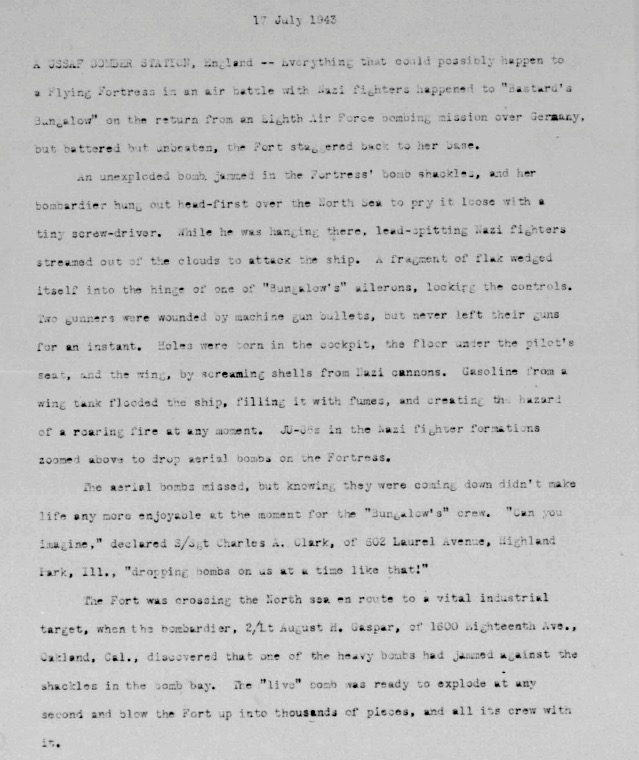
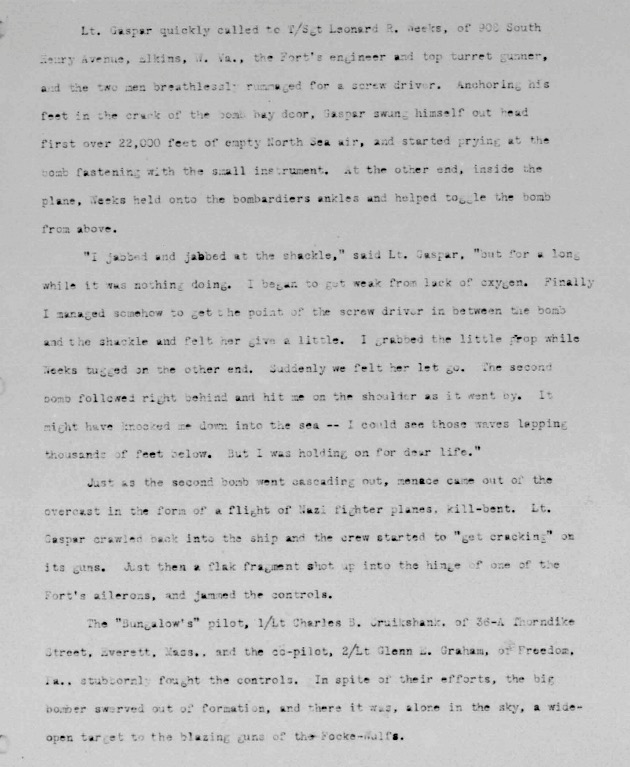
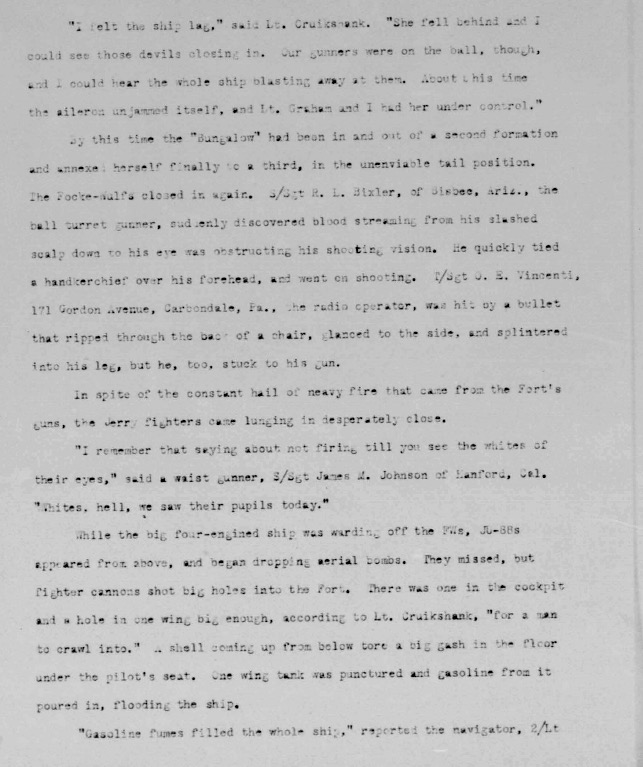
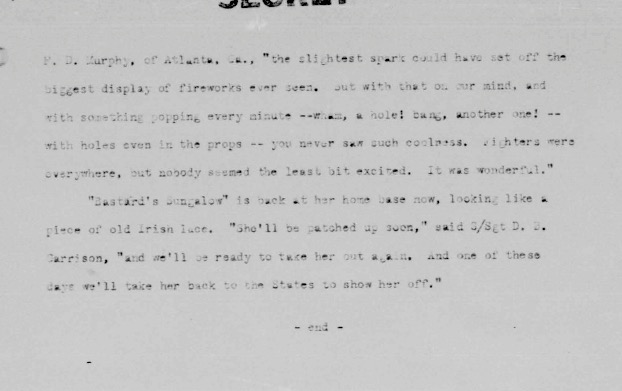
In ‘Bastard’s Bungalow' flown by Charles Cruikshank and Glenn Graham, although mayhem was along for the ride inside their fortress, everyone performed their job to the best of their abilities. The pilots’ controls had been damaged by flak, “two gunners were wounded by machine gun bullets…Holes were torn in the cockpit, the floor under the pilot’s seat, and the wing, by screaming shells from Nazi cannons. Gasoline from a wing tank flooded the ship, filling it with fumes… and creating the hazard of a roaring fire at any moment. JU-88’s in the Nazi fighter formations zoomed above to drop aerial bombs on the Fortress…” Cruikshank’s navigator, Frank Murphy tells us, "Gasoline fumes filled the whole ship, the slightest spark could have set off the biggest display of fireworks ever seen. But with that on our mind, and with something popping every minute – wham, a hole! Bam, another ! -- with holes even in the props – you never saw such coolness. Fighters were everywhere, but nobody seemed the least bit excited. It was wonderful."
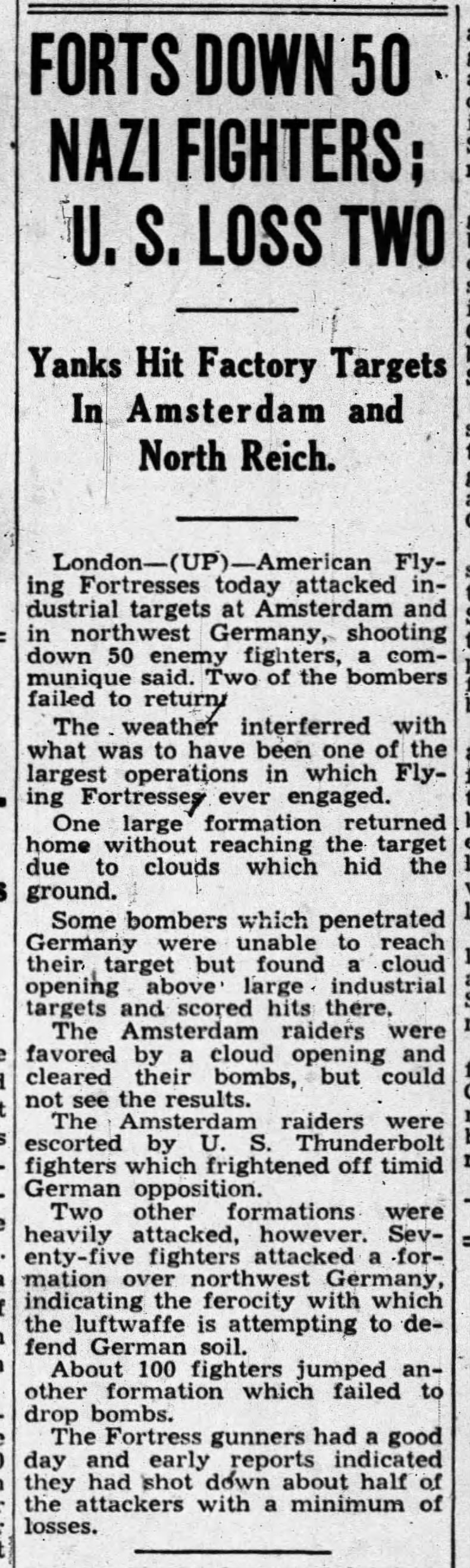
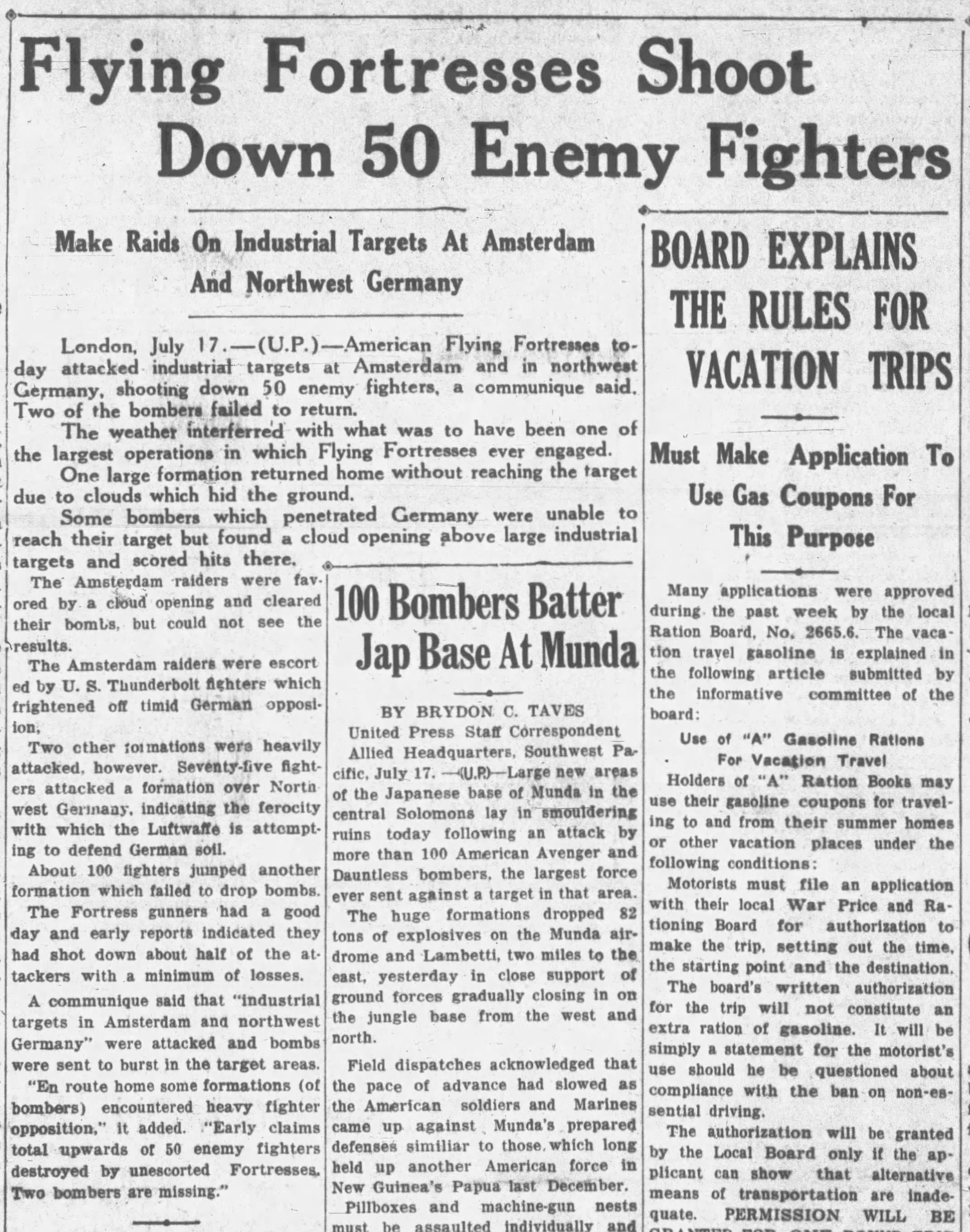
The 100th’s gunners were credited with destroying two ME 109s and three FW 190s and damaging one ME 109 and damaging four FW 190s. The main effort’s gunner’s had destroyed a total of twenty-eight enemy fighters, another nine 'probably destroyed’ and damaged an additional thirty-three enemy aircraft.
Although two additional B-17s had aborted the mission before the recall; ’Phartzac’ returned due to an inoperative nose and tail gun while ‘Picadilly Lilly’ had returned due to a left landing gear unable to retract, the remainder of the fortresses returned to Thorpe Abbotts safely, with Cruikshank bringing his B17 in for landing with two wounded aboard.
At Interrogation, “a new type of enemy aircraft with a round blunt nose, stubby fuselage, and elliptical wings” had been observed and reported by the crews. That evening, the 100BG was alerted and headquarters was busy once again with planning.
Crews identified to have flown this mission: Barr, Reed, Reeder, Roane, Carnell, Claytor, Hollenbeck, DeMarco, Braley, DeSanders, Fienup, Barker, Turner, Dye, Henington, Kiessling, Flesh, Cruikshank, Brady, Woodward, Knox
With no combat missions flown on July 15 and July 16, a formation practice mission planned for the 16th had tragic consequences for another of the 349th Squadron’s original crews. Twenty-five year-old pilots Woodrow Barnhill and Carl F. Hudson were in taxi position in ‘Flak Shack,’ a fortress that had been piloted by Major Veal and Barnhill on the Le Bourget mission two days earlier. An experienced pilot, Barnhill had been the ‘A' flight commander of the 349th Squadron. Loaded up with a light gas load and no bombs, ‘Flak Shack’ took off but within thirty-seconds at just 200 feet, two engines were believed to have failed and the B-17 was seen to make a hard bank to the right, disappearing behind the trees at the end of the runway. Crashing into the earth, those standing by “saw a huge flame bellow up.” Barnhill, CP Carl Hudson, NAV Winifred Rucker, TTE Peter Contos, ROG Edward Johnson and WG Newton Harris had all been killed. Believed to have been seated toward the back at take-off, three crew survived: BTG Frank Opala, WG Vincent Noel and TG Peter Russell. Within twenty-two days of the 100BG flying its 1st combat mission, the 349th had already lost four of its original nine crews.
On July 17, a “Maximum Effort” was ordered for the 4th Division under Field Order #24, and the ground crews were readying twenty-four B-17s for the 100th’s next mission.
At 0300 hours, twenty-four crews at Thorpe Abbotts had been awakened and were seated in the briefing room. As the target map was revealed, they were briefed on their long range mission to Germany with both a primary and secondary target at Hamburg. Any target of opportunity in the area would be a last resort target.
The 4th Division would be flying two efforts that morning, with the 402nd and 401st Combat Wings in the main effort headed to Hamburg. A “secondary effort” with the target of Amsterdam would be flown by two newly operational B-17 Groups, the 385th and the 388th Bomb Groups, forming the 403rd Combat Wing and flying their first missions. On the route out to the targets, the secondary effort would follow the main effort by forty-five minutes, with “the turn south into the Dutch coast and on into Amsterdam acting as a diversion to the main effort which continued straight ahead.”
The 402nd Combat Wing would lead the Division’s main effort, with the 95th leading and the 100BG flying second and 1000 feet below. The 401st wing would follow, made up of the 96BG in the lead, followed by the 94BG.
Due to the route in and out by sea, orders called for all B17s to be loaded with an extra six hundred gallons of extra fuel. The S-2 Officer reviewed the turns to be made after bombs away: a turn to the left from the target to the rally point, followed by a sharp left turn and another right turn to avoid the heavy anti-aircraft guns expected at Hamburg.
Taxiing into position on the runway, the men awaited the signal to begin take-off. At 0550 hours, loaded with ten 500 lb GP bombs, the B-17s began rumbling down the runway with three of the assigned B-17s failing to take off: Sam Turner had been unable to take off due to a run away engine during preflighting. ’Stymie’ flown by Ernest Kiessling, had a left tire blow out on take-off causing Kiessling to ground loop his aircraft and Roy Claytor flying in ‘Alice from Dallas’ failed to take off due to an oxygen leak.
With the remainder of the B-17s up, the 100BG assembled into the group formation and then joined with the 95BG to form the 402nd wing formation as planned. Division assembly was to occur at 2000 feet at Swartham, but by Cromer, a good formation had not been accomplished due to the groups being too spread out.
After leaving the English coast, Division headquarters moved zero hour by thirty minutes and the 95BG took the formation on a 180 degree turn back to England to lose some time, resuming the original course on the new time schedule.
Bad weather however over the North Sea and into Germany caused the Division leader to ultimately abandon the mission “after turning back on the first left of the feint” twenty miles from the mouth of the Elbe River. With the mission recalled at 0955 hours, the formations headed back to England over the North Sea.
Attacking out of the cloud cover, the main effort’s formations encountered enemy fighters made up of ME 109s, FW 190s and several JU 88’s. With continual attacks for forty minutes, the enemy fighters were reported to have attacked “in pairs and groups of 3 and 6, coming first from 10 to 12 o'clock above and driving through the formation, then turning to come in high from 5 to 7 o'clock on the two rear elements. The latter elements bore the brunt of the attack. The JU 88's stayed out of range and fired what appeared to be 37 mm shells into the formation.”
In ‘Bastard’s Bungalow' flown by Charles Cruikshank and Glenn Graham, although mayhem was along for the ride inside their fortress, everyone performed their job to the best of their abilities. The pilots’ controls had been damaged by flak, “two gunners were wounded by machine gun bullets…Holes were torn in the cockpit, the floor under the pilot’s seat, and the wing, by screaming shells from Nazi cannons. Gasoline from a wing tank flooded the ship, filling it with fumes… and creating the hazard of a roaring fire at any moment. JU-88’s in the Nazi fighter formations zoomed above to drop aerial bombs on the Fortress…” Cruikshank’s navigator, Frank Murphy tells us, "Gasoline fumes filled the whole ship, the slightest spark could have set off the biggest display of fireworks ever seen. But with that on our mind, and with something popping every minute – wham, a hole! Bam, another ! -- with holes even in the props – you never saw such coolness. Fighters were everywhere, but nobody seemed the least bit excited. It was wonderful."
The 100th’s gunners were credited with destroying two ME 109s and three FW 190s and damaging one ME 109 and damaging four FW 190s. The main effort’s gunner’s had destroyed a total of twenty-eight enemy fighters, another nine 'probably destroyed’ and damaged an additional thirty-three enemy aircraft.
Although two additional B-17s had aborted the mission before the recall; ’Phartzac’ returned due to an inoperative nose and tail gun while ‘Picadilly Lilly’ had returned due to a left landing gear unable to retract, the remainder of the fortresses returned to Thorpe Abbotts safely, with Cruikshank bringing his B17 in for landing with two wounded aboard.
At Interrogation, “a new type of enemy aircraft with a round blunt nose, stubby fuselage, and elliptical wings” had been observed and reported by the crews. That evening, the 100BG was alerted and headquarters was busy once again with planning.
Crews identified to have flown this mission: Barr, Reed, Reeder, Roane, Carnell, Claytor, Hollenbeck, DeMarco, Braley, DeSanders, Fienup, Barker, Turner, Dye, Henington, Kiessling, Flesh, Cruikshank, Brady, Woodward, Knox
Bombing Results
Bombing Results: RECALL
Aircraft Lost: 0
Crew Lost: 0
Claims of Enemy Losses (CLS): 5
Aircraft Returned:
Media Articles
Use your thumb to scroll through the results box below.
| Media Item | Type | Page | Volume/Issue | Broadcast Source | Time | Description | File |
|---|---|---|---|---|---|---|---|
| Cruikshank crew July 17 1943 press release part 1 | Air Force historical records July 1943 | 12:00 am | Cruikshank-Crew-July-17-1943-mission-recalled-part-1.jpeg | ||||
| Cruikshank crew July 17 1943 press release part 2 | AF historical records July 1943 | 12:00 am | Cruikshank-crew-July-17-1943-mission-recall-part-2.jpeg | ||||
| Cruikshank crew July 17 1943 press release part 3 | AF historical record July 1943 | 12:00 am | Cruikshank-crew-July-17-1943-mission-recall-part-3.jpeg | ||||
| Cruikshank crew July 17 1943 mission part 4 press release | AF historical records July 1943 | 12:00 am | Cruikshank-crew-July-17-1943-mission-recall-part-4.jpeg | ||||
| July 17 1943 mission | The Rock Island Argus July 17 1943 | 12:00 am | |||||
| July 17 1943 mission | Latrobe Bulletin July 17 1943 | 12:00 am |