Mission Date: July 24, 1943
TRONDHEIM, SUB PENS
100th BG Mission #: 8
Mission Summary
ON THIS DAY JULY 24, 1943
It would be one week from the Hamburg mission that the 100th’s B-17s would leave the ground for another combat mission. Practice formation missions were flown by the air crews while 8th Air Force housekeeping tasks would fill HQ’s days. The 100BG’s S-2 Intelligence group under Red Bowman was building an impressive reputation within the 8th Air Force. Twenty-nine year-old S-2 officer Charles W. Terry had written a report on the 100th’s July 17 aborted mission to Hamburg, with it being “the best ever received at the 4th Wing from point of view of detail and clarity.” With other air executives arriving to the base to review the 100th’s S-2 procedures and files kept, Bowman recorded on July 18, “seems the 100th S-2 section is acquiring a favorable reputation throughout the 8th AF. Lt. Ayres complimented our set-up as being one of the best he has seen in the many stations in the 8th AF he had visited.” On July 20, the base was officially handed over from the RAF, becoming ‘Station 139’ and the 390th Bomb Group became part of the 402nd Combat Wing, joining the 100BG and the 95BG. July 21-23 was spent awarding medals on airmen on base and to the wounded in the hospital.
Field Order #27 came through at 0030 hours on July 24, for a mission to go off later that morning. Awakened at 0300 hours, Donald Stout, navigator on Norman Scott’s crew, unaware of an alert before he went to bed, tells us, “Some guy pulled the covers off me in the middle of the night. We had an hour to dress and eat breakfast. We knew it must be something special, because we had fresh eggs for breakfast. We all went into the briefing room after breakfast, and the Colonel told us just as calmly and easily as ever that we were going to Norway…”
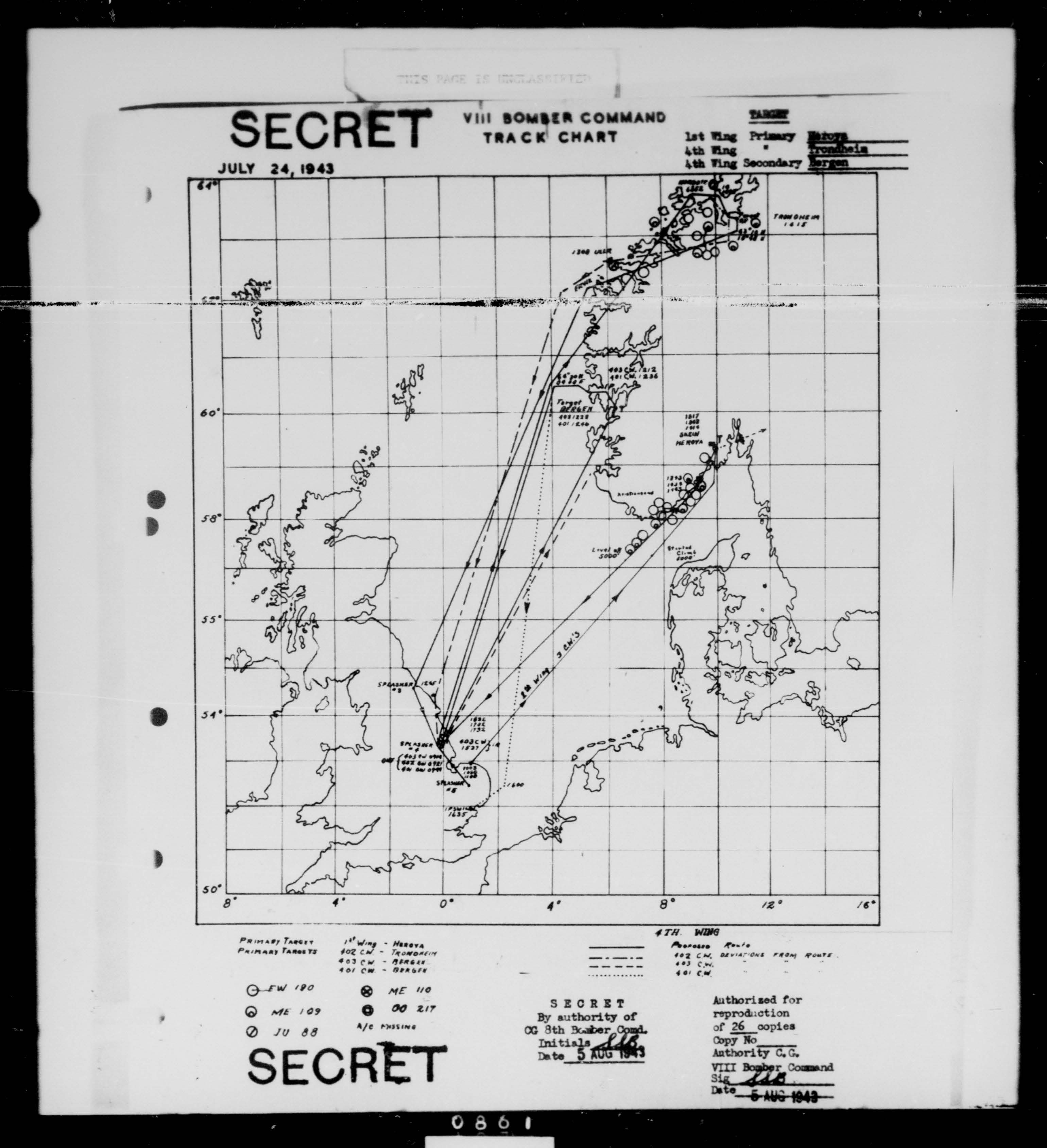
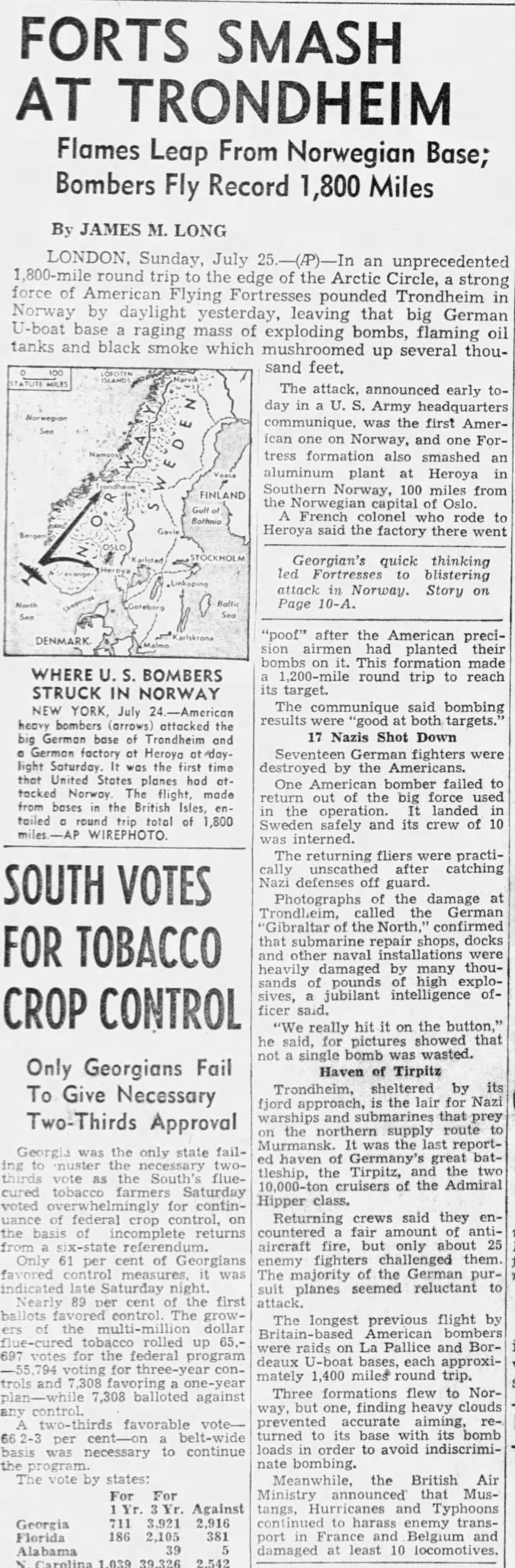
The 8th Air Force’s first attack on occupied Norway would be the longest mission to-date at 1,800 miles total round-trip, 1,000 miles of which would be over sea. Colonel Harding told those seated that they would be targeting the U-boat workshops and harbor installations at Trondheim, an important German naval base that was supplying the northern supply route to the Eastern front.
Only the 402nd CBW, led by the 100BG and followed by the 95BG, would target Trondheim. The 401st and 403rd would target Bergen, Norway. The 401st CBW, composed of the 94BG and the 385BG would lead, followed by a fifteen minute interval, then the 403rd CBW, made up of the 96BG and the 388BG. With the routes reviewed, the men were told that minimal enemy fighters were anticipated so no allied fighter support had been ordered. Advanced airdromes were assigned if refueling was necessary.
Colonel Harding would be flying as the 100BG’s Command Pilot, with Ev Blakely and crew in ‘Just-A-Snappin.’ Ollen Turner would fly with Glen Dye as a lead crew in ‘Janie’. Richard Carey would lead the second element of the high squadron in ‘Sweater Girl’ with William DeSanders in ‘Alice from Dallas’ flying as one of his wingmen.
Twenty-four of the 100th’s aircraft had been readied, loaded with eight 500# bombs. Take-off and group assembly went as planned, although patchy ground fog reduced visibility over the base. Assembled into the 402nd combat wing, the formation left the English coast and headed out over the North Sea, where the cloud coverage thickened to 6-8/10 coverage all the way to the coast of Norway.
Before the enemy coast had been crossed, three of the 349th’s fortresses had left the formation early: ‘Oh Nausea!,’ flown by Henington due to an oil lead on #3 oil tank, ’Forever Yours’ due an oil leak on #1 engine and ‘Torchy2’ who fell behind due to a temporary electrical shortage causing all instruments to go out and was unable to regain the formation.
Nearing the coast of Bergen, twelve to fifteen enemy fighters were spotted, coming in for an attack on the wing. Continuing for twenty minutes, ME109s, FW 190s, one JU88 and one ME 110 pressed their attacks, mostly from five to seven o’clock, level and above and singly in line from out of the sun and mostly on the 95BG. James Sides, LWG on Richard King’s B-17 tells us, “Intercepted by 6 German ME109s…” William DeSanders flying “Alice from Dallas” recorded “…I let Styles fly a while and went back into the waist and took a few pot shots at the me109s. Not such bad shooting but no good strikes…” Reported as a “light attack,” the gunners were successful in fending off the enemy fighters with the 100th’s gunners claiming two ME109s destroyed, while the 95BG claimed two FW 190s destroyed, another two probables and yet another three enemy aircraft damaged without the loss of any fortresses.
Identifying Trondheim ahead by its smoke pots, the 100th could identify the target and made its turn onto the bomb run, making an eighty-second run. Flying through the flak over the target, the bursts were reported as moderate, accurate and continuous following on the formations. James Sides continued, “…heavy flak. Received hit by 88 mm shell in vertical stabilizer.” With an effective smoke screen over the target, the lead bombardier sighted and the group dropped upon his bombs dropping. Following the 100th in over the target, the 95BG attacked next.
When the fortresses left Trondheim, the U-boat base was “a raging mass of exploding bombs, flaming oil tanks and black smoke which mushroomed up several thousand feet.” Later photographs would show that three workshops had been destroyed, another three damaged, the gas works were on fire and the dock area had been damaged. There had been a direct hit on the destroyer ‘Norvick' and a merchant ship’s bow was submerged due to a direct hit.
Returning back to England, the formation, minus one aircraft, was seen over Station 139 at 1954 hours, just under flying a twelve hour mission. Curtis Biddick’s B-17 had not returned and the men held out hope that Biddick had landed safely elsewhere.
Interrogation was full of exhausted airmen but high on adrenaline over a successful mission. Colonel Harding was pleased with his group’s performance and was quoted as saying, “…A day like this boosts morale 200 percent…” Bernie Demarco’s gunner, twenty-three year old Leo T. Callahan was happy to claim it an easy mission when he stated, “Naw, it was a milk route today. You just get up early and ride around and leave the order and come home and go to bed - where I’m going right now.”
Later, spirits ran even higher when headquarters heard from Curtis Biddick who reported in from Scotland, where he had made a crash landing. With a knocked out oxygen supply, he and his copilot had been sharing an emergency oxygen bottle as they tried to make it back to England. Red Bowman recorded that Biddick “was forced to make a crash landing in the vegetable garden of the Commanding Officer of a RAF training field in northern Scotland. The native had never seen Americans or American planes and their hospitality was terrific according to the crew which was flown out the next day.”
Brigadier General Curtis LeMay was pleased with the mission’s results, even though the 401st and 403rd combat wings did not attack Bergen due to 10/10 cloud coverage. His official comments were:
“This mission was the longest that has been accomplished by B-17 type aircraft in any theater of war. It is all the more noteworthy in view of the problems of navigation over so large an expanse of water to an area which was entirely new to the participating crews.
Both efforts were carried out with precision and it is believed the results would have been outstanding had not the target assigned to the stronger force been completely overcast.
The long slow climb over the sea was a definite aid in preventing abortives since it was not necessary to overtax the engines. A lower bombing altitude than usual was prescribed in view of the meagre AA defenses reported at the target.”
With good weather predicted ahead, that evening, the 100BG was on alert for a mission the next day.
Crews flying that day: Barr, Van Noy, MacCarter, Reeder, Roane, Henington, Carnell, Scott, Hollenbeck, DeMarco, Braley, DeSanders, Fienup, Murphy,Turner, Dye, King, Cruikshank, Brady, Woodward, Blakely, Moreno, Carey (some names missing)
It would be one week from the Hamburg mission that the 100th’s B-17s would leave the ground for another combat mission. Practice formation missions were flown by the air crews while 8th Air Force housekeeping tasks would fill HQ’s days. The 100BG’s S-2 Intelligence group under Red Bowman was building an impressive reputation within the 8th Air Force. Twenty-nine year-old S-2 officer Charles W. Terry had written a report on the 100th’s July 17 aborted mission to Hamburg, with it being “the best ever received at the 4th Wing from point of view of detail and clarity.” With other air executives arriving to the base to review the 100th’s S-2 procedures and files kept, Bowman recorded on July 18, “seems the 100th S-2 section is acquiring a favorable reputation throughout the 8th AF. Lt. Ayres complimented our set-up as being one of the best he has seen in the many stations in the 8th AF he had visited.” On July 20, the base was officially handed over from the RAF, becoming ‘Station 139’ and the 390th Bomb Group became part of the 402nd Combat Wing, joining the 100BG and the 95BG. July 21-23 was spent awarding medals on airmen on base and to the wounded in the hospital.
Field Order #27 came through at 0030 hours on July 24, for a mission to go off later that morning. Awakened at 0300 hours, Donald Stout, navigator on Norman Scott’s crew, unaware of an alert before he went to bed, tells us, “Some guy pulled the covers off me in the middle of the night. We had an hour to dress and eat breakfast. We knew it must be something special, because we had fresh eggs for breakfast. We all went into the briefing room after breakfast, and the Colonel told us just as calmly and easily as ever that we were going to Norway…”
The 8th Air Force’s first attack on occupied Norway would be the longest mission to-date at 1,800 miles total round-trip, 1,000 miles of which would be over sea. Colonel Harding told those seated that they would be targeting the U-boat workshops and harbor installations at Trondheim, an important German naval base that was supplying the northern supply route to the Eastern front.
Only the 402nd CBW, led by the 100BG and followed by the 95BG, would target Trondheim. The 401st and 403rd would target Bergen, Norway. The 401st CBW, composed of the 94BG and the 385BG would lead, followed by a fifteen minute interval, then the 403rd CBW, made up of the 96BG and the 388BG. With the routes reviewed, the men were told that minimal enemy fighters were anticipated so no allied fighter support had been ordered. Advanced airdromes were assigned if refueling was necessary.
Colonel Harding would be flying as the 100BG’s Command Pilot, with Ev Blakely and crew in ‘Just-A-Snappin.’ Ollen Turner would fly with Glen Dye as a lead crew in ‘Janie’. Richard Carey would lead the second element of the high squadron in ‘Sweater Girl’ with William DeSanders in ‘Alice from Dallas’ flying as one of his wingmen.
Twenty-four of the 100th’s aircraft had been readied, loaded with eight 500# bombs. Take-off and group assembly went as planned, although patchy ground fog reduced visibility over the base. Assembled into the 402nd combat wing, the formation left the English coast and headed out over the North Sea, where the cloud coverage thickened to 6-8/10 coverage all the way to the coast of Norway.
Before the enemy coast had been crossed, three of the 349th’s fortresses had left the formation early: ‘Oh Nausea!,’ flown by Henington due to an oil lead on #3 oil tank, ’Forever Yours’ due an oil leak on #1 engine and ‘Torchy2’ who fell behind due to a temporary electrical shortage causing all instruments to go out and was unable to regain the formation.
Nearing the coast of Bergen, twelve to fifteen enemy fighters were spotted, coming in for an attack on the wing. Continuing for twenty minutes, ME109s, FW 190s, one JU88 and one ME 110 pressed their attacks, mostly from five to seven o’clock, level and above and singly in line from out of the sun and mostly on the 95BG. James Sides, LWG on Richard King’s B-17 tells us, “Intercepted by 6 German ME109s…” William DeSanders flying “Alice from Dallas” recorded “…I let Styles fly a while and went back into the waist and took a few pot shots at the me109s. Not such bad shooting but no good strikes…” Reported as a “light attack,” the gunners were successful in fending off the enemy fighters with the 100th’s gunners claiming two ME109s destroyed, while the 95BG claimed two FW 190s destroyed, another two probables and yet another three enemy aircraft damaged without the loss of any fortresses.
Identifying Trondheim ahead by its smoke pots, the 100th could identify the target and made its turn onto the bomb run, making an eighty-second run. Flying through the flak over the target, the bursts were reported as moderate, accurate and continuous following on the formations. James Sides continued, “…heavy flak. Received hit by 88 mm shell in vertical stabilizer.” With an effective smoke screen over the target, the lead bombardier sighted and the group dropped upon his bombs dropping. Following the 100th in over the target, the 95BG attacked next.
When the fortresses left Trondheim, the U-boat base was “a raging mass of exploding bombs, flaming oil tanks and black smoke which mushroomed up several thousand feet.” Later photographs would show that three workshops had been destroyed, another three damaged, the gas works were on fire and the dock area had been damaged. There had been a direct hit on the destroyer ‘Norvick' and a merchant ship’s bow was submerged due to a direct hit.
Returning back to England, the formation, minus one aircraft, was seen over Station 139 at 1954 hours, just under flying a twelve hour mission. Curtis Biddick’s B-17 had not returned and the men held out hope that Biddick had landed safely elsewhere.
Interrogation was full of exhausted airmen but high on adrenaline over a successful mission. Colonel Harding was pleased with his group’s performance and was quoted as saying, “…A day like this boosts morale 200 percent…” Bernie Demarco’s gunner, twenty-three year old Leo T. Callahan was happy to claim it an easy mission when he stated, “Naw, it was a milk route today. You just get up early and ride around and leave the order and come home and go to bed - where I’m going right now.”
Later, spirits ran even higher when headquarters heard from Curtis Biddick who reported in from Scotland, where he had made a crash landing. With a knocked out oxygen supply, he and his copilot had been sharing an emergency oxygen bottle as they tried to make it back to England. Red Bowman recorded that Biddick “was forced to make a crash landing in the vegetable garden of the Commanding Officer of a RAF training field in northern Scotland. The native had never seen Americans or American planes and their hospitality was terrific according to the crew which was flown out the next day.”
Brigadier General Curtis LeMay was pleased with the mission’s results, even though the 401st and 403rd combat wings did not attack Bergen due to 10/10 cloud coverage. His official comments were:
“This mission was the longest that has been accomplished by B-17 type aircraft in any theater of war. It is all the more noteworthy in view of the problems of navigation over so large an expanse of water to an area which was entirely new to the participating crews.
Both efforts were carried out with precision and it is believed the results would have been outstanding had not the target assigned to the stronger force been completely overcast.
The long slow climb over the sea was a definite aid in preventing abortives since it was not necessary to overtax the engines. A lower bombing altitude than usual was prescribed in view of the meagre AA defenses reported at the target.”
With good weather predicted ahead, that evening, the 100BG was on alert for a mission the next day.
Crews flying that day: Barr, Van Noy, MacCarter, Reeder, Roane, Henington, Carnell, Scott, Hollenbeck, DeMarco, Braley, DeSanders, Fienup, Murphy,Turner, Dye, King, Cruikshank, Brady, Woodward, Blakely, Moreno, Carey (some names missing)
Bombing Results
Bombing Results: GOOD
Aircraft Lost: 0
Crew Lost: 0
Claims of Enemy Losses (CLS): 2
Aircraft Returned:
Media Articles
Use your thumb to scroll through the results box below.
| Media Item | Type | Page | Volume/Issue | Broadcast Source | Time | Description | File |
|---|---|---|---|---|---|---|---|
| Mission Map Trondheim July 24 1943 | AF Historical records | 12:00 am | |||||
| Neil Harding part 1 Norway raid | The Boston Globe July 26 1943 | 12:00 am | |||||
| Neil Harding part 2 Norway mission | The Boston Globe July 26 1943 | 12:00 am | |||||
| Trondheim part 1 | Evening Star July 25 1943 | 12:00 am | |||||
| Trondheim | The Atlanta Journal July 25 1943 | 12:00 am | |||||
| Trondheim part 2 | Evening Star July 25 1943 | 12:00 am |