Mission Date: July 25, 1943
WARNEMUNDE, KIEL, HARBOR
100th BG Mission #: 9
Mission Summary
ON THIS DAY…July 25, 1943
On Sunday morning, orders from VIII Bomber Command had originally called for two of General LeMay’s wings to attack an aircraft factory at Warnemunde while the other wing would attack the naval and dock installations at Kiel. This would be the deepest push into Germany and the formations would cross airspace heavily defended by enemy fighters which had previously attacked LeMay’s formations on June 13 in an “epic” battle. There would be no fighter support planned for this mission.
However, due to the reduced number of aircraft and crews available to fly, necessitating the need to form composite groups, LeMay felt it unwise to split his wings and suggested that Kiel should be eliminated as a primary target, providing “a stronger and more cohesive force against the target at Warnemunde.” Bomber Command agreed so LeMay’s Field Order #29 calling for one hundred and forty-one of his heavy bombers to attack Warnemunde as the primary target went out.
At Station 139, twenty-five crews had been awakened and were standing at attention when Colonel Harding walked into the briefing room at 0800 hours. Standing, John “Jack” Justice, pilot for one of the first four replacement crews assigned to the 100BG and finally operational for their #1 combat mission listened intently as the Colonel revealed that the 100th would be attacking the Heinkel aircraft factory at Warnemunde, located on the Baltic Sea at the mouth of the Warnow River. Rostock, further inland by ten miles, would be designated as the secondary target while any target of opportunity within Germany would be targets of last resort.
High altitude flying in unpressurized aircraft day after day took a physical toll on the men. Scheduled to fly his #8 mission that day, pilot William DeSanders awoke with a severe ear infection and he tells us, “Doc Hardy grounded me today…” DeSanders’ squadron Commanding Officer, twenty-three year old Richard Carey, would step in for DeSanders, flying that day with William Styles as his copilot and assigned to the B-17 named ‘Duration +6’.
The 100BG would be flying twenty-one B-17s as the second group in the 402nd Combat Wing, led by the 95BG as the Division’s lead group. The 100th’s main formation, flying second, would be led by Major John Egan, flying as command pilot with Everett Blakely and his crew. Another four crews and aircraft would fly in the low squadron of a composite group, led by another six from 95BG and eight from the 385BG flying as its high squadron.
The 403CBW, consisting of the 96th, 388th and 94th Groups in that order would form the second combat wing.
Reviewing the routes with the airmen, the Intelligence Officer indicated that both “the IP and rally point were chosen to evade the greater part of the AA gun fire at the primary target. The route out avoided known AA defenses and was calculated to draw attacking fighters a long distance from their bases. Let-down was to start at the enemy coast on the way out, the return to Cromer being by the more direct route.”
A delay in the mission, pushed all of the times back one and one-half hours but the aircraft and crews finally taxied into position with each fortress loaded with ten 500# bombs. At 1235 hours, the 100BG’s aircraft took off into a cloudless sky, except for ’Barker’s Burdens’ which had blown a left tire while taxiing.
The heavy haze over the base made the 100th’s assembly difficult and the wing and division assemblies were reported as “very ragged,” requiring the lead groups to ’S’ along considerably allowing time for the other formations to catch up and take their assigned places as the force headed out and started their climb over the North Sea.
Just before crossing the Danish coast, fifteen enemy fighters began attacks on the lead groups, although reported as “little fighter opposition.”
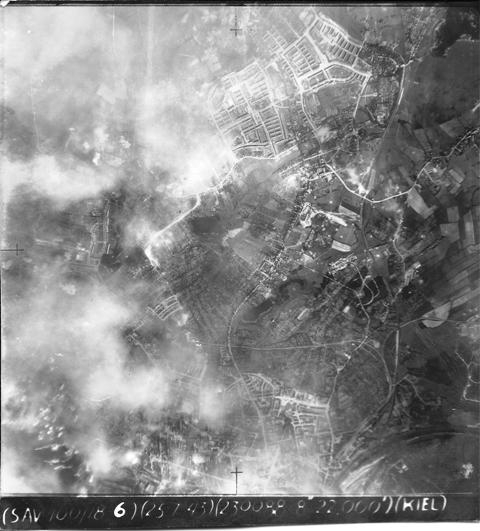
At 1618 hours, as the 95BG in the lead started its turn towards the IP, both Warnemunde and Rostock were completely covered by clouds, so the decision was made to “go more inland with better chances to bomb” and headed toward Kiel, 130 miles NW. Over a cloudless Kiel at 1649 hours, the heavily defended area sent up cannon fire described as intense, accurate and of a predicted barrage.
Absorbing the flak bursts, the 95BG and 100BG made their runs over Kiel with the 95BG making a two minute run with seventeen aircraft dropping on their leader at 1650 hours. The 100BG followed the 95BG in, making a 70 second bomb run at 22400 feet, with thirteen of its aircraft dropping and one B-17 lost to flak. Hits were scored “on the turbine shop, engine shop, workshops, one slipway and the dock area, with near misses on a merchant ship, floating crane and the floating dry dock.”
Meanwhile flying third in line, the composite group had found a break in the clouds at Warnemunde and recognizing the outline of their primary target, was able to make a visual attack on the aero-engine assembly plant with bombs away at 1643 hours.
Upon leaving Kiel, more enemy fighters consisting of FW 190s and Me-109s were encountered, with some attacks reported to last 25 minutes until they broke off after the Danish coast was departed. “ME 110s attacked from the rear out of range by lobbing 20 MM shells into the formation. JU 88s did likewise with what seemed to be heavier calibre shells.”
Richard Carey’s B-17 was in trouble with one engine smoking badly from flak damage. The twenty-three year old pilot from Long Beach, California had already spent eighteen months with the Royal Canadian Air Force and was second in command at the flight training center in Alberta before transferring to the Air Corps when the United States entered the war. Surviving a crash water landing in California when he was younger, Carey was praying for another miracle when he and copilot William Styles ditched ‘Duration +6’ into the North Sea. Rapidly sinking, both Carey and Styles were able to get out along with two of their severally injured crew, TG Maynard Parsons and WG Robert Lepper who had climbed out of the overhead hatch. The others had been trapped in the aircraft as it sunk: NAV Calvin Defevre, BOM William Griffith, TTE, Lester Berg, WG Charles Mayville and BTG Norman Eddy. Floating in their Mae West vests, Styles stated, “Griffith was struggling to get out of hatch as the plane was sinking, that is the last I saw of him.” Picked up by a Danish fishing boat, the fishermen dressed broken arm and leg wounds with splints made from a wooden fish crate. The rescued airmen were taken under German control when returned to port, becoming POWs.
The rest of the 100th’s formation had returned home to England, with Carey’s crew and aircraft never returning. Many of the Hundredth’s fortresses were reported to have returned early from the mission with equipment problems or difficulties keeping up with the formation: Flak Happy, Sans Finis, High Life, Janie, Just-A-Snappin, Picklepuss and Messie Bessie all returned early. And some returned with battle damage. Bill Ohl, waist gunner on Sam Barr’s B-17, recorded into his diary, “The flak in Germany is getting more intense every day. We had very good luck on this 7th raid, although our ship had four good-sized flak holes there was no damage to the crew. The closest to me was a piece that entered the fuselage just back of the entrance door and went out the other side back of the tail wheel. We have two pieces of flak that stuck to the ship as souvenirs…"
As far as General LeMay was concerned, he was content with the results at Kiel and official records contain his remarks: “Weather difficulties prevented successful bombing of the primary target, but good results were obtained against the target of opportunity at Kiel. It is recommended that, whenever possible, targets of outstanding importance be assigned as secondary and last resort targets. Many of these targets are already being studied by our crews in target identification classes and could be picked up easily in many cases when the primary target might be obscured.”
Crews flying: Barr, Van Noy, MacCarter, Reed, Roane, Scott, Hollenbeck, DeMarco, Helstrom, Oakes, Fienup, Murphy, Turner, Dye, King, Justice, Kiessling, Brady, Woodward, Blakely, Moreno, DeSanders, Barker, Knox
On Sunday morning, orders from VIII Bomber Command had originally called for two of General LeMay’s wings to attack an aircraft factory at Warnemunde while the other wing would attack the naval and dock installations at Kiel. This would be the deepest push into Germany and the formations would cross airspace heavily defended by enemy fighters which had previously attacked LeMay’s formations on June 13 in an “epic” battle. There would be no fighter support planned for this mission.
However, due to the reduced number of aircraft and crews available to fly, necessitating the need to form composite groups, LeMay felt it unwise to split his wings and suggested that Kiel should be eliminated as a primary target, providing “a stronger and more cohesive force against the target at Warnemunde.” Bomber Command agreed so LeMay’s Field Order #29 calling for one hundred and forty-one of his heavy bombers to attack Warnemunde as the primary target went out.
At Station 139, twenty-five crews had been awakened and were standing at attention when Colonel Harding walked into the briefing room at 0800 hours. Standing, John “Jack” Justice, pilot for one of the first four replacement crews assigned to the 100BG and finally operational for their #1 combat mission listened intently as the Colonel revealed that the 100th would be attacking the Heinkel aircraft factory at Warnemunde, located on the Baltic Sea at the mouth of the Warnow River. Rostock, further inland by ten miles, would be designated as the secondary target while any target of opportunity within Germany would be targets of last resort.
High altitude flying in unpressurized aircraft day after day took a physical toll on the men. Scheduled to fly his #8 mission that day, pilot William DeSanders awoke with a severe ear infection and he tells us, “Doc Hardy grounded me today…” DeSanders’ squadron Commanding Officer, twenty-three year old Richard Carey, would step in for DeSanders, flying that day with William Styles as his copilot and assigned to the B-17 named ‘Duration +6’.
The 100BG would be flying twenty-one B-17s as the second group in the 402nd Combat Wing, led by the 95BG as the Division’s lead group. The 100th’s main formation, flying second, would be led by Major John Egan, flying as command pilot with Everett Blakely and his crew. Another four crews and aircraft would fly in the low squadron of a composite group, led by another six from 95BG and eight from the 385BG flying as its high squadron.
The 403CBW, consisting of the 96th, 388th and 94th Groups in that order would form the second combat wing.
Reviewing the routes with the airmen, the Intelligence Officer indicated that both “the IP and rally point were chosen to evade the greater part of the AA gun fire at the primary target. The route out avoided known AA defenses and was calculated to draw attacking fighters a long distance from their bases. Let-down was to start at the enemy coast on the way out, the return to Cromer being by the more direct route.”
A delay in the mission, pushed all of the times back one and one-half hours but the aircraft and crews finally taxied into position with each fortress loaded with ten 500# bombs. At 1235 hours, the 100BG’s aircraft took off into a cloudless sky, except for ’Barker’s Burdens’ which had blown a left tire while taxiing.
The heavy haze over the base made the 100th’s assembly difficult and the wing and division assemblies were reported as “very ragged,” requiring the lead groups to ’S’ along considerably allowing time for the other formations to catch up and take their assigned places as the force headed out and started their climb over the North Sea.
Just before crossing the Danish coast, fifteen enemy fighters began attacks on the lead groups, although reported as “little fighter opposition.”
At 1618 hours, as the 95BG in the lead started its turn towards the IP, both Warnemunde and Rostock were completely covered by clouds, so the decision was made to “go more inland with better chances to bomb” and headed toward Kiel, 130 miles NW. Over a cloudless Kiel at 1649 hours, the heavily defended area sent up cannon fire described as intense, accurate and of a predicted barrage.
Absorbing the flak bursts, the 95BG and 100BG made their runs over Kiel with the 95BG making a two minute run with seventeen aircraft dropping on their leader at 1650 hours. The 100BG followed the 95BG in, making a 70 second bomb run at 22400 feet, with thirteen of its aircraft dropping and one B-17 lost to flak. Hits were scored “on the turbine shop, engine shop, workshops, one slipway and the dock area, with near misses on a merchant ship, floating crane and the floating dry dock.”
Meanwhile flying third in line, the composite group had found a break in the clouds at Warnemunde and recognizing the outline of their primary target, was able to make a visual attack on the aero-engine assembly plant with bombs away at 1643 hours.
Upon leaving Kiel, more enemy fighters consisting of FW 190s and Me-109s were encountered, with some attacks reported to last 25 minutes until they broke off after the Danish coast was departed. “ME 110s attacked from the rear out of range by lobbing 20 MM shells into the formation. JU 88s did likewise with what seemed to be heavier calibre shells.”
Richard Carey’s B-17 was in trouble with one engine smoking badly from flak damage. The twenty-three year old pilot from Long Beach, California had already spent eighteen months with the Royal Canadian Air Force and was second in command at the flight training center in Alberta before transferring to the Air Corps when the United States entered the war. Surviving a crash water landing in California when he was younger, Carey was praying for another miracle when he and copilot William Styles ditched ‘Duration +6’ into the North Sea. Rapidly sinking, both Carey and Styles were able to get out along with two of their severally injured crew, TG Maynard Parsons and WG Robert Lepper who had climbed out of the overhead hatch. The others had been trapped in the aircraft as it sunk: NAV Calvin Defevre, BOM William Griffith, TTE, Lester Berg, WG Charles Mayville and BTG Norman Eddy. Floating in their Mae West vests, Styles stated, “Griffith was struggling to get out of hatch as the plane was sinking, that is the last I saw of him.” Picked up by a Danish fishing boat, the fishermen dressed broken arm and leg wounds with splints made from a wooden fish crate. The rescued airmen were taken under German control when returned to port, becoming POWs.
The rest of the 100th’s formation had returned home to England, with Carey’s crew and aircraft never returning. Many of the Hundredth’s fortresses were reported to have returned early from the mission with equipment problems or difficulties keeping up with the formation: Flak Happy, Sans Finis, High Life, Janie, Just-A-Snappin, Picklepuss and Messie Bessie all returned early. And some returned with battle damage. Bill Ohl, waist gunner on Sam Barr’s B-17, recorded into his diary, “The flak in Germany is getting more intense every day. We had very good luck on this 7th raid, although our ship had four good-sized flak holes there was no damage to the crew. The closest to me was a piece that entered the fuselage just back of the entrance door and went out the other side back of the tail wheel. We have two pieces of flak that stuck to the ship as souvenirs…"
As far as General LeMay was concerned, he was content with the results at Kiel and official records contain his remarks: “Weather difficulties prevented successful bombing of the primary target, but good results were obtained against the target of opportunity at Kiel. It is recommended that, whenever possible, targets of outstanding importance be assigned as secondary and last resort targets. Many of these targets are already being studied by our crews in target identification classes and could be picked up easily in many cases when the primary target might be obscured.”
Crews flying: Barr, Van Noy, MacCarter, Reed, Roane, Scott, Hollenbeck, DeMarco, Helstrom, Oakes, Fienup, Murphy, Turner, Dye, King, Justice, Kiessling, Brady, Woodward, Blakely, Moreno, DeSanders, Barker, Knox
Bombing Results
Bombing Results:
Aircraft Lost: 1
Crew Lost: 10
Claims of Enemy Losses (CLS):
Aircraft Returned: