Mission Date: July 29, 1943
WARNEMUNDE, AC FACTORY
100th BG Mission #: 12
Mission Summary
ON THIS DAY... JULY 29,1943
Orders received the evening of July 28 required the 4CBW to furnish one wing made up of four groups. Due to the loss of fifteen bombers the previous day, the lead group would be a composite of the 96BG (11 AC) and the 388BG (10 AC), followed by a full group from the 100BG (21 AC), the 385BG (16 AC) and then another composite group made up of the 94BG (15 AC) and the 95BG (8 AC).
On July 29 at 0300, the twenty-one crews plus spares seated at Thorpe Abotts were briefed on their target for the day: the Ernest Heinkel Flugzegwerke, an important production plant that had been converted to manufacturing FW 190s. Located on the Warnemunde peninsula in Germany, the target had been completely covered by clouds on the July 25 mission. The mission’s secondary target would be Rostock with Kiel as the last resort target. Ollen Turner would fly as command pilot with Glenn Dye in ‘Janie.’
The briefing officer indicated the route in and out on the large map in front of the room: down over Denmark to Darsser Point in Germany to the target while the route out would take them over Doberan and back over Denmark. At double the 3rd Division’s force, the 1st Division would be in the same area with their target at Kiel, so the route into and out from the targets had been designated by VIII Bomber Command. HQ however was able to decide the bomb run which was to be a northeast-southwest run to minimize the time over AA gun fire. The importance of ensuring the checkpoints were made on time was reiterated. No fighter support was planned for this mission.
Lt Clifton Frye’s weather forecast was 8-10/10 clouds at 15000 feet but breaking up into scattered clouds over the North Sea and Denmark. The target was projected to have 2-4/10 cloud coverage.
Take-off time was 0520-0530. Two aircraft failed to take off: 42-3234 ‘Little Mike’ flown by Richard King had its interphone system shorted out due to a loose control box in the ball turret and ‘Squawkin’ Hawk’ 42-5863, flown by Sumner Reeder due to his #3 engine generator shorting out on his preflight.
Although the early morning’s visibility was not good, the remainder of the Fortresses departed the base without incident. Formed into the 100BG, it joined the other groups at Splasher 6 in the second position behind the composite of the 96BG-388BG.
Slight difficulties were encountered in the climb to altitude. The lead group was forced to slow down below the normal rate of climb in order to keep the succeeding groups in good combat wing formation. Departing the coast at Splasher 3, the formations were in excellent positions.
During the climb to high altitude, seven pilots from the 100th’s formation aborted the mission before crossing the enemy line, contributing to the total of twenty-seven abortions from the wing.
At the IP and the turn onto the bomb run, visibility was described as good and the bomb runs were undisturbed. Although a heavy concentration of guns were firing a fixed barrage, there was minimal damage done.
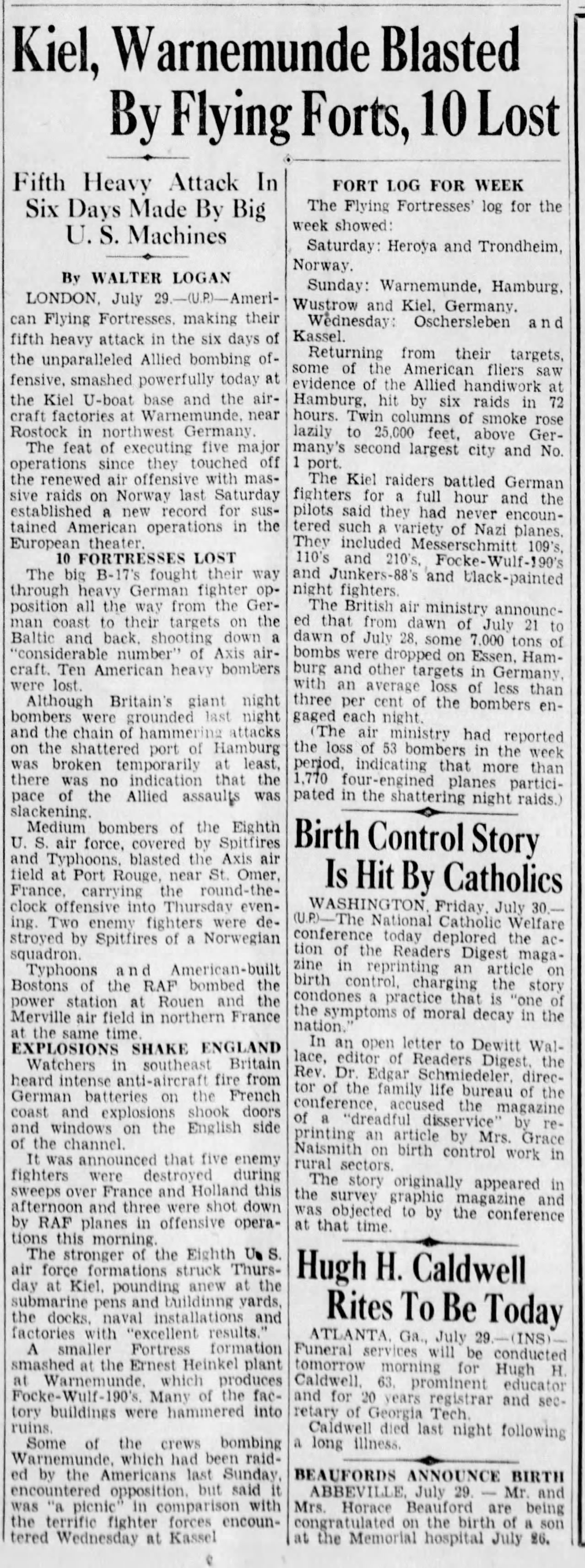
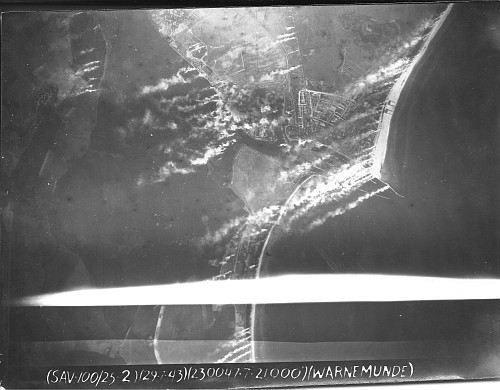
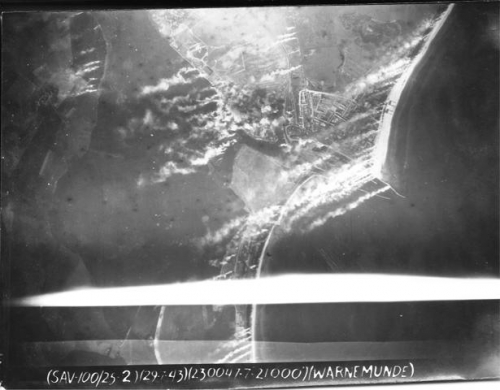
The 100BG arrived to the IP as scheduled and made the turn to attack the target. At 21750 feet, a seventy-second bomb run was made and the thirteen aircraft remaining in formation dropped on their lead aircraft at 0924. Bombing from all groups was perceived as good, with hits on 75% of the main buildings and the Fortresses reformed and headed for England.
All fourteen B-17s from the 100BG returned safely to base. Chief S-2 Intelligence Officer, Red Bowman recorded, “One of those days which compensate the Combat Crews for the many disappointments of strategic bombing. The Group paid a courtesy call on Warnemunde. Most of the flight was over a solid overcast, but at the target, Lt. Frye’s forecast was vindicated for once – clear at the target. Photo’s show the target was plastered. Jerry was fooled again – under a half dozen fighters seen and only meager flak.”
More importantly, General Le May felt positive about the day’s results and wrote, “This was one of the most successful missions flown by the 3rd Air Division to date. In spite of the fact that the weakening of our forces by previous losses made necessary a certain amount of shuffling of AC to produce one group from each combat wing, the mission was well flown and produced exceptionally good bombing results.
In striking at Kiel in coordination with our own effort, the 1st Air Division also escaped heavy fighter opposition. This again proves the effectiveness of sending two forces into the same general area at the same time. It is recommended that VIII Bomber Command continue to follow this plan, with enough variations to confuse the fighters and prevent their developing effective counter measures."
Pilots noted to have flown this mission: MacCarter, Reed, Reeder, Roane, Henington, Justice, Carnell, Scott N, Hollenbeck, Braley, Helstrom, Hummel, Fienup, Murphy T, Dye, King, Kiessling, Cruikshank, Brady, Knox, Moreno
Abortions:
’Barker’s Burdens’ 42-30059 had his oxygen pressure fall to 210 lbs. flown by Alvin Barker
‘Pasadena Nena’ 42-3229, flown by Jack Justice returned when his WG became ill at high altitude.
‘Damifino II’ 42-30259 flown by MacCarter had a supercharger fail in his #2 engine.
‘Alice from Dallas’ had engines fluctuating between 1500-2500 RPM,
‘Picklepuss’ 42-30063 flown by Robert Knox, his top turret became inoperative
‘El P’sstofo’ 42-30090 flown by Victor Reed, had issues with a supercharger.
‘Paddlefoot Proxy’ 42-5863 flown by Brady pulled out at 22000 feet due to the oxygen in the ball turret failing.
Orders received the evening of July 28 required the 4CBW to furnish one wing made up of four groups. Due to the loss of fifteen bombers the previous day, the lead group would be a composite of the 96BG (11 AC) and the 388BG (10 AC), followed by a full group from the 100BG (21 AC), the 385BG (16 AC) and then another composite group made up of the 94BG (15 AC) and the 95BG (8 AC).
On July 29 at 0300, the twenty-one crews plus spares seated at Thorpe Abotts were briefed on their target for the day: the Ernest Heinkel Flugzegwerke, an important production plant that had been converted to manufacturing FW 190s. Located on the Warnemunde peninsula in Germany, the target had been completely covered by clouds on the July 25 mission. The mission’s secondary target would be Rostock with Kiel as the last resort target. Ollen Turner would fly as command pilot with Glenn Dye in ‘Janie.’
The briefing officer indicated the route in and out on the large map in front of the room: down over Denmark to Darsser Point in Germany to the target while the route out would take them over Doberan and back over Denmark. At double the 3rd Division’s force, the 1st Division would be in the same area with their target at Kiel, so the route into and out from the targets had been designated by VIII Bomber Command. HQ however was able to decide the bomb run which was to be a northeast-southwest run to minimize the time over AA gun fire. The importance of ensuring the checkpoints were made on time was reiterated. No fighter support was planned for this mission.
Lt Clifton Frye’s weather forecast was 8-10/10 clouds at 15000 feet but breaking up into scattered clouds over the North Sea and Denmark. The target was projected to have 2-4/10 cloud coverage.
Take-off time was 0520-0530. Two aircraft failed to take off: 42-3234 ‘Little Mike’ flown by Richard King had its interphone system shorted out due to a loose control box in the ball turret and ‘Squawkin’ Hawk’ 42-5863, flown by Sumner Reeder due to his #3 engine generator shorting out on his preflight.
Although the early morning’s visibility was not good, the remainder of the Fortresses departed the base without incident. Formed into the 100BG, it joined the other groups at Splasher 6 in the second position behind the composite of the 96BG-388BG.
Slight difficulties were encountered in the climb to altitude. The lead group was forced to slow down below the normal rate of climb in order to keep the succeeding groups in good combat wing formation. Departing the coast at Splasher 3, the formations were in excellent positions.
During the climb to high altitude, seven pilots from the 100th’s formation aborted the mission before crossing the enemy line, contributing to the total of twenty-seven abortions from the wing.
At the IP and the turn onto the bomb run, visibility was described as good and the bomb runs were undisturbed. Although a heavy concentration of guns were firing a fixed barrage, there was minimal damage done.
The 100BG arrived to the IP as scheduled and made the turn to attack the target. At 21750 feet, a seventy-second bomb run was made and the thirteen aircraft remaining in formation dropped on their lead aircraft at 0924. Bombing from all groups was perceived as good, with hits on 75% of the main buildings and the Fortresses reformed and headed for England.
All fourteen B-17s from the 100BG returned safely to base. Chief S-2 Intelligence Officer, Red Bowman recorded, “One of those days which compensate the Combat Crews for the many disappointments of strategic bombing. The Group paid a courtesy call on Warnemunde. Most of the flight was over a solid overcast, but at the target, Lt. Frye’s forecast was vindicated for once – clear at the target. Photo’s show the target was plastered. Jerry was fooled again – under a half dozen fighters seen and only meager flak.”
More importantly, General Le May felt positive about the day’s results and wrote, “This was one of the most successful missions flown by the 3rd Air Division to date. In spite of the fact that the weakening of our forces by previous losses made necessary a certain amount of shuffling of AC to produce one group from each combat wing, the mission was well flown and produced exceptionally good bombing results.
In striking at Kiel in coordination with our own effort, the 1st Air Division also escaped heavy fighter opposition. This again proves the effectiveness of sending two forces into the same general area at the same time. It is recommended that VIII Bomber Command continue to follow this plan, with enough variations to confuse the fighters and prevent their developing effective counter measures."
Pilots noted to have flown this mission: MacCarter, Reed, Reeder, Roane, Henington, Justice, Carnell, Scott N, Hollenbeck, Braley, Helstrom, Hummel, Fienup, Murphy T, Dye, King, Kiessling, Cruikshank, Brady, Knox, Moreno
Abortions:
’Barker’s Burdens’ 42-30059 had his oxygen pressure fall to 210 lbs. flown by Alvin Barker
‘Pasadena Nena’ 42-3229, flown by Jack Justice returned when his WG became ill at high altitude.
‘Damifino II’ 42-30259 flown by MacCarter had a supercharger fail in his #2 engine.
‘Alice from Dallas’ had engines fluctuating between 1500-2500 RPM,
‘Picklepuss’ 42-30063 flown by Robert Knox, his top turret became inoperative
‘El P’sstofo’ 42-30090 flown by Victor Reed, had issues with a supercharger.
‘Paddlefoot Proxy’ 42-5863 flown by Brady pulled out at 22000 feet due to the oxygen in the ball turret failing.
Bombing Results
Bombing Results: EXCELLENT
Aircraft Lost: 0
Crew Lost: 0
Claims of Enemy Losses (CLS): 0
Aircraft Returned:
Media Articles
Use your thumb to scroll through the results box below.
| Media Item | Type | Page | Volume/Issue | Broadcast Source | Time | Description | File |
|---|---|---|---|---|---|---|---|
| Warnemunde mission July 29 1943 | The Greenville News July 30 1943 | 12:00 am |