Mission Date: August 12, 1943
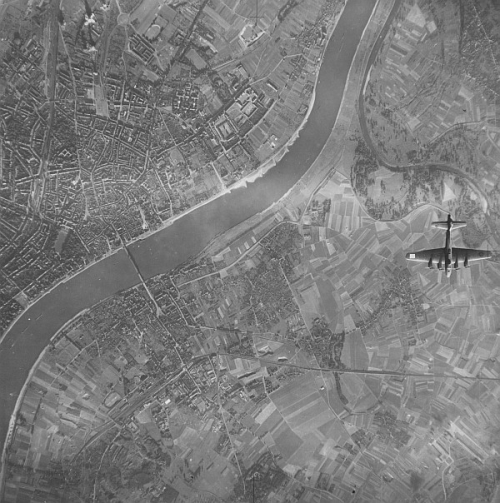
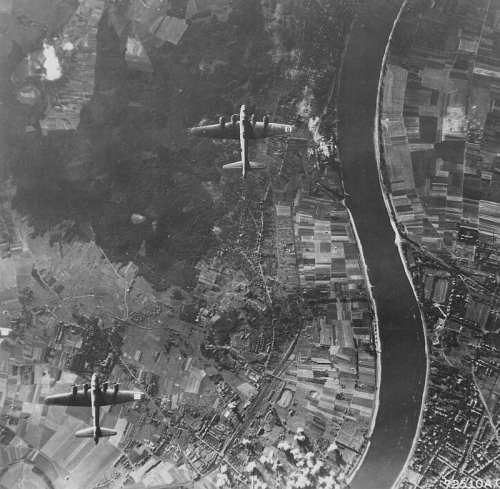
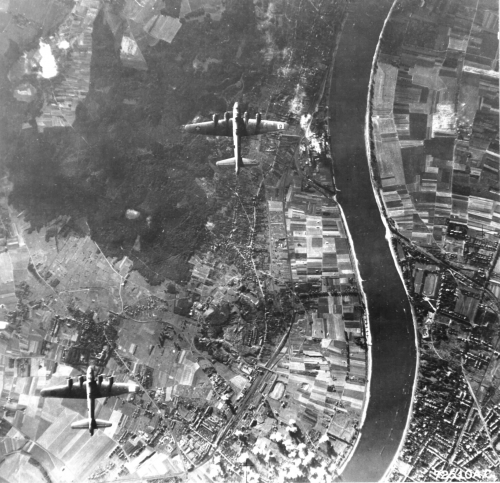
WESSELING, SYNTHETIC OIL, BONN (ST)
100th BG Mission #: 14
Mission Summary
ON THIS DAY…AUGUST 12, 1943
From July 31 to August 2, the combat crews were finally provided passes and according to Red Bowman, “…high time as they were going stale - too many missions in quick succession and not enough relaxation…” On August 1, the Americans launched ‘Operation Tidalwave,’ a risky low level attack on nine Romanian refineries in Polesti, Romania that supplied Germany and its Luftwaffe with its fuel. Flown by its B-24 Liberators from Libya, the attack made the headlines in all of the papers and radio.
On August 2, the men out on passes were called back to Thorpe Abbotts for execution of a special mission. However, they were not happy to be called back early when poor weather would ground all missions for another 8 days. On the 10th, “the Group took off at 0730 on what was to have been the big mission which has been bothering the entire Air Force for weeks, but about an hour out, the operation was scrubbed due to the weather. On their return, Colonel Harding gave the crews a special talk about the abort and the need for secrecy regarding the sortie, which he said would be flown when the weather permits.”
On August 12, the weather was deemed acceptable and twenty-one crews plus spares were once again seated in the briefing room. In attendance was Glen Dye and his copilot Lucky Luckadoo, who had already flown fourteen straight missions and diversions to date, a group record. Also seated was Everett Blakely and his lead crew, including Harry Crosby. Chick Harding, who would be flying as the 100BG’s command pilot, had specifically asked for Blakely to fly his lead aircraft even though Blakely had not been on the day’s roster due to the upcoming special mission. William Veal would fly as command pilot with Sammy Barr in ‘Torchy II.’
Seated in the briefing was thirty-four year old Lt Colonel Beirne Lay, Jr. As historian and head of the film unit for VIII Bomber Command, Lay wanted to experience combat firsthand and was permitted by General Eaker to fly with the 100th Bomb Group as an observer. This would be Lay's first combat mission and he would be flying in the copilot seat next to Gale Cleven.
The 100BG’s target for the day was divulged as Wesseling, Germany where the men would go after a synthetic oil production plant located along the Rhine, just south of the village of Wesseling between Cologne and Bonn. The secondary target would be at Bonn, southeast of Wesseling while last resort targets would be any industrial target of opportunity in the area.
Leading the Division in a new type of formation would be the 100BG, which would lead the 402CBW followed by the 95BG and then the 390BG, which would be flying its first official combat sortie.
Flying at a five mile interval behind the 402CBW, the 401st CBW would be made up of the 385th and the 94th Groups and flying in that order. The 403rd CBW flying last, would be made up of the 96BG and the 388BG. Orders had called for the wings to separate over the target and attack different MPIs.
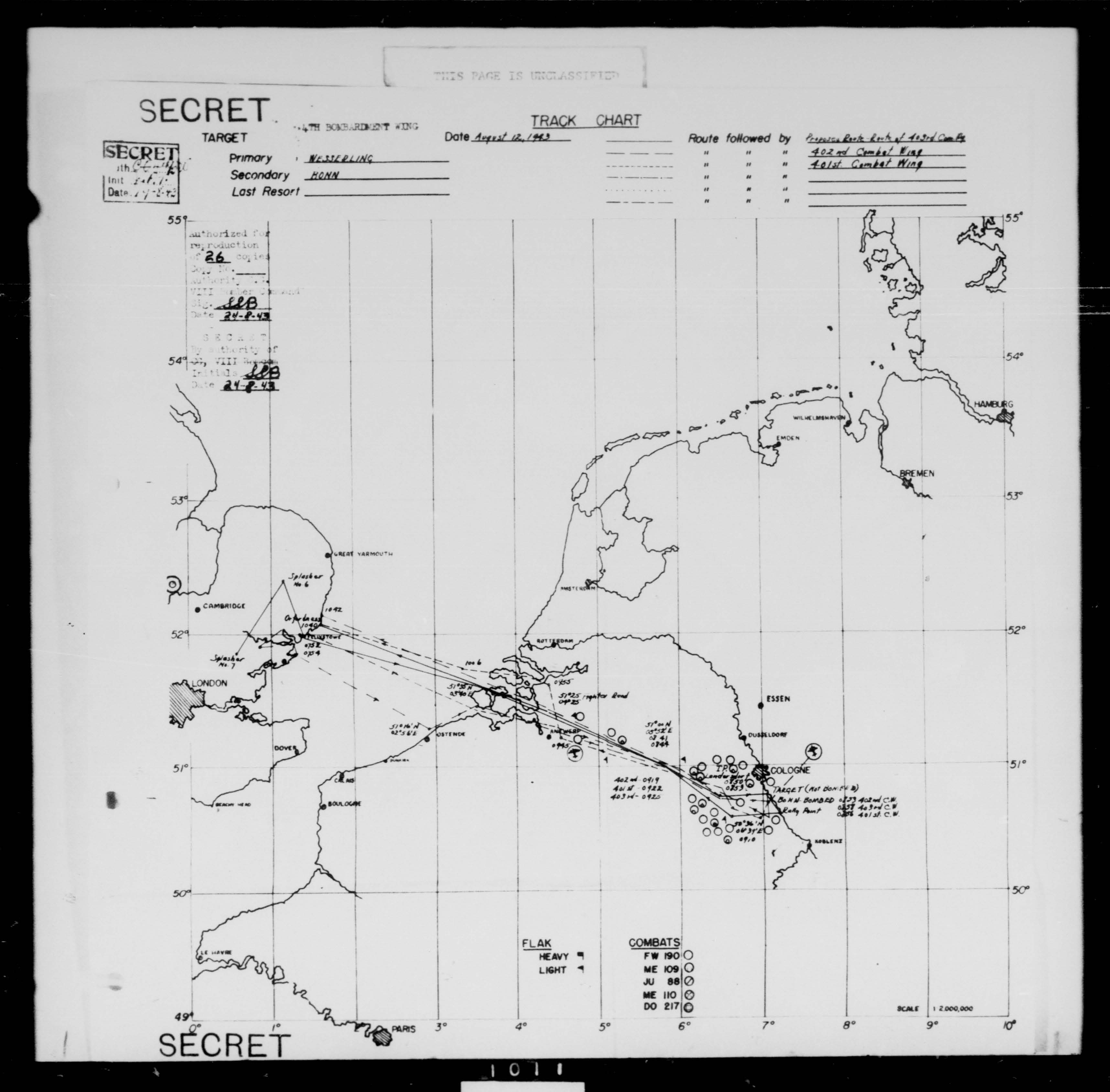
Reviewing the routes in and out from the target which had once again been designated by VIII Bomber Command, forty-six year old Major Minor Shaw, a tank corps veteran of World War I and now a senior S-2 officer for the 100BG, pointed to a spot on the map just east of the Belgian coast where three squadrons of P-47s were to rendezvous with the 3rd Division’s heavy bombers. Here, the friendlies were to fly close support up to the vicinity of Beverloo in Holland.
The positions of the AA gun locations were pointed out and the men were told to make a right turn off the target toward the rally point to keep out of the heavy AA fire. Once reformed at the rally point, they were to make the sharp turn in order to avoid any interference with the exiting 1st Division’s bombers. Instructions were also given to close up the five mile interval on the exit, to maximize protection. Shaw, pointing to a spot on the map east of Antwerp, indicated where the bombers would pick up six squadrons of Spitfire IX’s as support all the way back to the English coast.
Dismissed from the briefing, the Fortresses were readied and sat in order on the runway, ready for take off. In Sam Barr’s B-17, his crew was ready for their #9 mission and Barr’s WG William Ohl, ever the superstitious airman, tells us, “We took off this morning after a long siege of bad weather. I counted our ships as they run down the runway on the take off and soon found to my surprise we were going to be the "13" ship to take off…”
After Group assembly was accomplished, the Division assembly completed “five minutes late and below the 26000 feet specified.” The line of Fortresses crossed the English coast at Felixstowe and headed out across the Channel. Late in commencing the climb, bombing altitude was not reached until mid-channel.
By the time the 100BG crossed the enemy coast in Belgium, Thomas Hummel had aborted the mission in ‘Badger Beauty' due to #4 supercharger issue.
Fifteen minutes prior to reaching the IP, both of the 95BG’s leader and deputy leader aborted the mission and left the formation. “This caused considerable confusion among the remaining aircraft of this group which eventually joined the 100th Group formation.”
Making the turn at the IP and onto the bomb run, the P-47’s had turned back and the enemy fighters, mostly FW 190’s, began their attacks, staying with the formations all the way to the target. “The groups first aerial combats were not fierce ones' but few attacks were made on the formation, and these were not pressed vigorously….The attacks were very short duration, perhaps five minutes to each attack, and generally were not pressed home.”
With the target at Wesseling determined to be covered by clouds, Harding relayed that the secondary target at Bonn would be the new target. Official records tell us, “The 4th Air Division reached the IP as prescribed. However, when it was observed that the primary target was completely obscured by clouds, the Division turned and attacked the secondary target, the City of Bonn…” The 390BG following behind the combined 100BG and 95BG formation, turned on the target too late to synchronize.
In the target area of Bonn, the AA fire was “intense and accurate” and William Ohl wrote, “The flak that we flew through today was the heaviest yet, and each raid seems to have more then the last…”
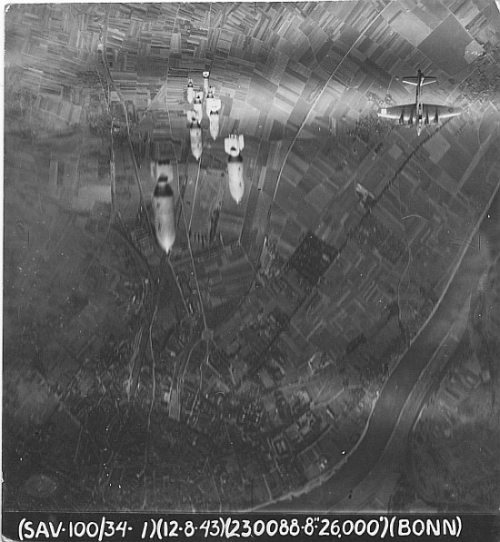
From 26,150 feet, the 100th’s bombs (including the attached 95BG) were released from seventeen aircraft who dropped on the leader at 0853. Through his journal entry, Ohl tells us, “… we went to the secondary and blew hell out of the center of an industrial town called Bohn or Bonn. We bombed from 26,500 ft. and made direct hits right in the middle of town. I have never been so cold in my life before as I was today. It was 35 degrees below zero. We must keep our waist windows open from the time we take off until we land. I keep stomping my feet and marking time to keep my feet warm and slapping my hands but not once leaving my position. Ice was building up all over my eyes and my eyelashes were stiff like icicles. My oxygen mask was full of ice and water would run part was down my neck and freeze there. I saw one enemy fighter go down for good.”
As the bombs were released in Victor Reed’s B-17 ‘El P’sstofo,’ “a burst of flak littered the cockpit with slivers of hot steel. One sizable fragment penetrated Reed's outer clothing but struck the silver wings he was wearing over his left shirt pocket. The velocity of the shard was so great as to drive the insignia through the skin and cause severe bruising of the chest muscles…” The fragments had also slashed clothing worn by Reed’s twenty-one year old copilot Charles Brooks, who took over the controls from the wounded Reed.
Reformed into the 402CBW, notice was radioed to the friendlies that the formation would be late in the rendezvous which was subsequently accomplished west of Antwerp where again “close and level” flak bursts were encountered.
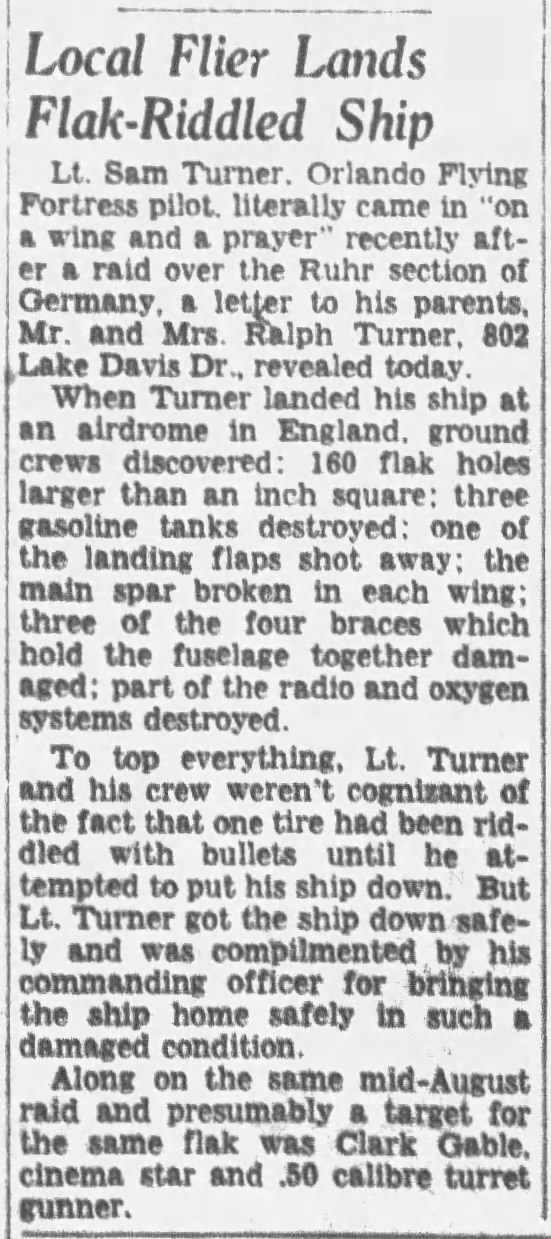
After a nine and one-half hour mission, all of the 100th’s Fortresses successfully returned to base but not without battle damage caused by both flak and fighters. Sam Turner’s B-17 ‘Raunchy’ had taken on severe flak damage. Fortunate to have landed with no injuries to his crew, his aircraft told a different story. With no brakes and a tire “riddled with bullets,” ‘Raunchy’ only came to a stop when Turner and his copilot William Freund ran off the end of the runway. It was reported that his ground crew discovered “160 flak holes larger than an inch square, three gasoline tanks destroyed, one of the landing flaps shot away, the main spar broken in each wing, three of the four braces holding the fuselage together damaged and part of the radio and oxygen system destroyed.” ‘Raunchy’ would be out of commission for some time.
Also grateful to have returned safely, Sergeant William Ohl finished his diary entry telling us, “…As I said before being the "13" ship in the air this morning seemed to be a charm. Out of our entire group ours is the only one that didn't get a single hole in it. The American 8th air force lost twenty five planes today. Reed, the pilot of crew six, very good friends of crew one, got hit in the chest with a piece of flak but will be ok soon. We were over Germany for at least an hour and a half. At the end of the 9th mission we are still all ok and ready to go again.”
At interrogation, the crews were reported to have been very enthusiastic about the level of friendly fighter support. Officially recorded as ‘weak,’ the fighter attacks were reported as "short in duration, five minutes to each attack and generally not pressed home."
Crews flying this mission:
349: Barr with Veal (lead) Van Noy, Reed, Reeder, Roane, Henington
350: Claytor, Hollenbeck, Braley, Helstrom, Hummer, Cleven with Bernie Lay as CP
351: Fienup, Murphy, Floyd, Turner, Dye, King
418: Blakely with Harding (Command ship) Knox, Moreno, Kiessling
From July 31 to August 2, the combat crews were finally provided passes and according to Red Bowman, “…high time as they were going stale - too many missions in quick succession and not enough relaxation…” On August 1, the Americans launched ‘Operation Tidalwave,’ a risky low level attack on nine Romanian refineries in Polesti, Romania that supplied Germany and its Luftwaffe with its fuel. Flown by its B-24 Liberators from Libya, the attack made the headlines in all of the papers and radio.
On August 2, the men out on passes were called back to Thorpe Abbotts for execution of a special mission. However, they were not happy to be called back early when poor weather would ground all missions for another 8 days. On the 10th, “the Group took off at 0730 on what was to have been the big mission which has been bothering the entire Air Force for weeks, but about an hour out, the operation was scrubbed due to the weather. On their return, Colonel Harding gave the crews a special talk about the abort and the need for secrecy regarding the sortie, which he said would be flown when the weather permits.”
On August 12, the weather was deemed acceptable and twenty-one crews plus spares were once again seated in the briefing room. In attendance was Glen Dye and his copilot Lucky Luckadoo, who had already flown fourteen straight missions and diversions to date, a group record. Also seated was Everett Blakely and his lead crew, including Harry Crosby. Chick Harding, who would be flying as the 100BG’s command pilot, had specifically asked for Blakely to fly his lead aircraft even though Blakely had not been on the day’s roster due to the upcoming special mission. William Veal would fly as command pilot with Sammy Barr in ‘Torchy II.’
Seated in the briefing was thirty-four year old Lt Colonel Beirne Lay, Jr. As historian and head of the film unit for VIII Bomber Command, Lay wanted to experience combat firsthand and was permitted by General Eaker to fly with the 100th Bomb Group as an observer. This would be Lay's first combat mission and he would be flying in the copilot seat next to Gale Cleven.
The 100BG’s target for the day was divulged as Wesseling, Germany where the men would go after a synthetic oil production plant located along the Rhine, just south of the village of Wesseling between Cologne and Bonn. The secondary target would be at Bonn, southeast of Wesseling while last resort targets would be any industrial target of opportunity in the area.
Leading the Division in a new type of formation would be the 100BG, which would lead the 402CBW followed by the 95BG and then the 390BG, which would be flying its first official combat sortie.
Flying at a five mile interval behind the 402CBW, the 401st CBW would be made up of the 385th and the 94th Groups and flying in that order. The 403rd CBW flying last, would be made up of the 96BG and the 388BG. Orders had called for the wings to separate over the target and attack different MPIs.
Reviewing the routes in and out from the target which had once again been designated by VIII Bomber Command, forty-six year old Major Minor Shaw, a tank corps veteran of World War I and now a senior S-2 officer for the 100BG, pointed to a spot on the map just east of the Belgian coast where three squadrons of P-47s were to rendezvous with the 3rd Division’s heavy bombers. Here, the friendlies were to fly close support up to the vicinity of Beverloo in Holland.
The positions of the AA gun locations were pointed out and the men were told to make a right turn off the target toward the rally point to keep out of the heavy AA fire. Once reformed at the rally point, they were to make the sharp turn in order to avoid any interference with the exiting 1st Division’s bombers. Instructions were also given to close up the five mile interval on the exit, to maximize protection. Shaw, pointing to a spot on the map east of Antwerp, indicated where the bombers would pick up six squadrons of Spitfire IX’s as support all the way back to the English coast.
Dismissed from the briefing, the Fortresses were readied and sat in order on the runway, ready for take off. In Sam Barr’s B-17, his crew was ready for their #9 mission and Barr’s WG William Ohl, ever the superstitious airman, tells us, “We took off this morning after a long siege of bad weather. I counted our ships as they run down the runway on the take off and soon found to my surprise we were going to be the "13" ship to take off…”
After Group assembly was accomplished, the Division assembly completed “five minutes late and below the 26000 feet specified.” The line of Fortresses crossed the English coast at Felixstowe and headed out across the Channel. Late in commencing the climb, bombing altitude was not reached until mid-channel.
By the time the 100BG crossed the enemy coast in Belgium, Thomas Hummel had aborted the mission in ‘Badger Beauty' due to #4 supercharger issue.
Fifteen minutes prior to reaching the IP, both of the 95BG’s leader and deputy leader aborted the mission and left the formation. “This caused considerable confusion among the remaining aircraft of this group which eventually joined the 100th Group formation.”
Making the turn at the IP and onto the bomb run, the P-47’s had turned back and the enemy fighters, mostly FW 190’s, began their attacks, staying with the formations all the way to the target. “The groups first aerial combats were not fierce ones' but few attacks were made on the formation, and these were not pressed vigorously….The attacks were very short duration, perhaps five minutes to each attack, and generally were not pressed home.”
With the target at Wesseling determined to be covered by clouds, Harding relayed that the secondary target at Bonn would be the new target. Official records tell us, “The 4th Air Division reached the IP as prescribed. However, when it was observed that the primary target was completely obscured by clouds, the Division turned and attacked the secondary target, the City of Bonn…” The 390BG following behind the combined 100BG and 95BG formation, turned on the target too late to synchronize.
In the target area of Bonn, the AA fire was “intense and accurate” and William Ohl wrote, “The flak that we flew through today was the heaviest yet, and each raid seems to have more then the last…”
From 26,150 feet, the 100th’s bombs (including the attached 95BG) were released from seventeen aircraft who dropped on the leader at 0853. Through his journal entry, Ohl tells us, “… we went to the secondary and blew hell out of the center of an industrial town called Bohn or Bonn. We bombed from 26,500 ft. and made direct hits right in the middle of town. I have never been so cold in my life before as I was today. It was 35 degrees below zero. We must keep our waist windows open from the time we take off until we land. I keep stomping my feet and marking time to keep my feet warm and slapping my hands but not once leaving my position. Ice was building up all over my eyes and my eyelashes were stiff like icicles. My oxygen mask was full of ice and water would run part was down my neck and freeze there. I saw one enemy fighter go down for good.”
As the bombs were released in Victor Reed’s B-17 ‘El P’sstofo,’ “a burst of flak littered the cockpit with slivers of hot steel. One sizable fragment penetrated Reed's outer clothing but struck the silver wings he was wearing over his left shirt pocket. The velocity of the shard was so great as to drive the insignia through the skin and cause severe bruising of the chest muscles…” The fragments had also slashed clothing worn by Reed’s twenty-one year old copilot Charles Brooks, who took over the controls from the wounded Reed.
Reformed into the 402CBW, notice was radioed to the friendlies that the formation would be late in the rendezvous which was subsequently accomplished west of Antwerp where again “close and level” flak bursts were encountered.
After a nine and one-half hour mission, all of the 100th’s Fortresses successfully returned to base but not without battle damage caused by both flak and fighters. Sam Turner’s B-17 ‘Raunchy’ had taken on severe flak damage. Fortunate to have landed with no injuries to his crew, his aircraft told a different story. With no brakes and a tire “riddled with bullets,” ‘Raunchy’ only came to a stop when Turner and his copilot William Freund ran off the end of the runway. It was reported that his ground crew discovered “160 flak holes larger than an inch square, three gasoline tanks destroyed, one of the landing flaps shot away, the main spar broken in each wing, three of the four braces holding the fuselage together damaged and part of the radio and oxygen system destroyed.” ‘Raunchy’ would be out of commission for some time.
Also grateful to have returned safely, Sergeant William Ohl finished his diary entry telling us, “…As I said before being the "13" ship in the air this morning seemed to be a charm. Out of our entire group ours is the only one that didn't get a single hole in it. The American 8th air force lost twenty five planes today. Reed, the pilot of crew six, very good friends of crew one, got hit in the chest with a piece of flak but will be ok soon. We were over Germany for at least an hour and a half. At the end of the 9th mission we are still all ok and ready to go again.”
At interrogation, the crews were reported to have been very enthusiastic about the level of friendly fighter support. Officially recorded as ‘weak,’ the fighter attacks were reported as "short in duration, five minutes to each attack and generally not pressed home."
Crews flying this mission:
349: Barr with Veal (lead) Van Noy, Reed, Reeder, Roane, Henington
350: Claytor, Hollenbeck, Braley, Helstrom, Hummer, Cleven with Bernie Lay as CP
351: Fienup, Murphy, Floyd, Turner, Dye, King
418: Blakely with Harding (Command ship) Knox, Moreno, Kiessling
Bombing Results
Bombing Results: GOOD
Aircraft Lost: 0
Crew Lost: 0
Claims of Enemy Losses (CLS): 0
Aircraft Returned:
Media Articles
Use your thumb to scroll through the results box below.
| Media Item | Type | Page | Volume/Issue | Broadcast Source | Time | Description | File |
|---|---|---|---|---|---|---|---|
| Mission Map August 12, 1943 mission | 4th Bombardment Wing mission summary | 12:00 am | |||||
| Sam Turner August 12 1943 mission | Orlando Evening Star September 4 1943 | 12:00 am |