Mission Date: June 25, 1943
BREMEN, SUB YARDS
100th BG Mission #: 1
Target Country: Germany
Mission Summary
ON THIS DAY…JUNE 25,1943
At 0300 hours across Thorpe Abbotts, twenty-two crews, including spares were awakened for their #1 combat mission. This day would mark the first official combat mission of the 100th Bomb Group, flying as part of the 402nd Provisional Combat Wing, attached to the 4th Bombardment Wing under the command of Curtis LeMay.
The 4th’s Field Order #12 would call for the heavy bombers to attack Bremen with a force of seventy-eight aircraft; forty-one from the 401st CBW (94BG and 96BG) and thirty-seven from the 402nd (95BG and 100BG). Scheduled to fly behind the 401st’s formation, the 402nd would send out eighteen aircraft from the 95BG in the lead group and nineteen from the 100BG flying last.
Seated that morning for their #1 combat mission were the crews of Adams, Barr, Braley, Carnell, Claytor, Cleven, DeSanders, Duncan, Dye, Flesher, Fuller, Hollenbeck, Kiessling, King, Murphy, Oakes, Petrich, Schmalenbach, Swartout, Turner Ollen, Turner Sam, and Van Noy. The men were briefed for the primary target of the U-boat pens at Bremen, Germany with a secondary target of Bremerhaven and a last resort target identified as “any industrial target of opportunity in Germany.”
The 350th’s Squadron Commander, twenty-four year-old Gale Cleven would fly with Mark Carnell and lead the high squadron. Robert Flesher, would fly as command pilot of the low squadron. Twenty-three year-old Oran “Jack” Petrich would lead a flight with twenty-three year-old Paul Schmalenbach and twenty-eight year-old Alonzo Adams as his wingmen, all of the 349th and flying in the low squadron.
With each B-17 loaded with ten 500# bombs, the pilots took off successfully into the intermittent rain and low heavy clouds. After forming up, the Group joined with the 95BG and the 402nd CBW soon merged into the 4th Air Division’s assembly line at Thetford, falling in behind the 96BG.
The Division’s aircraft departed Splasher No 5 in good formation but due to tail winds at the low altitudes, the 402nd CBW had to do considerable “s’ing” to stay in formation. As they continued their climb, due to the multiple cloud layers from 3000 feet to 19000 feet, the 100BG lost contact with its wing several times over the North Sea. Ronald Hollenbeck would return to base, unable to find the formation in the poor weather.
The dense and persistent condensation trails made flying difficult over the North Sea. Clouds were reported at every altitude. Sam Barr would turn back after a propeller from his #3 engine spun off into the clouds. His navigator, James Brown stated, “At the time of leaving the English coast, the 349th, flying low squadron, was perhaps a mile to the rear of the lead squadron…Both the high and lead squadrons seemed scattered all over the sky and a true Group combat formation never existed…”
As the Frisian Islands were approached, the first flak bursts appeared. At 0840 hours, the 94th Group leading the Division at 17000 feet, radioed that they were turning back due to the poor weather but the 100BG, not receiving the message, proceeded into the thick layers of clouds. When it emerged out of the clouds at 25000 feet, the Group’s leader found himself with only eight aircraft remaining in his formation. Proceeding five minutes past the German coast, the remaining Fortresses in formation jettisoned their bombs in Germany and made the turn toward home.
Meanwhile the other dispersed aircraft had either attached to another formation or singly attempted to return to base. Petrich, Schmallenbach and Adams in the first element of the 349th’s formation had disappeared into the clouds, never returning to base. Red Bowman, the 100th’s lead S-2 Officer would later record into his diary, “The weather was too bad to get any reliable story of their loss. Apparently they simply disappeared, although there were some who though Capt. Petrich’s plane had been hit and his wingmen followed him down to protect him and all became victims of enemy fighters.”
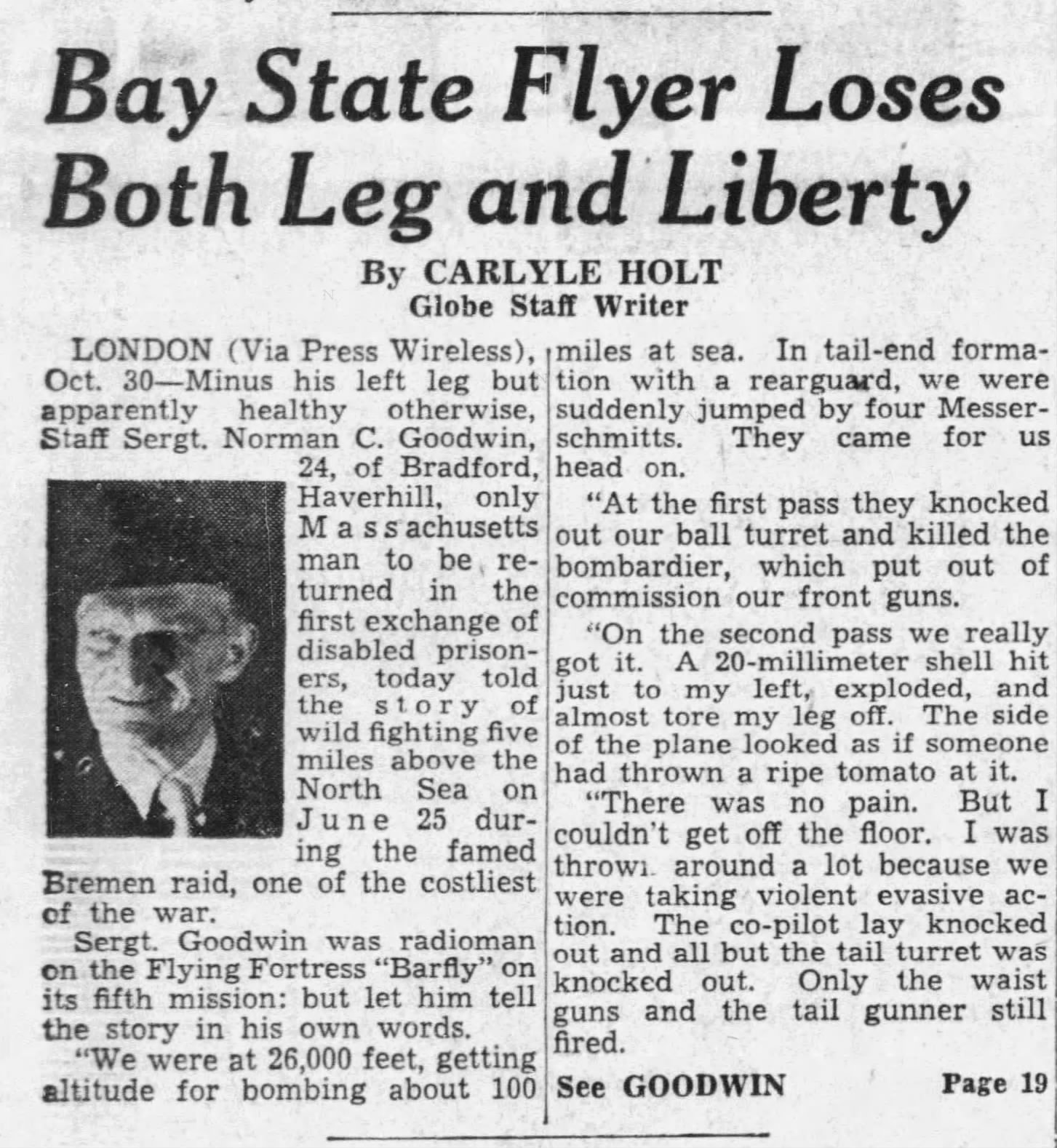
In Paul Schmalenbach’s aircraft, BTG Gunner, Norman Goodwin tells us, “We were at 26000 feet, getting altitude for bombing about 100 miles at sea. In tail-end formation with a rearguard, we were suddenly jumped by four Messerschmitts. They came for us head on. At the first pass they knocked out our ball turret and killed our bombardier, which put out of commission our front guns. On the second pass we really got it. A 20-millimeter shell hit just to my left, exploded and almost tore my leg off. The side of the plane looked as if someone had thrown a ripe tomato at it…I was thrown around a lot because we were taking violent evasive action. The co-pilot lay knocked out and all but the tail turret was knocked out. Only the waist guns and the tail gunner still fired…Their Radio Operator Frank Podbielski added, “After 30 minutes of combat action, the top turret guns were silent. T/Sgt. Beck (TTE) could have been wounded or killed. Sgt. Goodwin (BTG) lay wounded on the floor of radio room, Sgt. Russo (WG) lay wounded to the right of the ball turret after administering first aid to Goodwin.” John Brown, Schmalenbach’s navigator wrote, “The navigator was the nearest to the escape hatch, and it was his job to release the door… I had pulled the release and was trying to get it open when Jack (Jack Clark BOM) came up behind me, reached around with his foot and kicked the door off. Being right in front of the hatch, I went out first and expected that Jack would be right behind. I never did see or hear from him again…His action in kicking off the door may have saved my life, and I am very grateful…I have always felt that Jack, rather than following me, had gone up to check on the pilots…” Goodwin continued, “The jump signal itself never came - because the pilot had been knocked out. The plane went into a spin…Without warning the plane broke apart…Then the plane blew up…”
Alonzo Adams’s Fortress had also been attacked. Nicholas Demchack, Adams’ navigator tells us, “…After approximately 10 minutes of fighting, the alarm bell was sounded to abandon ship. I tried to reach Lt. Adams, the pilot, and I received no response… Lt.Gurley (BOM) was in nose of ship and was not hurt when we received the bail out signal - I was firing my guns and did not hear the signal but Gurley informed me. I believe Adams (P) and Krech (CP) were severely wounded or killed by a burst of machine gun fire which came quite close to me and from the angle appeared to enter the cockpit. Directly after that the bail out signal was given. I believe the plane exploded at that moment and the rest of the crew were killed by the explosion or rendered unconscious and unable to operate their chutes…”
All but three of the Fortresses that went out of Thorpe Abbotts that morning would return to base by 1130 hours. Barr’s Navigator, Jim Brown remembered, “The men were saddened, depressed and numb with grief for several days at the loss of thirty men with whom they had lived and laughed and worked and played for the prior seven months. If ever there had existed the thought that war was a glamorous, exciting “adventure” for those who wore the “Silver Wings” such thought was erased on 25 June. From that day on we all realized that our job was dirty, dangerous and downright brutal. Any feeling of our personal immortality left us swiftly on that day.”
For the 4th Bomb Division, out of the seventy-eight aircraft sent out, only eighteen ships from the 95BG managed to bomb a target of opportunity.
Later in a mission critique, Curtis LeMay would focus his comments on the critical nature of maintaining combat formation. He wrote, “This mission again make it clear that good weather is necessary if we are successfully to attain our objectives. Without it, the Wing leader cannot properly handle the formation and there is small likelihood of our aircraft ever reaching the target area. It is also essential that we have proper control within the formation, and a high state of air discipline at all times. Group Commanders have been directed to bend every effort toward perfecting this control and discipline within their organizations. All concerned have been strongly reminded that Group leaders must constantly keep a listening watch on the assigned R/T frequency. Only in this way can the groups be sure of receiving messages which may be sent back by the Wing leader.
Bombing missions cannot be conducted in this theatre unless the units are in a good combat wing defensive formation. Losses have been heavy on every occasion where enemy action, weather or other factors have prevented a good formation being flown.
Unless the destruction of the target is so important that it warrants expensive losses, the Division leader should abandon the mission when weather conditions or other factors are such that a good combat wing formation cannot be flown. Curtis E. Le May”
Crews #1, #2 and #3 from the 100th Bomb Group were lost that day. For Crew #1 under Oran Petrich, all would be killed in action. Crew #2, Alonzo Adams’ crew, only his navigator Nicholas Demchak would survive, becoming a POW. For Paul Schmalenbach and his crew #3, five were killed in action while four survived and would become POWs after being rescued from the North Sea.
At 0300 hours across Thorpe Abbotts, twenty-two crews, including spares were awakened for their #1 combat mission. This day would mark the first official combat mission of the 100th Bomb Group, flying as part of the 402nd Provisional Combat Wing, attached to the 4th Bombardment Wing under the command of Curtis LeMay.
The 4th’s Field Order #12 would call for the heavy bombers to attack Bremen with a force of seventy-eight aircraft; forty-one from the 401st CBW (94BG and 96BG) and thirty-seven from the 402nd (95BG and 100BG). Scheduled to fly behind the 401st’s formation, the 402nd would send out eighteen aircraft from the 95BG in the lead group and nineteen from the 100BG flying last.
Seated that morning for their #1 combat mission were the crews of Adams, Barr, Braley, Carnell, Claytor, Cleven, DeSanders, Duncan, Dye, Flesher, Fuller, Hollenbeck, Kiessling, King, Murphy, Oakes, Petrich, Schmalenbach, Swartout, Turner Ollen, Turner Sam, and Van Noy. The men were briefed for the primary target of the U-boat pens at Bremen, Germany with a secondary target of Bremerhaven and a last resort target identified as “any industrial target of opportunity in Germany.”
The 350th’s Squadron Commander, twenty-four year-old Gale Cleven would fly with Mark Carnell and lead the high squadron. Robert Flesher, would fly as command pilot of the low squadron. Twenty-three year-old Oran “Jack” Petrich would lead a flight with twenty-three year-old Paul Schmalenbach and twenty-eight year-old Alonzo Adams as his wingmen, all of the 349th and flying in the low squadron.
With each B-17 loaded with ten 500# bombs, the pilots took off successfully into the intermittent rain and low heavy clouds. After forming up, the Group joined with the 95BG and the 402nd CBW soon merged into the 4th Air Division’s assembly line at Thetford, falling in behind the 96BG.
The Division’s aircraft departed Splasher No 5 in good formation but due to tail winds at the low altitudes, the 402nd CBW had to do considerable “s’ing” to stay in formation. As they continued their climb, due to the multiple cloud layers from 3000 feet to 19000 feet, the 100BG lost contact with its wing several times over the North Sea. Ronald Hollenbeck would return to base, unable to find the formation in the poor weather.
The dense and persistent condensation trails made flying difficult over the North Sea. Clouds were reported at every altitude. Sam Barr would turn back after a propeller from his #3 engine spun off into the clouds. His navigator, James Brown stated, “At the time of leaving the English coast, the 349th, flying low squadron, was perhaps a mile to the rear of the lead squadron…Both the high and lead squadrons seemed scattered all over the sky and a true Group combat formation never existed…”
As the Frisian Islands were approached, the first flak bursts appeared. At 0840 hours, the 94th Group leading the Division at 17000 feet, radioed that they were turning back due to the poor weather but the 100BG, not receiving the message, proceeded into the thick layers of clouds. When it emerged out of the clouds at 25000 feet, the Group’s leader found himself with only eight aircraft remaining in his formation. Proceeding five minutes past the German coast, the remaining Fortresses in formation jettisoned their bombs in Germany and made the turn toward home.
Meanwhile the other dispersed aircraft had either attached to another formation or singly attempted to return to base. Petrich, Schmallenbach and Adams in the first element of the 349th’s formation had disappeared into the clouds, never returning to base. Red Bowman, the 100th’s lead S-2 Officer would later record into his diary, “The weather was too bad to get any reliable story of their loss. Apparently they simply disappeared, although there were some who though Capt. Petrich’s plane had been hit and his wingmen followed him down to protect him and all became victims of enemy fighters.”
In Paul Schmalenbach’s aircraft, BTG Gunner, Norman Goodwin tells us, “We were at 26000 feet, getting altitude for bombing about 100 miles at sea. In tail-end formation with a rearguard, we were suddenly jumped by four Messerschmitts. They came for us head on. At the first pass they knocked out our ball turret and killed our bombardier, which put out of commission our front guns. On the second pass we really got it. A 20-millimeter shell hit just to my left, exploded and almost tore my leg off. The side of the plane looked as if someone had thrown a ripe tomato at it…I was thrown around a lot because we were taking violent evasive action. The co-pilot lay knocked out and all but the tail turret was knocked out. Only the waist guns and the tail gunner still fired…Their Radio Operator Frank Podbielski added, “After 30 minutes of combat action, the top turret guns were silent. T/Sgt. Beck (TTE) could have been wounded or killed. Sgt. Goodwin (BTG) lay wounded on the floor of radio room, Sgt. Russo (WG) lay wounded to the right of the ball turret after administering first aid to Goodwin.” John Brown, Schmalenbach’s navigator wrote, “The navigator was the nearest to the escape hatch, and it was his job to release the door… I had pulled the release and was trying to get it open when Jack (Jack Clark BOM) came up behind me, reached around with his foot and kicked the door off. Being right in front of the hatch, I went out first and expected that Jack would be right behind. I never did see or hear from him again…His action in kicking off the door may have saved my life, and I am very grateful…I have always felt that Jack, rather than following me, had gone up to check on the pilots…” Goodwin continued, “The jump signal itself never came - because the pilot had been knocked out. The plane went into a spin…Without warning the plane broke apart…Then the plane blew up…”
Alonzo Adams’s Fortress had also been attacked. Nicholas Demchack, Adams’ navigator tells us, “…After approximately 10 minutes of fighting, the alarm bell was sounded to abandon ship. I tried to reach Lt. Adams, the pilot, and I received no response… Lt.Gurley (BOM) was in nose of ship and was not hurt when we received the bail out signal - I was firing my guns and did not hear the signal but Gurley informed me. I believe Adams (P) and Krech (CP) were severely wounded or killed by a burst of machine gun fire which came quite close to me and from the angle appeared to enter the cockpit. Directly after that the bail out signal was given. I believe the plane exploded at that moment and the rest of the crew were killed by the explosion or rendered unconscious and unable to operate their chutes…”
All but three of the Fortresses that went out of Thorpe Abbotts that morning would return to base by 1130 hours. Barr’s Navigator, Jim Brown remembered, “The men were saddened, depressed and numb with grief for several days at the loss of thirty men with whom they had lived and laughed and worked and played for the prior seven months. If ever there had existed the thought that war was a glamorous, exciting “adventure” for those who wore the “Silver Wings” such thought was erased on 25 June. From that day on we all realized that our job was dirty, dangerous and downright brutal. Any feeling of our personal immortality left us swiftly on that day.”
For the 4th Bomb Division, out of the seventy-eight aircraft sent out, only eighteen ships from the 95BG managed to bomb a target of opportunity.
Later in a mission critique, Curtis LeMay would focus his comments on the critical nature of maintaining combat formation. He wrote, “This mission again make it clear that good weather is necessary if we are successfully to attain our objectives. Without it, the Wing leader cannot properly handle the formation and there is small likelihood of our aircraft ever reaching the target area. It is also essential that we have proper control within the formation, and a high state of air discipline at all times. Group Commanders have been directed to bend every effort toward perfecting this control and discipline within their organizations. All concerned have been strongly reminded that Group leaders must constantly keep a listening watch on the assigned R/T frequency. Only in this way can the groups be sure of receiving messages which may be sent back by the Wing leader.
Bombing missions cannot be conducted in this theatre unless the units are in a good combat wing defensive formation. Losses have been heavy on every occasion where enemy action, weather or other factors have prevented a good formation being flown.
Unless the destruction of the target is so important that it warrants expensive losses, the Division leader should abandon the mission when weather conditions or other factors are such that a good combat wing formation cannot be flown. Curtis E. Le May”
Crews #1, #2 and #3 from the 100th Bomb Group were lost that day. For Crew #1 under Oran Petrich, all would be killed in action. Crew #2, Alonzo Adams’ crew, only his navigator Nicholas Demchak would survive, becoming a POW. For Paul Schmalenbach and his crew #3, five were killed in action while four survived and would become POWs after being rescued from the North Sea.
Bombing Results
Bombing Results:
Aircraft Lost: 3
Crew Lost: 30
Claims of Enemy Losses (CLS): 0
Aircraft Returned:
Media Articles
Use your thumb to scroll through the results box below.
| Media Item | Type | Page | Volume/Issue | Broadcast Source | Time | Description | File |
|---|---|---|---|---|---|---|---|
| Norman Goodwin quote, Schmalenbach, Podbielski, “Barfly”, June 25 1943 mission Part 1 | The Boston Globe October 31 1943 | 12:00 am | |||||
| Norman Goodwin quote, Schmalenbach, Podbielski, “Barfly”, June 25 1943 mission part 2 | The Boston Globe October 31 1943 | 12:00 am |

Notes
Mission Stories
Lost Crews: Adams, Petrich and Schmalenbach
Photos

Bremen
Mission map June 25 1943 from 4th Bombardment Wing files