Mission Date: June 28, 1943
ST.NAZAIRE, SUB PENS
100th BG Mission #: 2
Mission Summary
ON THIS DAY… JUNE 28,1943
Field Order #14 would mark the first time in the ETO, that the Americans would utilize the longer range wing-tip fuel tanks, called Tokyo tanks. With these tanks, the aircraft would be able to fly a wider route both in and out over the sea at lower altitudes, ideally allowing the bombers to avoid detection by radar until the last possible minute and ideally minimize possible fighter attacks. Due to this, no fighter support was planned for the first force.
The target for the day would be the U-boat pens operating out of St. Nazaire, in Normandy, France. The Germans had completed building a new eastern lock and VIII Bomber Command wanted it taken out. Planning called for the 1st and 4th Divisions to fly to St Nazaire; the 4th in the first wave, would attack from the sea, while the 1st Division’s main force would attack from land fifteen minutes later. Diversionary attacks on other targets by the 1st Division’s secondary force were also planned to draw away any German fighters.
At 0900 at Thorpe Abbotts, twenty-one crews plus spares were given their target and mission orders. The men were briefed that they would fly as the first force. With all groups flying a twenty-one aircraft formation, the 96BG would lead, the 95BG would fly at a lower altitude and the 100BG would fly as its high group. The 94BG’s aircraft would be split amongst the 95BG and 96BG formations. Major Gale Cleven would lead the 100th and any spare aircraft unneeded when departing the English coast at Lizard Point would return to base. Briefed to expect heavy flak, the submarine pens would be defended by a reported forty-three anti-aircraft guns shooting 20 to 40 mm. The RAF had already given St Nazaire the moniker of “Flak City.”
Heavily loaded down with two 2000 lb bombs, the inexperience with such a heavy load made the take-offs and assembly difficult for the young pilots. The briefed for rate of climb was too fast and the aircraft became too spread out.
Although Splasher 6 was to be the wing’s assembly point with the 96BG at 1500 feet, 95BG at 2500 feet and the 100BG at 3500 feet, the low haze restricted visibility. Orders had called for the groups to fly in echelon until bombing altitude was reached. With excessive tail winds at their altitudes, the 95BG and 100BG had problems staying behind their lead group. Departing the English coast at Lizard Point and out over the Atlantic, proper combat formation was not attained until the IP had been reached and the groups made the turn for their bomb runs. In order to confuse the AA barrage predicators, orders called for a one thousand foot change in altitude to be executed shortly before the IP.
Through little clouds and good visibility, the 96BG began its turn onto the bomb run. Just before the target, the 95th and 100BGs flying behind observed the commencement of the AA guns firing from below and the bursting flak hitting the fortresses. Taking evasive action for several minutes, the 96BG dropped its bombs from 25600 feet. The 95BG, next over the target, was led by its low squadron after its leader’s bomb bay doors failed to open.
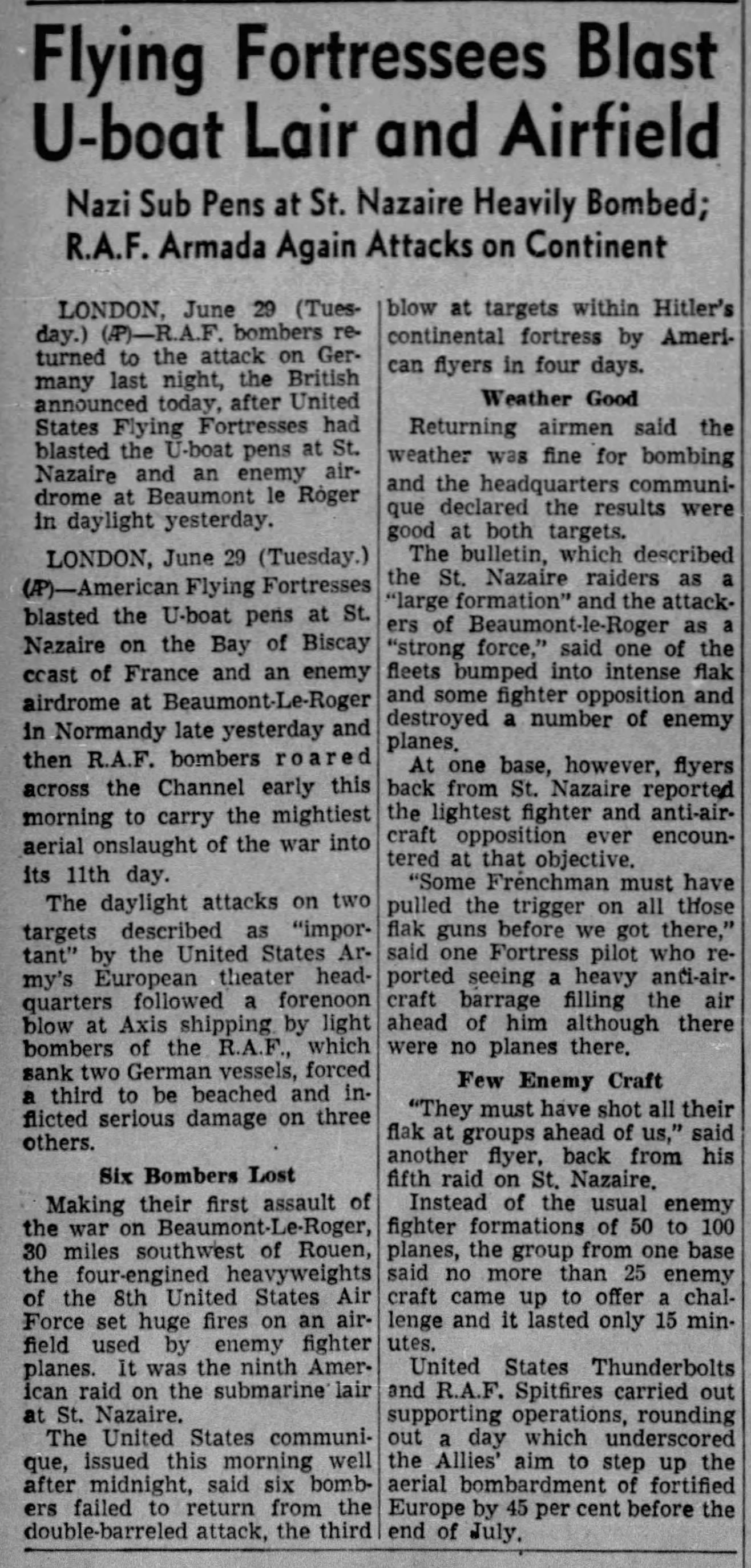
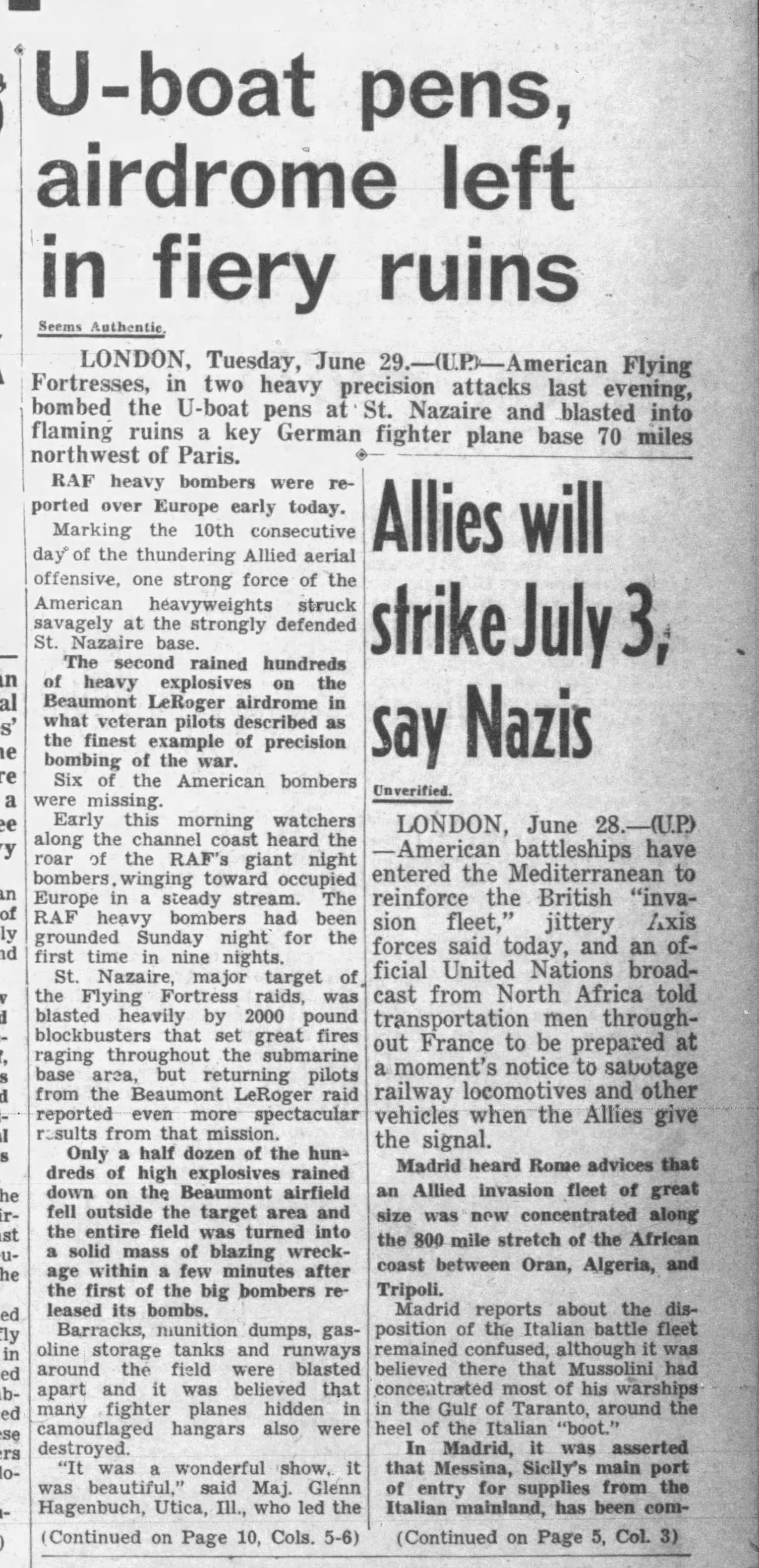
After the turn at the IP and with bomb bay doors open, Major Cleven took the formation through its own evasive action on the approach, making a good bomb run of forty-seconds through the intense accurate continuous following flak over the target. As the 100th’s B-17s continued to absorb the flak bursts, bombs were successfully away from 26,900 feet. Vance Boswell, bombardier on Sam Turner’s Fortress stated, “We just blew that target right off the face of France…After one bomb hit there was a big deep red flash followed by smoke. We must have hit oil or gasoline.”
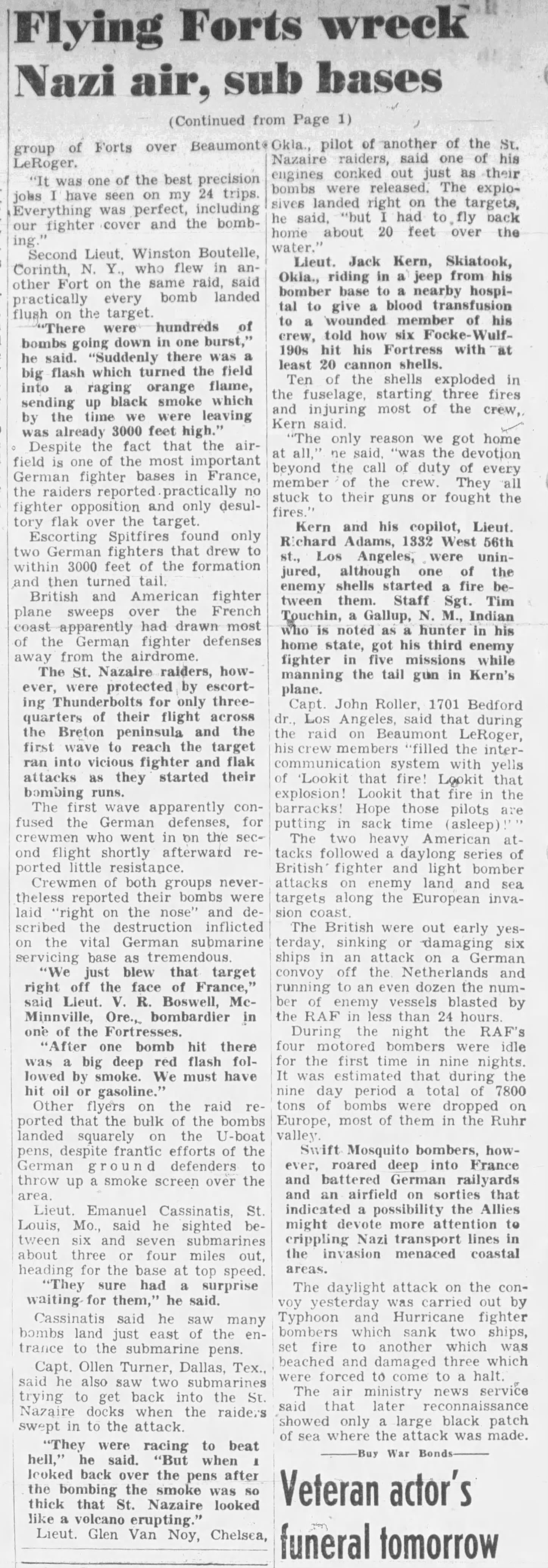
Making the Rally Point at Castelli Point, the route out over the sea was planned at a low altitude to “permit the best defense against intercepting fighters.” After sighting six to seven submarines three miles out, Emanuel Cassimatis, navigator on Edgar Woodward’s B17 stated “They sure had a surprise waiting for them” while Ollen Turner stated, “They were racing to beat hell. But when I looked back over the pens after the bombing the smoke was so thick that St Nazaire looked like a volcano erupting.”
With several flak crippled aircraft, the 95BG purposely slowed their descent to provide protection to its stragglers and save gas. The 100BG, struggling to not overtake the 95BG’s formation, made large and continuous “S” turns to stay behind it. Glen Van Noy, having lost an engine over the target was unable to maintain formation and had to anxiously “fly back home about 20 feet over the water.” Fortunately for Van Noy, the small number of enemy fighters encountered fifty miles from the Rally Point had focused on the 95th’s stragglers.
Three of the 100th’s pilots had aborted the mission early, all due to engine problems and the eighteen remaining fortresses returned safely to Thorpe Abbotts, although some with slight battle damage. Reports would later show that the majority of the bombs from all of the groups hit within the target area and results were deemed to be excellent.
Intelligence Officer, Red Bowman would record into his daily diary, “Ran the first really successful mission today on the sub pens at St. Nazaire. Conditions were very favorable although the Germans tossed up a lot of flak and trotted out considerable fighter opposition. One man came back with a slight wound from flak, S/Sgt Bernard I. Hanover, our first candidate for a Purple Heart with a small flesh wound on is arm… The ships were loaded with 500 lb bombs and they were dropped squarely on the assigned targets. Crews were happy and elated – ate more and talked more freely – waited patiently for interrogation...”
And Headquarters was happy. In a mission critique, Colonel Curtis Le May would write, "This mission was one of our best to date. It definitely proves that under good weather conditions and with the normal amount of enemy opposition, pin point targets can be identified, hit and destroyed. Additional experience under actual operating conditions is necessary before definite conclusions can be reached regarding the maximum operating radius of aircraft with extra wing tanks. It is apparent however, that when these tanks are used, long slow climbs will have to be made in order to avoid damage to the engines. A rate of climb of 200 feet per minute and 150 miles per hour appears to be desirable when the Tokyo tanks are used. Curtis E. Le May Colonel, Air Corps, Commanding"
Crews known to fly:
Barr, Van Noy, Fuller, Carnell, Claytor, Duncan, Barley, DeSanders, Murphy, Barker, Turner, Dye, King, Swartout, Kiessling (spare), Flesh, Cruikshank, Brady, Blakely, Knox, Woodward (some crew mission lists missing)
Field Order #14 would mark the first time in the ETO, that the Americans would utilize the longer range wing-tip fuel tanks, called Tokyo tanks. With these tanks, the aircraft would be able to fly a wider route both in and out over the sea at lower altitudes, ideally allowing the bombers to avoid detection by radar until the last possible minute and ideally minimize possible fighter attacks. Due to this, no fighter support was planned for the first force.
The target for the day would be the U-boat pens operating out of St. Nazaire, in Normandy, France. The Germans had completed building a new eastern lock and VIII Bomber Command wanted it taken out. Planning called for the 1st and 4th Divisions to fly to St Nazaire; the 4th in the first wave, would attack from the sea, while the 1st Division’s main force would attack from land fifteen minutes later. Diversionary attacks on other targets by the 1st Division’s secondary force were also planned to draw away any German fighters.
At 0900 at Thorpe Abbotts, twenty-one crews plus spares were given their target and mission orders. The men were briefed that they would fly as the first force. With all groups flying a twenty-one aircraft formation, the 96BG would lead, the 95BG would fly at a lower altitude and the 100BG would fly as its high group. The 94BG’s aircraft would be split amongst the 95BG and 96BG formations. Major Gale Cleven would lead the 100th and any spare aircraft unneeded when departing the English coast at Lizard Point would return to base. Briefed to expect heavy flak, the submarine pens would be defended by a reported forty-three anti-aircraft guns shooting 20 to 40 mm. The RAF had already given St Nazaire the moniker of “Flak City.”
Heavily loaded down with two 2000 lb bombs, the inexperience with such a heavy load made the take-offs and assembly difficult for the young pilots. The briefed for rate of climb was too fast and the aircraft became too spread out.
Although Splasher 6 was to be the wing’s assembly point with the 96BG at 1500 feet, 95BG at 2500 feet and the 100BG at 3500 feet, the low haze restricted visibility. Orders had called for the groups to fly in echelon until bombing altitude was reached. With excessive tail winds at their altitudes, the 95BG and 100BG had problems staying behind their lead group. Departing the English coast at Lizard Point and out over the Atlantic, proper combat formation was not attained until the IP had been reached and the groups made the turn for their bomb runs. In order to confuse the AA barrage predicators, orders called for a one thousand foot change in altitude to be executed shortly before the IP.
Through little clouds and good visibility, the 96BG began its turn onto the bomb run. Just before the target, the 95th and 100BGs flying behind observed the commencement of the AA guns firing from below and the bursting flak hitting the fortresses. Taking evasive action for several minutes, the 96BG dropped its bombs from 25600 feet. The 95BG, next over the target, was led by its low squadron after its leader’s bomb bay doors failed to open.
After the turn at the IP and with bomb bay doors open, Major Cleven took the formation through its own evasive action on the approach, making a good bomb run of forty-seconds through the intense accurate continuous following flak over the target. As the 100th’s B-17s continued to absorb the flak bursts, bombs were successfully away from 26,900 feet. Vance Boswell, bombardier on Sam Turner’s Fortress stated, “We just blew that target right off the face of France…After one bomb hit there was a big deep red flash followed by smoke. We must have hit oil or gasoline.”
Making the Rally Point at Castelli Point, the route out over the sea was planned at a low altitude to “permit the best defense against intercepting fighters.” After sighting six to seven submarines three miles out, Emanuel Cassimatis, navigator on Edgar Woodward’s B17 stated “They sure had a surprise waiting for them” while Ollen Turner stated, “They were racing to beat hell. But when I looked back over the pens after the bombing the smoke was so thick that St Nazaire looked like a volcano erupting.”
With several flak crippled aircraft, the 95BG purposely slowed their descent to provide protection to its stragglers and save gas. The 100BG, struggling to not overtake the 95BG’s formation, made large and continuous “S” turns to stay behind it. Glen Van Noy, having lost an engine over the target was unable to maintain formation and had to anxiously “fly back home about 20 feet over the water.” Fortunately for Van Noy, the small number of enemy fighters encountered fifty miles from the Rally Point had focused on the 95th’s stragglers.
Three of the 100th’s pilots had aborted the mission early, all due to engine problems and the eighteen remaining fortresses returned safely to Thorpe Abbotts, although some with slight battle damage. Reports would later show that the majority of the bombs from all of the groups hit within the target area and results were deemed to be excellent.
Intelligence Officer, Red Bowman would record into his daily diary, “Ran the first really successful mission today on the sub pens at St. Nazaire. Conditions were very favorable although the Germans tossed up a lot of flak and trotted out considerable fighter opposition. One man came back with a slight wound from flak, S/Sgt Bernard I. Hanover, our first candidate for a Purple Heart with a small flesh wound on is arm… The ships were loaded with 500 lb bombs and they were dropped squarely on the assigned targets. Crews were happy and elated – ate more and talked more freely – waited patiently for interrogation...”
And Headquarters was happy. In a mission critique, Colonel Curtis Le May would write, "This mission was one of our best to date. It definitely proves that under good weather conditions and with the normal amount of enemy opposition, pin point targets can be identified, hit and destroyed. Additional experience under actual operating conditions is necessary before definite conclusions can be reached regarding the maximum operating radius of aircraft with extra wing tanks. It is apparent however, that when these tanks are used, long slow climbs will have to be made in order to avoid damage to the engines. A rate of climb of 200 feet per minute and 150 miles per hour appears to be desirable when the Tokyo tanks are used. Curtis E. Le May Colonel, Air Corps, Commanding"
Crews known to fly:
Barr, Van Noy, Fuller, Carnell, Claytor, Duncan, Barley, DeSanders, Murphy, Barker, Turner, Dye, King, Swartout, Kiessling (spare), Flesh, Cruikshank, Brady, Blakely, Knox, Woodward (some crew mission lists missing)
Bombing Results
Bombing Results: GOOD
Aircraft Lost: 0
Crew Lost: 0
Claims of Enemy Losses (CLS): 0.5
Aircraft Returned:
Media Articles
Use your thumb to scroll through the results box below.
| Media Item | Type | Page | Volume/Issue | Broadcast Source | Time | Description | File |
|---|---|---|---|---|---|---|---|
| St Nazaire June 28 1943 mission | The Los Angeles Times June 29 1943 | 12:00 am | |||||
| Boswell, Cassimattis, Turner St Nazaire part 1 | The Daily News June 29 1943 | 12:00 am | |||||
| St Nazaire part 2 | Daily News June 29 1943 | 12:00 am |