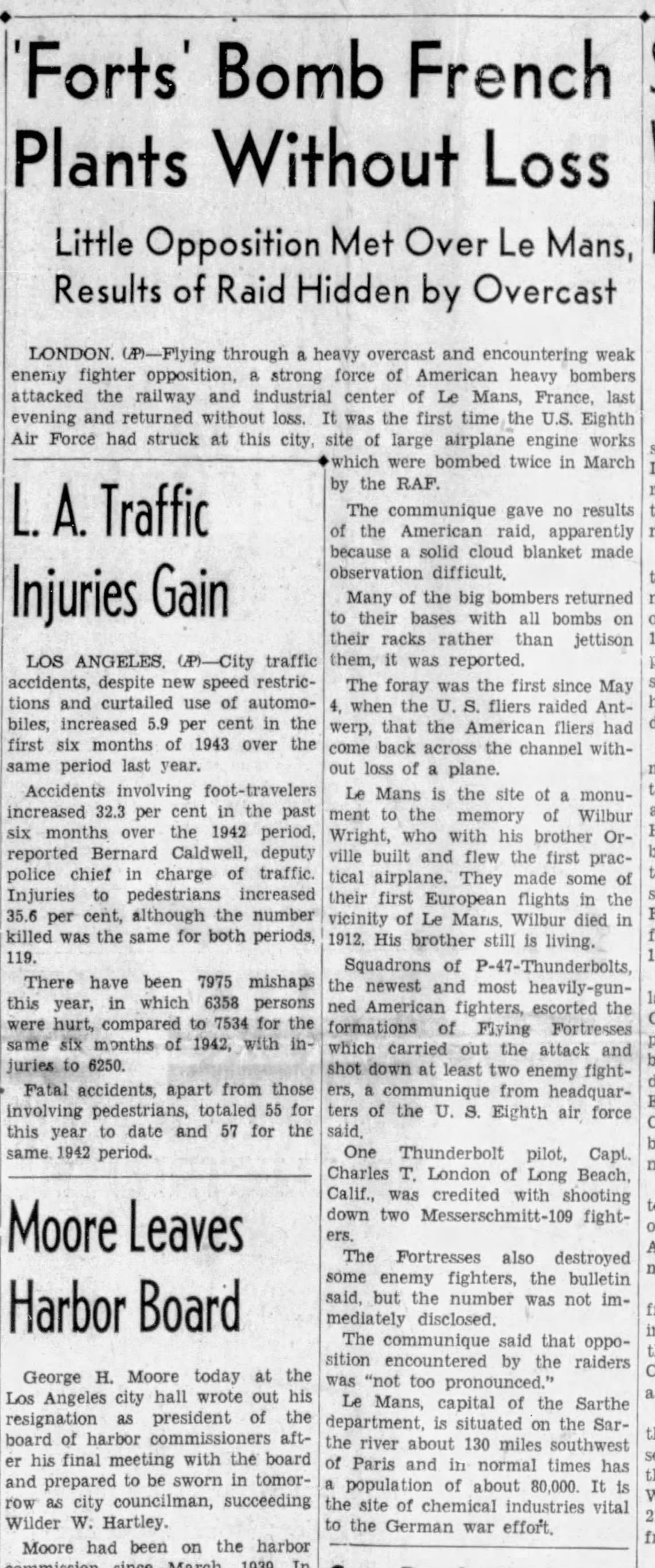
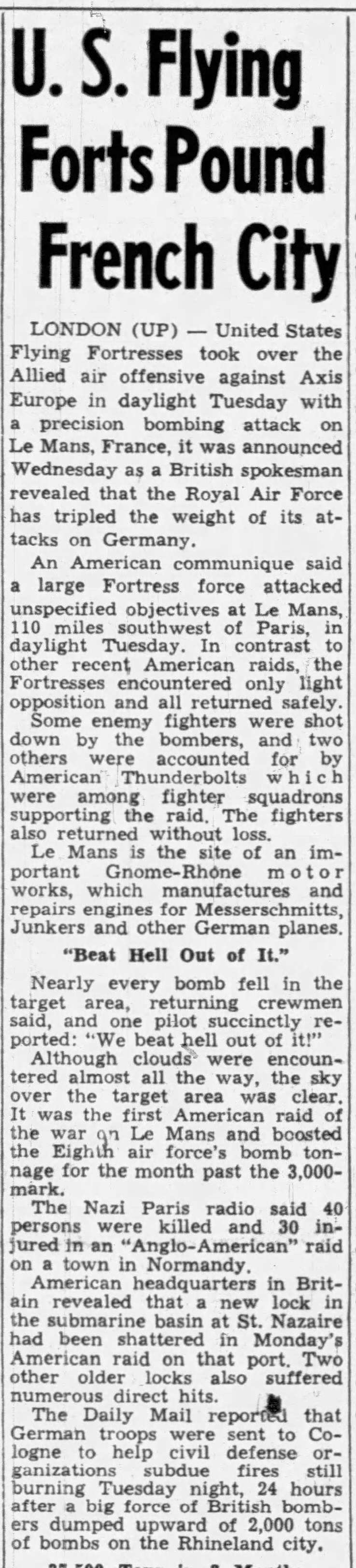
Mission Date: June 29, 1943
Le MANS, AERO ENGINES
100th BG Mission #: 3
Mission Summary
ON THIS DAY JUNE 29, 1943
According to S-2 Intelligence Officer Red Bowman,"The good weather has put Bomber Command on its high horse. Got another mission tossed down to us today. The assignment is to go back and finish the job on the Gnome & Rhone engine works…” Plans called for the 4th Air Division to follow the 1st Air Division’s main force into France until Bolbec, where the 1st would split off for an attack on Paris’ airdrome at Villacoublay. The 1st Division would also be sending a secondary smaller diversionary formation into France fifty minutes before the 8th’s main forces to attack the Tricqueville airfield. The 4th would fly south to attack the engine works at Le Mans.
At Thorpe Abbotts, most of the seated crews in the afternoon briefing would be flying their #2 or #3 combat mission. They were told of the high priority target located at Le Mans, located one hundred miles into France and their furthest point of penetration to date. "This plant… has been turning out motors for Nazi aircraft, particularly for the huge six-engined ME-323 transport, which was employed to carry troops in the North African campaign.” Their secondary target would be Poissy, France.
Field Order #15 would call for the 402nd Combat Wing to lead the 4th Air Division, followed by the 401st Combat Wing with all groups flying twenty-one aircraft formations consisting of two elements of three bombers in the lead squadron, three elements in the high squadron and two elements in the low. The 95BG would lead the division with the 100BG flying second in the 402 CBW. All of the fortresses would carry a bomb load of ten 500 lb bombs.
After take-off from Thorpe Abbotts, the 100th’s pilots assembled with the 95BG over Horham at 1600 feet and formed into the 402nd Combat Wing. Joining the 401st CBW at 12000 feet at Peterborough, the 4th division executed a circle to allow the 1st Division to take its position as the lead. Not quite successful, the 4th Division found itself under the 1st Division’s as the English Coast was departed.
Crossing into France at Bolbec just west of Le Havre, intense flak was encountered but no bombers were lost. Eight squadrons of clipped wing Spitfire V’s successfully rendezvoused with the 4th Division’s formation at 13000 at Argentan and the crews were grateful for the excellent and close cover as they continued south. At 1937 hours, the 1st Division turned off toward Paris.
Continuing the briefed route south, the formation flew to Bernay and on to Ferté-Bernard before making the turn west to Le Mans. With two anti-aircraft batteries expected in the NW section of the city, the bomb run was briefed to be made from NE to SW direction, with a slight turn west after bombs away.
The 95BG in the lead, turned off the IP at 1957 hours and shot up a red flare, signaling to the other groups the opening of bomb bay doors. From 21700 feet, a forty-second bomb run was made but bombs were released on the wrong target. Recognizing the correct target to the left, the bombardier “told his pilot to make a sharp turn toward it so that the groups behind could identify it…The briefing had left him with the impression that the target would be more camouflaged than it was…”
The 100BG flying behind, reported that the sun had hampered the group leader’s vision and “by the time he finally became oriented and recognized the target, it was too late to get an accurately synchronized run. He feels that the pictures given him at the briefing were inadequate, since they did not reveal the true appearance of the target…” The remaining bombardiers released on their respective leaders from an altitude of 20000 feet.
The 96BG’s leader however, saw that the 95BG and 100BG were heading too far north of the target, so he turned toward the marshalling yard and picked up the correct aiming point in his bombsight.
After bombs were away, on the route out, the pilots made a rapid descent to ensure the fighter escort was met over Argentan and to get under the 1500 overcast reported at Beachy Head on the English coast. Although between ten to fourteen German fighters had been observed in the distance on the route in, they had chased after the 1st Division. With no fighters encountered and minimal flak on the route out, the relieved crews could finally breathe easier. In the clear, the spitfire pilots put on quite a show for the Americans and it was reported that, “Anglo-American amity was expressed once again via serial acrobatics performed by the British planes for the relaxing American airmen.”
All of the 100BG’s bombers returned safely to base by 2200 hours.
Red Bowman would record into the Group’s diary, “…once again our boys fielded a tomato. The Leader – some other Group – missed the Initial Point and the bombardiers following him scattered bombs all over the country side. I guess it was a pitiful exhibition. Lt. Peal, the Group Bombardier, saw what was happening and brought his bombs back. Another Group went back and took a second run since there was no opposition from either E/A or flak.”
The 100th’s crews were just getting their combat legs under them. Real combat was nothing like they had trained for in the States and continued discipline and study would be required of everyone. The mission critique from the 4th Bombardment Wing had scored the mission a failure. Colonel LeMay would write, “This mission brings out more strongly than ever, the importance of target identification, and the need of continued emphasis on this subject in the ground training program. All bombardier-navigator teams must be thoroughly familiar with the target and the surrounding terrain. It is impossible in the short period of time allowed during briefing, to gain the degree of familiarity required. Hours of study must be made in ground school, and the briefing used only for review. Curtis E. Le May, Colonel, Air Corps, Commanding”
Crews known to have flown this mission: Barnhill, Reed, Reeder, Carnell, Duncan, Braley, DeSanders, Murphy, Turner, Dye, King, Kiessling, Flesh, Cruikshank (Missing 7 crew names)
According to S-2 Intelligence Officer Red Bowman,"The good weather has put Bomber Command on its high horse. Got another mission tossed down to us today. The assignment is to go back and finish the job on the Gnome & Rhone engine works…” Plans called for the 4th Air Division to follow the 1st Air Division’s main force into France until Bolbec, where the 1st would split off for an attack on Paris’ airdrome at Villacoublay. The 1st Division would also be sending a secondary smaller diversionary formation into France fifty minutes before the 8th’s main forces to attack the Tricqueville airfield. The 4th would fly south to attack the engine works at Le Mans.
At Thorpe Abbotts, most of the seated crews in the afternoon briefing would be flying their #2 or #3 combat mission. They were told of the high priority target located at Le Mans, located one hundred miles into France and their furthest point of penetration to date. "This plant… has been turning out motors for Nazi aircraft, particularly for the huge six-engined ME-323 transport, which was employed to carry troops in the North African campaign.” Their secondary target would be Poissy, France.
Field Order #15 would call for the 402nd Combat Wing to lead the 4th Air Division, followed by the 401st Combat Wing with all groups flying twenty-one aircraft formations consisting of two elements of three bombers in the lead squadron, three elements in the high squadron and two elements in the low. The 95BG would lead the division with the 100BG flying second in the 402 CBW. All of the fortresses would carry a bomb load of ten 500 lb bombs.
After take-off from Thorpe Abbotts, the 100th’s pilots assembled with the 95BG over Horham at 1600 feet and formed into the 402nd Combat Wing. Joining the 401st CBW at 12000 feet at Peterborough, the 4th division executed a circle to allow the 1st Division to take its position as the lead. Not quite successful, the 4th Division found itself under the 1st Division’s as the English Coast was departed.
Crossing into France at Bolbec just west of Le Havre, intense flak was encountered but no bombers were lost. Eight squadrons of clipped wing Spitfire V’s successfully rendezvoused with the 4th Division’s formation at 13000 at Argentan and the crews were grateful for the excellent and close cover as they continued south. At 1937 hours, the 1st Division turned off toward Paris.
Continuing the briefed route south, the formation flew to Bernay and on to Ferté-Bernard before making the turn west to Le Mans. With two anti-aircraft batteries expected in the NW section of the city, the bomb run was briefed to be made from NE to SW direction, with a slight turn west after bombs away.
The 95BG in the lead, turned off the IP at 1957 hours and shot up a red flare, signaling to the other groups the opening of bomb bay doors. From 21700 feet, a forty-second bomb run was made but bombs were released on the wrong target. Recognizing the correct target to the left, the bombardier “told his pilot to make a sharp turn toward it so that the groups behind could identify it…The briefing had left him with the impression that the target would be more camouflaged than it was…”
The 100BG flying behind, reported that the sun had hampered the group leader’s vision and “by the time he finally became oriented and recognized the target, it was too late to get an accurately synchronized run. He feels that the pictures given him at the briefing were inadequate, since they did not reveal the true appearance of the target…” The remaining bombardiers released on their respective leaders from an altitude of 20000 feet.
The 96BG’s leader however, saw that the 95BG and 100BG were heading too far north of the target, so he turned toward the marshalling yard and picked up the correct aiming point in his bombsight.
After bombs were away, on the route out, the pilots made a rapid descent to ensure the fighter escort was met over Argentan and to get under the 1500 overcast reported at Beachy Head on the English coast. Although between ten to fourteen German fighters had been observed in the distance on the route in, they had chased after the 1st Division. With no fighters encountered and minimal flak on the route out, the relieved crews could finally breathe easier. In the clear, the spitfire pilots put on quite a show for the Americans and it was reported that, “Anglo-American amity was expressed once again via serial acrobatics performed by the British planes for the relaxing American airmen.”
All of the 100BG’s bombers returned safely to base by 2200 hours.
Red Bowman would record into the Group’s diary, “…once again our boys fielded a tomato. The Leader – some other Group – missed the Initial Point and the bombardiers following him scattered bombs all over the country side. I guess it was a pitiful exhibition. Lt. Peal, the Group Bombardier, saw what was happening and brought his bombs back. Another Group went back and took a second run since there was no opposition from either E/A or flak.”
The 100th’s crews were just getting their combat legs under them. Real combat was nothing like they had trained for in the States and continued discipline and study would be required of everyone. The mission critique from the 4th Bombardment Wing had scored the mission a failure. Colonel LeMay would write, “This mission brings out more strongly than ever, the importance of target identification, and the need of continued emphasis on this subject in the ground training program. All bombardier-navigator teams must be thoroughly familiar with the target and the surrounding terrain. It is impossible in the short period of time allowed during briefing, to gain the degree of familiarity required. Hours of study must be made in ground school, and the briefing used only for review. Curtis E. Le May, Colonel, Air Corps, Commanding”
Crews known to have flown this mission: Barnhill, Reed, Reeder, Carnell, Duncan, Braley, DeSanders, Murphy, Turner, Dye, King, Kiessling, Flesh, Cruikshank (Missing 7 crew names)
Bombing Results
Bombing Results: FAIR
Aircraft Lost: 0
Crew Lost: 0
Claims of Enemy Losses (CLS): 0
Aircraft Returned:
Media Articles
Use your thumb to scroll through the results box below.
| Media Item | Type | Page | Volume/Issue | Broadcast Source | Time | Description | File |
|---|---|---|---|---|---|---|---|
| Le Mans June 29 1943 mission | 12:00 am | ||||||
| Le Mans | The Gazette June 30 1943 | 12:00 am | |||||
| Le Mans | The Buffalo News June 30 1943 | 12:00 am |