Mission Date: July 4, 1943
La PALLICE, HARBOR (COWBOY
100th BG Mission #: 4
Mission Summary
ON THIS DAY…JULY 4 1943
Mission planning under the VIII Bomber Command and Brigadier General Orville “Andy” Anderson, the American’s “strategic bombardment theorist and devotee,” continued to focus on German U-boat targets. On July 4,1943, Field Order #17 called for an attack on the submarine base at La Pallice near La Rochelle, on the Northwest coast of France. The mission order called for the maximum number of aircraft with long-range wing-tip fuel tanks to fly “for the route flown was entirely over water, from the coast of England to landfall near Bordeaux, with low altitude maintained through the flight to escape detection by RDF.”
At Thorpe Abbotts, it had been five days since the 100BG had flown a combat mission. That morning, twenty-nine crews were called to attention as their new Commanding Officer, thirty-eight year old Colonel Neil B. Harding entered the briefing room. West Virginian, “Chick” Harding as he was called during his “All American” Army football days in the mid 1920s, had taken over command of the 100BG two days earlier from Colonel Huglin, who had been relieved due to severe stomach ulcers that had landed him in the hospital. The men were briefed for their target at La Pallice, with no secondary or last resort target designated. Harding would lead the 100th’s main formation of twenty-one aircraft flying with Ollen Turner. In addition, the 100BG was ordered to supply seven of its crews and aircraft to fly with the 401st Combat Wing: five with the 96BG and another two with the 94BG.
Twenty-seven year old Major John Egan would carry Brigadier General O. A. Anderson as a special observer in his Fortress. General Anderson would be on his first combat mission over Europe. Thirty-one year-old Robert C. Pearson, was scheduled to fly the lead of the second element and two of the new replacement crews, who had just arrived to Thorpe Abbotts on June 26, would be flying their #1 combat missions under the leadership of their twenty-one year old pilots, Owen Roane and Henry Henington.
The men were briefed on their routes in and out. The Initial Point from where the turn onto the bomb run would be made in group formation, would be at sea. Although the long-range fuel tanks were expected to cover the planned for ten hour flight, emergency bases were identified to the crews if forced landings were necessary due to insufficient fuel levels.
Loaded down with 1000 pound bombs, those flying with the other groups took off first, in light fog and low visibility of 1000 yards. The 100th’s main formation of B17s followed. Take off was without incident although the haze caused some difficulty in assembling. Only “Messie Bessie” would fail to take-off, due to an electrical junction box failure on its ball turret.
Late in assembling, the 402nd CBW failed to join the 401st at Splasher 6 as planned. Low clouds had separated the groups and they were forced to climb on top of the cloud coverage. Not completed at the briefed for time or point, the Division’s assembly finally occurred at Lizard Point, the southern point of England from where the 4th Air Division departed the English coast. With no slots open at Lizard Point, flying as one of the spare B-17s, Glen Van Noy turned “Damifino II” around and headed back to base.
As the climb to altitude commenced over the water, problems maintaining formations resulted and the 402nd CBW found itself five thousand feet above the 401st, its lead wing. During the climb over the water, two of the 100BG’s pilots would abort the mission: “Oh Naseau” flown by Victor Reed, returned due to a power failure to his #3 engine in addition to a high oil temperature in his #1 engine while “Mugwump” flown by William Flesh returned due to a failure in his oxygen system.
At the designated IP, the groups began their turn toward the target but due to the large distance between the groups, “confusion and converging courses also resulted at the IP and on the bombing run.” During the climb to altitude, Robert Pearson’s Fortress experienced issues when his oil pressure ran dangerously high. Nursing his fortress along, he kept dropping lower and further behind the formation. His two wingmen followed him down until 18000 feet, but then returned to the formation. Observers said Pearson’s bomb bay doors were open. His crew would recall that their bombs were jettisoned in the water. At 5000 feet, Pearson told his crew that he would try and reach the small island of Ile d’Oleron. As he flew over the island with his wheel down, the anti-aircraft gunners opened up on his B17. Pearson's bombardier John Dunbar was wounded. After Pearson rang the bailout bell, his waist gunner Lonnie Rutledge moved toward the escape hatch “and fell through, getting caught in the gears.” Pulled free by his engineer, Jack Goss, they successfully bailed out before their B17 crashed on the island.
Meanwhile, the main formations continued on to the target under CAVU (Clear and Visibility Unlimited) conditions, encountering intense AA fire coming up from below.
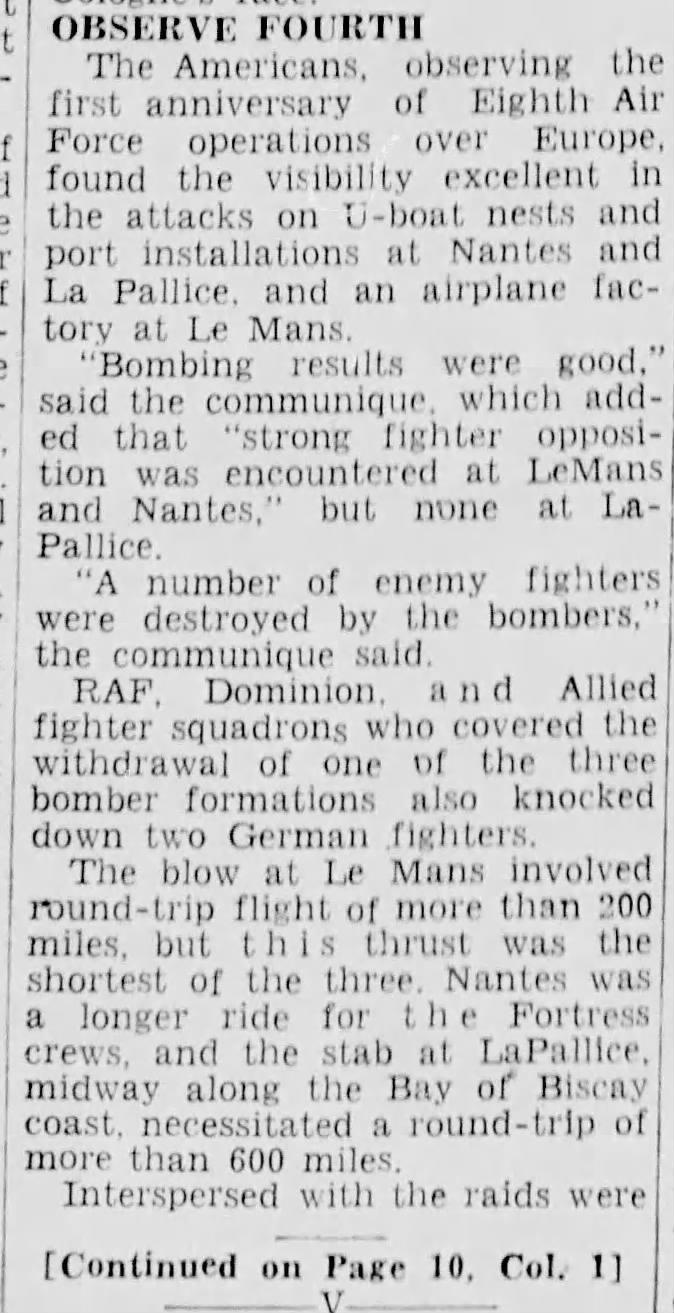
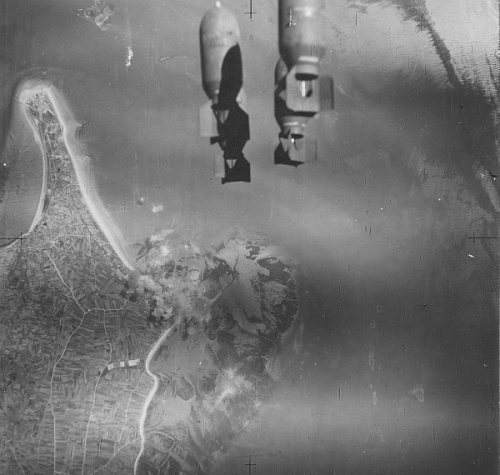
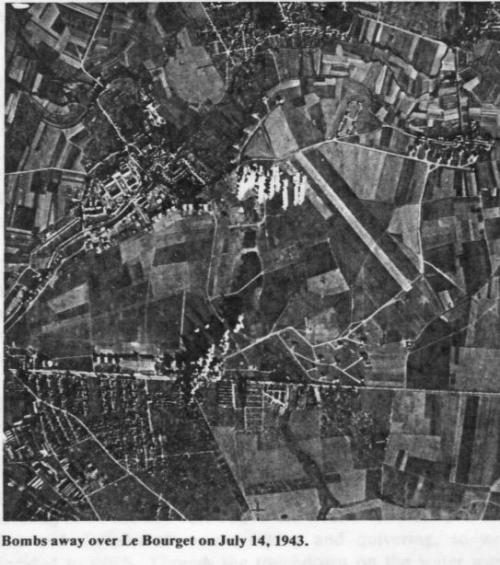
Flying through the bursting flak, the 94BG was first over the target and its bombs were away from 24000 feet at 1203 hours. Next, the 96BG released from 22000 feet. Making the turn after bombs away, the two groups became somewhat jammed up and the 95th, third over the target found itself above the 94BG on its bomb run. Careful not to drop on the 94BG, its bombs were successfully away. Coming in last and in trail of the 95BG, the 100BG reached the target after a two minute bomb run. Bombs were away from 27500 feet. Reports would later state “A very good run was made by this group and the visual results of their bombs was excellent.”
No fighter support had been planned for this mission and the crews had been briefed to reform at the Rally Point to maintain their wing’s defensive formation for maximum protection before descending in altitude. However, the leader in the 94BG had flown over the rally point and proceeded back to England alone, without the 96BG or the entire 402nd CBW which had reformed. The 96BG would subsequently attach itself to the 402nd CBW for its return.
All but Pearson’s fortress would be counted in coming over Thorpe Abbotts. Major John Egan would be grateful to just return with a sleeve torn off his shirt. During the mission, he saw his top turret gunner, John Shay’s dangling feet which meant that his oxygen hose had become disconnected. Collapsed, Shay's head "had caught between the turret and the gunsight, his hands still grasping the turret controls. Despite the fact that he was risking unconsciousness himself, Major Eagen climbed into the narrow turret, replaced the gunner's oxygen supply, and narrowly missed death when the reviving man touched off the turret controls, setting the mechanism revolving. Both Major and Sergeant were sent spinning around, banging against the sides of the narrow passageway. By the time the pilot had stopped the whiling turret, the gunner had suffered a chip fracture of the hip bone, and Major Eagan was minus a sleeve.” Major Egan was quoted as saying "I had visions of being ground up into one great meat ball…but I'm going to miss that shirt – it was my Sunday best."
Later, Red Bowman would record into the 100th’s diary, “The 4th of July and we celebrated with a raid on La Pallice, France. It was one of the most successful to date and the men who came back from the raid all agreed they had never had more fun on the 4th or set off bigger firecrackers.”
Robert Pearson and his crew had all successfully bailed out, landing on Ile D’Oleron, a small island filled with two thousand German soldiers. All but twenty-eight year old John Dunbar were captured and became POWs. After having a tourniquet applied to his injured arm by a French farmer, Dunbar hid in a briar patch for three days until he was further assisted in his escape by the French Resistance. Supplied a fishing boat located at the island’s shore, he made it to the mainland of France. Dunbar would walk through 400 miles through France, crossing the Pyrenees into Spain and would become the 100BG’s first airman to escape capture, not returning to England until September 8, 1943.
Although Colonel LeMay would be critical of his Division’s formation flying, he would mark this a successful mission. “Successful navigation was the highlight of this mission. Never before had our bombers been asked to go so far over water and come in on a pin point target. This accomplishment is all the more noteworthy in view of the overcast at sea which made it impossible to take a drift reading until our aircraft were within twenty-five or thirty miles of the coast.
Immediate steps have been taken to correct the unsatisfactory formation flying which was exhibited on this mission. Intensive instruction and practice is being conducted by each group under the close supervision of this Headquarters Curtis E. Le May, Colonel, Air Corps, Commanding “
Crews Flying: Barr, Van Noy, Barnhill, Reed, Reeder, Roane, Carnell, Claytor, Braley, Scott Hollenbeck, Helstrom, Pearson, Fienup, Murphy, Turner, Dye, King, Swartout, Henington, Kiessling, Flesh, Cruikshank, Blakely, Knox, Woodward (25 names - some missing)
Mission planning under the VIII Bomber Command and Brigadier General Orville “Andy” Anderson, the American’s “strategic bombardment theorist and devotee,” continued to focus on German U-boat targets. On July 4,1943, Field Order #17 called for an attack on the submarine base at La Pallice near La Rochelle, on the Northwest coast of France. The mission order called for the maximum number of aircraft with long-range wing-tip fuel tanks to fly “for the route flown was entirely over water, from the coast of England to landfall near Bordeaux, with low altitude maintained through the flight to escape detection by RDF.”
At Thorpe Abbotts, it had been five days since the 100BG had flown a combat mission. That morning, twenty-nine crews were called to attention as their new Commanding Officer, thirty-eight year old Colonel Neil B. Harding entered the briefing room. West Virginian, “Chick” Harding as he was called during his “All American” Army football days in the mid 1920s, had taken over command of the 100BG two days earlier from Colonel Huglin, who had been relieved due to severe stomach ulcers that had landed him in the hospital. The men were briefed for their target at La Pallice, with no secondary or last resort target designated. Harding would lead the 100th’s main formation of twenty-one aircraft flying with Ollen Turner. In addition, the 100BG was ordered to supply seven of its crews and aircraft to fly with the 401st Combat Wing: five with the 96BG and another two with the 94BG.
Twenty-seven year old Major John Egan would carry Brigadier General O. A. Anderson as a special observer in his Fortress. General Anderson would be on his first combat mission over Europe. Thirty-one year-old Robert C. Pearson, was scheduled to fly the lead of the second element and two of the new replacement crews, who had just arrived to Thorpe Abbotts on June 26, would be flying their #1 combat missions under the leadership of their twenty-one year old pilots, Owen Roane and Henry Henington.
The men were briefed on their routes in and out. The Initial Point from where the turn onto the bomb run would be made in group formation, would be at sea. Although the long-range fuel tanks were expected to cover the planned for ten hour flight, emergency bases were identified to the crews if forced landings were necessary due to insufficient fuel levels.
Loaded down with 1000 pound bombs, those flying with the other groups took off first, in light fog and low visibility of 1000 yards. The 100th’s main formation of B17s followed. Take off was without incident although the haze caused some difficulty in assembling. Only “Messie Bessie” would fail to take-off, due to an electrical junction box failure on its ball turret.
Late in assembling, the 402nd CBW failed to join the 401st at Splasher 6 as planned. Low clouds had separated the groups and they were forced to climb on top of the cloud coverage. Not completed at the briefed for time or point, the Division’s assembly finally occurred at Lizard Point, the southern point of England from where the 4th Air Division departed the English coast. With no slots open at Lizard Point, flying as one of the spare B-17s, Glen Van Noy turned “Damifino II” around and headed back to base.
As the climb to altitude commenced over the water, problems maintaining formations resulted and the 402nd CBW found itself five thousand feet above the 401st, its lead wing. During the climb over the water, two of the 100BG’s pilots would abort the mission: “Oh Naseau” flown by Victor Reed, returned due to a power failure to his #3 engine in addition to a high oil temperature in his #1 engine while “Mugwump” flown by William Flesh returned due to a failure in his oxygen system.
At the designated IP, the groups began their turn toward the target but due to the large distance between the groups, “confusion and converging courses also resulted at the IP and on the bombing run.” During the climb to altitude, Robert Pearson’s Fortress experienced issues when his oil pressure ran dangerously high. Nursing his fortress along, he kept dropping lower and further behind the formation. His two wingmen followed him down until 18000 feet, but then returned to the formation. Observers said Pearson’s bomb bay doors were open. His crew would recall that their bombs were jettisoned in the water. At 5000 feet, Pearson told his crew that he would try and reach the small island of Ile d’Oleron. As he flew over the island with his wheel down, the anti-aircraft gunners opened up on his B17. Pearson's bombardier John Dunbar was wounded. After Pearson rang the bailout bell, his waist gunner Lonnie Rutledge moved toward the escape hatch “and fell through, getting caught in the gears.” Pulled free by his engineer, Jack Goss, they successfully bailed out before their B17 crashed on the island.
Meanwhile, the main formations continued on to the target under CAVU (Clear and Visibility Unlimited) conditions, encountering intense AA fire coming up from below.
Flying through the bursting flak, the 94BG was first over the target and its bombs were away from 24000 feet at 1203 hours. Next, the 96BG released from 22000 feet. Making the turn after bombs away, the two groups became somewhat jammed up and the 95th, third over the target found itself above the 94BG on its bomb run. Careful not to drop on the 94BG, its bombs were successfully away. Coming in last and in trail of the 95BG, the 100BG reached the target after a two minute bomb run. Bombs were away from 27500 feet. Reports would later state “A very good run was made by this group and the visual results of their bombs was excellent.”
No fighter support had been planned for this mission and the crews had been briefed to reform at the Rally Point to maintain their wing’s defensive formation for maximum protection before descending in altitude. However, the leader in the 94BG had flown over the rally point and proceeded back to England alone, without the 96BG or the entire 402nd CBW which had reformed. The 96BG would subsequently attach itself to the 402nd CBW for its return.
All but Pearson’s fortress would be counted in coming over Thorpe Abbotts. Major John Egan would be grateful to just return with a sleeve torn off his shirt. During the mission, he saw his top turret gunner, John Shay’s dangling feet which meant that his oxygen hose had become disconnected. Collapsed, Shay's head "had caught between the turret and the gunsight, his hands still grasping the turret controls. Despite the fact that he was risking unconsciousness himself, Major Eagen climbed into the narrow turret, replaced the gunner's oxygen supply, and narrowly missed death when the reviving man touched off the turret controls, setting the mechanism revolving. Both Major and Sergeant were sent spinning around, banging against the sides of the narrow passageway. By the time the pilot had stopped the whiling turret, the gunner had suffered a chip fracture of the hip bone, and Major Eagan was minus a sleeve.” Major Egan was quoted as saying "I had visions of being ground up into one great meat ball…but I'm going to miss that shirt – it was my Sunday best."
Later, Red Bowman would record into the 100th’s diary, “The 4th of July and we celebrated with a raid on La Pallice, France. It was one of the most successful to date and the men who came back from the raid all agreed they had never had more fun on the 4th or set off bigger firecrackers.”
Robert Pearson and his crew had all successfully bailed out, landing on Ile D’Oleron, a small island filled with two thousand German soldiers. All but twenty-eight year old John Dunbar were captured and became POWs. After having a tourniquet applied to his injured arm by a French farmer, Dunbar hid in a briar patch for three days until he was further assisted in his escape by the French Resistance. Supplied a fishing boat located at the island’s shore, he made it to the mainland of France. Dunbar would walk through 400 miles through France, crossing the Pyrenees into Spain and would become the 100BG’s first airman to escape capture, not returning to England until September 8, 1943.
Although Colonel LeMay would be critical of his Division’s formation flying, he would mark this a successful mission. “Successful navigation was the highlight of this mission. Never before had our bombers been asked to go so far over water and come in on a pin point target. This accomplishment is all the more noteworthy in view of the overcast at sea which made it impossible to take a drift reading until our aircraft were within twenty-five or thirty miles of the coast.
Immediate steps have been taken to correct the unsatisfactory formation flying which was exhibited on this mission. Intensive instruction and practice is being conducted by each group under the close supervision of this Headquarters Curtis E. Le May, Colonel, Air Corps, Commanding “
Crews Flying: Barr, Van Noy, Barnhill, Reed, Reeder, Roane, Carnell, Claytor, Braley, Scott Hollenbeck, Helstrom, Pearson, Fienup, Murphy, Turner, Dye, King, Swartout, Henington, Kiessling, Flesh, Cruikshank, Blakely, Knox, Woodward (25 names - some missing)
Bombing Results
Bombing Results:
Aircraft Lost: 1
Crew Lost: 10
Claims of Enemy Losses (CLS): 0
Aircraft Returned:
Media Articles
Use your thumb to scroll through the results box below.
| Media Item | Type | Page | Volume/Issue | Broadcast Source | Time | Description | File |
|---|---|---|---|---|---|---|---|
| La Pallice July 4 1943 | The Macon Telegraph July 5 1943 | 12:00 am |