Mission Date: July 14, 1943
Le BOURGET (PARIS) AF
100th BG Mission #: 6
Mission Summary
ON THIS DAY…JULY 14, 1943
Poor weather kept the bombers at Thorpe Abbotts grounded for three days with another mission to Le Bourget scrubbed on July 13. With the weather clearing, the 100BG was alerted again that evening.
On July 14, twenty-four crews including two spare crews were awakened for the 0230 briefing. Standing in front of the unveiled map, Colonel Harding once again divulged the target as Le Bourget, the Luftwaffe airdrome outside of Paris.
Under Field Order #21, the 4th Air Division would send out two combat wings of heavy bombers: the 401st, led by the 96BG and followed by the 94BG, would fly first. The 402nd CBW would be led by the 95BG and would be followed by the 100BG flying last in the Division line. Both the 95th and the 100th would target the hangar and engine repair shops at the airdrome. Their designated secondary target would be the airfield at Evreaux-Fauvill while the last resort target would be the airfield at Triqueville.
Colonel Neil Harding would fly as the 100th’s Command Pilot, along with the 349th’s CO William Veal in Woodrow Barnhill’s Fortress, aptly named “Flak Shack.” The Group formation would consist of six aircraft lead and low boxes while the high box would contain nine aircraft.
S-2 Officer Marvin Bowman briefed the men with similar details as in the July 10 mission. Spitfire IX fighters would escort the bombers on the route in, while Spitfire Vs would provide escort on the route out. Bowman warned the formation leaders to make their turn at the IP as briefed if they were to avoid the heavy anti-aircraft guns expected from Paris. In addition, the 1st Divisions’ heavies would be in the same target area at Paris, so the pilots were told “if necessary move slightly south of course to avoid interference.”
With take-offs underway by 0500 hours, only the Fortress named ‘Our Baby’ flown by Bernard DeMarco failed to get off the ground, due to the “solenoid in the BT” being inoperative.
The weather was 4/10 cloud coverage over the base with visibility of five miles. Successfully assembled into Group formation, the 100BG climbed with the 95BG over Horham and formed the 402nd CBW. By 0613 hours, the 402nd CBW had departed Splasher #6, echeloned to the left of the 401st CBW. Leaving the English coast at Selsey Bill at 0714 hours, all groups were reported in good formation as they started across the Channel, continuing their climb to the bombing altitude of 24000 feet.
The Channel however, brought worsened cloud conditions of 9-10/10 coverage. It would be aircraft issues however, that would play havoc with the 100th’s formation. Multiple B-17 problems causing the inability to stay up with the formation caused ten additional pilots to abort the mission: the Fortresses named ‘Just A Snappin’, ‘Picklepuss’, ‘Muggs’, ‘Sweater Girl’, ‘Raunchy’, ‘Barker’s Burden’, ‘Black Jack’, ‘Damifino’, ‘Flak Happy’ and ‘Oh Nausea’ would all return back to base early.
Losing fifty percent of its bombers from its defensive box, the remaining eleven aircraft remaining in the 100th’s formation tightened up further. When the heavies were ten miles west of crossing the French coast at Fécamp, four squadrons of Spitfire IXs met the formations on time, remaining with the bombers until the turn was made south to Evreux.
With the exit of the escort fighters, tensions heightened as the gunners dutifully scanned the sky. At Evreaux, 75-100 German fighters were encountered with mostly FW-190s and ME-109s pressing their attacks on the bombers all the way up to the target, with most of the attacks coming from “out of the sun, level and above, from 10 to 2 o’clock…As many as 4 enemy aircraft would come in at a time on one B-17, one following the other out of the sun and pressing in almost to the point of collision…” In the 401st CBW flying, the pilots watched as a German fighter crashed head on with a B-17, while another German fighter flew into another B-17, sheering off its wing.
The attacks continued but the wing would hold its defensive position until the IP at Cormeilles-en-Paris was reached and the flak commenced, albeit meager and inaccurate. Visibility was reported as good over the target and at the IP, the red flare was observed ahead from the 96BG leader’s plane. Over the target, the 401st could be seen flying through the now heavy, accurate and intense flak bursts, with the 96BG dropping first from 22900 feet, followed by the 94BG.
The German fighters were still pressing their attacks on the 401st CBW as it executed its turn onto the bomb run while the 402CBW’s lead group was taking violent evasive action involving a change in direction every 30 seconds. Flying ahead of the 100BG, the 95th made its turn onto the bombing run, but had some difficulty bombing due to the 94th flying below them and causing difficulties for the 95BG in “uncovering” the 94th. Only fourteen of its bombers dropped on its leader at 0800 hours.
Finally, the 100BG made its turn onto the bomb run as planned at 25575 feet. Due to the evasive action taken, the sight gyro in the 100th’s lead ship was lost and no bombs were dropped from the lead ship. Awaiting the lead aircraft’s drop which never came, only four of the 100BG’s fortresses would ultimately drop their bombs.
With the 100th last over the target, the laying-in-wait Luftwaffe pilots prepared for their next round of attacks on the exiting bombers, especially those damaged by the intense exploding flak over the target. At the Rally Point, the 95th and 100th were back in their wing defensive position and made the turn right.
At 0839, fighters were again spotted, and pressed their attacks once again on the formations on the route out from Bernay, all the way to the French coast, where the escort fighters were picked up.
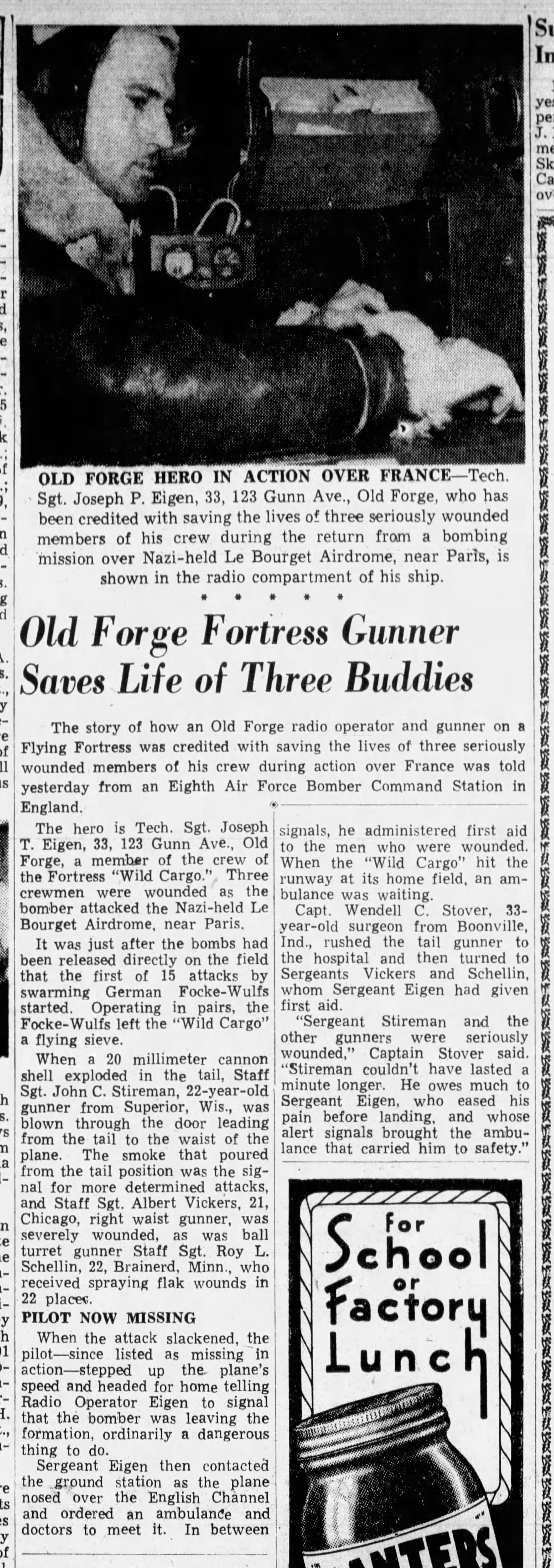
The 100th’s crews were taking on wounded. In twenty-eight year-old Curtis Biddick’s fortress named ‘Wild Cargo,’ a 20 mm cannon shell had exploded in the tail after bombs away, severally wounding and blowing his TG, twenty-two year-old John Stireman into the waist of the aircraft. Exploding flak had also sprayed twenty-two year-old BTG Roy Schellin, hitting him in twenty-two places. With Biddick’s aircraft in obvious distress as the smoke poured from its tail after bombs away, the German fighters pressed in on their attacks, severally wounding thirty-one year-old RWG Albert Vickers with bullets after spraying the fortress with bullets.
In twenty-five year-old Ronald Braley’s fortress, named ‘Pasadena Nena’ after his hometown, fighter bullets were spraying his B-17 with one bullet going between BTG Phil Ong’s legs, another grazing his hand while yet another broke his plexi-glass and entered the turret just past his head.
The gunners in twenty-six year old Richard C. King’s B17, named ‘Little Mike’ after his six year-old son, were spraying the fighters with their own bullets. His TG Donald Wise had been wounded in both arms by flak shrapnel but continued manning his guns during the fighter attacks, notifying his pilot, “I’m hit, but I’m staying right here.”
Making it out of the air battle without losing any fortresses, the 100BG crossed the channel and made the peel off for landing. Biddick had already left the formation earlier, arriving to Thorpe Abbotts as fast as possible and with red flares shot from the cabin roof. Ambulances were ready and Doc Stover got into the fortress quickly to work on Stireman and Biddick’s other wounded crew.
Ultimately, six of the 100th’s men would return from the mission wounded and the B-17s would return with battle damage. But all had returned. That day, Red Bowman recorded into the 100th’s record, “Mission to Le Bourget with favorable weather for a change. It was a short and unhappy mission. Only four A/C dropped bombs and they were not very close to the target. Ten out of 22 returned early – some mechanical and other never caught the formation. Colonel Harding led and returned in a very dark mood. Things are going to get tougher for the Combat Crews from now on it seems…”
The 4th Air Division had done their share of eliminating Luftwaffe fighters that day, destroying forty-one fighters, with another twenty-eight probably destroyed and thirty-two damaged. The 401st combat wing taking the brunt of the attacks, destroyed twenty-nine and probably damaged another eighteen. It would lose a total of forty-one men with an additional ten wounded.
The 402nd CBW’s gunners would contribute their share with the destruction of twelve fighters, another nine probably destroyed while damaging another nineteen. The 95BG alone reported firing 82,970 rounds.The 100th’s gunners had done their part and were credited with destroying seven fighters, an additional four probables and damaging five more.
Although we don’t know what was said to Colonel Harding about the 100th’s number of abortions and lack of bombing, the official record has Curtis LeMay’s comments as follows: “On this mission the formation was reported to have been well flown, which probably accounts for our low losses in spite of exceedingly strong fighter opposition. This result is particularly gratifying in view of the emphasis being placed by this Headquarters on formation flying. Lead crews again have been strongly reminded of the importance of correct approach to the IP and the execution of a smooth maneuver at that point. Crews who fail to realize the vital necessity of perfecting their technique in this respect will be replaced.”
Crews known to be flying that day:
Barker, Barnhill, Biddick, Blakely, Brady, Braley, Carey, Claytor, Cruikshank, Demarco, Dye, Fienup, Hallstrom, Hennington, Hollenbeck, Kiessling, MacCarter, Reeder, Roane, Scott, Swartout, Turner, Van Noy, Woodward
100th Group abortives (from 4th Division mission record)
42-30061 returned early – prop governor drive shaft sheared (Blakeley) Just A Snappin
42-30063 returned early – pilot reported no 1 supercharger regulator not operating properly (Brady) Picklepuss
42-30184 returned early – no 3 engine running excessively rough allowing ship to lag (Cruikshank) Muggs
42-30047 returned early –46 inch HG manifold pressure required to keep in formation (Scott) Sweater Girl
42-30057 returned early – cylinder head temperature excessive (Sam Turner) Raunchy
42-30059 returned early – oil temperatire on no 2 engine rose to 95 degrees (Barker) Barker’s Burden
42-30086 returned early – empty cartridge shell broke the glass cover plate in one of the oxygen flow meters and cause slight leakage (Reeder) Black Jack
42-30002 returned early – no boost obtainable from no 4 supercharger, and no 4 engine running rough. (Hennington) Damifino
42-3232 returned early: lack of fuel (Hollenbeck) Flak Happy
42-30042 returned early – no 2 and 3 superchargers would not show boost at 5000 feet. (MacCarter) Oh Naseau
Poor weather kept the bombers at Thorpe Abbotts grounded for three days with another mission to Le Bourget scrubbed on July 13. With the weather clearing, the 100BG was alerted again that evening.
On July 14, twenty-four crews including two spare crews were awakened for the 0230 briefing. Standing in front of the unveiled map, Colonel Harding once again divulged the target as Le Bourget, the Luftwaffe airdrome outside of Paris.
Under Field Order #21, the 4th Air Division would send out two combat wings of heavy bombers: the 401st, led by the 96BG and followed by the 94BG, would fly first. The 402nd CBW would be led by the 95BG and would be followed by the 100BG flying last in the Division line. Both the 95th and the 100th would target the hangar and engine repair shops at the airdrome. Their designated secondary target would be the airfield at Evreaux-Fauvill while the last resort target would be the airfield at Triqueville.
Colonel Neil Harding would fly as the 100th’s Command Pilot, along with the 349th’s CO William Veal in Woodrow Barnhill’s Fortress, aptly named “Flak Shack.” The Group formation would consist of six aircraft lead and low boxes while the high box would contain nine aircraft.
S-2 Officer Marvin Bowman briefed the men with similar details as in the July 10 mission. Spitfire IX fighters would escort the bombers on the route in, while Spitfire Vs would provide escort on the route out. Bowman warned the formation leaders to make their turn at the IP as briefed if they were to avoid the heavy anti-aircraft guns expected from Paris. In addition, the 1st Divisions’ heavies would be in the same target area at Paris, so the pilots were told “if necessary move slightly south of course to avoid interference.”
With take-offs underway by 0500 hours, only the Fortress named ‘Our Baby’ flown by Bernard DeMarco failed to get off the ground, due to the “solenoid in the BT” being inoperative.
The weather was 4/10 cloud coverage over the base with visibility of five miles. Successfully assembled into Group formation, the 100BG climbed with the 95BG over Horham and formed the 402nd CBW. By 0613 hours, the 402nd CBW had departed Splasher #6, echeloned to the left of the 401st CBW. Leaving the English coast at Selsey Bill at 0714 hours, all groups were reported in good formation as they started across the Channel, continuing their climb to the bombing altitude of 24000 feet.
The Channel however, brought worsened cloud conditions of 9-10/10 coverage. It would be aircraft issues however, that would play havoc with the 100th’s formation. Multiple B-17 problems causing the inability to stay up with the formation caused ten additional pilots to abort the mission: the Fortresses named ‘Just A Snappin’, ‘Picklepuss’, ‘Muggs’, ‘Sweater Girl’, ‘Raunchy’, ‘Barker’s Burden’, ‘Black Jack’, ‘Damifino’, ‘Flak Happy’ and ‘Oh Nausea’ would all return back to base early.
Losing fifty percent of its bombers from its defensive box, the remaining eleven aircraft remaining in the 100th’s formation tightened up further. When the heavies were ten miles west of crossing the French coast at Fécamp, four squadrons of Spitfire IXs met the formations on time, remaining with the bombers until the turn was made south to Evreux.
With the exit of the escort fighters, tensions heightened as the gunners dutifully scanned the sky. At Evreaux, 75-100 German fighters were encountered with mostly FW-190s and ME-109s pressing their attacks on the bombers all the way up to the target, with most of the attacks coming from “out of the sun, level and above, from 10 to 2 o’clock…As many as 4 enemy aircraft would come in at a time on one B-17, one following the other out of the sun and pressing in almost to the point of collision…” In the 401st CBW flying, the pilots watched as a German fighter crashed head on with a B-17, while another German fighter flew into another B-17, sheering off its wing.
The attacks continued but the wing would hold its defensive position until the IP at Cormeilles-en-Paris was reached and the flak commenced, albeit meager and inaccurate. Visibility was reported as good over the target and at the IP, the red flare was observed ahead from the 96BG leader’s plane. Over the target, the 401st could be seen flying through the now heavy, accurate and intense flak bursts, with the 96BG dropping first from 22900 feet, followed by the 94BG.
The German fighters were still pressing their attacks on the 401st CBW as it executed its turn onto the bomb run while the 402CBW’s lead group was taking violent evasive action involving a change in direction every 30 seconds. Flying ahead of the 100BG, the 95th made its turn onto the bombing run, but had some difficulty bombing due to the 94th flying below them and causing difficulties for the 95BG in “uncovering” the 94th. Only fourteen of its bombers dropped on its leader at 0800 hours.
Finally, the 100BG made its turn onto the bomb run as planned at 25575 feet. Due to the evasive action taken, the sight gyro in the 100th’s lead ship was lost and no bombs were dropped from the lead ship. Awaiting the lead aircraft’s drop which never came, only four of the 100BG’s fortresses would ultimately drop their bombs.
With the 100th last over the target, the laying-in-wait Luftwaffe pilots prepared for their next round of attacks on the exiting bombers, especially those damaged by the intense exploding flak over the target. At the Rally Point, the 95th and 100th were back in their wing defensive position and made the turn right.
At 0839, fighters were again spotted, and pressed their attacks once again on the formations on the route out from Bernay, all the way to the French coast, where the escort fighters were picked up.
The 100th’s crews were taking on wounded. In twenty-eight year-old Curtis Biddick’s fortress named ‘Wild Cargo,’ a 20 mm cannon shell had exploded in the tail after bombs away, severally wounding and blowing his TG, twenty-two year-old John Stireman into the waist of the aircraft. Exploding flak had also sprayed twenty-two year-old BTG Roy Schellin, hitting him in twenty-two places. With Biddick’s aircraft in obvious distress as the smoke poured from its tail after bombs away, the German fighters pressed in on their attacks, severally wounding thirty-one year-old RWG Albert Vickers with bullets after spraying the fortress with bullets.
In twenty-five year-old Ronald Braley’s fortress, named ‘Pasadena Nena’ after his hometown, fighter bullets were spraying his B-17 with one bullet going between BTG Phil Ong’s legs, another grazing his hand while yet another broke his plexi-glass and entered the turret just past his head.
The gunners in twenty-six year old Richard C. King’s B17, named ‘Little Mike’ after his six year-old son, were spraying the fighters with their own bullets. His TG Donald Wise had been wounded in both arms by flak shrapnel but continued manning his guns during the fighter attacks, notifying his pilot, “I’m hit, but I’m staying right here.”
Making it out of the air battle without losing any fortresses, the 100BG crossed the channel and made the peel off for landing. Biddick had already left the formation earlier, arriving to Thorpe Abbotts as fast as possible and with red flares shot from the cabin roof. Ambulances were ready and Doc Stover got into the fortress quickly to work on Stireman and Biddick’s other wounded crew.
Ultimately, six of the 100th’s men would return from the mission wounded and the B-17s would return with battle damage. But all had returned. That day, Red Bowman recorded into the 100th’s record, “Mission to Le Bourget with favorable weather for a change. It was a short and unhappy mission. Only four A/C dropped bombs and they were not very close to the target. Ten out of 22 returned early – some mechanical and other never caught the formation. Colonel Harding led and returned in a very dark mood. Things are going to get tougher for the Combat Crews from now on it seems…”
The 4th Air Division had done their share of eliminating Luftwaffe fighters that day, destroying forty-one fighters, with another twenty-eight probably destroyed and thirty-two damaged. The 401st combat wing taking the brunt of the attacks, destroyed twenty-nine and probably damaged another eighteen. It would lose a total of forty-one men with an additional ten wounded.
The 402nd CBW’s gunners would contribute their share with the destruction of twelve fighters, another nine probably destroyed while damaging another nineteen. The 95BG alone reported firing 82,970 rounds.The 100th’s gunners had done their part and were credited with destroying seven fighters, an additional four probables and damaging five more.
Although we don’t know what was said to Colonel Harding about the 100th’s number of abortions and lack of bombing, the official record has Curtis LeMay’s comments as follows: “On this mission the formation was reported to have been well flown, which probably accounts for our low losses in spite of exceedingly strong fighter opposition. This result is particularly gratifying in view of the emphasis being placed by this Headquarters on formation flying. Lead crews again have been strongly reminded of the importance of correct approach to the IP and the execution of a smooth maneuver at that point. Crews who fail to realize the vital necessity of perfecting their technique in this respect will be replaced.”
Crews known to be flying that day:
Barker, Barnhill, Biddick, Blakely, Brady, Braley, Carey, Claytor, Cruikshank, Demarco, Dye, Fienup, Hallstrom, Hennington, Hollenbeck, Kiessling, MacCarter, Reeder, Roane, Scott, Swartout, Turner, Van Noy, Woodward
100th Group abortives (from 4th Division mission record)
42-30061 returned early – prop governor drive shaft sheared (Blakeley) Just A Snappin
42-30063 returned early – pilot reported no 1 supercharger regulator not operating properly (Brady) Picklepuss
42-30184 returned early – no 3 engine running excessively rough allowing ship to lag (Cruikshank) Muggs
42-30047 returned early –46 inch HG manifold pressure required to keep in formation (Scott) Sweater Girl
42-30057 returned early – cylinder head temperature excessive (Sam Turner) Raunchy
42-30059 returned early – oil temperatire on no 2 engine rose to 95 degrees (Barker) Barker’s Burden
42-30086 returned early – empty cartridge shell broke the glass cover plate in one of the oxygen flow meters and cause slight leakage (Reeder) Black Jack
42-30002 returned early – no boost obtainable from no 4 supercharger, and no 4 engine running rough. (Hennington) Damifino
42-3232 returned early: lack of fuel (Hollenbeck) Flak Happy
42-30042 returned early – no 2 and 3 superchargers would not show boost at 5000 feet. (MacCarter) Oh Naseau
Bombing Results
Bombing Results: GOOD
Aircraft Lost: 0
Crew Lost: 0
Claims of Enemy Losses (CLS): 7
Aircraft Returned:
Media Articles
Use your thumb to scroll through the results box below.
| Media Item | Type | Page | Volume/Issue | Broadcast Source | Time | Description | File |
|---|---|---|---|---|---|---|---|
| Wild Cargo July 14,1943 mission to Le Bourget | 1 | The Boonville Enquirer December 17 1943 | 12:00 am | ||||
| Wild Cargo July 14 1943 mission to Le Bourget page 2 | 2 | The Boonville Enquirer December 17 1943 | 12:00 am | ||||
| Joseph Eigen saves life of three buddies - Le Bourget July 14,1943 mission | The Tribune Dec 10 1943 | 12:00 am | |||||
| Wendell Stover article by Saul Levitt | The Indianapolis Star March 19 1944 | 12:00 am | |||||
| Le Bourget part 1 July 14 1943 | 12:00 am | ||||||
| Le Bourget part 2 July 14 1943 | The Gazette and Daily July 15 1943 | 12:00 am | |||||
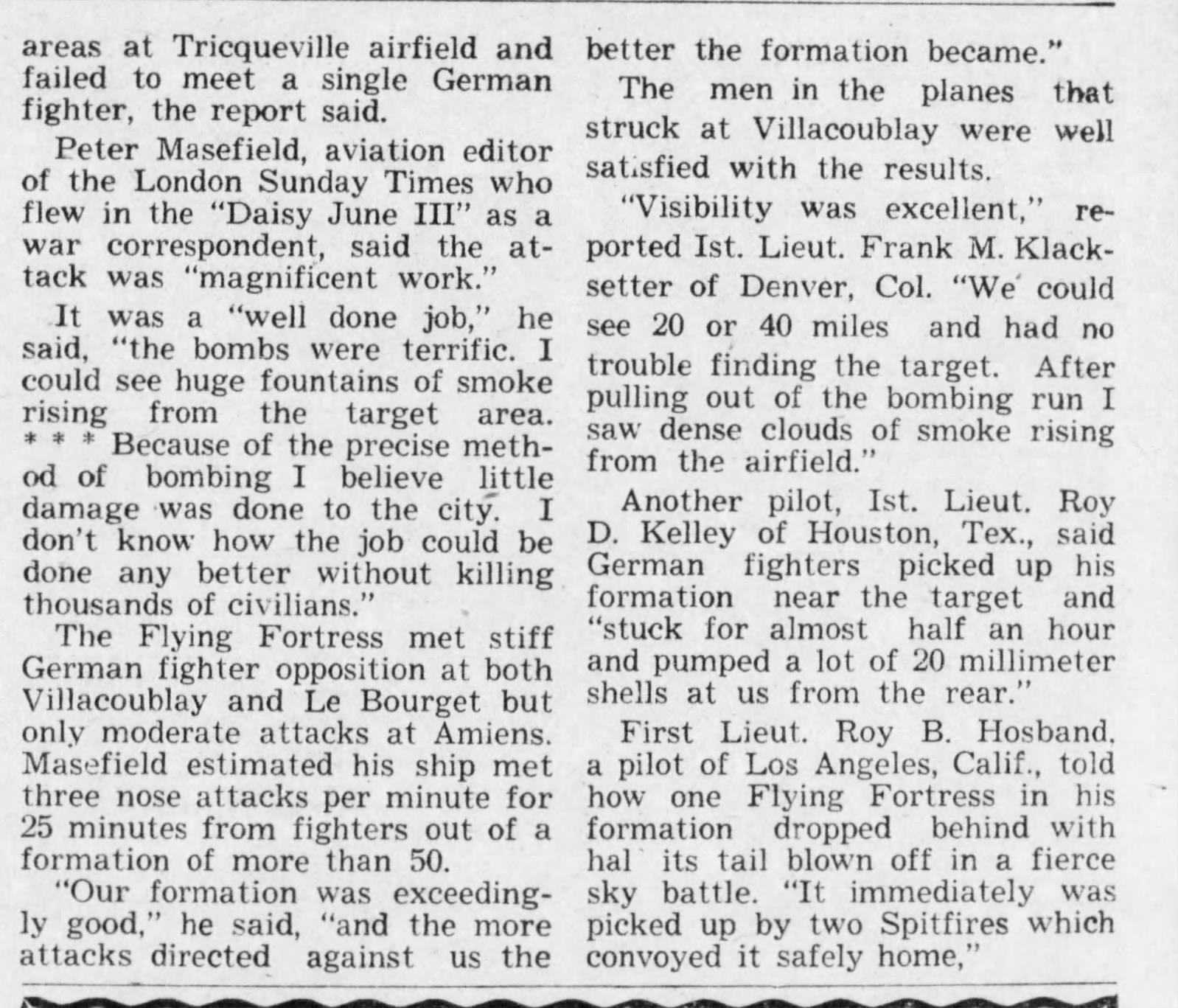
| Le Bourget July 14, 1943 mission | London Daily Mirror July 15 1943 | 12:00 am | |||||
| Le Bourget July 14 1943 mission part 1 | London Daily Herald July 15 1943 | 12:00 am | |||||
| Le Bourget July 14 1943 mission | London Daily Mirror part 2 | 12:00 am |






Photos
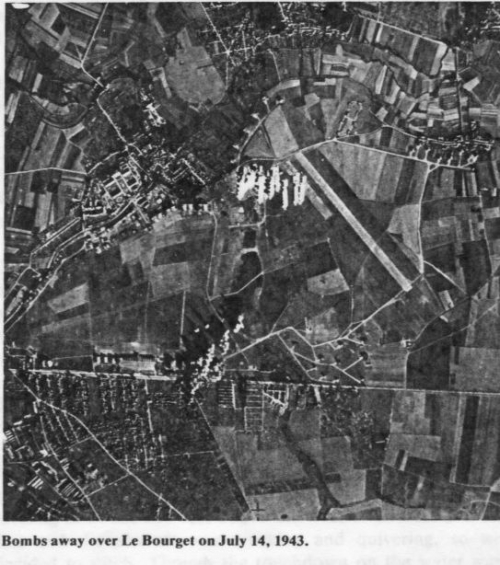
Le Bourget mission on 14 Jul 1943
Le Bourget mission on 14 Jul 1943