Maj
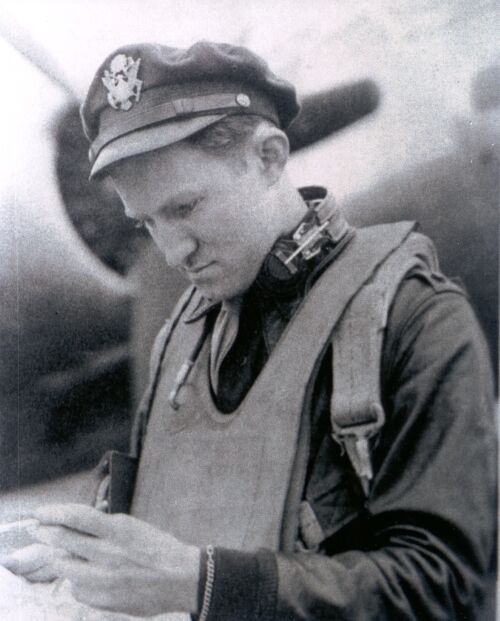
Harry H. CROSBY


Assigned to the 100th Bombardment Group
Location:
Unit: 418th Bombardment Squadron
Rank:
Position: Navigator
Beginning Date of 100th Service: Unknown
Time of Service at Thorpe Abbotts: Unknown - Unknown
Additional 100th Service Notes
Status: CPT
Comments: 31 MAR 45 BAD BERKA LEDGENDARY 100TH GROUP NAVIGATOR
Media Articles
Use your thumb to scroll through the results box below.
| Media Item | Type | Page | Volume/Issue | Broadcast Source | Time | Description | File |
|---|---|---|---|---|---|---|---|
| Blakely, Kidd, Thornton, Douglas, Crosby Bremen mission | The Fresno Bee Oct 12 1943 | 12:00 am | |||||
| Harry Crosby flown on 3 historic missions | The Constitution Tribune Aug 12 1944 | 12:00 am | |||||
| Kenneth Welty, Harry Crosby and Navigation | The Billings Times Aug 10 1944 | 12:00 am | |||||
| Harry Crosby part 1 | Bangor Daily News Sept 5 1995 | 12:00 am | |||||
| Harry Crosby part 2 | Bangor Daily News Sept 5 1995 | 12:00 am | |||||
| Harry Crosby part 3 | Bangor Daily News Sept 5 1995 | 12:00 am |


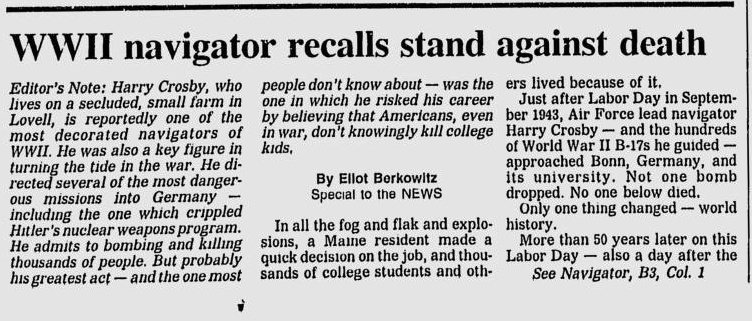

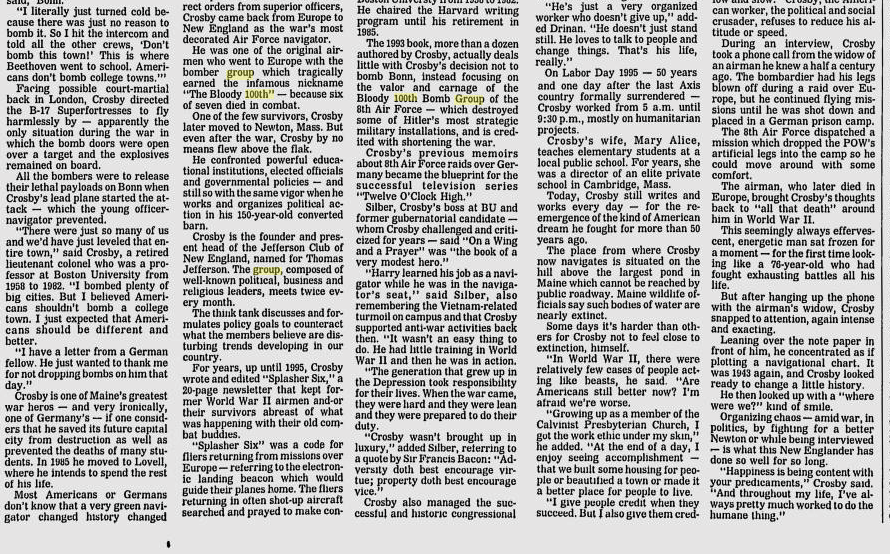
Featured in Splasher Six
- Bremen Mission Report by Harry Crosby - Splasher Six Volume 53, Fall 2022, No 3
Comments and Notes
Memo 1:
CREW


1st Lt John D.Brady                P   POW      10/10/43 TARGET WAS MUNSTER

2nd Lt John L.Hoerr               CP  POW      10/10/43 TARGET WAS MUNSTER

2nd Lt Harry H. Crosby          NAV  CPT       31/3/45     BAD BERKA    (SEE MISSION LIST BELOW)

2nd Lt Howard B.Hamilton     BOM  POW    10/10/43 TARGET WAS MUNSTER

Pvt Adolph Blum                 TTE   POW     10/10/43 TARGET WAS MUNSTER

S/Sgt Saul Levitt                 ROG                Transferred to "YANK" magazine staff.

Pvt Roland D.Gangwer         BTG   POW     10/10/43 TARGET WAS MUNSTER

S/Sgt Harold E.Clanton         WG   KIA       10/10/43 TARGET WAS MUNSTER             MACR #1029,

S/St James A.McCusker         WG  POW     10/10/43 TARGET WAS MUNSTER           Micro-fiche #341

S/Sgt George J.Petrohelos     TG   POW     10/10/43  TARGET WAS MUNSTER       A/C #230830"MLLE. ZIG ZIG"


418th  Sqdn.   This an "ORIGINAL crew. #32


On 10/10/43,Lt David Soloman from the crew of E.A.Kiessling was flying in place of Harry Crosby and became a POW. Saul Levitt had been injured in a Jeep/truck accident on base and, when he recovered,was transferred to "YANK" magazine. After the war,Saul had a brilliant career as a writer until his death in 1977 from a fatal heart attack. On 10/10/43,T/Sgt Joseph E. Hafer,who had flown overseas with the 100th was aboard. Also aboard the A/C on 10/10/43 was Major John Egan who became a POW. He was the 418th Squadron Commander and was flying as Command pilot. On this mision.


Both Hamilton & Gangwer were wounded and spent many weeks in the hospital.


List of Missions of Lt John Brady Crew & Paddlefoot's Proxy"


1.    June 26, 1943   LeMans                   25863 Paddlefoot's Proxy LD-V   Lt John D. Brady


2.    June 28, 1943   St Nazaire (Flak City) 25863 Paddlefoot's Proxy LD-V   Lt John D. Brady


3.     July 17, 1943   Hamburg                 25863 Paddlefoot's Proxy LD-V   Lt John D. Brady


4.     July 24, 1943   Trondheim              25863 Paddlefoot's Proxy LD-V   Lt John D. Brady


5.     July 25, 1943   Kiel                        25863 Paddlefoot's Proxy LD-V   Lt John D. Brady


6.     July 26, 1943   Hanover                 25863 Paddlefoot's Proxy LD-V   Lt John D. Brady


7.     July 28, 1943   Oschersleben          25863 Paddlefoot's Proxy LD-V  Lt John D. Brady


8.     July 29, 1943   Warnemunde          25863 Paddlefoot's Proxy LD-V  Lt John D. Brady


9.     July 30, 1943   Kassel                     25863 Paddlefoot's Proxy LD-V  Lt John D. Brady


10.   Aug 15, 1943   Merville & Lille          25863 Paddlefoot's Proxy LD-V  Lt John D. Brady


11.   Aug 17, 1943   Regensburg             230830 M'lle Zig Zig LD-U


12.   Aug 24, 1943   Bordeaux-Merignac   230830 M'lle Zig Zig LD-U


13    Sept 3,  1943   Paris                      25863 Paddlefoot's Proxy LD-V  Lt John D. Brady


       Sept 6,  1943   Stuttgart                25863 Paddlefoot's Proxy LD-V  Capt. Bucky Elton (test flight, crash landed)


14.  Sept 15, 1943   Paris                      230830 M'lle Zig Zig LD-U


15.  Sept 16, 1943   Bordeaux               230830 M'lle Zig Zig LD-U


16.  Sept 23, 1943   Vannes                  230830 M'lle Zig Zig LD-U


17.  Sept 26, 1943   Paris                      230830 M'lle Zig Zig LD-U


18.  Sept 27, 1943   Emden                  230830 M'lle Zig Zig LD-U


19.  Oct. 4, 1943     Hanau                   230830 M'lle Zig Zig LD-U


20.  Oct 10, 1943    Munster                 230830 M'lle Zig Zig LD-U  (SHOT DOWN)


******************************************************************************************************************

SECOND CREW


1st Lt Everett E.Blakely                     P    CPT

 2nd Lt Charles A.Via,Jr.                   CP   SWA   8/10/43  Bremen

1st Lt Joseph H." Bubbles" Payne    NAV  KIA     28/4/44 Sottevast  (With crew of W,G.Lakin - mission lead by Col. R.H. Kelly)

 2nd Lt James R.Douglas                BOM   CPT

T/Sgt Howard J.Brock                    TTE   POW   17/8/43 (With the W.R.Flesh crew)      Regensburg

T/Sgt Monroe B.Thornton               WG   CPT

T/Sgt Edmund G.Forkner               ROG   CPT

S/Sgt John L.Olson                       BTG   Transferred

S/Sgt Lyle E.Nordstrom                  WG   KIA   29/5/44 (with crew of B.L.Williams) Leipzig, Aircraft repair depot..

S/Sgt Lester W.Saunders                TG   KIA  8/10/43  Bremen


418th Sqdn.  An ''Original" crew.  CREW #35  A/C #42-30061     "JUST-A-SNAPPIN"


NOTE: JOHN OLSON, AFTER FLYING SEVERAL MISSIONS WITH THIS CREW MAY HAVE BEEN TRANSFERRED TO ANOTHER GROUP.

LT PAYNE WAS REPLACED ON THE CREW BY HARRY CROSBY FROM THE CREW OF LT JOHN BRADY.  SGT OLSON WAS REPLACED ON THE CREW BY SGT WILLIAM MC CLELLAND/  T/SGT THORNTON BECAME THE ENGINEER AFTER AUGUST 17, 1943 AND HIS POSTION AT WG WAS FILLED BY SGT ED YEVICH.


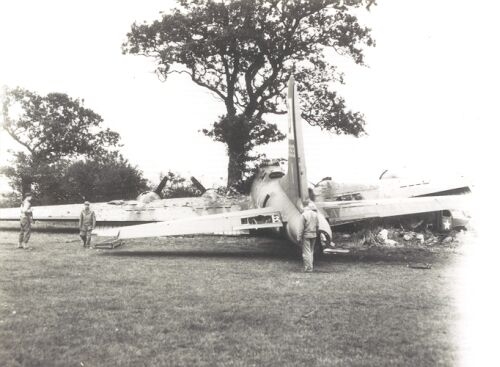
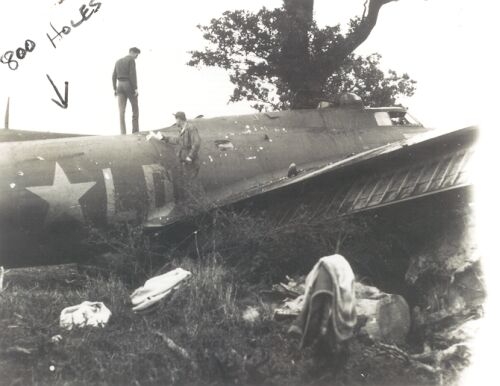
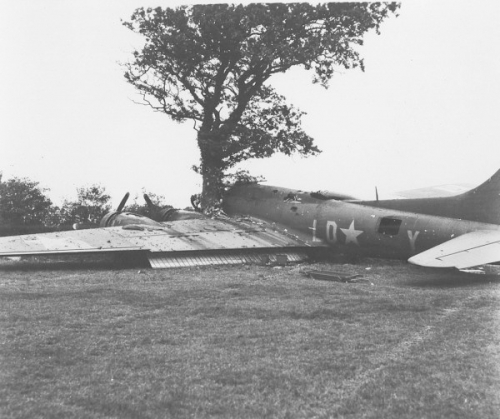
JUST-A-SNAPPIN IS ONE OF THE BETTER KNOWN PLANES IN 100TH LORE, SHE IS REMEMBERED FOR BRINGING THIS CREW BACK FROM BREMEM ON 8 OCT 43.  BADLY DAMAGED EV BLAKELY AND JOHN KIDD, GROUP OPS OFFICER WHO LED THE MISSION FROM THE CO-PILOT'S SEAT, LANDED "JUST-A-SNAPPIN" IN A FIELD AT LUDHAM.  DAMAGE TO THE HYDRAULIC SYSTEM RENDERED THE BRAKES IN-OPERATIVE AND "JUST-A-SNAPPIN" COLLIDED WITH A LARGE TREE.  IMPACT WAS BETWEEN THE #1 AND #2 ENGINE.  THERE ARE SEVERAL PROMINENT  PHOTOGRAPHS OF HER AND THE TREE.


Much has been written about this crew. See p.49 of THE BLOODY HUNDREDTH by H.Varian and p.184/195 of FLYING PORTRESS by E.Jablomski for details of the mission of 8/10/43.


On 8/10/43, S/Sgt Edward S.Yevich LWG & S/Sgt William F.McClelland, BTG were aboard in the place of H.J.Brock & J.L.Olson. Both of these men were wounded.


See photo of this crew on p.228 of "CONTRAILS"


Lyle Nord was flying as TG on the crew of B.L.Williams on 29/5/44 and was hit in the back by a 20mm. He had flown a total of 27 missions,the last 8 of them with the Williams crew.


CREW ON OCTOBER 8, 1943 MISSION TO BREMEN: Last mission with Capt. Ev Blakely Crew.


MAJ. JOHN B. KIDD                 COM PILOT  CPT

1st Lt Everett E.Blakely                        P   CPT

 2nd Lt Charles A.Via,Jr.                      CP   SWA   8/10/43  BREMEN

1st Lt Harry Crosby                             NAV CPT    GROUP NAVIGATOR

 2nd Lt James R.Douglas                     BOM CPT    GROUP BOMBARDIER

T/Sgt Monroe B.Thornton                  TTE   CPT

T/Sgt Edmund G.Forkner                    ROG  CPT

S/Sgt William F. McClelland                  BTG  WIA 8/10/43 BREMEN  SN#17164959

S/Sgt Edward S. Yevich                      WG  WIA 8/10/43 BREMEN

S/Sgt Lyle E.Nordstrom                       WG   KIA  29/5/44 LEIPZIG (with crew of B.L.Williams), Aircraft repair depot..

S/Sgt Lester W.Saunders                    TG     KIA 8/10/43 BREMEN


MISSIONS OF MAJ. HARRY CROSBY:


1.    JUN.  28, 1943   ST. NAZAIRE "FLAK CITY" (with Lt Brady Crew)

2.    JUL.    4, 1943   La PALLICE                      (with Lt Brady Crew)

3.    JUL.  24, 1943   TRONDHEIM                    (Col Harding Command P with Ev Blakely Crew)

4.    JUL.  25, 1943   WARNEMUNDE, KIEL        (Maj Egan-Command Pilot with Ev Blakely Crew)

5.    AUG. 12, 1943   WESSELING / BONN (ST)  (Group Lead with Col Harding-Command Pilot with Ev Blakely Crew

6.    AUG. 17, 1943   REGENSBURG                  (Group Lead with Maj Jack Kidd-Command Pilot with Ev Blakely Crew)

7.    AUG. 24, 1943   BORDEAUX-MERIGNAC      (Maj Jack Kidd with Ev Blakely Crew, on return from Africa)

8.    AUG. 31, 1943   MEULAN LES MERUEAUX   (Wing Lead with Ev Blakely Crew)

9.    SEPT.  6, 1943   STUTTGART/CONCHES     (with Ev Blakely Crew)

10.  SEPT.  9, 1943   BEAUVAIS-TILLE              (with Ev Blakely Crew)

11.  SEPT. 15, 1943   PARIS                            (with Ev Blakely Crew)

12.  SEPT. 16, 1943   La PALLICE                     (Wing Lead with Col Harding as Command Pilot-Ev Blakely Crew)

13.  SEPT. 23, 1943   VANNES                         (Maj Flesher, Group Air Exec flew as Command Pilot with Ev Blakely Crew)

14.  SEPT. 27, 1943   EMDEN                           (with Ev Blakely Crew)

15.   OCT.   2, 1943   EMDEN                           (with Ev Blakely Crew)

16.   OCT.   8, 1943   BREMEN                         (Group Lead Maj. Jack Kidd-Command Pilot, this is the last mission with Capt. Ev Blakely Crew.)

17.   NOV. 13, 1943   BREMEN                         (Col, Harding, Command Pilot-PFF crew from Alconbury)

18.    DEC. 13, 1943   KIEL                              (Wing Lead with Maj. Jack Kidd, Command Pilot-Lt Frank Valesh PFF Crew)

19.    DEC. 24, 1943   ST.JOSEPH au BOIS (NOBALL) (3rd Air Division Lead, Col Harding Command Pilot-Lt Frank Valesh PFF Crew)

20.    JAN.   4, 1944   KIEL

21,    FEB    3, 1944   WILHELMSHAVEN

22.    FEB  13, 1944    LIVOSSART & BOIS REMPRE (NOBALL) (flew with Lt Frank Valesh PFF Crew and were assigned to 385th BG

                                                                                      Maj. H.T. "Spoon" Witherspoon 551st BS C.O. and later Grp Air Exec.)

23.    APR. 13, 1944  AUGSBURG                       (Lt Col Kidd-PFF)

24.    MAY  7, 1944   BERLIN

25.   JUN. 21, 1944   RUHLAND (Russian Shuttle) (High Sqdn lead with Capt. Richard Helmick Crew, Capt Joe "Fuzzy" Zeller-Command Pilot)

26.   JUN. 26, 1944   DROHOBYCZ (POLAND)      (with Capt. Richard Helmick Crew, Capt Joe "Fuzzy" Zeller-Command Pilot)

27.   JUL.   3, 1944   ARAD (RUMANIA)               (with Capt. Richard Helmick Crew, Capt Joe "Fuzzy" Zeller-Command Pilot)

28.   JUL.   5, 1944   BEZIERS, (from ITALY)       (with Capt. Richard Helmick Crew, Capt Joe "Fuzzy" Zeller-Command Pilot)


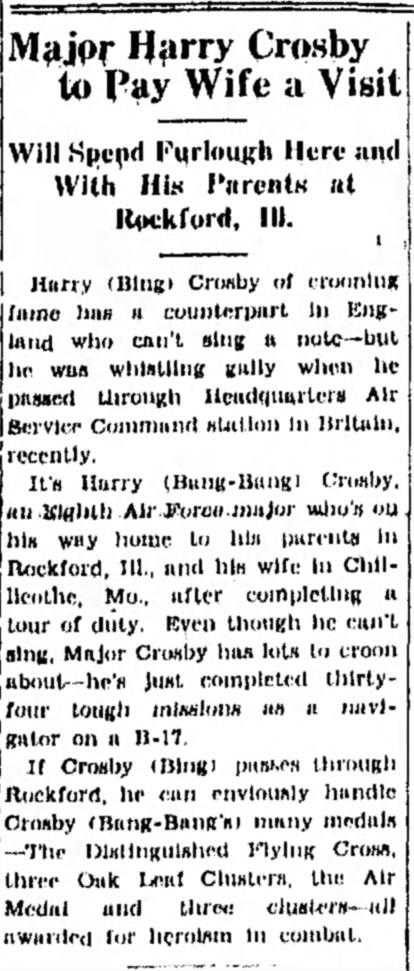
CAPT. CROSBY HAD COMPLETED HIS REQUIRED MISSIONS AND COULD NOW BE ROTATED STATESIDE  BUT UPON HIS RETURN TO THORPE ABBOTTS FROM RUSSIAN SHUTTLE MISSION, HARRY CROSBY WAS INFORMED THAT HE HAD BEEN  PROMOTED TO THE RANK OF MAJOR AND WOULD NOT BE ROTATED HOME.


29.   SEPT. 8, 1944   MANIZ                              (8th Air Force Lead with Col Jeffrey as Command Pilot and Capt. Austin Dunlap Crew)

30.

31.   MAR 28, 1945   HANOVER     A-SQDN LEAD  Lt Col David "Handlebar Hank" LYSTER, Maj, CROSBY  Lt RAIFORD   719  W    PFF

                                                                        HARDSTAND # 35

32.   MAR.31, 1945   BAD BERKA                      (Lt Col. Harry Cruver Command Pilot with Maj Crosby and Capt. Murray Crew 790 V PFF

                                                                      Hardstand  50


                                                                  MAJOR H.H. CROSBY


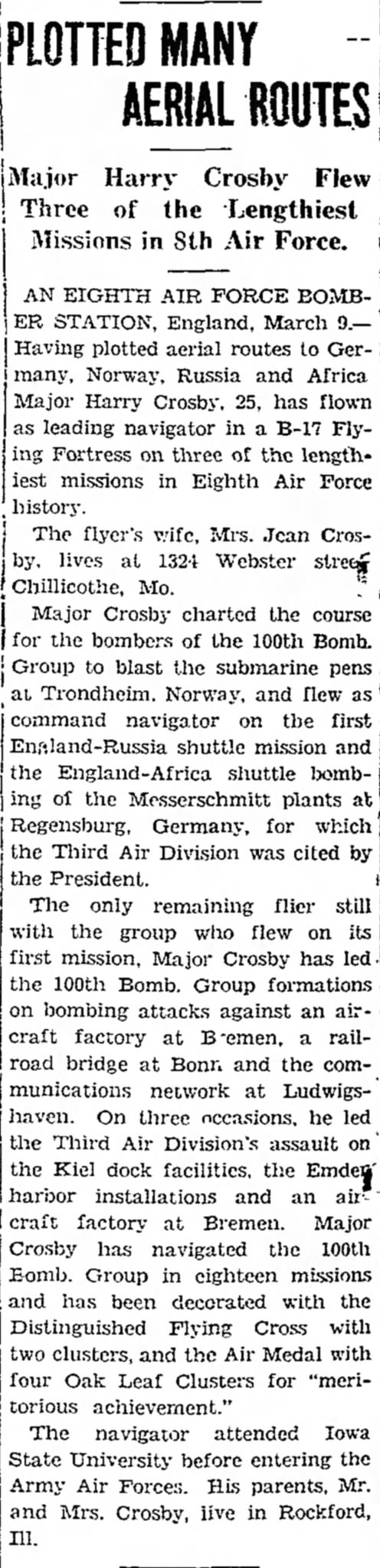
Orginal 100th Navigator..went overseas with Lt John Brady's crew (Crew  # 32, Aircraft #42-30071 "Skipper"), thus arrived in the ETO in June 1943.  Became Group Navigator and was with the 100th until the end of hostilities 9 May 45. Major Crosby's tour spans the entire twenty-two months the 100th was on operational status in WWII.


Well known as the navigator of #42-23393 ("Just-A-Snappin") on the 8 0ct 43 Bremen mission. See Edward Jablonski's work FLYING FORTRESS  for an account of this mission. Lead Navigator for many of the long range and all the shuttle missions flown by the 100th starting with the 24 Jul 1943 1900 mile trip to Trondeim, Norway with Col Neil Harding (100th Gp Commander). This was the start of a series of missions known as "Blitz Week."  The Ragensburg/Africa shuttle with Major John Kidd and Everett Blakely, the Group's long shuttle to Migorod via Ruhland, always a dangerous target that lay just south of Berlin. This second shuttle mission was code named "Frantic", a mission which demanded the utmost in precison navigtion as the distance closely approached the maximum range of the B-17.

        Dr. Crosby has continued to serve the 100th for two and one half decades as editor of the 100th Bomb Group Association's  Splasher 6. publication.  He is assurdly one of the better known 100th veterans and is highly respected by his peers.

        He has written a treatise on the 100th that is in publishing as of Feb, 1993.  It is anixously awaited by his 100th comrades.


SPLASHER SIX

The Newsletter of the 100th Bomb Group Association

Harry H. Crosby, Editor Emeritus

Smart's Hill Farm

Lovell,Maine04051-8297

207/925-2431

FAX: 207/925-3257

 September 2, 1995


 Mr. Paul West, Historian

 The 100th Bomb Group

 Rte 2 - Box 402 FAX 817/726-3733

 Valley View, Texas 76272  817/726-3563


Dear Paul--and Betty:


 Eventually I do what I commit myself to do--or at least most of it.


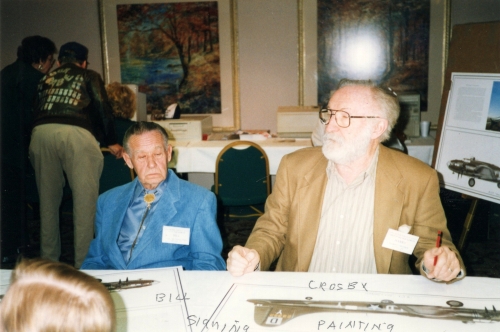
 Now I send you your promised copy of Gil Cohen's "The Regensburg Mission." As your "Print Documentation" shows, you have #23 of the 25 "Presentation Proofs." I endorsed it properly to make you rich if the paintings ever get wildly inflated in value.


 Speaking of "value, " I will punch the right buttons on my computer to bring up the story of the painting.


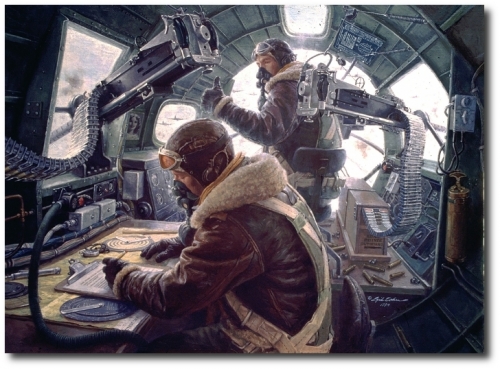
 For some time Gil Cohen has been doing a series on aviation during WWII. He decided to do a picture on the inside of a B-17 and fixed on one of me. For his research, Gil read my book and several other books about the 100th. He went to Thorpe Abbotts, our base when we were in England, 1943-45. He interviewed me several times via phone. He also spent a lot of time at the Pentagon decided at several Air Force Museums. He talked with Keith Ferris, who did the painting on the dust jacket of the hard-cover edition of my book.


 Gil decided that the best setting for the painting would be in the nose of " Just-a-Snappin" at the moment we dropped the bombs over Regensburg. One touch of authenticity is that I am writing with my left hand. The plane and equipment are very accurate.


 Jim Douglas our bombardier, is in the picture. He has just dropped the bombs and is looking back at me, his thumb raised in the "We did it" gesture. In the final 34 x 21 picture, an inscription describes the event and includes both our names.


 Gil Cohen sold the original to a Memphis, Tennessee, doctor and duplication rights to a publisher, Spofford House in New Hampshire, who made 850 copies. Spofford seems to be promoting the picture quite extensively, and several members of my 100th Bomb Group Old Boy Network have sent me ads which have appeared in several military and art magazine.


 The painting seems to be developing a life of its own. Recently a group of Luftwaffe and other German leaders decided that the fortunes of World War II changed when they lost control of the skies. When the 8th destroyed the ball bearings in Schweinfurt and the aircraft factors in Regensburg, the war was over for Germany. As a result, a painting of that moment has become very significant, and collectors are buying the picture. One man drove 200 miles round trip to get my autograph on a print; another drove a hundred round. One aficionado sent me a copy to autograph. When it was damaged uninsured on the return, he shelled out another $130 for a second copy. I get other reports that the picture is selling well.


 The Aerospace Education Foundation puts out a calendar each year which features aviation paintings. This year the illustration for the month of April is the Cohen painting, complete with an account of the event over Regensburg. A mail order firm, Tailwinds, lists in its catalogue a 1000-piece jigsaw puzzle for $19.95. It too is the Regensburg painting. Near Washington, O. C., a Virginia Bader, niece of the RAF ace, Douglas Bader, runs an art gallery. On March 10-12, she put on a show featuring the picture and flew me down for the event. Jack Kidd and Ed Yevich, ex-100th fellows who were with me on the plane that day were there, as was John Brady, my first pilot. That was when you were at Harry Cruver's party, Paul.


 The picture has brought me as much notice as the book A fellow from Canada sent me a picture of a B-17 to autograph. Already on the pictures were the signatures of John Lawlor, the copilot who got a Medal of Honor for bringing a B-17 home with his pilot decapitated, and the pilots of the Enola Gay and the Memphis Belle. I told him he had put me in quite august company.


 I wouldn't say I am embarrassed by all this--in fact, I have thoroughly enjoyed all the attention--but I am a bit dazzled, and very surprised. I find it interesting that all I do is sign things and other people are trying to make me into a legend. I just never expected all this to happen when I wrote my book.


 That's the story, Paul and Betty. I hope all goes well with you. Because of commitments here Mary Alice will not be in Fort Worth, which I regret because I wanted her to meet some grand people, the Wests.


Yours,

Harry Crosby

*************************************************************************************************************


Harry Herbert Crosby, long-time resident of Newton, MA and of Lovell, ME, died peacefully at Jesmond Nursing Home in Lynn on July 28, 2010. He was 91.


Harry was born in 1919 to Guy and Eva Crosby in New England, North Dakota. His family moved to Oskaloosa, Iowa, where, during high school, he played clarinet and started, in his words, a “floperoo” of a dance band called Harry Crosby and his Maroon Melodies.


Harry entered the University of Iowa, in Iowa City, Iowa, a happy period of his life about which he spoke often, especially marrying Jean Evelyn Boehner, from Chillicothe, Missouri, in 1943, and the fun of working at the Student Union as a “Union Boy.”


In 1942, he joined the WWII war effort as a cadet, trained as a navigator, and arrived in England in June, 1943 with the 100th Bomb Group (Heavy) of the Eighth Air Force. Rapidly promoted to Group Navigator, he was responsible for assembling as many as 2000 warplanes from various bases in England, leading them to their targets and safely home again. After a full tour of 25 missions, he remained in England for seven more, serving until the end of hostilities on May 9, 1945. He left the service with the rank of Lt. Colonel and many medals, including the Distinguished Flying Cross, Bronze Star and Croix de Guerre.


Returning to school, he graduated from Iowa with an M.A. in 1947 and then from Stanford University in Palo Alto, California, where Wallace Stegner supervised his Ph.D. thesis in 1953. Harry taught English composition and American literature at Iowa City, where he was Writing Supervisor of the Rhetoric Program, from 1950 to 1958, when he moved with his wife and four children to Newton, Massachusetts for a faculty position at the College of Basic Studies at Boston University. He retired from Boston University in 1984, after chairing the Department of Rhetoric at CBS and authoring or co-authoring with CBS colleagues eight textbooks on college writing. During his early retirement, he served briefly as Director of the Writing Center at Harvard University.


His combined military and university experience prepared him to help develop curriculum at the Air Force Academy, early in its history in Colorado Springs. In 1960, Harry took a leave of absence from Boston University for two years as Director of Studies for the Pakistani Air Academy in Risalpur, (West) Pakistan. There with his family, he helped develop a pilot training program into an academy like the service academies in the United States.


During his twenty-six years in Newton, he and Jean were very active in church, community and civic affairs. They attended Grace Church where Harry served on the Vestry Committee and, with Jean, supported church sponsorship of several immigrant Cambodian “boat people” families. They chaired the Newton campaign effort for Representative Father Robert Drinan during several election seasons and, in 1980, Harry worked in Representative Barney Frank’s first congressional campaign. He was also an early and long supporter of Michael Dukakis’ political career. Harry served on the Newton Board of Aldermen from 1970 – 73, during which he was particularly pleased to support development of both the Newton Arts Center and low-income housing. Harry’s wife Jean died of cancer in 1980.


Harry married Mary Alice Tompkins Brennan in 1982 and moved with her to her lovely hilltop tree farm in Lovell, Maine after retiring from academics. During his sixteen years in Lovell, Harry continued his commitment to community service as a Trustee of the Charlotte Hobbs Memorial Library, an active member of the Lovell United Church of Christ, and participant in the Grey Eagles, a New Hampshire organization of veterans of WWII. He also founded and led “The Jefferson Group” a weekly Sunday afternoon gathering dedicated to discussion of scholarly matters and topics of the day.


While in Maine, Dr. Crosby authored two more textbooks and, in 1993, Harper Collins published his well-received WWII memoir, “A Wing and a Prayer”, a personal history of the famous “Bloody 100th” Bomb Group flying B-17s out of England. The book was carried by the Smithsonian Institute gift store and through their catalog for several years and Harry traveled extensively promoting the book. In 1998, for his 79th birthday, Harry’s children took him to London for interviews about his WWII service, and for a visit to the 100th Bomb Group Memorial Museum at Thorpe Abbotts, the small airfield from which Harry flew. Harry remained an active veteran by serving for two and a half decades as editor of the 100th Bomb Group Association’s “Splasher Six” publication. His name figures in nearly every history of the Eighth Air Force, especially Edward Jablonski’s book about B-17s, “Flying Fortress”, and Harry was interviewed as recently as last year for his appearance in a March, 2010 television show, “The Bombing of Germany” shown on PBS’s “American Experience”.


In 2001, Harry moved from Maine to Springhouse, an assisted living facility in Jamaica Plain, MA., where he enjoyed the many activities, visits and travel with his family, and the highly professional and friendly staff until just six weeks before his death. At Springhouse, he was called “Mr. Wonderful” because, when asked how he was, he reliably replied with a hearty, “Wonderful!” and during his brief stay at Jesmond Nursing Home in Lynn, he was called “Friend” because that’s how he addressed everyone else.


Harry is survived by his wife, Mary Alice Brennan-Crosby, of Lovell, Maine; four children, Steve of Boston, MA., April of Fairbanks, Alaska, Jeff of Lynn, MA., and Rebecca Hutchinson of Deerfield, NH., eight grandchildren and one great-grandchild; and three stepchildren, Haley Childs, Maura Brennan Burton and John Tompkins Brennan, and five stepgrandchildren.


Arrangements are being made by the Eaton Mackay Funeral Home. As he wished, Dr. Crosby will be cremated and buried beside his first wife in the East Parish Burying Ground, the Old Newton Cemetery on Centre Street. A memorial service is planned for Saturday, August 7 at 2:00 p.m. at Grace Episcopal Church, 76 Eldredge Street in Newton, MA. Harry’s friends and colleagues are invited to join his family at this service to celebrate his long and full life. In lieu of flowers, donations may be sent to the Springhouse Employee Holiday Fund, Springhouse, 44 Allandale Street, Jamaica Plain, MA. 02130.

********************************************************************************************************


To whom it may concern:


100 BG Navigator Harry Crosby, longtime editor of the 100 BG newsletter and former 100 BG Group Navigator, passed away in July.  From the Newton, MA Tab:


Harry Herbert Crosby, long-time resident of Newton, and of Lovell, Maine died peacefully at Jesmond Nursing Home in Lynn Wednesday, July 28, 2010. He was 91. Harry was born in 1919 to Guy and Eva Crosby in New England, N.D. His family moved to Oskaloosa, Iowa, where, during high school, he played clarinet and started, in his words, a floperoo of a dance band called Harry Crosby and his Maroon Melodies. Harry entered the University of Iowa, in Iowa City, a happy period of his life about which he spoke often, especially marrying Jean Evelyn Boehner, from Chillicothe, Mo., in 1943, and the fun of working at the Student Union as a Union Boy. In 1942, he joined the World War II war effort as a cadet, trained as a navigator, and arrived in England in June 1943 with the 100th Bomb Group (Heavy) of the Eighth Air Force. Rapidly promoted to Group Navigator, he was responsible for assembling as many as 2000 warplanes from various bases in England, leading them to

their targets and safely home again. After a full tour of 25 missions, he remained in England for seven more, serving until the end of hostilities on May 9, 1945. He left the service with the rank of Lt. Colonel and many medals, including the Distinguished Flying Cross, Bronze Star and Croix de Guerre. Returning to school, he graduated from Iowa with an M.A. in 1947 and then from Stanford University in Palo Alto, Calif., where Wallace Stegner supervised his Ph.D. thesis in 1953. Harry taught English composition and American literature at Iowa City, where he was Writing Supervisor of the Rhetoric Program, from 1950-1958, when he moved with his wife and four children to Newton, Mass. for a faculty position at the College of Basic Studies at Boston University. He retired from Boston University in 1984, after chairing the Department of Rhetoric at CBS and authoring or co-authoring with CBS colleagues eight textbooks on college writing. During his early

retirement, he served briefly as Director of the Writing Center at Harvard University. His combined military and university experience prepared him to help develop curriculum at the Air Force Academy, early in its history in Colorado Springs. In 1960, Harry took a leave of absence from Boston University for two years as Director of Studies for the Pakistani Air Academy in Risalpur, (West) Pakistan. There with his family, he helped develop a pilot training program into an academy like the service academies in the United States. During his 26 years in Newton, he and Jean were very active in church, community and civic affairs. They attended Grace Church where Harry served on the Vestry Committee and, with Jean, supported church sponsorship of several immigrant Cambodian boat people families. They chaired the Newton campaign effort for Representative Father Robert Drinan during several election seasons and, in 1980, Harry worked in Representative Barney

Franks first congressional campaign. He was also an early and long supporter of Michael Dukakis political career. Harry served on the Newton Board of Aldermen from 1970|1973, during which he was particularly pleased to support development of both the Newton Arts Center and low-income housing. Harrys wife Jean died of cancer in 1980. Harry married Mary Alice Tompkins Brennan in 1982 and moved with her to her lovely hilltop tree farm in Lovell, Maine after retiring from academics. During his sixteen years in Lovell, Harry continued his commitment to community service as a Trustee of the Charlotte Hobbs Memorial Library, an active member of the Lovell United Church of Christ, and participant in the Grey Eagles, a New Hampshire organization of veterans of WWII. He also founded and led The Jefferson Group a weekly Sunday afternoon gathering dedicated to discussion of scholarly matters and topics of the day. While in Maine, Dr. Crosby authored two more

textbooks and, in 1993, Harper Collins published his well-received WWII memoir, A Wing and a Prayer, a personal history of the famous Bloody 100th Bomb Group flying B-17s out of England. The book was carried by the Smithsonian Institute gift store and through their catalog for several years and Harry traveled extensively promoting the book. In 1998, for his 79 birthday, Harrys children took him to London for interviews about his WWII service, and for a visit to the 100th Bomb Group Memorial Museum at Thorpe Abbotts, the small airfield from which Harry flew. Harry remained an active veteran by serving for two and a half decades as editor of the 100th Bomb Group Associations Splasher Six publication. His name figures in nearly every history of the Eighth Air Force, especially Edward Jablonskis book about B-17s, Flying Fortress, and Harry was interviewed as recently as last year for his appearance in a March, 2010 television show, The Bombing of Germany

shown on PBSs American Experience. In 2001, Harry moved from Maine to Springhouse, an assisted living facility in Jamaica Plain, where he enjoyed the many activities, visits and travel with his family, and the highly professional and friendly staff until just six weeks before his death. At Springhouse, he was called Mr. Wonderful because, when asked how he was, he reliably replied with a hearty, Wonderful! and during his brief stay at Jesmond Nursing Home in Lynn, he was called Friend because thats how he addressed everyone else. Harry is survived by his wife, Mary Alice Brennan-Crosby, of Lovell, Maine; four children, Steve of Boston, April of Fairbanks, Alaska, Jeff of Lynn, and Rebecca Hutchinson of Deerfield, N.H., eight grandchildren and one great-grandchild; and three stepchildren, Haley Childs, Maura Brennan Burton and John Tompkins Brennan, and five step grandchildren. Arrangements are being made by the Eaton Mackay Funeral Home. As he wished,

Dr. Crosby will be cremated and buried beside his first wife in the East Parish Burying Ground, the Old Newton Cemetery on Centre Street. A memorial service is planned for Saturday, Aug. 7, at 2 p.m. at Grace Episcopal Church, 76 Eldredge St. in Newton. Harrys friends and colleagues are invited to join his family at this service to celebrate his long and full life. In lieu of flowers, donations may be sent to the Springhouse Employee Holiday Fund, Springhouse, 44 Allandale St., Jamaica Plain, MA. 02130.
Memo 2:
MISSION Notes from Harry Crosby


October 8. 1943-Bremen:

"Leading a large formation of B-17s, we were hit hard over the target, spun out of control and saved from crashing by the superb efforts of our pilot and command pilot. With two engines knocked out, we were forced to head home alone at low altitude, our plane riddled by over 1,200 shell holes by actual count, one crewman mortally wounded and five severely injured. When we were attacked repeatedly by Luftwaffe fighters along the way, our gunners shot down ten of them. Unable to ditch in the North Sea because of our wounded or to make it to our own airfield, [we] crash-landed at a “dummy” airfield on the English coast."


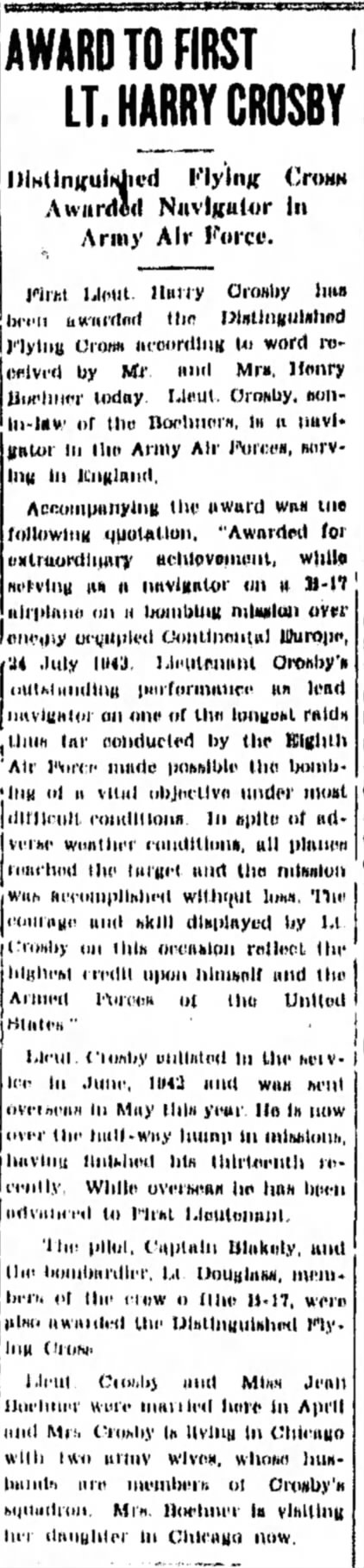
DFC Citation

"For extraordinary achievement, while serving as Navigator of a B-17 airplane on a bombing mission over Continental Europe, 24 July 1943. Lieutenant Crosby’s outstanding performance as lead Navigator on one of the longest raids thus far conducted by the Eighth Air Force made possible the bombing of a vital objective under difficult conditions. In spite of adverse weather conditions, all planes reached the target and the mission was accomplished without loss. The courage and skill displayed by Lieutenant Crosby on this occasion reflect the highest credit upon himself and the Armed Forces of the United States."

*************************************


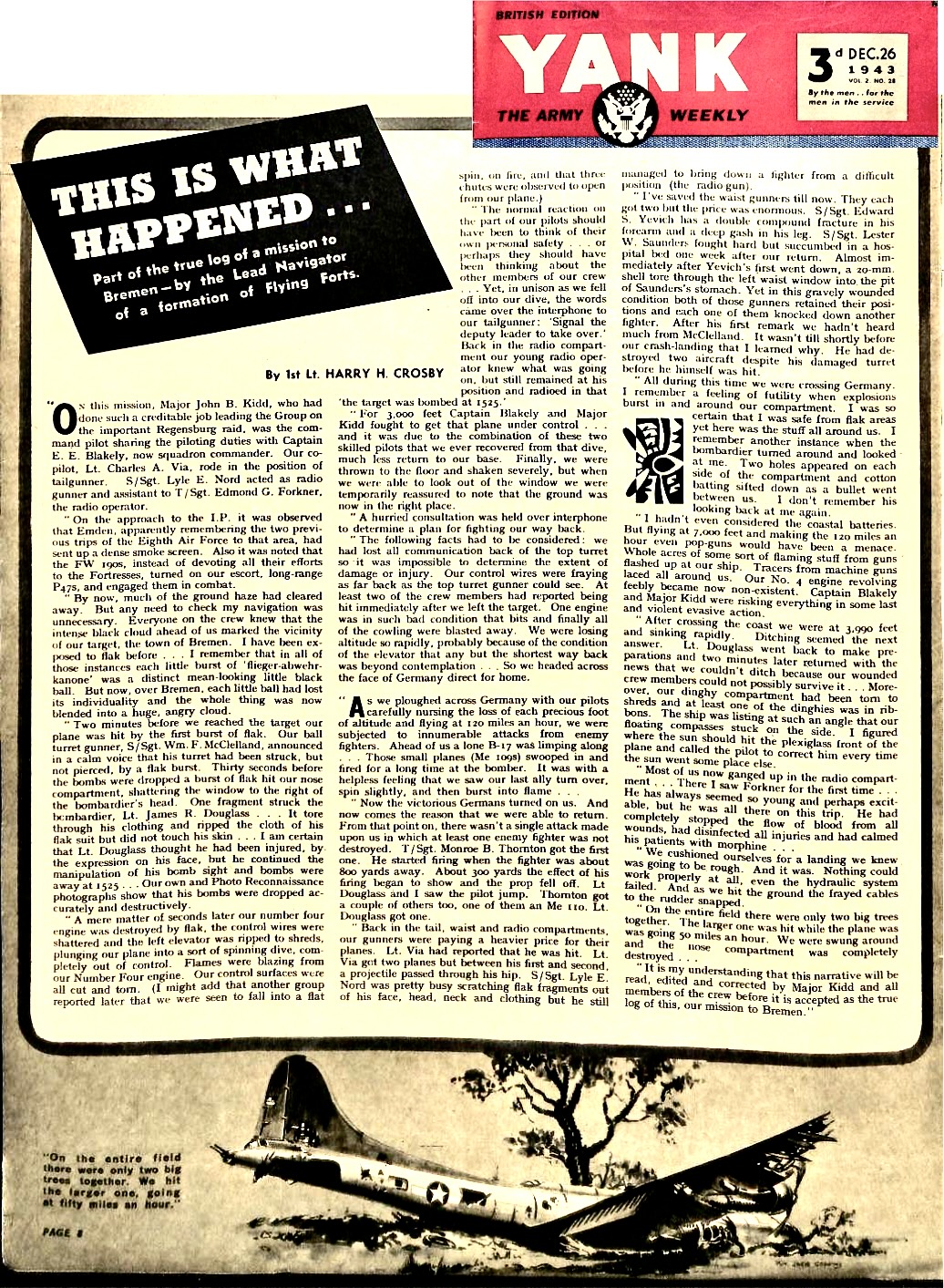
           THIS IS WHAT HAPPENED…

            By 1st Lt. Harry H. Crosby

(Yank, The Army Weekly, December 26, 1943, pg. 8)


On this mission, Major John B. Kidd, who had done such a creditable job leading the Group on the important Regensburg raid, was the command pilot sharing the piloting duties with Captain E. E. Blakely, now squadron commander. Our co-pilot, Lt. Charles A. Via, rode in the position of tailgunner. S/Sgt. Lyle E. Nord acted as radio gunner and assistant to T/Sgt. Edmond G. Forkner, the radio operator.

"On the approach to the I.P. it was observed that Emden, apparently remembering the two previous trips of the Eighth Air Force to that area, had sent up a dense smoke screen. Also it was noted that the FW 190s, instead of devoting all their efforts to the Fortresses, turned on our escort, long-range P47s, and engaged them in combat.

By now, much of the ground haze had cleared away. But any need to check my navigation was unnecessary. Everyone on the crew knew that the intense black cloud ahead of us marked the vicinity of our target, the town of Bremen. I have been exposed to flak before... I remember that in all of those instances each little burst of 'flieger-abwehr-kanone' was a distinct mean-looking little black ball. But now, over Bremen, each little ball had lost its individuality and the whole thing was now blended into a huge, angry cloud.

"Two minutes before we reached the target our plane was hit by the first burst of flak. Our ball turret gunner, S/Sgt. Wm. F. McClelland, announced in a calm voice that his turret had been struck, but not pierced, by a flak burst. Thirty seconds before the bombs were dropped a burst of flak hit our nose compartment, shattering the window to the right of the bombardier's head. One fragment struck the bombardier, Lt. James R. Douglass... It tore through his clothing and ripped the cloth of his flak suit but did not touch his skin... I am certain that Lt. Douglass thought he had been injured, by. the expression on his face, but he continued the manipulation of his bomb sight and bombs were away at 1525... Our own and Photo Reconnaissance photographs show that his bombs were dropped accurately and destructively.

“A mere matter of seconds later our number four engine was destroyed by flak, the control wires were shattered and the left elevator was ripped to shreds, plunging our plane into a sort of spinning dive, completely out of control. Flames were blazing from our Number Four engine. Our control surfaces were all cut and torn. (I might add that another group reported later that we were seen to fall into a flat spin, on fire, and that three chutes were observed to open from our plane.)

"The normal reaction on the part of our pilots should have been to think of their own personal safety or perhaps they should have been thinking about the other members of our crew ... Yet, in unison as we fell off into our dive, the words came over the interphone to our tailgunner: 'Signal the deputy leader to take over. ' Back in the radio compartment our young radio operator knew what was going on, but still remained at his position and radioed in that 'the target was bombed at 1525."

"For 3,000 feet Captain Blakely and Major Kidd fought to get that plane under control... and it was due to the combination of these two skilled pilots that we ever recovered from that dive, much less return to our base. Finally, we were thrown to the floor and shaken severely, but when we were able to look out of the window we were temporarily reassured to note that the ground was now in the right place.

"A hurried consultation was held over interphone to determine a plan for fighting our way back. "The following facts had to be considered: we had lost all communication back of the top turret so it was impossible to determine the extent of damage or injury. Our control wires were fraying as far back as the top turret gunner could see. least two of the crew members had reported being hit immediately after we left the target. One engine was in such bad condition that bits and finally all of the cowling were blasted away. We were losing altitude so rapidly, probably because of the condition of the elevator that any but the shortest way back was beyond contemplation... So we headed across the face of Germany direct for home.

“As we ploughed across Germany with our pilots carefully nursing the loss of each precious foot of altitude and flying at 120 miles an hour, we were subjected to innumerable attacks from enemy fighters. Ahead of us a lone B-17 was limping along … Those small planes (Me 109s) swooped in and fired for a long time at the bomber. It was with a helpless feeling that we saw our last ally turn over, spin slightly, and then burst into flame...

Now the victorious Germans turned on us. And now comes the reason that we were able to return. From that point on, there wasn't a single attack made upon us in which at least one enemy fighter was not destroyed. T/Sgt. Monroe B. Thornton got the first one. He started firing when the fighter was about 800 yards away. About 300 yards the effect of his firing began to show and the prop fell off. Lt Douglass and I saw the pilot jump. Thornton got a couple of others too, one of them an Me 110. Lt. Douglass got one.

"Back in the tail, waist and radio compartments, our gunners were paying a heavier price for their planes. Lt. Via had reported that he was hit. Lt. Via got two planes but between his first and second, a projectile passed through his hip. S/Sgt. Lyle E. Nord was pretty busy scratching flak fragments out of his face, head, neck and clothing but he still managed to bring down a fighter from a difficult position (the radio-gun).

"I've saved the waist gunners till now. They each got two but the price was enormous. S/Sgt. Edward S. Yevich has a double compound fracture in his forearm and a deep gash in his leg. S/Sgt. Lester W. Saunders fought hard but succumbed in a hospital bed one week after our return. Almost immediately after Yevich's first went down, a 20-mm. shell tore through the left waist window into, the pit of Saunders's stomach. Yet in this gravely wounded condition both of those gunners retained their positions and each one of them knocked down another fighter. After his first remark we hadn't heard much from McClelland. It wasn't till shortly before our crash-landing that I learned why. He had destroyed two aircraft despite his damaged turret before he himself was hit."

"All during this time we were crossing Germany. I remember a feeling of futility when explosions burst in and around our compartment. I was so certain that I was safe from flak areas yet here was the stuff all around us. I remember another instance when the bombardier turned around and looked at me. Two holes appeared on each side of the compartment and cotton batting sifted down as a bullet went between us. I don't remember his looking back at me again.

"I hadn't even considered the coastal batteries. But flying at 7,000 feet and making the 120 miles an hour even pop-guns would have been a menace. Whole acres of some sort of flaming stuff from guns flashed up at our ship. Tracers from machine guns laced all around us. feebly became now non-existent. Captain Blakely Our No. 4 engine revolving and Major Kidd were risking everything in some last and violent evasive action.

"After crossing the coast we were at 3.990 feet. and sinking rapidly. Ditching seemed the next answer. Lt. Douglass went back to make preparations and two minutes later returned with the news that we couldn't ditch because our wounded crew members could not possibly survive it... Moreover, our dinghy compartment had been tom to shreds and at least one of the dinghies was in ribbons. The ship was listing at such an angle that our floating compasses stuck on the side. where the sun should hit the plexiglass front of the I figured plane and called the pilot to correct him every time the sun went some place else.

"Most of us now ganged up in the radio compartment... There I saw Forkner for the first time... He has always seemed so young and perhaps excitable, but he was all there on this trip. He had completely stopped the flow of blood from all wounds, had disinfected all injuries and had calmed his patients with morphine..

"We cushioned ourselves for a landing we knew was going to be rough. And it was. Nothing could work properly at all, even the hydraulic system failed. And as we hit the ground the frayed cables to the rudder snapped.

"On the entire field there were only two big trees together. The larger one was hit while the plane was was going 50 miles an hour. We were swung around and the nose compartment destroyed completely…

"It is my understanding that this narrative will be read, edited and corrected by Major Kidd and all members of the crew before it is accepted as the true log of this, our mission to Bremen."
Photos
Click here to see album - 35 items
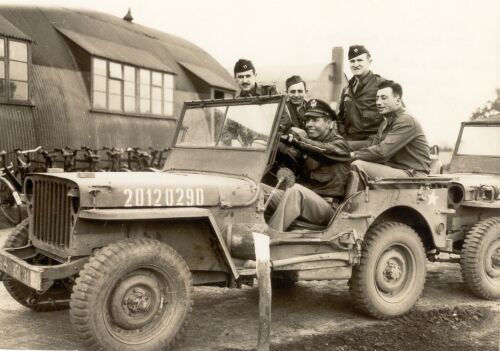
Click here to see album - 35 items

Click here to see album - 35 items

Click here to see album - 35 items

Click here to see album - 35 items
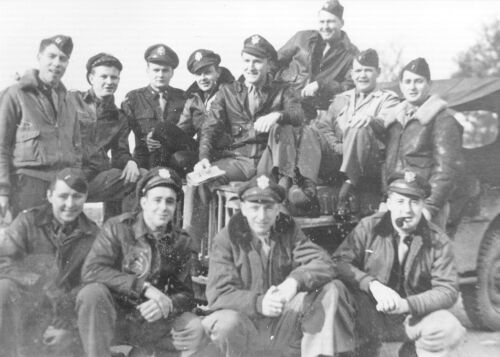
Click here to see album - 35 items

Click here to see album - 35 items

Click here to see album - 35 items
Click here to see album - 35 items

Click here to see album - 35 items
Click here to see album - 35 items
Click here to see album - 35 items
Click here to see album - 35 items
Click here to see album - 35 items

Click here to see album - 35 items

Click here to see album - 35 items
Click here to see album - 35 items

Click here to see album - 35 items
Click here to see album - 35 items
Click here to see album - 35 items
Click here to see album - 35 items
Click here to see album - 35 items

Click here to see album - 35 items

Click here to see album - 35 items
Click here to see album - 35 items
Click here to see album - 35 items
Click here to see album - 35 items
Click here to see album - 35 items
Click here to see album - 35 items
Click here to see album - 35 items
Click here to see album - 35 items
Click here to see album - 35 items
Click here to see album - 35 items
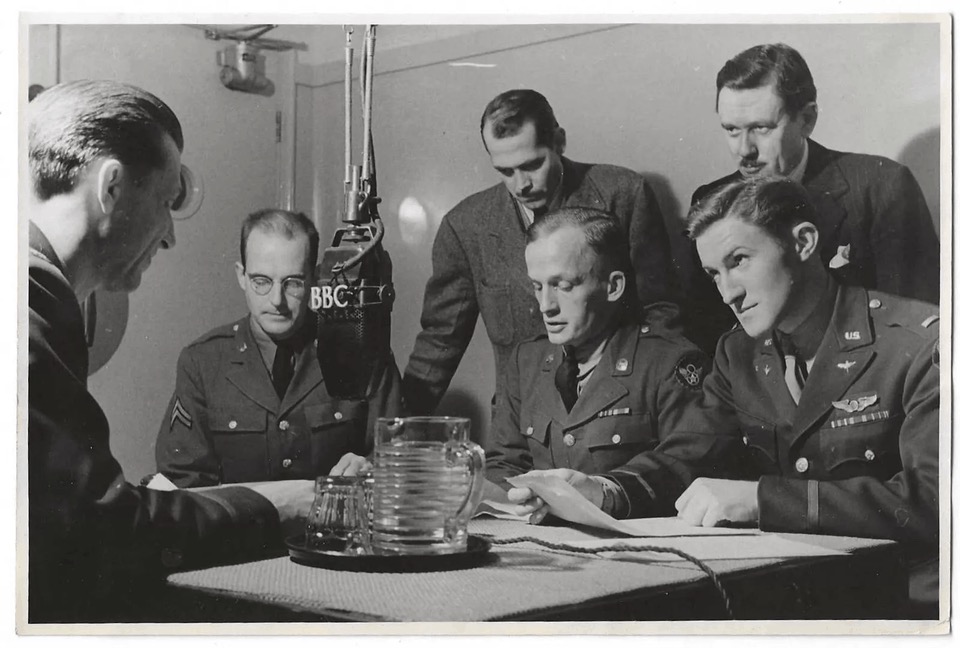
Click here to see album - 35 items
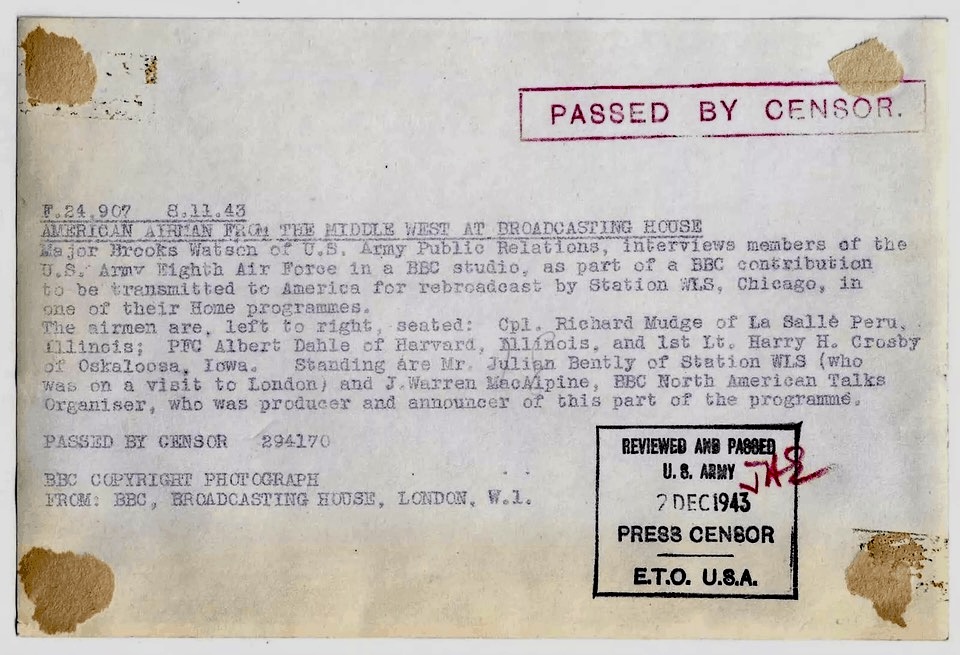
Click here to see album - 35 items

Click here to see album - 29 items

Click here to see album - 29 items

Click here to see album - 29 items

Click here to see album - 29 items

Click here to see album - 29 items

Click here to see album - 29 items

Click here to see album - 29 items
Click here to see album - 29 items
Click here to see album - 29 items

Click here to see album - 29 items

Click here to see album - 29 items

Click here to see album - 29 items
Click here to see album - 29 items

Click here to see album - 29 items
Click here to see album - 29 items

Click here to see album - 29 items
Click here to see album - 29 items

Click here to see album - 29 items
Click here to see album - 29 items
Click here to see album - 29 items

Click here to see album - 29 items

Click here to see album - 29 items
Click here to see album - 29 items

Click here to see album - 29 items

Click here to see album - 29 items

Click here to see album - 29 items
Click here to see album - 29 items
Click here to see album - 29 items

Click here to see album - 29 items
Crew List
1st Crew List
Use your thumb to scroll through the results box below.
| Rank | Name | Pos | Status |
|---|---|---|---|
| Maj | BLAKELY, Everett E. | P | CPT |
| Maj | CROSBY, Harry H. | NAV | CPT |
2nd Crew List
Use your thumb to scroll through the results box below.
| Rank | Name | Pos | Status |
|---|---|---|---|
| Maj | EGAN, John C. | COM | POW |
| Capt | BRADY, John D. | P | POW |
| Lt | HOERR, John | CP | POW |
| Maj | CROSBY, Harry H. | NAV | CPT |
| HAMILTON, Howard B. | BOM | POW | |
| T/Sgt | BLUM, Adolph (Adolf) | TTE | POW |
| T/Sgt | HAFER, Joseph E. | ROG | POW |
| S/SGT | LEVITT, Saul | ROG | RFS |
| Sgt | GANGWER, Roland D. | BTG | POW |
| S/Sgt | CLANTON, Harold | WG | KIA |
| S/Sgt | MCCUSKER, James | WG | POW |
| S/Sgt | PETROHELOS, George J. | TG | POW |