Lt
Kenneth R. LORCH
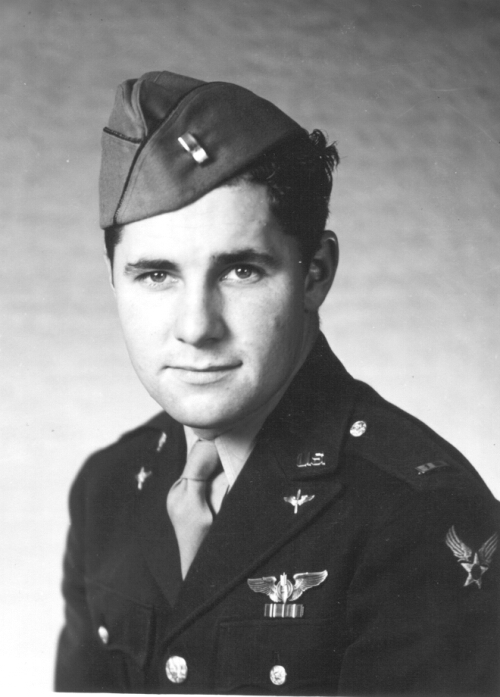
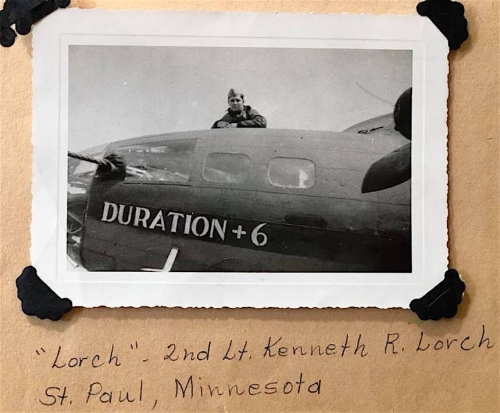

Hometown During Time of Service: St Paul, MN
Army Serial Number: O-734714
Assigned to the 100th Bombardment Group
Location:
Unit: 350th Bombardment Squadron
Rank:
Position: Bombardier
Beginning Date of 100th Service: Unknown
Time of Service at Thorpe Abbotts: Unknown - Unknown
Additional 100th Service Notes
Status: POW
MACR: 00678
CR: 00678
Comments: 17 AUG 43 REGENSBURG (FLAK - EXP)
Media Articles
Use your thumb to scroll through the results box below.
| Media Item | Type | Page | Volume/Issue | Broadcast Source | Time | Description | File |
|---|---|---|---|---|---|---|---|
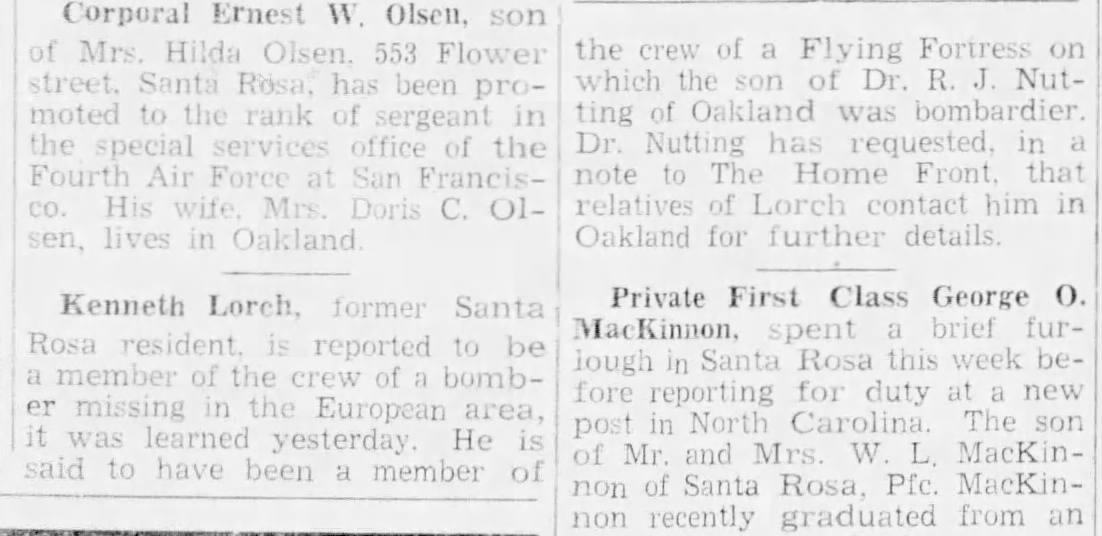
| Kenneth Lorch MIA | Santa Rosa Republican October 8 1943 | 12:00 am |
Comments and Notes
Memo 1:
CREW


                           1ST LT ROY F. CLAYTOR


CREW #11  A/C #42-5862  "DURATION + 6"    MACR #678     CREW WAS FLYING# 42-5867 "ALICE FROM DALLAS" ON AUG 17, 1943


1ST LT  ROY F. CLAYTOR                           P: EVADEE   17 AUG 43 REGENSBURG


2ND LT  RAYMOND J. NUTTING, JR       CP: EVADEE   17 AUG 43 REGENSBURG


2ND LT  OSCAR C. AMISON, JR.            NAV: POW      17 AUG 43 REGENSBURG


2ND LT  KENNETH R. LORCH                BOM: POW      17 AUG 43 REGENSBURG


T/SGT   JOHN W. BURGIN                    TTE: EVADEE  17 AUG 43 REGENSBURG


S/SGT   CHARLES K. BAILEY               WG: EVADEE  17 AUG 43 REGENSBURG


T/SGT   STEVEN S. KOPCZEWSKI        ROG: KIA        25 JUL 43 KIEL               (flying with Capt. Carey/DeSanders Crew)  SEE BELOW


S/SGT   ROBERT H. WUSSOW            BTG: KIA        08 OCT 43 BREMEN         (flying with 1st Lt Frank H. Meadows Crew) SEE BELOW


S/SGT   JOSEPH E. KEHOE                   WG: NOC       INJURED IN GRD ACCIDENT AT T.A. AND RTN TO USA


S/SGT   EDWARD A. MUSANTE              TG: KIA        17 AUG 43 REGENSBURG


AUGUST 17, 1943: ON THE REGENSBURG MISSION THIS CREW WAS THE LEAD CREW OF THE SECOND ELEMENT, LOW SQUADRON. AT 1020 FIGHTERS ATTACKED THE LOW SQUADRON OVER EASTERN BELGIUM AND SEVERELY DAMAGED THE AIRCRAFT CAUSING CLAYTOR TO SOUND THE BAIL-OUT ALARM. EIGHT OF THE MEN ABOARD GOT OUT SAFELY, BUT MUSANTE'S CHUTE CAUGHT ON THE HORIZONTAL STABLIZER AND WAS KILLED WHEN THE PLANE EXPLODED IN MID-AIR OR WHEN IT CRASHED. WILLIAM M. HINTON, WHO WAS FLYING IN PLACE OF ROBERT WUSSOW, APPARENTLY DID NOT BAIL OUT- HE MAY HAVE STAYED TOO LONG TO ASSIST MUSANTE- AND WAS KILLED. BOTH HINTON AND MUSANTE WERE GIVEN A MILITARY FUNERAL AND WERE BURIED 20 AUG 43 ON THE AIRDROME AT ST. TROND. HINTON'S GRAVE NUMBER IS #287 AND MUSANTE'S #268.


TWO OTHER REPLACEMENTS FLYING ON THE CREW THAT DAY WERE, WILLIAM M. QUINN AS RADIO OPERATOR AND CLIFFORD R. STARKEY AS WAIST GUNNER.  STARKEY BECAME A POW BUT QUINN EVADED CAPTURE AND MADE IT BACK TO ENGLAND. CLAYTOR, NUTTING, BURGIN AND BAILEY ALSO WERE SUCCESSFUL IN EVADING CAPTURE AND, AFTER MONTHS WITH THE UNDERGROUND, GOT BACK TO ENGLAND. KENNETH LORCH WAS LATER CAPTURED BY THE GERMANS AFTER HIDING OUT FOR NEARLY EIGHT MONTHS. IT WAS THE 10TH MISSION FOR MOST OF THE CREW BUT ONLY NUMBER TWO FOR HINTON.


Statement from Roy F. Claytor:

When questioned, after the war, as to Musante, Claytor had this to say: "He was a strange boy and was frequently given to air sickness. I think he was actually afraid of the air.  However, I mentioned having him removed from the crew several times but he always persuaded me to keep him.  He seemed to be brave and courageous except I believe he had an inherent fear of the air.  I admired him very much and have never seen him fail in anything but I do believe he was afraid to bail out.


Statement from Charles K. Baily:

Charles Bailey's statement as regards Musante was as follows: "Musante was the TG and I was the WG.  I always took a personal interest in him because I was older then he, and he seemed to depend on me to a great extent.  He always had trouble hearing over the intercam and I always made it a point to be sure that he always

understood the commands given over the intercom so when the pilot gave the command to bail out I checked with Musante and he started making preparations to bail out.  We both went to the escape hatch and I pulled the emergency release, and Musante stepped up to jump but for same reason he changed his mind, and motioned for me to jump first. Because two engines were on fire, and the plane

seemed to be going down fast, I couldn't see any reason to waste more time so I jumped. After my chute opened, I tried to keep my eye on the plane to see how many chutes opened but all I could ever see was eight chutes. The underground organization that helped me told me that one of the crew members was killed when the plane went down because his chute hung on the plane and from their description, I knew it was Musante.”


MISSION LIST LT CLAYTOR: (courtesy of Paul Andrews-Luck of the Draw appendix)


#         DATE                TARGET                                  A/C NUMBER                            A/C NAME


1.    25 JUN 1943         BREMEN                                       25862                             DURATION + 6


       26 JUN 1943         LeMANS  (ABORT/WEATHER)      25862                          DURATION + 6


2.    28 JUN 1943         ST NAZAIRE (FLAK CITY)             25862                           DURATION + 6


3.    29 JUN 1943         LeMANS                                       25862                             DURATION + 6


4.     4  JUL 1943         LaPALLICE                                    25862                             DURATION + 6


5.   10 JUL 1943          LeBOURGET                                  25862                            DURATION + 6


6.   14 JUL 1943          LeBOURGET                                  25862                            DURATION + 6


7.   17 JUL 1943          HAMBURG                                     25862                            DURATION + 6


8.   12 AUG 1943        WESSLING                                   230380                                 LN-P


9.   15 AUG 1943        MERVILLE, AF & LILLE                  25867                             ALICE FROM DALLAS


10. 17 AUG 1943        REGENSBURG-SHOT DOWN       25867                             ALICE FROM DALLAS


------------------------------------------------------------


Information from Belgian historian Alain Rosseels:


In August 1943 Frans Govaerts from the sector Bilzen ( Belgian secret army ) came to me (Frans Vangronsveld) –Some airman came down in the neighborhood. He wanted that they could come to rest at my house for a few hours and that I would hep them with civilian clothes. My elderly house was at the outskirts of the village and a safe area. Govaerts gave my a part of a letter and with this paper I had to go to a café in the nearby village Beverst. Here I met a certain man named Colson , a military from 11th Regiment. This man had the other part of the letter. We drove together to the village of Schoonbeek. Behind the forest was a big pasture with a stable. Here we found an American covered under the hay. He was dresses in civilian clothes but the didn’t fit him at all, his pants were to short and his shoes to big. All these clothes came from the countess of the Beverst castle. I tried to explain the American that he had to follow us on a bicycle and that I was going to put him on a train in Beverst. The station manager, who also was part of the Secret Army knew that we were coming. We put him on the train to Liége.


Frans Vangronsfeld did not know who the American was until 36 years later when John Burgin visited Belgium, the man he put on the train was Lt Kenneth E Lorch, the bombardier. He stayed with Doctor Charles in Liége but was arrested later in France.


When I (Frans Vangronsfeld) came home after my job with the American, a man named Andries Poesen another with a second man stood in front of the house.Poesen said to me “Give this man a hand “I asked who he was and Poesen said to me “an American“ He was well dressed , the man turned out to be George Mikel from 92 BG. This all happened on August 19 1944. A few moments later Pieter Thijs and Colla Lathouwers from the village of Grote-Spouwen arrived with a third American, his name was John Burgin (the engineer of Alice from Dallas)


John Burgin and his wife arrived back 36 years later in Belgium and he told his story:


Our target was the Messerschmitt aircraft factory at Regensburg. We belonged to the 350 BS 100 BG from Thorpe-Abbotts. Our crew was:


1st Lt Roy F Claytor pilot


Lt Raymond J Nutting co-pilot


Lt Oscar F Amison navigator


Lt Kenneth E Lorch bombardier


T/Sgt John Burgin engineer


S/Sgt Charles K Bailey gunner


T/Sgt Steve Copinzutsky radio ?????


S/Sgt William A Hinton ball turret gunner


Sgt Joe Keikow tailgunner


Musante E gunner


We flew over Belgium, heading for Algiers in Morrocco and from there back to the UK. It was my 17th mission. Over the province of Limburg (Belgium) we were shot up by Flak at around 10.30 hrs AM. Immediatly our two wings were on fire. When the pilot gave the order to bail out I came out of my turrett. The pilot put the aircraft on auto-pilot and told us to get out as quick as possible. We bailed out from about 5.600 meters ( 15.500 feet )


Eight parachutes floated down. Later I found out from Sgt Bailey that Musante and Hinton were killed when two Me 109 attacked us from behind. When I was hiding in the forest of the village Waltwider I saw some Germans looking for our tailgunner Sgt Keikow. He was picked up by the Germans as our navigator Lt Amison. The entire day and night the Germans were looking for me, lucky enough I had a very good hiding place and they didn’t fund me. I waited till the next day until the Germans got in a truck and drove away. At the edge of the forest was a big pasture and a farmhouse. There were a lot of people working over there. We were told in the UK to talk only to the elder people when we were trying to escape. I saw on elderly man working on his own, I watched him for a while. I got out of my hiding place and whistled. He saw me and I waved with my hand. He waved back but didn’t moved. So I went back to my hiding place, and then he came over to me. The first thing he did with me was hugging me. We sat down, and he pointed out on his with the number 7. First I didn’t understand this , but he wanted to point out that I had to stay and waited until 7 AM next morning. The next morning two man arrived and told me “ come, bicycle , come “ After some time we arrived at a big house ( the Vangronsfeld house )They took me upstairs and there I met George Mikel. We stayed at the house for two days and Frans an another man took us to the town of Hasselt. When we arrived in Hasselt on bicycle Frans left us waiting in a little park with a statue and we sat down on a rocky wall. This was in the immediately surroundings of the German Kommandtur( Headquarters )Suddenly a group of Germans left the building , but nothing happened to us.


The next day Vangronsveld had to bring the two Americans by tram from Hasselt to Liége. Burgin said “ We stood at one side of the tramrails , our Belgian guards on the other side. They had told us not to stand to close to the other people waiting. Suddenly I German came right over to us. I had to think very quick how to react; He says something to me, I say something , acting like someone who is deaf He looked at me , turned around and he went away. When we where in the tram, a German was sitting right over me, he looked at me and I looked back. Then I realized that I was still wearing my brown leather GI shoes!


In the town of Tongeren we took another tram to Liége. In Liége I saw back the German from the tram , he was a sergeant. We crossed the town and arrived in a café. In the backroom from the café I met Rudolphe Depelsenaire. He asked my name and more information about our plane. After that he told me that he already knew this because he had been talking to my pilot. The they brought me to a farm south-east of Liége. We got two times a day food. Every second day we could make a walk in a nearby pasture. One day we went back to Liége. I left with Emle Mawet and George Mikel. I never saw Mikel back- he was arrested.During several months he stayed in different camps before they sended him also to Stalag Luft III Sagan. After a weeks with Mawet I had to leave , because they told me , that at school the little Mawet boy was asked several times if there was some stranger living with the family. Then the Delpensaire family gave me shelter. Food for me came from Professor Albert Shlag.One day Rudolphe took me to town to meet someone. At Dr Charles house I met our bombardier Lorch, co-pilot Nutting and some more aircrew. I stayed with the Delpensaire family for six weeks.


------------------------------------------------------------


Death of Crew Member T/Sgt. Steven S. Kopczewski:


On July 25, 1943, William D. Desanders was either ill or on leave and Captain Richard Carey, Operations Officer of the 350th, flew in his stead and became a POW.  Another replacement on the crew this day was T/Sgt. Steven S. Kopczewski, the regular radio operator on Crew #11.  He was killed in action.


Unable to bomb Warnemunde, the primary target, the Group flew to Keil where intense flak was met.  Plane was so damaged by flak that Captain Carey decided to ditch in the sea.  All the crew except for pilot and copilot were in radio room when ship hit the water


Apparently, Parsons and Lepper, both of whom were wounded, got out of the overhead hatch but the others in the radio room were trapped and went down with the ship which rapidly sank.  A subsequent report by William Styles said that, "Griffith was struggling to get out of hatch as the plane was sinking, that is the last I saw of him."


During a search for survivors, Danish fishermen found the body of Sgt. Kopczewski but, after making certain of death, left it in the water. Carey, Styles, Lepper and Parsons were picked up by a Danish fishing boat and the latter two were taken to a hospital in Schleswig


-------------------------------------------------------------------

Death of Crew Member S/Sgt. Robert H. Wussow


During the mission to Bremen on October 8, 1943, Wussow flew as a replacement gunner with Lt. Frank H. Meadows’s crew (Reference: M.A.C.R #947).


This was apparently the seventh mission for all members of the Meadows crew with the exception of Bob Wussow & Dexter Pate. Wussow, the radio operator on the original crew #11, was probably about at the end of his tour. Pate was likely a replacement on the crew and the number of his missions is not known. Lt. Hubbard, after the war, stated; "The reason I cannot answer most of these questions is because our plane had two bombs that failed to release and received a flak hit which caused them to explode. I being lucky enough to get out alive with quite a few injuries that caused me to become unconscious after I pulled the rip cord. One waist gunner (Jim Ward) was blown thru the side of the plane as it exploded. His chute opened and he reached ground. Note: The airmen killed in action from the crew were initially buried in a cemetery at Waller Friedhof, near Bremen.


-------------------------------------------------------------------

The Evasion and Captivity of Kenneth Lorch, 350th Squadron Bombardier (Splasher Six, November 2021)


Editor’s Note: The participation of new 100th Bomb Group families in the recent Dallas Reunion was gratifying, not just on a personal level for our expanding 100th BG family, but because they are a source of historical information. In particular, families of airmen who evaded capture by the Germans after bailing out of their crippled bomber often fill in details of their airmen’s survival. For Greg, Nick and Landen Lorch – son, grandson and great grandson of Kenneth – Dallas was their inaugural 100 th event. Photos and letters that they provided are now added to the group’s historical archives, forming a more complete story of Kenneth Lorch’s evasion through Belgium and France, and his eventual capture in Bordeaux. He survived captivity, while some of his helpers and protectors died assisting him and other downed airmen. Thanks to the Lorch family for sharing information on Kenneth’s fate in the war, and to Matt Mabe for recounting his story. Evasion stories can be complicated to convey – evadees moved frequently, and real names were rarely shared (to protect identities in case of capture). With that in mind, research did uncover some names of those who helped save Kenneth Lorch, as well as his fellow airman John Burgin, although it was not fully understood until decades later.


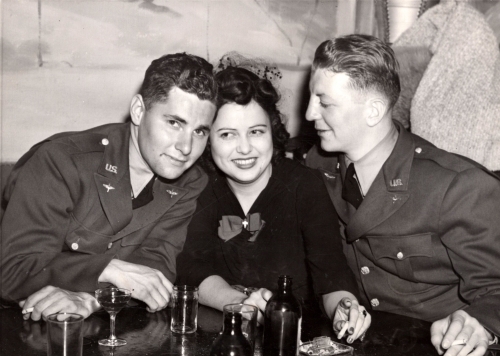
Kenneth R. Lorch, Bombardier on the Roy Claytor crew, was a member of the 100 th Bomb Group’s original cadre. A native of St. Paul, Minnesota, Lorch was attending law school at the University of Minnesota, working a side job as an attendant at Seibeck’s gas station when World War II began. Lorch left school to enlist in the US Army Air Forces in January 1942. Arriving at Thorpe Abbotts in early June 1943 as part of the 350 th Squadron, Lorch flew on the group’s first mission to Bremen on June 25, 1943. He completed nine missions by August 15, 1943. On the August 17, 1943 North African shuttle mission to bomb Regensburg, Lorch’s crew was the lead crew of the second element, low squadron, flying the B-17 Alice from Dallas. According to eyewitness accounts, at 1020 German fighters attacked the low squadron over eastern Belgium and severely damaged Claytor’s aircraft causing him to sound the bail-out alarm. With two engines engulfed in flames, eight of the airmen got out safely, but Tail Gunner Edward Musante’s parachute caught on the horizontal stabilizer and he was killed when the plane exploded in mid-air. For reasons that remain unclear, replacement Ball Turret Gunner William Hinton apparently did not bail out in time. The surviving airmen landed near the village of Waltwilder, Belgium, five managing to evade capture.


In a letter written August 24, 1943, to Lorch’s parents, 350 th C.O. Gale “Buck” Cleven wrote, “I have flown with Ken on numerous occasions and know his capabilities. His skill and reserve make it a certainty that he can more than adjust himself to and cope with whatever might be required of him – anything to safeguard and ensure his own safety as well as that of the men associated with him. The fact that he has apparently met with difficulties only serves to strengthen my confidence in him. I can only offer you my own sentiments and convictions. That Lt. Lorch is a friend in whose safety and well-being I have the deepest personal regard and that he is, as always, an officer whom this command is justly proud.”


Tracking movements of evading airmen can be challenging, but according to interviews done by Belgian researcher Alain Rosseels, it was Belgian Secret Army member Frans Govaerts who informed local resident Frans Vangronsveld that Allied airmen landed nearby. Vangronsveld’s house was located in a safe area on the outskirts of town, and he agreed that the airmen could rest at his house for a few hours and he’d help them obtain civilian clothes. Govaerts gave him part of a letter, instructing him to go to a café in the nearby village of Beverst. Upon arriving at the café, he met a man named Colson who had the other part of the letter, thus proving he could be trusted. Next the two men drove to the village of Schoonbeek where they found the American in a stable hidden under the hay. He was dressed in ill-fitting civilian clothes which came from the Countess of Beverst - his pants were too short and the shoes too big. Vangronsveld told him to follow them on a bicycle, said that he was going to be put on a train in Beverst where the station manager was also a part of the Secret Army and could be trusted. The airman took the train to Liége. Real names were not shared, and Vangronsveld did not know Lorch’s identity until 36 years later when John Burgin, Top Turret Engineer on Claytor’s crew, told him the man he put on the train that day was his fellow crew member Kenneth Lorch. Vangronsveld also aided John Burgin’s evasion. Hidden first on a farm southeast of Liége, he was moved by another Belgian, Rudolphe Depelsenaire, into the care of “Dr. Charles” in Liége. Here Burgin was reunited with Lorch, Co-Pilot Raymond Nutting and other airmen. They stayed at this location for the next six weeks. For a period of his time in hiding, Lorch lived with another Belgian family where he pretended to be a deaf mute to avoid any undue suspicion. During the months following the August 17 mission, Lorch remained classified as “missing in action” (MIA) by USAAF. The local newspaper back home in St. Paul ran a story detailing the ceremony where Lorch’s Air Medal with Oak Leaf Cluster was presented to his parents George and Blanche at their home.

After the commander of the local air detachment presented the medal in its box, “George Lorch put his pipe back in his mouth and went out on the porch to look over the city toward the Cathedral in the distance… In the house, Mrs. Lorch closed the box, and ran her hand slowly over the smooth exterior. She looked up at the pictures on the piano, ‘Howard (1 st Lt. Howard Lorch) is a transport pilot in New Guinea. He’s a good pilot. Kenneth was good too…he wanted to be like Howard.’” Turning to the relatives in the room, Blanche Lorch remarked “’He’s missing in action you know. He isn’t lost. We’ve never received official word that he’s gone. He’s some place in Europe. He is, isn’t he George?’ George Lorch stood in the doorway. He nodded slowly at his wife.” Meanwhile, details are unclear about Lorch’s activities and movements in late 1943. An escape and evasion debriefing report of 303 rd Bomb Group Co-Pilot Frank Mitchell states that he, Lorch, and two other airmen sought refuge together in a Church in December 1943. Aided by the French Underground, the airmen hid in a building in Lille near the French-Belgian border. On December 30, 1943, the airmen departed in separate groups aboard the evening train to Paris, and were escorted to another house near the Gare d’Austerlitz to stay with two Red Cross workers. They moved next to a four-story building on Rue du Faubourg du Temple to stay with a local butcher for two weeks, and then on to another safe house a short distance away before being moved to Belleville on the east side of Paris.


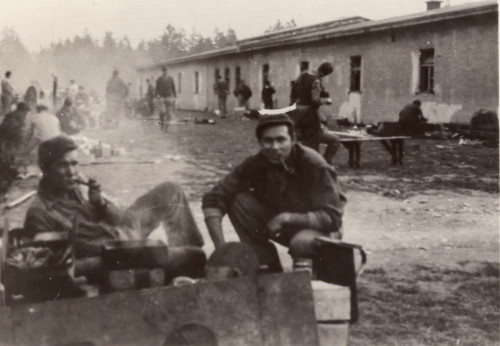
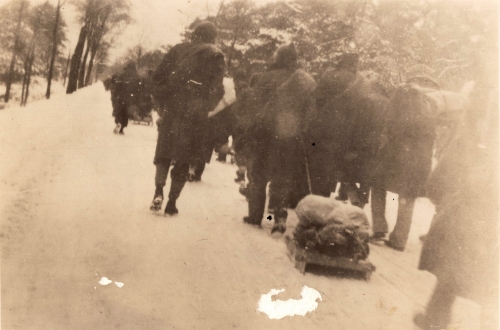
On February 26, 1944, Lorch finally headed southwest to Bordeaux, but was captured upon his arrival. The Frenchman hiding him was reportedly shot by the Germans. After evading for nearly seven months, Lorch likely suffered harsh interrogation by the Germans before heading to Stalag Luft III. There he was reunited with other members of the 100 th . Lorch survived the forced POW march to Moosburg, Germany in late winter 1945, capturing a very rare image taken during the march showing POWs pulling a makeshift sled along a snowy road.


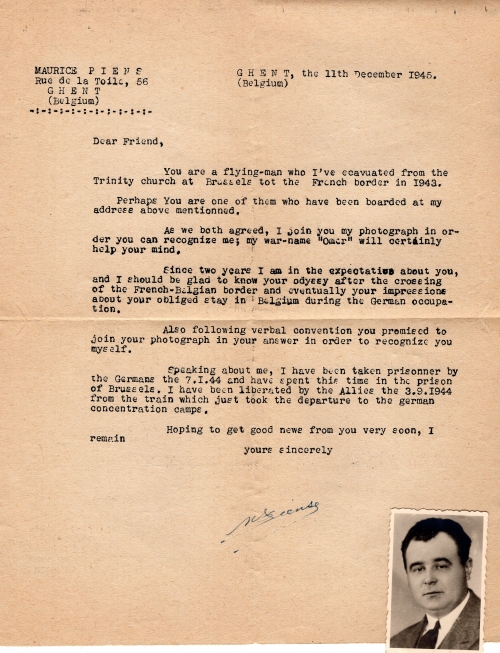
After Stalag VII-A at Moosburg was liberated April 25, 1945, Lorch returned home to Minnesota. Sadly, he learned that his father George died of a heart attack in February 1945 before he could see his son again. Lorch’s time evading capture surely lingered in his mind, and in the minds of those that provided him assistance and protection at great personal risk. Later that year, Lorch received a letter from Maurice Piens, of Ghent, Belgium, dated December 11, 1945, which stated “You are the flying-man who I’ve evacuated from the Trinity Church at Brussels to the French border in 1943… since two years I am in the expectations about you, and I should be glad to know your odyssey after the crossing of the French-Belgian border and eventually your impressions about your obliged stay in Belgium during the German occupation. …speaking about me, I have been taken a prisoner of the Germans on January 7, 1944 and have spent this time in the prison of Brussels. I have been liberated by the Allies on September 3, 1944 from the train which just took the departure to the German concentration camps. Hoping to get good news from you very soon, I remain yours sincerely, Maurice.” There’s no record of Lorch’s reply, but the train Maurice references was stopped by Belgian underground fighters in order to save their fellow resistance men and women from likely death in German concentration camps. Three generations of the Lorch family - Greg, Nick, and Landen - honored Kenneth Lorch by attending their first 100 th Bomb Group Foundation reunion in Dallas, sharing photos and letters which are now part of our historical archives. Welcome to the 100th family!

------------------------------------------------------------------------------------------------------------------------------------------
KIA / MIA / EVA / INT Information:
Target:
Regensburg
Aircraft:
"Alice From Dallas" (42-5867)
Date:
1943-08-17
Cause:
FLAK-Explosion
Photos

Click here to see album - 15 items

Click here to see album - 15 items

Click here to see album - 15 items

Click here to see album - 15 items

Click here to see album - 15 items

Click here to see album - 15 items

Click here to see album - 15 items

Click here to see album - 15 items

Click here to see album - 15 items
Click here to see album - 15 items

Click here to see album - 15 items
Click here to see album - 15 items
Click here to see album - 15 items
Click here to see album - 15 items

Click here to see album - 15 items


Crew List
1st Crew List
Use your thumb to scroll through the results box below.
| Rank | Name | Pos | Status |
|---|---|---|---|
| Lt | CLAYTOR, Roy | P | EVA |
| Lt | NUTTING, Raymond | CP | EVA |
| Lt | AMISON, Oscar C. | NAV | POW |
| Lt | LORCH, Kenneth R. | BOM | POW |
| T/Sgt | BURGIN, John W. | TTE | EVA |
| S/Sgt | KOPCZEWSKI, Steven S. | ROG | KIA |
| T/Sgt | QUINN, William M. | ROG | EVA |
| S/SGT | HINTON, William M. | BTG | KIA |
| S/Sgt | WUSSOW, Robert | BTG | KIA |
| S/Sgt | BAILEY, Charles | WG | EVA |
| S/SGT | KEHOE, Joseph E. | WG | NOC |
| S/SGT | STARKEY, Clifford R. | WG | POW |
| S/Sgt | MUSANTE, Edward A. | TG | KIA |