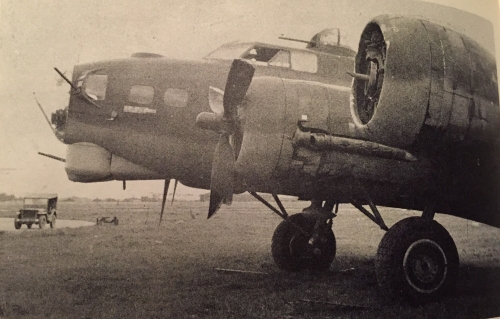
Mission Date: May 7, 1944
BERLIN, CITY
100th BG Mission #: 111
Mission Summary
ON THIS DAY...MAY 7, 1944
Forty crews were seated at the 0245 briefing when they were called to attention for the entry of the new Commanding Officer, Thomas S. Jeffrey. The twenty-six year-old Jeffrey was the Deputy Group Commander of the 390th BG when General LeMay had reportedly offered him the choice of commanding either the 95th or the 100th BG. Jeffrey chose the 100th where he “saw an opportunity to make over the 100th into a better combat unit.” After the 100th’s previous Commander had been shot down after only nine days on the job, “the bets were being placed as to how long he would stay.”
The men learned that Berlin would be targeted again with the main objective to damage its transportation system by targeting as many of its locomotives and servicing facilities as possible. Two mission plans were sent over and changed multiple times throughout the night and into the briefing hour which would result in a great deal of confusion for the Groups flying.
The 3rd Division would be lead by the 13th CBW which would fly two composite Wing formations. The 100th would lead the 13A formation, with 390th’s aircraft flying as its High Group and the Low Group in a Composite with 15 ships from the 100th. The 13B formation, to be echeloned on the 13A, would be made up of the 95th BG in the Lead and Low with the 96th BG from the 45th CBW flying as its High Group.
Commanding the 13A wing would be Lt Col Jack Kidd flying with LT Clark in the first PFF aircraft while Captain Rosenthal would fly with LT Kincannon as Deputy Lead in the second PFF.
Loaded up with ten 500 lb bombs, the 100th’s Composite ships took-off first at 0530 hours with the 100th's main formation ships off at 0545 hours.
With so many changes to the mission plans, the Wing assembly became a mass of confusion. The 390th’s ‘A’ Group never formed up with the 100th, flying with the 45th’s Wing all the way to the IP. The 95th’s lead PFF ship aborted before the wing assembly point so its Lead and Low Groups finally tacked on to the 45th CBW at the coast. And four of the 100BG’s pilots returned before leaving the coast: Rice, Roth, Rosine and Lacy.
While forming up near the coast as the lead ship in one of the 100th’s elements, the Ralph 'Wendall' Wright crew experienced a deadly fire in their ship ‘Cap’N Crow.’ TTE, Alden Madsen had been firing a flare when a live spark flew back into the box of flares. “The intensely hot fireballs, shooting crazily in the little compartment quickly started the whole forward section of the plane blazing and filled it with suffocating smoke.” Madsen valiantly tried to put out the fire but was blown back into the radio room by an oxygen bottle explosion. Wright was able to give the bailout order before he and his copilot, Jack Raper became unconscious. The ship went into a spin before all of the crew could bail out, hitting the ground with a full gas and bomb load on the estate owned by Lord and Lady Somerleyton between Great Yarmouth and Lowestoft. All Officers and one EM were killed.
As the formations flew over the Zuider Zee, the 95th’s Low Squadron leader in the Wing’s ‘B’ formation aborted “and his whole squadron followed him home.”
The weather was 10/10 cloud coverage all the way to the target. As expected, the fifteen heavy guns protecting the target sent up flak that was ‘barrage, intense and accurate’ and some of the 100th’s ships took hits. Dickie Kendall, flying in the 390th’s Low Composite formation remembered, “The flak was as bad as ever. I don’t know why I worry so much about it. It only takes one piece in the right place.” Although Kendall was lucky, Loren Van Steenis’ ship also flying with the 390th’s Composite, took a direct flak hit. His twenty-three year-old NAV Harold Becker was killed at his map table and BOM Lester Torbett was severely injured by flak wounds to his back. As the enlisted men provided first aid to Torbett, the pilots pulled their flak riddled ship out of formation and headed back over the North Sea.
The 100th’s bombs were successfully away at 1117 hours on the Primary target from 24560-24000 feet. Heading for home, they again flew through another round of heavy flak, this time over Amsterdam.
Successfully landing after a nine hour mission, all but Wright’s ship had returned to base. Five ships returned with battle damage with three of those requiring Sub-Depot repair.
That evening, the alert light was on again and the crews were alerted for a mission the next day.
Lord and Lady Somerleyton would later dedicate a commemorative stone plaque to the 8th Air Force flyers that crashed on their estate including the men from Ralph Wright's crew and two fighter pilots who had also crashed on their land. Names from the 100th on the plaque: Ralph Wendall Wright, Jack W. Raper, Richard Curran, Carl Herrmann and Randolph Moore. The inscription reads that these men, "all of the U.S. Army Eighth Air Force, gave their lives in defense of this country. Greater love hath no man than this that a man lay down his life for his friends.”
Crews flying that day: Townsend, Stout, Giles, Rogers, Jesperson, Herres, Noble, Granier, Horne, Malooly, Williamson, Rake, Wright, Van Steenis, Gibbons, Bichen, Riggle, Shelly, Rosine, Scott, Dille, Lacy, Roth, Schwank, Hunter, Simmons, Kinder, Runley, Niewort, Mylius, Lischer, Ryan, Wolf, Rice, Bethea, Williams B, Clark, Kincannon
Bombing Results
Bombing Results:
Aircraft Lost: 0
Crew Lost: 0
Claims of Enemy Losses (CLS): 0
Aircraft Returned: