Mission Date: May 19, 1944
BERLIN, CITY
100th BG Mission #: 118
Mission Summary
ON THIS DAY...May 19,1944
Originally scheduled to fly that morning in a Pathfinder aircraft was twenty-three year-old pilot Frank Valesh. When he brought his crew and Pathfinder over to Thorpe Abbotts at 0230 hours that morning, maintenance was still being done on the long runway and would not be completed for several hours. Valesh was told that he would have to use the short runway. Loaded with bombs, he wasn’t thrilled with that idea. Due to enemy intruders reported in the area, the runway lights were not lit and NAV Dick Johnson remembered, “Someone on the ground ‘helped’ by firing a flare which burst right in front of the aircraft, effectively blinding Valesh and Booth for several seconds." Landing long and letting his ship roll, Valesh hit a road. Johnson continued, “The aircraft was totaled but there was no fire. The first man to reach us didn't ask about anyone being hurt but only if there were bombs aboard. When we told him yes he took off like a striped ass ape and as far as I know, hasn't been seen since… The bombs were not fused.” Two Waist Gunners and the NAV on Valesh’s crew were hospitalized in the landing accident.
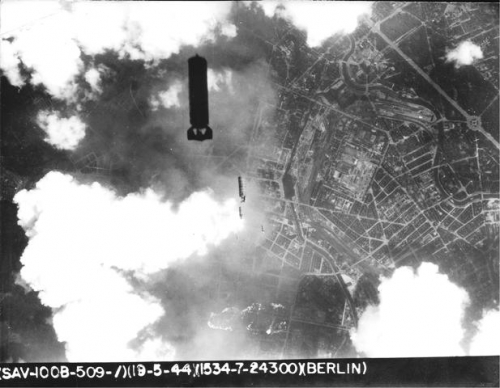
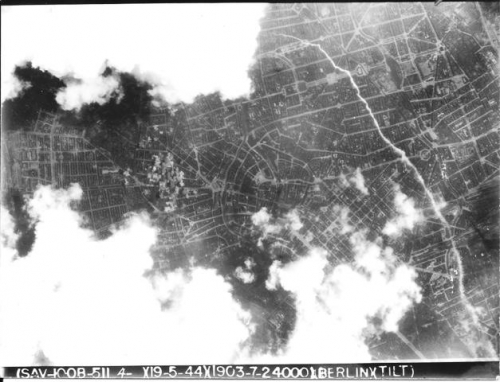
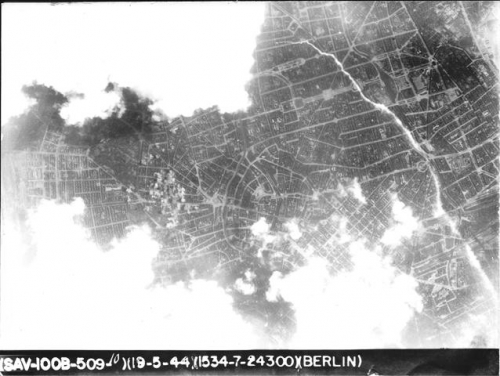
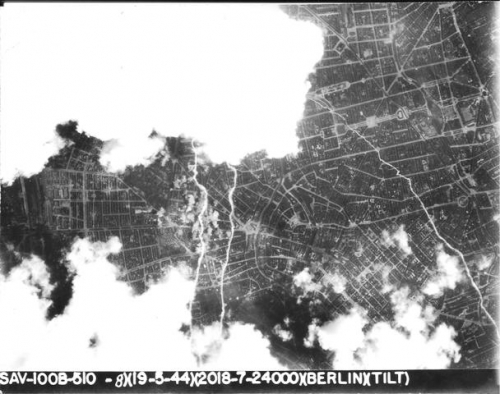
At the 0600 briefing, thirty-four crews were called to attention as the 100th’s Air Executives entered. Charles Terry, the day’s briefing Officer, pulled the curtain back from the map showing that the 100th would be attacking Berlin again. Its Primary target would be the Friedrichstrasse Station located in a part of the city that was not as badly damaged as others. The Secondary target would be a bomber assembly factory at Rostock while the Target of Last Resort would be the submarine and shipbuilding yard at Kiel.
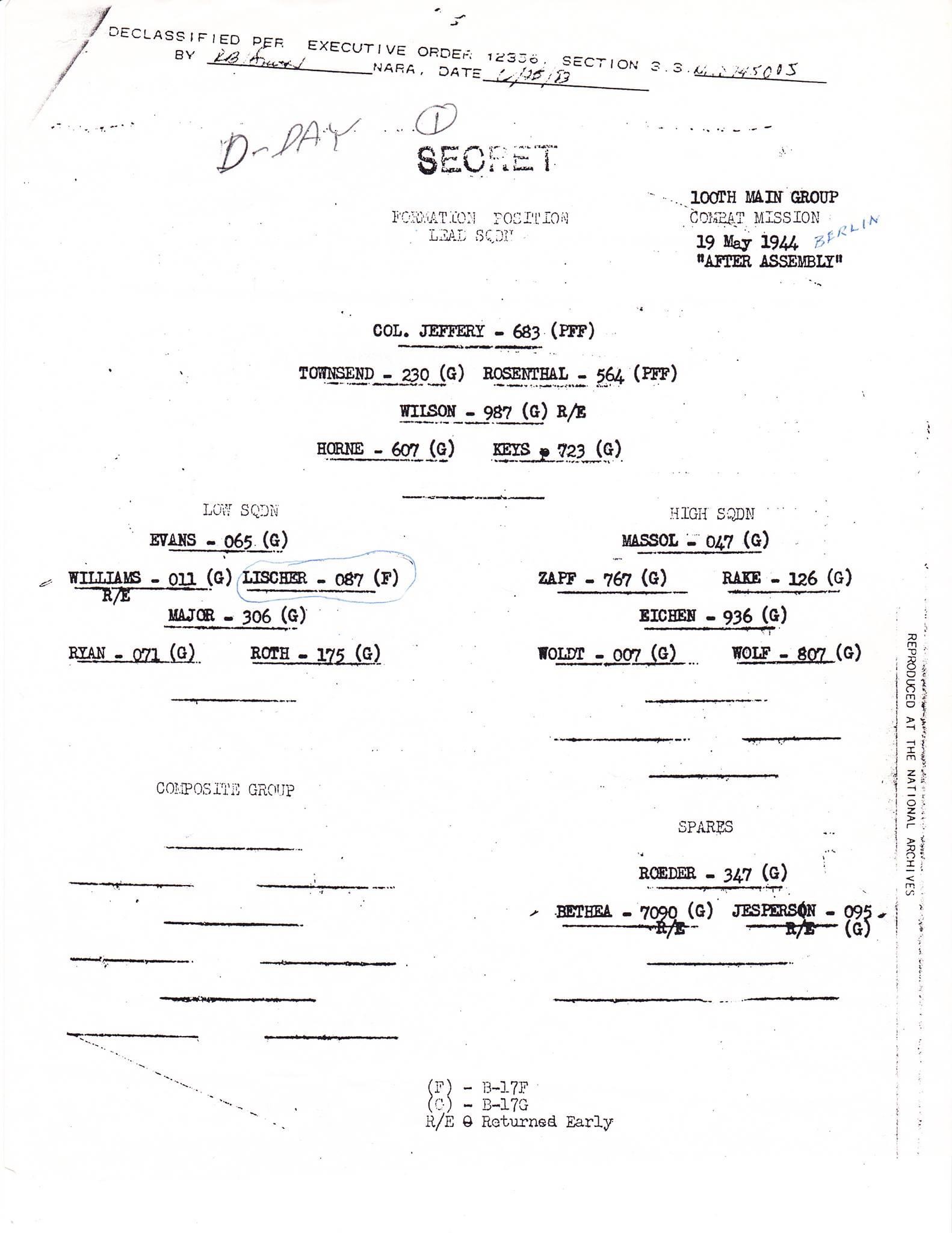
The 13A wing formation would fly the 100A as its Lead Group, with the 390A flying as the High Group and the 390B flying six bombers. The Low Group would fly with twelve 100B aircraft as its Low and High Squadrons.
Flying the 100th’s Command Pilot position would be the 100th’s new Commander, twenty-seven year-old Colonel Thomas Jeffrey flying with E.C. King. His wingmen would be Lawrence Townsend and Robert Rosenthal, flying with Joseph Farcht in the second PFF ship as Deputy Lead.
With the ships topped off with gas, the bombers in the lead group had been loaded with five 1000 lb bombs while those scheduled for the Composite formation would carry ten 500 lb bombs.
Take-off was at 0900 hours. Proper assembly was made difficult at the English Coast due to heavy and persistent contrails and four of the 100th’s ships aborted the mission early: Williams due to a broken oxygen line for his BTG and RWG, Bethea due to #4 engine being out, B. Williams who was not only sick, but had an inoperative ball turret and TG’s heated suit not working. Scheduled to fly in the 100B formation, Wegrzynek turned back at 1045, unable to catch up with the formation that was fifteen minutes ahead.
The remaining formation flew over the North Sea, with weather worsening again at the Danish Coast. As the formation neared Berlin, they encountered 4-7/10 clouds up to 15000 feet. The city was obscured effectively by its defensive smoke screen and soon the one hundred and fifty enemy guns began sending 20 mm shells up to meet the bombers. The flak was reported as ‘intense, using continuous pointed fire as well as barrage.’
The IP was reached at 1411, and the turn was made onto the bomb run. As the formation continued on the bomb run, seven of the 100th’s ships took flak hits. Flying his #8 mission with the Roth crew, WG Carl Carlson remembered, “one 20MM shell exploded in the radio room.”
Bombs were away from 23300-24800 at 1420 hours and the Rally Point was made with the formation beginning its route out towards home, flying over the tip of North Germany. Observed flying to the left and parallel to the 100BG, in a formation similar to the American bombers, were twenty-five German fighters. Just as they began to pull ahead, two P-51’s dove into the enemy’s formation, scattering the ships. Like disturbed angry hornets, the German fighters commenced their attacks on all three groups in the wing.
The 100th’s Martin Rupert’s ship in the Composite Group was attacked from 3 o’clock level at 1518 hours. There was an orange flash near the cockpit and a fire was started in the front of the ship. BOM Lynn Barbour tells us, “…I immediately tried to extinguish it. In moving from my position; in the nose of the ship to the location of the fire, my inter phone & oxygen system were disconnected, therefore I was not in communication with the other members of the crew from the time the attack started until I bailed out. As we were immediately put out of action, and the plane was out of control, there was no time to re-establish inter-phone communications. Not certain whether the crew had been notified to abandon ship, I shouted at the navigator to ascertain that fact and he did so. The plane being out of control and pilotless we had no choice but to bail out.” Six chutes were observed.
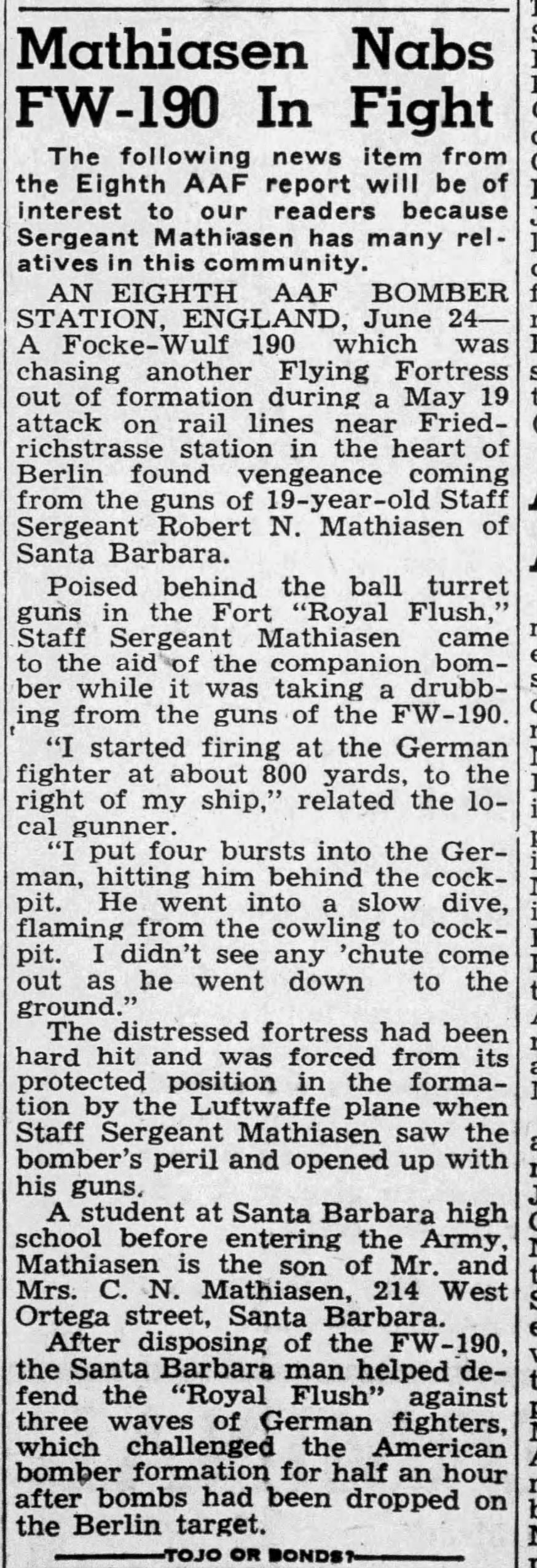
Flying in Townsend’s ship, BTG Chalmers Anderson watched as an enemy fighter pulled up to attack the lead squadron’s lead element. “I followed this E/A which turned out to be an FW 190, and opened fire on him when he started pulling up toward our element when 1000-1200 yards out. I fired 70-100 rounds in short bursts as E/A closed in to 500 yards…” Spiraling slowly down, the fighter “plunged into the waters of Kiel Bay.”
As the attacks continued, calls to the formation’s escorting P-38s for aid went out with no response. “After the initial attack some E/A turned and made tail attacks employing the ‘Sisters Act’ and ‘Tail Pecker’ tactics while others queued on either side of more nose attacks. In another attack by elements of three the standard ‘Triple Threat’ tactics were employed except that usually one E/A would pass through or under our Group formation.”
Ralph Horne’s ship in the Lead squadron was attacked by two enemy aircraft from 12 o’clock high. With his #3 and #4 engines hit, all power was lost. As the ship fell back from the formation, they were attacked again from the rear. CP John McGrath tells us, “The tail section was severely damaged. How Joe Staron escaped without a scratch is a miracle. As I glanced out my side window the FW190 was overtaking us and was no more than 20 yards off our right wing. He must have been wounded, no sane pilot would come that close and slow. He continued slowly to pass us and continued in a slow left turn in front of us where the bombardier and navigator finished him. We were losing altitude fast and our navigator said with our rate of decent we would never reach the channel, but we might reach Sweden. We opted for Sweden but never made it…”
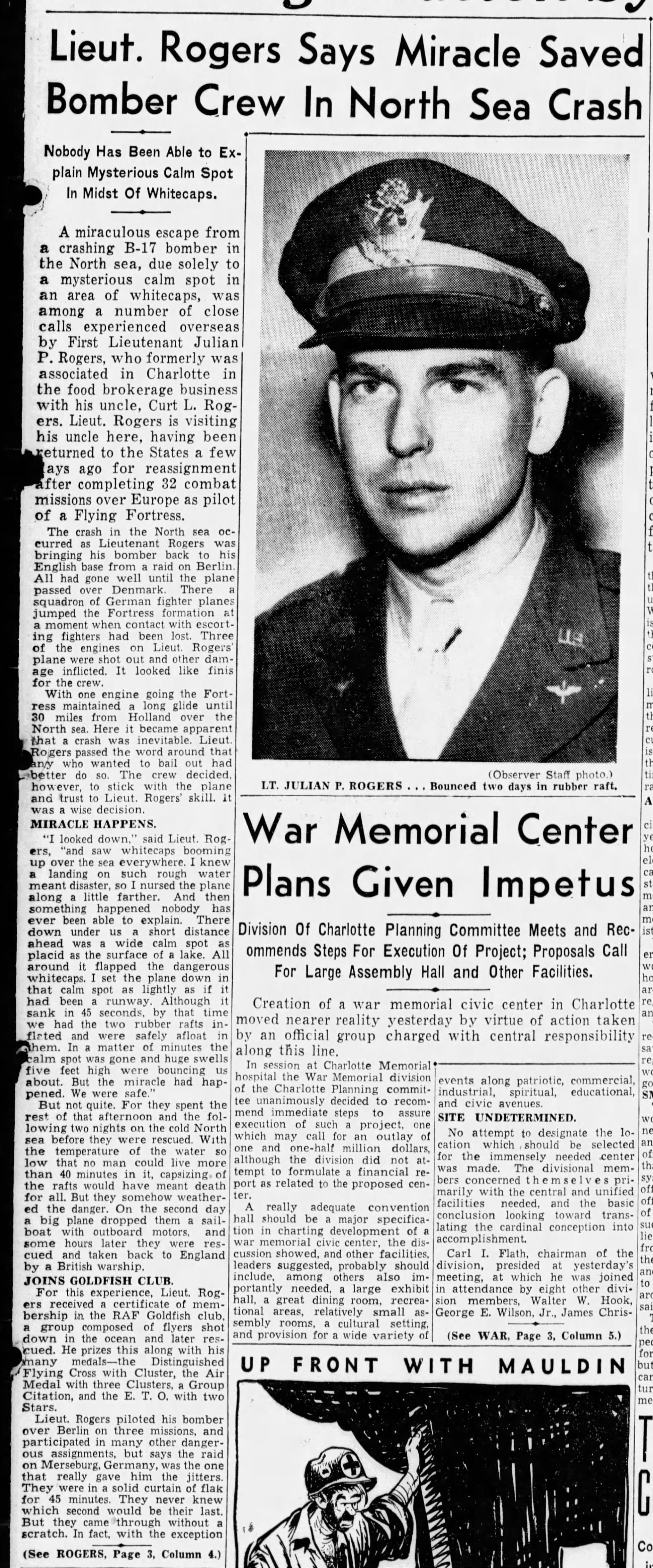
Flying in the Composite Group, Julian “Buck” Rogers’ ship was attacked and three of his engines were shot out. The ship began to straggle and lose altitude. Rogers was heard on VHF to be ditching into the whitecaps of the sea. Able to miraculously find a calm spot, Rogers tells us, “…I set the plane down in that calm spot as lightly as if it had been a runway. Although it sank in 45 seconds, by that time we had the two rubber rafts inflated and were safely afloat in them. In a matter of minutes the calm spot was gone and huge swells five feet high were bouncing us about. But the miracle had happened. We were safe.” This was their #11 mission.
After seven to eight passes made on the 13CBW’s formation, the attacks were broken off at 1530 hours. The 100th's gunners had worked hard at their jobs that day, destroying a credited eight enemy fighters with another three probables.
After close to a ten hour mission, all but three of the 100th’s bombers returned safely to Thorpe Abbotts with Evans and Majors returning with wounded aboard. At Interrogation, Crews were vocal about the lack of P-38 support during the attacks. From the Gibbons Crew, “P-38’s were called to help against fighter attack, but did not comply and passed our formation without giving any assistance at all.” And from the Evans crew, “P-38s were above us but would not come to our aid while we were being attacked.” Woldt’s crew addded, “P-38s disappeared during attack by E/A, and came back after encounters were over. Two P-51’s did more good than all the P-38’s combined.”
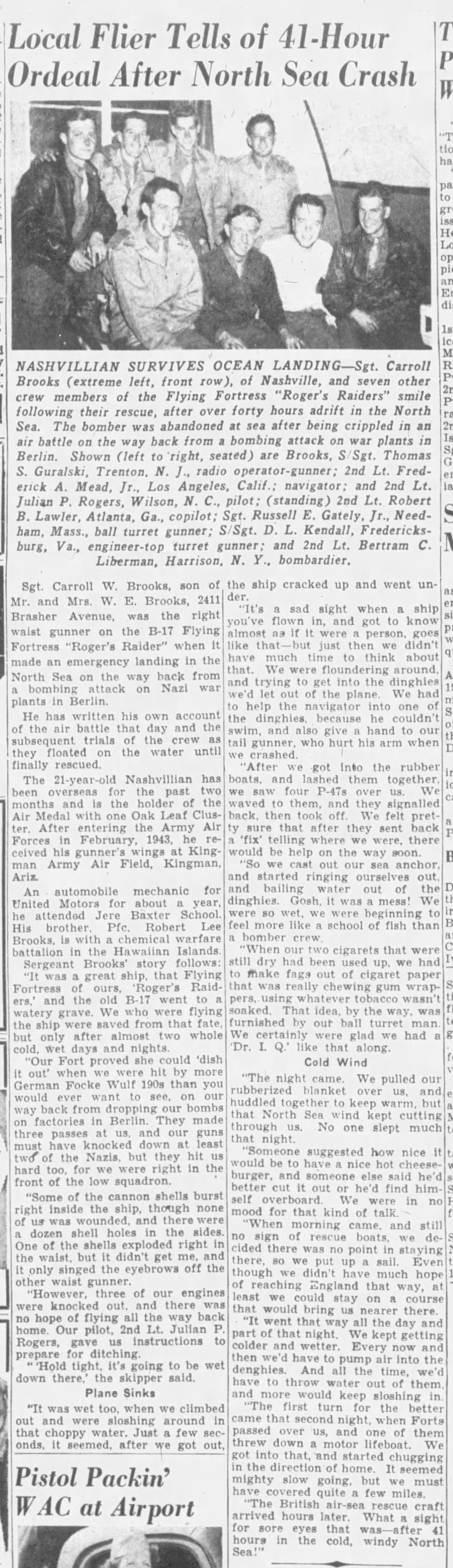
Fortunately, two of the three non returning bomber’s crews would survive. After ditching and climbing into their life rafts, the Rogers Crew would spend the rest of the day and night in the cold North Sea. Spotted by British Air Rescue, a plane dropped them a “craft complete with motors.” Rogers stated, “We set course for home. However, we ran into heavy seas and had to keep baling out water. We took turns during the night steering for home.” Finally, after a second night on the North Sea, a Danish fishing boat picked them up. Transferred to a British high-speed launch, the crew would return to Thorpe Abbotts but had flown their last mission.
Ralph Horne’s ship had ditched in the water south of Glacno Island in Denmark and after deploying their two dingies, paddled to the Danish shore where they the next day within an hour of each other, were all taken POWs: Horne, Evans, Willey and Fosdick in Nyrup, Denmark and McGath, Hiley, Hunt, Perinsky, Hall and Staron in Snedinge, Denmark.
BOM Lynn Barbour would be the only crew member to survive in Martin Rupert’s crew. The ship’s crash was seen by Danish fishermen from Rodbyhavn. Picking up Barbour, no other survivors were found. Barbour became a POW but the others, Ruppert, Raring, James, Hawk, Cole, McNeer, Haswell, Hick, and Hohman had all been killed in action.
Crews flying this day: Main - Bethea, Eichen, Evans, Horne, Jesperson, Keys, Lischer, Major, Massol, Rake, Roeder, Roth, Ryan, Townsend, Williams, Wilson, Woldt, Wolf, Zapf
Composite- Brewer, Dille, Gibbons, Lacy, Malooly, Noble, Pearson, Rogers, Ruppert, Stewert, Wegrzynek, Williamson
Originally scheduled to fly that morning in a Pathfinder aircraft was twenty-three year-old pilot Frank Valesh. When he brought his crew and Pathfinder over to Thorpe Abbotts at 0230 hours that morning, maintenance was still being done on the long runway and would not be completed for several hours. Valesh was told that he would have to use the short runway. Loaded with bombs, he wasn’t thrilled with that idea. Due to enemy intruders reported in the area, the runway lights were not lit and NAV Dick Johnson remembered, “Someone on the ground ‘helped’ by firing a flare which burst right in front of the aircraft, effectively blinding Valesh and Booth for several seconds." Landing long and letting his ship roll, Valesh hit a road. Johnson continued, “The aircraft was totaled but there was no fire. The first man to reach us didn't ask about anyone being hurt but only if there were bombs aboard. When we told him yes he took off like a striped ass ape and as far as I know, hasn't been seen since… The bombs were not fused.” Two Waist Gunners and the NAV on Valesh’s crew were hospitalized in the landing accident.
At the 0600 briefing, thirty-four crews were called to attention as the 100th’s Air Executives entered. Charles Terry, the day’s briefing Officer, pulled the curtain back from the map showing that the 100th would be attacking Berlin again. Its Primary target would be the Friedrichstrasse Station located in a part of the city that was not as badly damaged as others. The Secondary target would be a bomber assembly factory at Rostock while the Target of Last Resort would be the submarine and shipbuilding yard at Kiel.
The 13A wing formation would fly the 100A as its Lead Group, with the 390A flying as the High Group and the 390B flying six bombers. The Low Group would fly with twelve 100B aircraft as its Low and High Squadrons.
Flying the 100th’s Command Pilot position would be the 100th’s new Commander, twenty-seven year-old Colonel Thomas Jeffrey flying with E.C. King. His wingmen would be Lawrence Townsend and Robert Rosenthal, flying with Joseph Farcht in the second PFF ship as Deputy Lead.
With the ships topped off with gas, the bombers in the lead group had been loaded with five 1000 lb bombs while those scheduled for the Composite formation would carry ten 500 lb bombs.
Take-off was at 0900 hours. Proper assembly was made difficult at the English Coast due to heavy and persistent contrails and four of the 100th’s ships aborted the mission early: Williams due to a broken oxygen line for his BTG and RWG, Bethea due to #4 engine being out, B. Williams who was not only sick, but had an inoperative ball turret and TG’s heated suit not working. Scheduled to fly in the 100B formation, Wegrzynek turned back at 1045, unable to catch up with the formation that was fifteen minutes ahead.
The remaining formation flew over the North Sea, with weather worsening again at the Danish Coast. As the formation neared Berlin, they encountered 4-7/10 clouds up to 15000 feet. The city was obscured effectively by its defensive smoke screen and soon the one hundred and fifty enemy guns began sending 20 mm shells up to meet the bombers. The flak was reported as ‘intense, using continuous pointed fire as well as barrage.’
The IP was reached at 1411, and the turn was made onto the bomb run. As the formation continued on the bomb run, seven of the 100th’s ships took flak hits. Flying his #8 mission with the Roth crew, WG Carl Carlson remembered, “one 20MM shell exploded in the radio room.”
Bombs were away from 23300-24800 at 1420 hours and the Rally Point was made with the formation beginning its route out towards home, flying over the tip of North Germany. Observed flying to the left and parallel to the 100BG, in a formation similar to the American bombers, were twenty-five German fighters. Just as they began to pull ahead, two P-51’s dove into the enemy’s formation, scattering the ships. Like disturbed angry hornets, the German fighters commenced their attacks on all three groups in the wing.
The 100th’s Martin Rupert’s ship in the Composite Group was attacked from 3 o’clock level at 1518 hours. There was an orange flash near the cockpit and a fire was started in the front of the ship. BOM Lynn Barbour tells us, “…I immediately tried to extinguish it. In moving from my position; in the nose of the ship to the location of the fire, my inter phone & oxygen system were disconnected, therefore I was not in communication with the other members of the crew from the time the attack started until I bailed out. As we were immediately put out of action, and the plane was out of control, there was no time to re-establish inter-phone communications. Not certain whether the crew had been notified to abandon ship, I shouted at the navigator to ascertain that fact and he did so. The plane being out of control and pilotless we had no choice but to bail out.” Six chutes were observed.
Flying in Townsend’s ship, BTG Chalmers Anderson watched as an enemy fighter pulled up to attack the lead squadron’s lead element. “I followed this E/A which turned out to be an FW 190, and opened fire on him when he started pulling up toward our element when 1000-1200 yards out. I fired 70-100 rounds in short bursts as E/A closed in to 500 yards…” Spiraling slowly down, the fighter “plunged into the waters of Kiel Bay.”
As the attacks continued, calls to the formation’s escorting P-38s for aid went out with no response. “After the initial attack some E/A turned and made tail attacks employing the ‘Sisters Act’ and ‘Tail Pecker’ tactics while others queued on either side of more nose attacks. In another attack by elements of three the standard ‘Triple Threat’ tactics were employed except that usually one E/A would pass through or under our Group formation.”
Ralph Horne’s ship in the Lead squadron was attacked by two enemy aircraft from 12 o’clock high. With his #3 and #4 engines hit, all power was lost. As the ship fell back from the formation, they were attacked again from the rear. CP John McGrath tells us, “The tail section was severely damaged. How Joe Staron escaped without a scratch is a miracle. As I glanced out my side window the FW190 was overtaking us and was no more than 20 yards off our right wing. He must have been wounded, no sane pilot would come that close and slow. He continued slowly to pass us and continued in a slow left turn in front of us where the bombardier and navigator finished him. We were losing altitude fast and our navigator said with our rate of decent we would never reach the channel, but we might reach Sweden. We opted for Sweden but never made it…”
Flying in the Composite Group, Julian “Buck” Rogers’ ship was attacked and three of his engines were shot out. The ship began to straggle and lose altitude. Rogers was heard on VHF to be ditching into the whitecaps of the sea. Able to miraculously find a calm spot, Rogers tells us, “…I set the plane down in that calm spot as lightly as if it had been a runway. Although it sank in 45 seconds, by that time we had the two rubber rafts inflated and were safely afloat in them. In a matter of minutes the calm spot was gone and huge swells five feet high were bouncing us about. But the miracle had happened. We were safe.” This was their #11 mission.
After seven to eight passes made on the 13CBW’s formation, the attacks were broken off at 1530 hours. The 100th's gunners had worked hard at their jobs that day, destroying a credited eight enemy fighters with another three probables.
After close to a ten hour mission, all but three of the 100th’s bombers returned safely to Thorpe Abbotts with Evans and Majors returning with wounded aboard. At Interrogation, Crews were vocal about the lack of P-38 support during the attacks. From the Gibbons Crew, “P-38’s were called to help against fighter attack, but did not comply and passed our formation without giving any assistance at all.” And from the Evans crew, “P-38s were above us but would not come to our aid while we were being attacked.” Woldt’s crew addded, “P-38s disappeared during attack by E/A, and came back after encounters were over. Two P-51’s did more good than all the P-38’s combined.”
Fortunately, two of the three non returning bomber’s crews would survive. After ditching and climbing into their life rafts, the Rogers Crew would spend the rest of the day and night in the cold North Sea. Spotted by British Air Rescue, a plane dropped them a “craft complete with motors.” Rogers stated, “We set course for home. However, we ran into heavy seas and had to keep baling out water. We took turns during the night steering for home.” Finally, after a second night on the North Sea, a Danish fishing boat picked them up. Transferred to a British high-speed launch, the crew would return to Thorpe Abbotts but had flown their last mission.
Ralph Horne’s ship had ditched in the water south of Glacno Island in Denmark and after deploying their two dingies, paddled to the Danish shore where they the next day within an hour of each other, were all taken POWs: Horne, Evans, Willey and Fosdick in Nyrup, Denmark and McGath, Hiley, Hunt, Perinsky, Hall and Staron in Snedinge, Denmark.
BOM Lynn Barbour would be the only crew member to survive in Martin Rupert’s crew. The ship’s crash was seen by Danish fishermen from Rodbyhavn. Picking up Barbour, no other survivors were found. Barbour became a POW but the others, Ruppert, Raring, James, Hawk, Cole, McNeer, Haswell, Hick, and Hohman had all been killed in action.
Crews flying this day: Main - Bethea, Eichen, Evans, Horne, Jesperson, Keys, Lischer, Major, Massol, Rake, Roeder, Roth, Ryan, Townsend, Williams, Wilson, Woldt, Wolf, Zapf
Composite- Brewer, Dille, Gibbons, Lacy, Malooly, Noble, Pearson, Rogers, Ruppert, Stewert, Wegrzynek, Williamson
Bombing Results
Bombing Results:
Aircraft Lost: 3
Crew Lost: 30
Claims of Enemy Losses (CLS): 10
Aircraft Returned:
Media Articles
Use your thumb to scroll through the results box below.
| Media Item | Type | Page | Volume/Issue | Broadcast Source | Time | Description | File |
|---|---|---|---|---|---|---|---|
| Robert Mathiasen in Royal Flush nabs FW 190 May 19 1944 | The Minden Courier July 6 1944 | 12:00 am | |||||
| Julian Rogers miracle saves crew part 1 | The Charlotte Observer Nov 11 1944 | 12:00 am | |||||
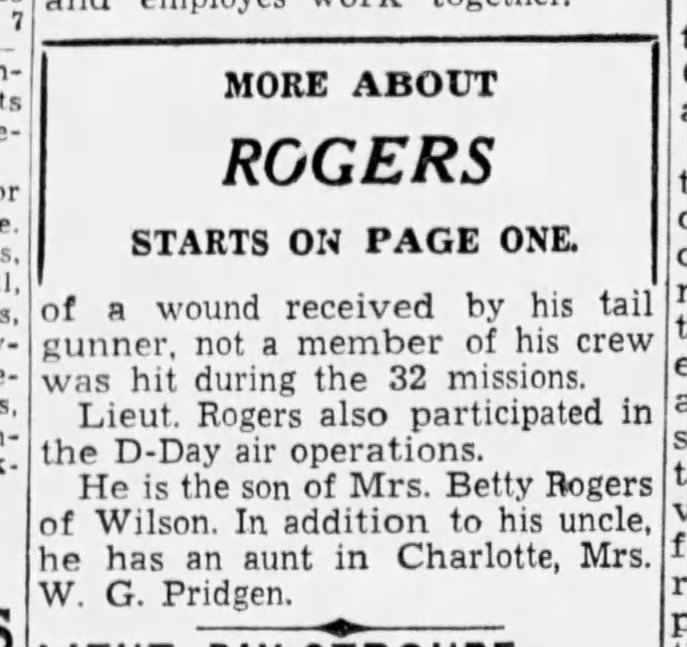
| Julian Rogers miracle saves crew part 2 | The Charlotte Observer Nov 11 1944 | 12:00 am | |||||
| Carrol Brooks, Guralski, Mead, Rogers, Lawler, Gately, Kendall, Liberman | Nashville Banner June 12 1944 | 12:00 am |