Mission Date: June 6, 1944
OUISTREHAM, TOWN
100th BG Mission #: 132
Mission Summary
ON THIS DAY...JUNE 6, 1944
First of three missions:
Many of the Officers awakened at 0300 hours on June 5, were still awake when they were alerted at 2200 that same evening for an Officer’s briefing to be held in one hour. Having just completed his #2 mission, CP Keith Lamb, lucky to have hit the sack remembered, “had hardly fallen asleep after hitting Boulogne that day, when a jeep drove up to our barracks with the Sergeant, who announced there would be an 11 pm. briefing. Even the old-timers considered that unusual, never having had a briefing that early before…Ransom and the rest of us moaned a little but not for long. When we got down to briefing we soon forgot about complaining and found we were actually glad it was M.E.”
With lead crews previously briefed, at 2300 hours, S-2 Officer Marvin Bowman told the forty-two crews that D-Day was finally upon the Allies with ‘zero hour’ designated as 0725 on June 6, when the tide would be “midway between high and low watermarks and will be incoming.”
The 100th’s Primary target would be Ouistreham, France, a coastal town ten miles from Caen.
Joseph Costanza, WG on Keys crew recorded, “The Colonel himself gave us the news, and said, ‘Well boys, this is it’ with a big smile on his face but everyone was quiet.”
The Group’s official records include the following briefing message: “This is it; Later in the morning you will be a part of the greatest display of military, naval and air power ever conceived or realized. The invasion is irrevokably on - it cannot be postponed — it cannot be scrubbed. Objectives for heavy bombers during the early phase of the invasion are to knock out enemy strongpoints, coastal batteries, military headquarters, and choke points on military roads. In addition, it is hoped that the bombing of strong points and batteries will force enemy gunners to keep their heads down and will immobilize them just before and during the actual landings. Targets are small and close together in many places - they will be difficult to find. There will be no second runs on these beach targets. Ground troops are counting on you to knock out these targets and you must not fail them. There will be all types of friendly A/C in the area. Fighter bombers may be attacking your targets at the same time as you are. Medium bombers will be bombing on the right and may be seen withdrawing along your withdrawal route. Naval shelling may be taking place on your targets at the time of the attack. You will see many ships, boats and landing craft along the route. All surface vessels are to be considered friendly and are not to be bombed under any circumstances. Crews forced to leave their formation S. Of the English coast must not turn back against the main flow of air-traffic. Only A/C flying along the scheduled route will be considered friendly by naval gunners.”
The 13CBW would fly nineteen Squadrons. Led by the 95A, followed by 95B, 390A and 390B, the 100BG would fly five squadrons of bombers. Colonel Jeffrey would lead the 100th's formation, flying with Stanley Clark in the 100A. The 100B would be led by Major Sumner Reeder flying with Francis Kincannon and the 100C by Gorski and Harris.
The mission’s need for secrecy and logistics for thousands of aircraft in the air at one time, created the need for additional orders and Bowman continued. “In no case are flares to be used after departure from English Coast except by A/C in distress. A straggler is not considered an aircraft in distress. Aborting aircraft will turn right from bomber channel and cross English coast in at Portland Bill. Guns will be manned at all times but they will not be test fired on this mission. Only boats or ships heading toward the UK will stop to pick up crews members of ditched A/C.”
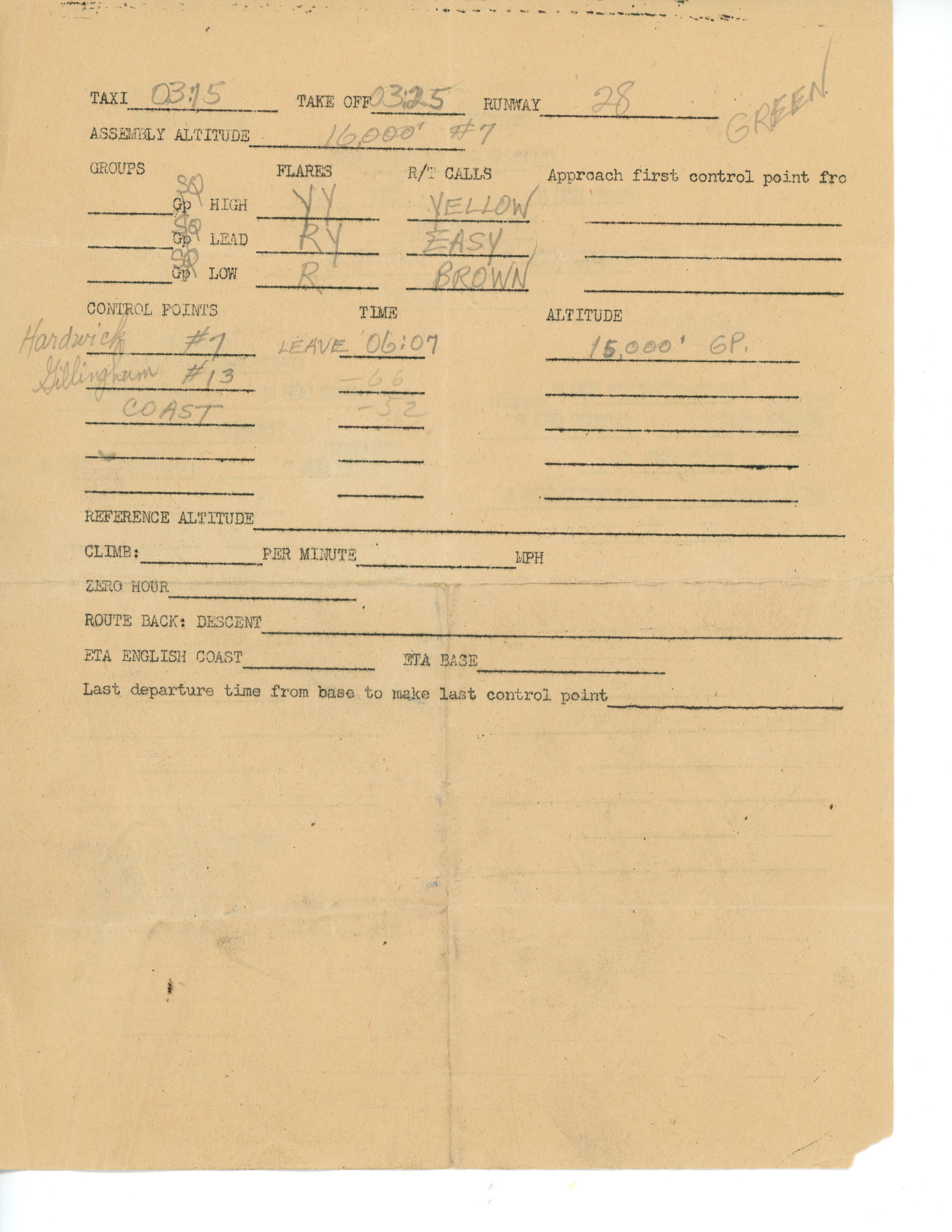
Keith Lamb tells us, “We took off at 3 a.m., and this was murder, assembling in the dark.” Following the briefed route in, the ships encountered meager flak and none at the target. Lamb continued, “Bombs were away at 7:03. The Channel was covered with clouds, so we couldn't see the landings. In the air our heavy bombers were in front of us and as far behind us as we could see. Below us were the medium bombers and fighters—underneath the overcast. The RAF and 15th Air Force from Italy were also out in full strength. Altogether, more than 11,000 airplanes were over Normandy. It was impossible to fly without getting into prop-wash.”
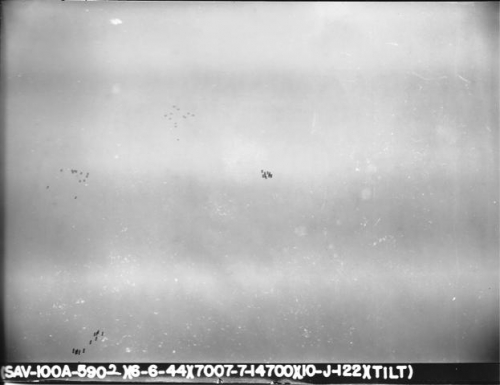
In a 10/10 undercast, bombs were away from 14900-15000 feet via Pathfinder guidance. On the route out, the 100B flew off course and as it passed over Guernsey Island, the 'meager but accurate' flak did damage to the ships flown by its lowest element. Chadwick’s ship, had two engines knocked out and a riddled wing forcing him to land at another base in England. While Brewer's ship sustained minor flak damage, Shelly was injured in the face around the eyes by flak.
All ships but Chadwick’s returned to base at 1100 hours.
Crews flying first mission of the day:
100A Lead Jeffrey/Clark, Dille, PFF, Schomp, Simmons, Wolf
High: Helmick/Howard, Ransom, Woldt, Greiner, Keys, Terminello
Low: Monrad/Williams, Schwank,. Rumley, Major, Fory, Anderson
100B Lead: Reeder/Kincannon, Elbel, David, Noordyk, Dunlap, Steussy
Low: Noble/Stapleton, Rosine, McEwen, Chadwick, Shelly, Brewer
100C Lead: Harris/Gorski, Lischer, Ryan, Evans, Rice, Roth
Low: Ehorn/Harrison, Gustafson, Allen, Townsend, Harding, Williams
Photo from: Century Bombers book - 100th BG D-Day Briefing
First of three missions:
Many of the Officers awakened at 0300 hours on June 5, were still awake when they were alerted at 2200 that same evening for an Officer’s briefing to be held in one hour. Having just completed his #2 mission, CP Keith Lamb, lucky to have hit the sack remembered, “had hardly fallen asleep after hitting Boulogne that day, when a jeep drove up to our barracks with the Sergeant, who announced there would be an 11 pm. briefing. Even the old-timers considered that unusual, never having had a briefing that early before…Ransom and the rest of us moaned a little but not for long. When we got down to briefing we soon forgot about complaining and found we were actually glad it was M.E.”
With lead crews previously briefed, at 2300 hours, S-2 Officer Marvin Bowman told the forty-two crews that D-Day was finally upon the Allies with ‘zero hour’ designated as 0725 on June 6, when the tide would be “midway between high and low watermarks and will be incoming.”
The 100th’s Primary target would be Ouistreham, France, a coastal town ten miles from Caen.
Joseph Costanza, WG on Keys crew recorded, “The Colonel himself gave us the news, and said, ‘Well boys, this is it’ with a big smile on his face but everyone was quiet.”
The Group’s official records include the following briefing message: “This is it; Later in the morning you will be a part of the greatest display of military, naval and air power ever conceived or realized. The invasion is irrevokably on - it cannot be postponed — it cannot be scrubbed. Objectives for heavy bombers during the early phase of the invasion are to knock out enemy strongpoints, coastal batteries, military headquarters, and choke points on military roads. In addition, it is hoped that the bombing of strong points and batteries will force enemy gunners to keep their heads down and will immobilize them just before and during the actual landings. Targets are small and close together in many places - they will be difficult to find. There will be no second runs on these beach targets. Ground troops are counting on you to knock out these targets and you must not fail them. There will be all types of friendly A/C in the area. Fighter bombers may be attacking your targets at the same time as you are. Medium bombers will be bombing on the right and may be seen withdrawing along your withdrawal route. Naval shelling may be taking place on your targets at the time of the attack. You will see many ships, boats and landing craft along the route. All surface vessels are to be considered friendly and are not to be bombed under any circumstances. Crews forced to leave their formation S. Of the English coast must not turn back against the main flow of air-traffic. Only A/C flying along the scheduled route will be considered friendly by naval gunners.”
The 13CBW would fly nineteen Squadrons. Led by the 95A, followed by 95B, 390A and 390B, the 100BG would fly five squadrons of bombers. Colonel Jeffrey would lead the 100th's formation, flying with Stanley Clark in the 100A. The 100B would be led by Major Sumner Reeder flying with Francis Kincannon and the 100C by Gorski and Harris.
The mission’s need for secrecy and logistics for thousands of aircraft in the air at one time, created the need for additional orders and Bowman continued. “In no case are flares to be used after departure from English Coast except by A/C in distress. A straggler is not considered an aircraft in distress. Aborting aircraft will turn right from bomber channel and cross English coast in at Portland Bill. Guns will be manned at all times but they will not be test fired on this mission. Only boats or ships heading toward the UK will stop to pick up crews members of ditched A/C.”
Keith Lamb tells us, “We took off at 3 a.m., and this was murder, assembling in the dark.” Following the briefed route in, the ships encountered meager flak and none at the target. Lamb continued, “Bombs were away at 7:03. The Channel was covered with clouds, so we couldn't see the landings. In the air our heavy bombers were in front of us and as far behind us as we could see. Below us were the medium bombers and fighters—underneath the overcast. The RAF and 15th Air Force from Italy were also out in full strength. Altogether, more than 11,000 airplanes were over Normandy. It was impossible to fly without getting into prop-wash.”
In a 10/10 undercast, bombs were away from 14900-15000 feet via Pathfinder guidance. On the route out, the 100B flew off course and as it passed over Guernsey Island, the 'meager but accurate' flak did damage to the ships flown by its lowest element. Chadwick’s ship, had two engines knocked out and a riddled wing forcing him to land at another base in England. While Brewer's ship sustained minor flak damage, Shelly was injured in the face around the eyes by flak.
All ships but Chadwick’s returned to base at 1100 hours.
Crews flying first mission of the day:
100A Lead Jeffrey/Clark, Dille, PFF, Schomp, Simmons, Wolf
High: Helmick/Howard, Ransom, Woldt, Greiner, Keys, Terminello
Low: Monrad/Williams, Schwank,. Rumley, Major, Fory, Anderson
100B Lead: Reeder/Kincannon, Elbel, David, Noordyk, Dunlap, Steussy
Low: Noble/Stapleton, Rosine, McEwen, Chadwick, Shelly, Brewer
100C Lead: Harris/Gorski, Lischer, Ryan, Evans, Rice, Roth
Low: Ehorn/Harrison, Gustafson, Allen, Townsend, Harding, Williams
Photo from: Century Bombers book - 100th BG D-Day Briefing
Bombing Results
Bombing Results:
Aircraft Lost: 0
Crew Lost: 0
Claims of Enemy Losses (CLS): 0
Aircraft Returned:
Formation Chart(s)
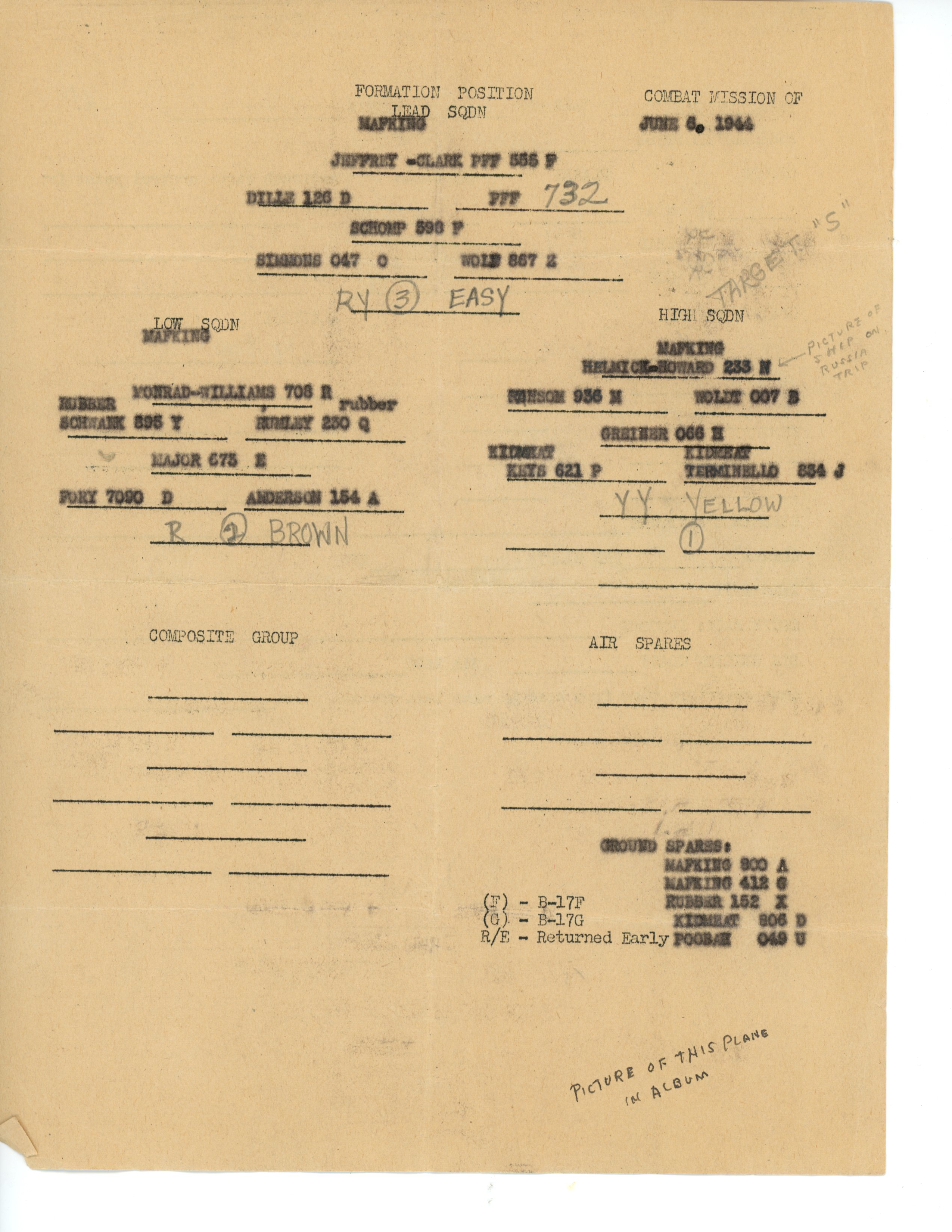
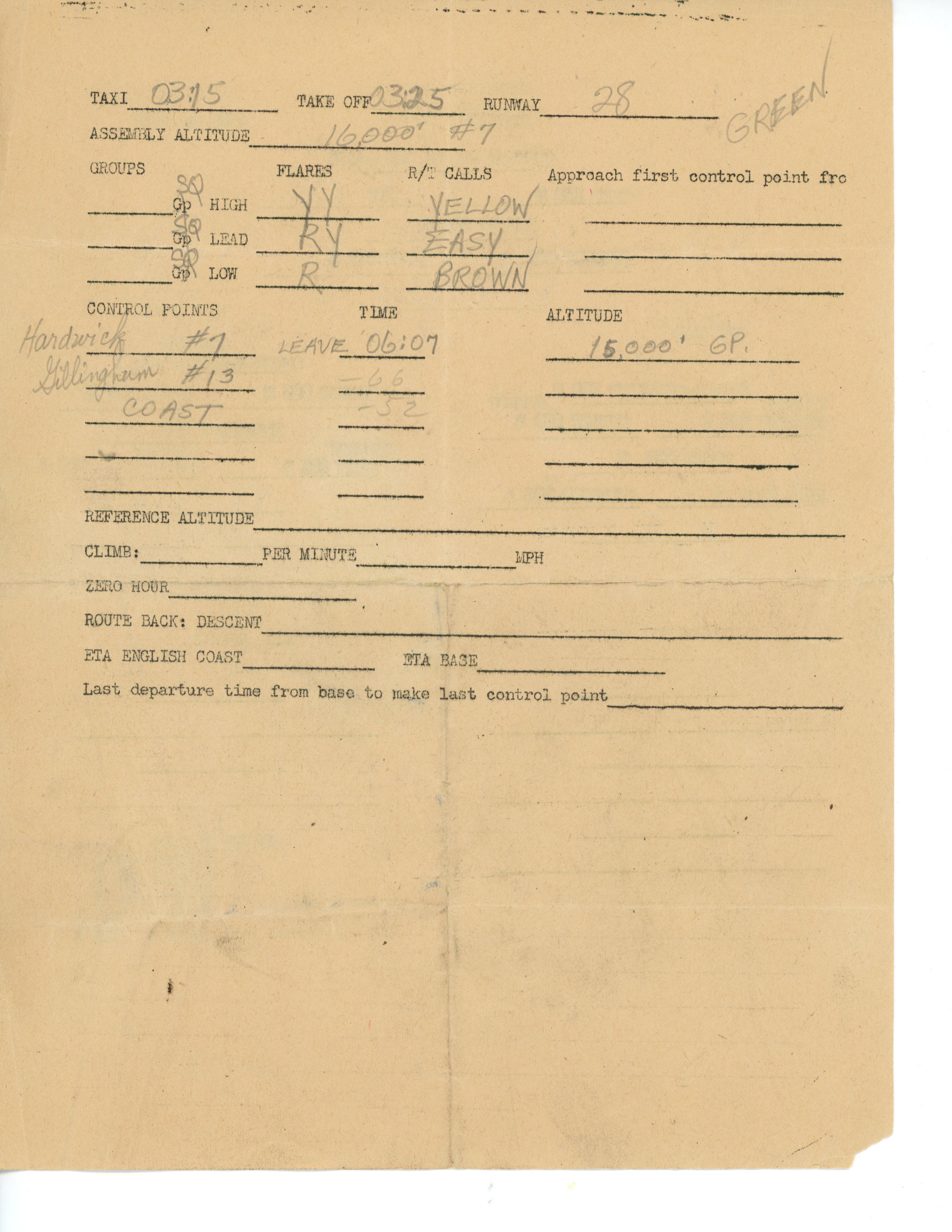
June 6, 1944 formation chart
Formation Chart
Media Articles
Use your thumb to scroll through the results box below.
| Media Item | Type | Page | Volume/Issue | Broadcast Source | Time | Description | File |
|---|---|---|---|---|---|---|---|
| June 6 1944 Formation Chart | 12:00 am | From the Richard Helmick Collection |