Mission Date: June 7, 1944
NANTES, BRIDGE
100th BG Mission #: 135
Mission Summary
ON THIS DAY...JUNE 7, 1944
The exhausted air crews finally had a chance to sleep for close to 11 hours before they were awakened again between 1100-1200 for their next mission.
In the late afternoon, the thirty-nine crews seated in the guarded briefing room learned that another tactical mission would be flown - to Nantes, France in the Loire. Their Primary target would be a bridge which the Germans were using to transport Panzer units to the beach head.
The crews were briefed to expect a heavy smoke screen at Nantes and were warned to not drop their bombs if they were unsure of the target. Second runs were approved if needed and bombing was to occur in group formation. As the routes in and out were reviewed, flak warnings were also given to avoid Le Mans as well as the twenty-two enemy guns located at Tours.
The 13CBW would fly three formations with the 100BG flying as its ‘A’ wing, the 95th as its ‘B’ and the 390th as its ‘C’. Leading the 100th’s formation would be Jack Kidd, flying with Richard Helmick. Its High squadron would be led by John Giles while the Low would be led by Andrew Gorski and Charles Harris.
With each B17 loaded with two 2000 lb GP bombs and 2300 gallons of fuel, the pilots took off under good conditions at 1730 hours. The three spare B17s flown by Woodall, Anderson and Tiahrt also took off with ultimately Tiahrt and Anderson filling open formation positions before crossing the water. Joseph Costanza, WG in Keys' ship gives us his perspective of what he saw below, “The ground crew didn’t even have time to repair yesterday’s damage. I put on my heated suit and harness while in flight at the coast of France. I could see hundreds of different kinds of boats. The coast we bombed on D-Day looked like a pin board. While going over France, we could see fire all over, and smoke filled the air.”
Encountering no flak on the way in to the target, the 100th’s formation made their turn at the IP to commence the bomb run when an accurate flak burst in front of the formation caused the 100th’s lead squadron to spread out due after taking evasive action. With continuous pointed fire and a reported two ground rockets, the 100th’s lead formation absorbed the flak: George Allen’s ship had two engines hit and the TG’s oxygen knocked out by exploding flak. Thomas Kemp’s ship was riddled with flak holes and his #2 engine damaged, Tiahrt’s ship was hit in the wing and his #2 main tank and Keys ship took flak in its rudder and Frank Barili, TTE in John David’s crew recorded, “…Frank E. Yates our left waste gunner was hit just below the kidney by flak… Our prop ran away twice. Once on the bomb run due to faulty adjustment of prop governor.”
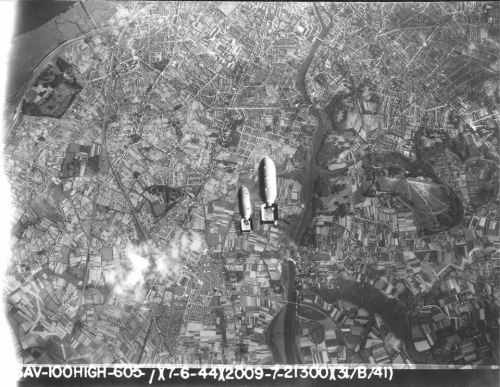
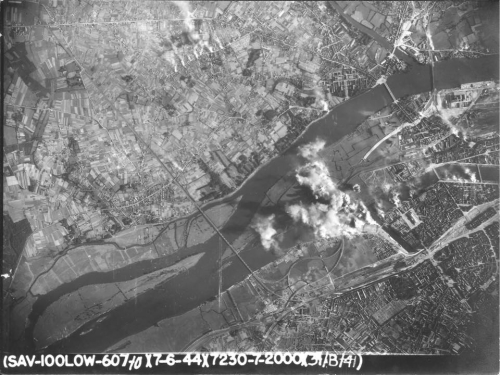
Flying through the exploding shrapnel, bombs were successfully away between 1903-1906 hours from 20000-21500 feet. S-2 Intelligence Officer, Red Bowman would later record, “Target smacked cold by high and low groups, with the lead group putting one 2,000 pound egg squarely between the rails.”
All ships returned to Thorpe Abbotts around 2300 hours except Allen’s damaged ship. According to his TTE, William Oberman, “We landed at a RAF glider base, about 40 miles south of London. We threw ammo and guts of machine guns and radio receivers out as radio man did not need to contact to contact base. This was done to maintain altitude.”
However, after the pilots had taxied to their hard stands, their excitement for the day continued. Emmett Schmitt on James Ransom’s crew remembered, “Just as we shut off the engines, we had a red alert and a German plane strafed the field at about 50 ft altitude. The ground gunners threw everything at him but the kitchen sink but he got away. Tracers flying all over like a 4th of July fireworks display. Two men hit while standing near interrogation room.” Ransom’s CP, Keith Lamb adds, “Tracers were passing about six feet over my head. I jumped from the bed of the truck to flatten out on the concrete….The Germans had followed us back that evening and were raising cain all over. A group of our B-24s were trying to land at their base right next to us, and a bunch of Focke Wulf -190s were shooting the devil out of them…I heard they got nine 24s from the field next to us. The attack was a complete surprise. Most of the gunners had already unloaded and disassembled their guns…From then on, our crew made it a practice never to unload their guns until after we landed and in our parking stall.”
Crews flying this day:
Lead squadron - Helmick, Keys, Allen, Townsend, Kemp, Harding, Mylius, Zapf, Dille, Eichen, Williams, McKeague
High squadron - Giles, Rogers, Steussy, Noordyk, David, Elbel, Chadwick, McEwen, Massol, Ransom, Simmons
Low squadron - Harris, Rice, Lischer, Rumley, Roth, Ryan, Major, Rowland, Neu, Greiner, Delaney, Cumming
Spares - Woodall, Anderson, Tiahrt
Bombing Results
Bombing Results: FAIR
Aircraft Lost: 0
Crew Lost: 0
Claims of Enemy Losses (CLS): 0
Aircraft Returned: