Mission Date: June 12, 1944
ROSIERES & DUNKIRK SHORE DEF
100th BG Mission #: 138
Mission Summary
ON THIS DAY...JUNE 12-13, 1944
Both the scheduled briefing Officers and the S-2 Intelligence Officers were notified at 2000 hours on the 11th that the 100th’s next mission’s orders were coming in from Headquarters. Briefed at half past midnight, the lead crews learned that their Primary target would be the Luftwaffe air depot at Rosières-en-Santerre, just east of Amiens, France and the Secondary at Bernay-Saint Martin, east of La Rochelle. “Last resort targets would be any bridge, railroad center, enemy transportation, enemy troops or other military objective not within the bomb line.”
At the 0130 main briefing, thirteen crews listened to their objective of rendering the air depots unserviceable. “During the period of 2 June to 9 June a wholesale transfer has been made from Germany to France of single and twin engine fighter units. Based on initial equipment of units, strength in France has increased by 425 single engine and 100 twin engine fighters….”
The Division line would be led by the 13A CBW, flown by the 95 BG. Following it would be the 13B CBW, led by the 390B, with the 100th BG’s twelve ships flying as its High group and the 390A flying as its Low. Mason and Herres would lead the 100th’s formation.
The crews of Herres, McKeague, Harding, Terminello, Gustafson, Ryan, Schomp, Dille, Zapf, Noble, Elbel, David and Dickert, listened to the warnings from the briefing Officer. They were reminded that no enemy aircraft had been encountered on the previous tactical targets and our gunners may have gotten careless, so they must be alert. “It is reported that ME-109s have been encountered with black and white markings similar to our fighter planes and crews should be briefed on this.” In regard to their route in and out of the target, they should avoid Ostend, Dunkirk and Courtrai. Two minutes prior to the IP, attacks would be made under a group peel off, announced by the Leader with a red flare.
With take-off at 0500 hours, the Group assembled and proceeded to wing assembly. At 0635, the 100th’s Lead squadron lost Gustafson’s ship when his #3 engine had problems, causing him to return to base early. Dickert, flying as the only spare, took his place in the formation. Then Zapf turned back at 0730 hours due to a non-functioning #3 supercharger.
With a reported 10/10 undercast at the Primary, the 13A and B Wings were reported to have flown around France looking for a target. Noting in his journal, S-2 Intelligence Officer, ‘Red’ Bowman wrote, “Ninety-fifth, leading took us all over France (excepting the target)” and Pilot William Terminello added, “We were over France at 07.30 and could not bomb our Primary. We were briefed to bomb any target of opportunity. We flew over plenty but did not drop our bombs.”
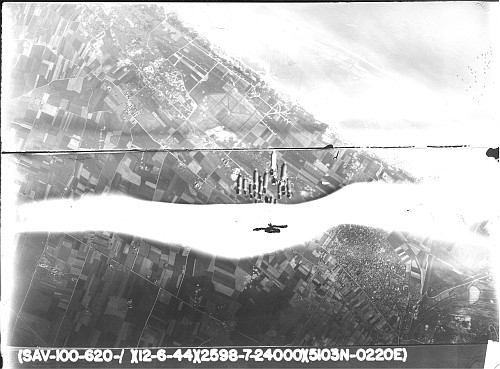
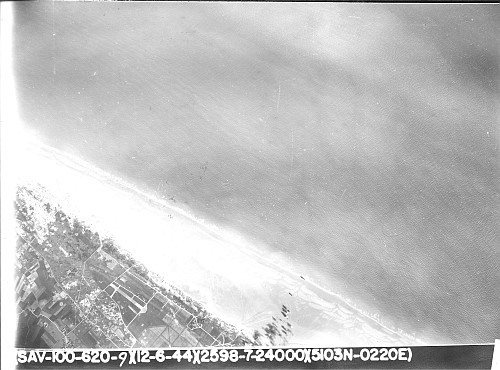
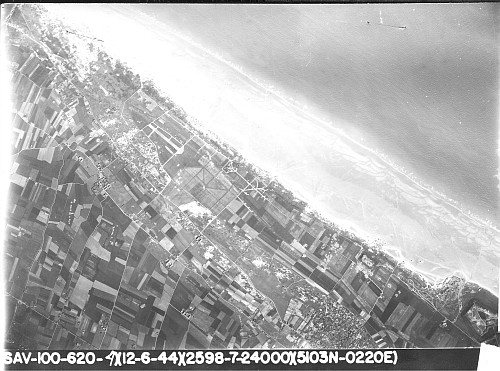
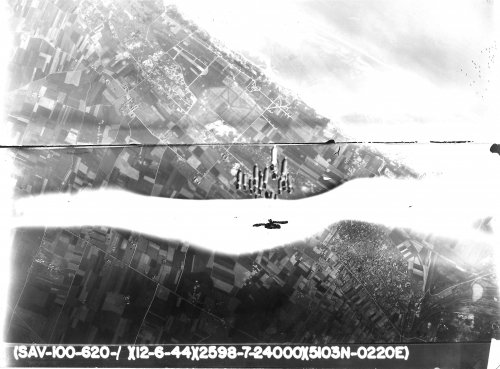
The 100th, separated from the other groups eventually made a bomb run on an area north of Dunkirk where the heavy bombers encountered continuous pointed fire from the flak gunners below. The accurately aimed shells hit eight of the eleven remaining ships from the 100th, shooting down Ryan and McKeague’s ships and damaging those flown by Dickert, Dille, Schomp, Herres, Terminello and Harding.
John Ryan’s ship was hit by flak at 0853 at 24000 feet, starting a fire between #3 and #4 engines. Believed to have been hit close to a gas tank, his ROG George Sherback remembered, “My last observation from the radio room was a fairly large hole that was enlarging as the skin was melting.” Then Ryan’s wing broke off and the ship went down in a spin, out of control and crashed into the North Sea.
Hit by flak one minute later, twenty-three year-old Pilot Edward P. McKeague tells us, “For we were on our way back, heading over the French coast, when several direct hits by flak knocked out three of our engines, smashed the ball turret, and set afire motor cowlings and other parts of the bomber. I ordered the crew to make sure their parachutes were okay and prepare to abandon the bomber…We were going into a dive when the crew began to scramble out…” McKeague’s TTE, George Penman adds, “…the ball turret had received a direct hit and that the Radio operator was assisting the BT operator out of the turret to render first aid to him, but in vain. The pilot called back the WG asking how the fire was and the WG told him it was getting worse. Pilot then ordered everybody to bail out as we would land in the vicinity of three mine sweepers we were headed for. I turned around and crawled through my top turret and on to the catwalk in the bomb bay and jumped. The bomb bay door would not close electrically after release of our bombs thus preventing any possibility of ditching.“
While the remaining ships continued their return to base, McKeague’s crew had bailed out. Landing in the water, McKeague tells us, “I couldn’t unbuckle my harness, so I took a knife from my pocket, cut all the shroud lines…My boots were water-filled, and were weighing me down into the water. I was unconscious when they rescued me…I had been in the water 45 minutes when I was rescued by a British lifeboat, not far from the English coast. I guess I was pretty badly shocked. They brought me to a Marine hospital to recuperate.” Also surviving the bailout, George Penman wrote, “I landed about 3,000 yards away from one mine sweeper and was in the water, as told by the Captain of the ship, for about 20 minutes.The same mine sweeper brought our RWG and myself back to Dover where we were in the Hospital eight days before returning to our home base." Rescued were McKeague, Penman and Gallagher while the other crew members of CP Ritter, NAV Louros, TOG Peters, ROG Allen, BTG Swafford, LWG Hudnall and TG Pellegrino were all killed in action. McKeague however would die three months later due to complications from his bailout.
ROG George Sherback would be the only crew member to survive from John Ryan’s ship. According to Sherback, he did not remember leaving the plane and believes he must have been blown clear. Landing injured, he was taken as a POW. Sherback remembered, “Conversation with German officer after first aid to wounds. This officer held the rank of Captain, was a Cambridge graduate and spoke excellent English. After some first aid for my wounds, I was taken to a bunker where this officer informed me that our aircraft had exploded and fell into the channel and that all of my comrades were lost.” Killed in Action were: P Ryan, CP Tobiczyk, NAV Chorpenning, BOM McGinty, TTE Fenner, BTG Healy, RWG Whipple, LWG McFarland and TG Elmer Anderson. This was the crew’s first mission together.
That night, the base was alerted for their next mission. Intelligence Officer ‘Red’ Bowman recorded, “Waited all night for a 0115 briefing for Fallersleben. At midnight, Combat Wing notified us the target would be changed. At about 0130 they decided there would be no mission and another night had gone to hell. Weather presumably to blame. The Jerries must have some arrangement with the devil.”
Bombing Results
Bombing Results:
Aircraft Lost: 2
Crew Lost: 17
Claims of Enemy Losses (CLS): 0
Aircraft Returned: