Mission Date: June 15, 1944
HANOVER , WILSTER, CITY (ST)
100th BG Mission #: 140
Mission Summary
On the 14th, Colonel Jeffrey and ‘Red’ Bowman had been at a meeting at Division headquarters to hear about a planned shuttle mission to Russia, from where the Group would make several missions and then return home via Italy. Expected to be briefed at midnight that same evening, the mission was scrubbed. According to Ed Wolf, “Certain crews on field were restricted, ours being one of them. Tonight we were told to pack clothes for about one week’s wear - we were given flea power. Arose 2230 for briefing - takeoff delayed, mission scrubbed.”
Instead, a pre-briefing was held at 2300 hours for a mission to Germany. At the main briefing, held at 0100 hours on the 15th, Captain Bowers briefed twenty crews for the mission. Pulling the curtain back, the red string went to Misburg, Germany just five miles E of Hanover. The 100th’s Primary target would be an oil refinery at Misburg. Their Secondary target would be the Celle air depot, NE of Hanover while the target of last resort would be “any military objective identified in Germany.”
The 13A CBW would lead its Division, followed by the 13B, 4A, 4B, 45th CBWs. The Wing’s 13A would be led by the 95A BG, with the 95B flying as its High group and the 100BG as its Low.
Flying as Command Pilot for the 100th’s formation would be Robert Rosenthal who would fly with John Giles. Completing the Lead squadron would be Brewer, David, Rosine, Elbel and Smith. Monrad would lead the High squadron with Dickert, Ransom, Terminello, Harding and Kemp while Evans would lead the Low with Houghton, Jones, Schwank, Johnson and Rowland.
S-2 Officer, Bowers briefed the crews that zero hour was designated as 0615 hours. Further, orders from General LeMay indicated that the Primary target was to be bombed in Group formation while the Secondary and any target of opportunity were to be bombed in Wing formation.
The route and times would put the formation over the primary target at 0816 hours with an expected time of return back to base at 1120 hours, in time for chow. Bowers warned the crews however to take care crossing the enemy coast at Cuxhaven and Bremerhaven due to the expected flak.
At the target, one hundred and twenty guns were expected in the target area and it was believed that at least thirty-four of them would be able to reach the Fortresses on the bomb run so they were to make sure they made a sharp right after bombs away to avoid the main defenses at Hanover.
Further warnings were given to the Officers to keep their Gunners alert and for the pilots to ensure that they flew a tight formation as the 1st Division had been interrupted in Paris by enemy fighters. Two minutes prior to the IP, the 100th would implement Plan X, a Group peel off utilized by the 13A wing only and to be announced by a red flare at the fan out point.
Loaded up with ten 500 lb bombs, take-off was at 0400 hours and the Group and Wing assemblies were successful without incident. Two spares were sent up with the eighteen named crews in the 100th’s formation. Rowland dropped out of the formation early and Gustafson, the first spare took his place. Unneeded, JD Williams, the 2nd spare, returned home to base.
With flak encountered throughout their time over Germany, at the turn at the IP on the flare, the Groups peeled off with the 95th heading over the Primary target and dropping its bombs under its PFF ship guidance due to the 10/10 cloud coverage. The 100th's formation, flying without a PFF ship to direct its bombing efforts, held its bombs and headed to the Secondary target. The Hanover defenses put up intense and fairly accurate flak, with continuous pointed fire on the 100th's formation as well as the 95B flying ahead. Serious battle damage was received by both Gustafson's and Johnson's ships over Hanover. Over Celle, flak from it and the western Hamburg defenses damaged Schwank’s ship.
Unable to bomb the primary target, Emmett Schmitt on Ransom’s Crew tells us, “Unable to see the target because of 10/10-cloud cover. Also unable to bomb secondary target which was an airfield 12 miles north of Primary target. Went back over the North Sea and went back in for our second run. Dropped our bombs on the town of Wilster and started for home. Had good fighter escort of P-51's and P-38's, no enemy fighters seen but flak was very heavy. Got a piece of flak in our left wing.”
The 100th was not going home without hitting a target and a target of last resort, Wilster was hit when the bombs were away at 0909 hours from 19600-20400 feet altitude. After bombs away, the formation turned left and hit flak again at Scharnharn Island, although meager. Seeing a large convoy beneath them, Rosenthal swung his Group north and left to avoid them but the convoy also put up flak which was fortunately inaccurate. Finally, flying out close to Heglioland, more flak was encountered, reported at a good altitude but out of range.
All ships returned safely to Thorpe Abbotts after an eight hour long mission. William Terminello noted, “We were really tired when we got home as we flew the second element lead of the high squadron, which is the hardest position of all to fly.”
After interrogation and chow, the airmen dropped into bed, some alerted for the next day’s mission.
Bombing Results
Bombing Results:
Aircraft Lost: 0
Crew Lost: 0
Claims of Enemy Losses (CLS): 0
Aircraft Returned:
Photos
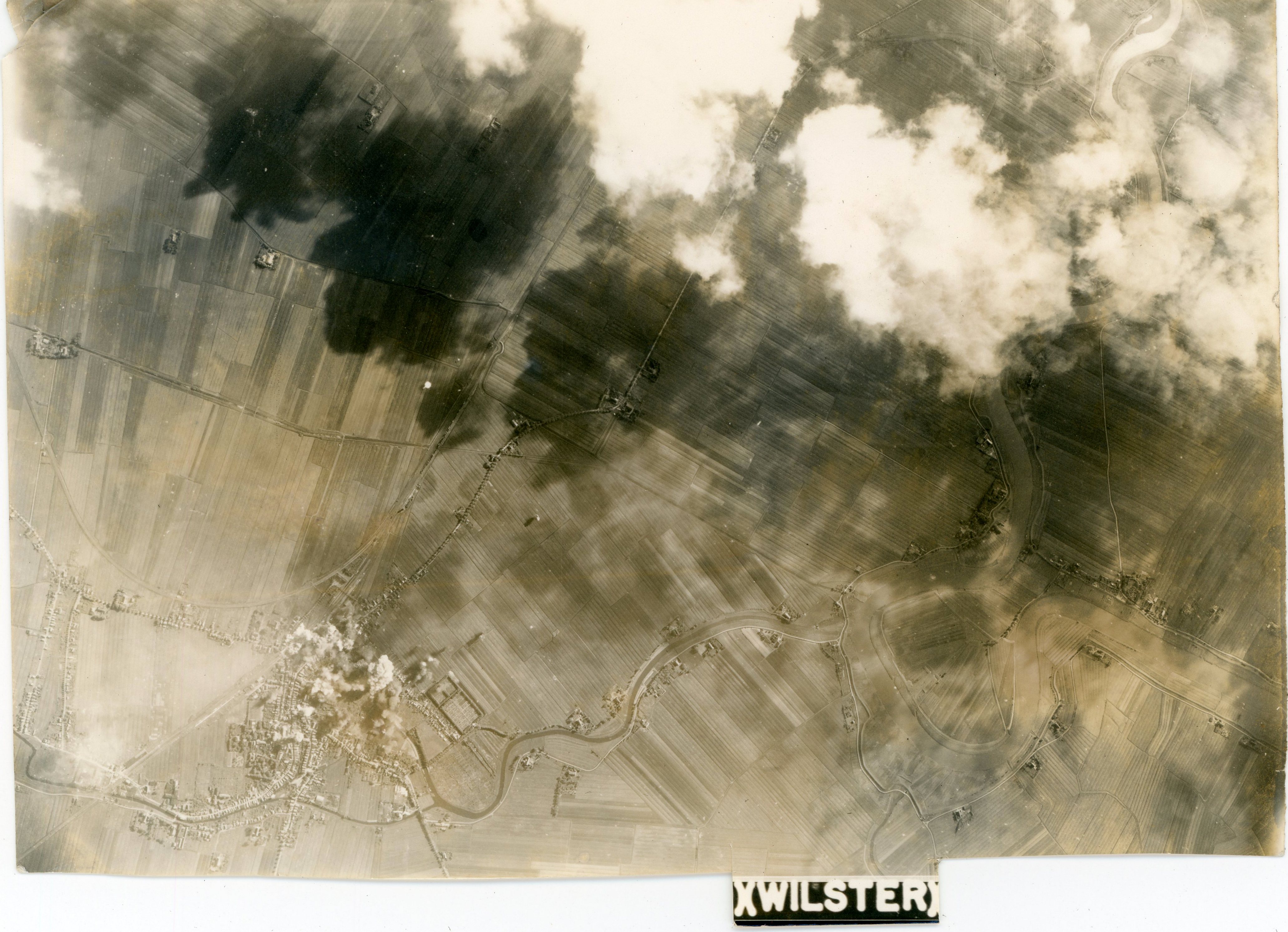
Wilster Strike Photo
Wilster Strike Photo (Bruzzone collection)