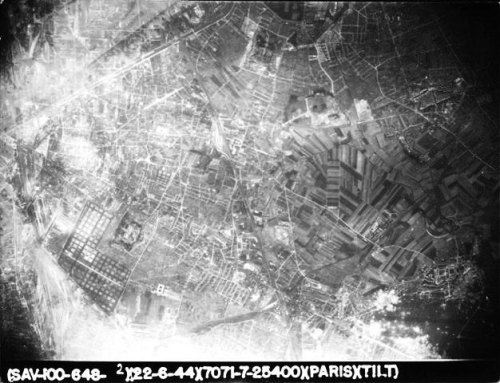
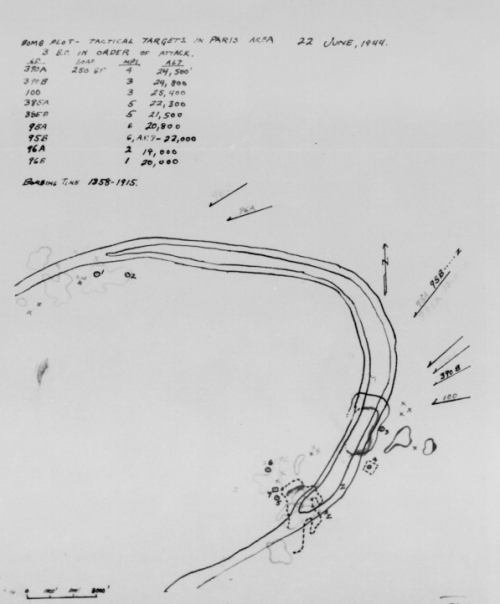
Mission Date: June 22, 1944
PARIS, RIVER DOCKS
100th BG Mission #: 146
Mission Summary
Under Field Order 284, the 100th was ordered to the Paris area with an assigned tactical target of river docks. The 100th would fly as the High group in the lead wing of the 3rd Division’s column of B-17s. Briefed that afternoon were the crews of: Dunlop, Rowland, Johnson, Anderson, Jones, Miller, Forsythe, Delaney, Woodall, Harris, Kassebaum and Lambert.
Captain Robert Rosenthal would fly as Command Pilot with Dunlop, and would also be the designated Deputy Wing Leader.
Still located at the 95th’s base in Framlingham due to ongoing repairs at Thorpe Abbotts, twelve ships took off at 1452 in the afternoon and formed up successfully as a group. Forming with the 390BG’s ships in the Lead and Low, the 13A wing formation was successfully completed without any issues.
With the 13A leading the 3rd Division’s column, the 4A CBW, 13B CBW and the 4B CBW fell in line behind. Avoiding Caen and Le Havre on the route in, the enemy coast was crossed at 1736 hours. Flak from Chartres, aimed at the 390BG in the lead was continuous pointed fire, although meager and inaccurate.
Reaching the IP at 1850 hours, as the formations in the wing began their turns onto the bomb run, five German ME-109s came in from the 12 o’clock high position with four passing in front of the 100th’s formation, not attacking. The fifth ME-109 “peeled off" and came in level at 12 o’clock.” James A. Morrow, TTE in Herres’ lead ship in the Low Squadron, stated, “5 E/A came in at 12 o’clock abreast. I had the far left E/A framed at 1000 yards out. I started firing at E/A when he came to within 800 yards. He kept on coming in with smoke streaming from his tail. I kept firing all the time. The E/A executed a ‘snap roll.’ I saw smoke streaming from rear of E/A. The TG saw E/A nose down as it came within his vision and then saw E/A’s wings wobble from side to side as if out of control with smoke pouring from his right wing at fusillage and from engine. Last seen in a dive straight down towards the earth.”
Continuing on the bomb run through the intense, pointed fire, one-half of the 100th’s ships were absorbing flak damage, with Anderson’s, Miller’s and Jones’ ships all receiving major damage. Jones’ TG, twenty-one year-old Herbert W. Beyer from Wisconsin, was severally wounded by flak in his right foot.
Haze and clouds were encountered at the target and although a second bomb run had been authorized, only one was needed and the 100th’s bombs were away at 1858 hours from 25400-25500’ altitude with black smoke reported seen rising up to 10000 feet. From the target to the Rally Point, the flak became even heavier and accurate on all sides of the formation. Pilot Leslie Kassebaum remembered, “God, What flak”
However, the 13A returned to England as briefed and with no further encounters with enemy aircraft or flak. Ten of the 100th’s ships landed back at Framlingham while two landed back at Thorpe Abbotts. Severally wounded, Beyer would require a lengthy stay in the 65th General Hospital and Morrow, credited with the destroyed aircraft would later be awarded the DFC.
All crews welcomed the Stand Down order for the next day.
Meanwhile in Russia, the shuttle crews were in Mirgorod and after the red alert for enemy aircraft spotted the previous night, it was anticipated that the Luftwaffe would soon be back in force. Without sufficient anti-aircraft protection, it was decided that all of the Groups should be dispersed. A plan was developed for the B17s to take off just before dark, flying low under any radar detection and land at other bases further away so the 100th and the 95th were ordered to Kharkov while the 390BG went to Zaporazhe.
As the ships taxied for take-off, a problem arose with Colonel Jeffrey’s ship. Red Bowman, the S-2 Officer and a passenger on his B-17 recorded, “On taxiing, however, Colonel Jeffrey put a wheel through a weak spot on the runway, so we watched the other planes depart for Kharkov. Colonel Jeffrey’s plane, the Pathfinder and two others were left on the field, one the victim of a flat tire, the other needing an engine change. The Jerries sure changed it that night.”
Forunately, the crews were safely in Kharkov when at 0100 hours, just into the next morning, seventy-five to one hundred German JU-88’s bombed the hell out of the field. The 96BG was not so lucky at Poltava, where over sixty of their B-17s were destroyed.
Bowman added into his comments, “Due to the sudden need for dispersal, the Russians at the dispersal air fields had but little time to prepare for our personnel. It is felt that, all things considered, an excellent job was done."
Bombing Results
Bombing Results: GOOD
Aircraft Lost: 0
Crew Lost: 0
Claims of Enemy Losses (CLS): 1
Aircraft Returned: