Mission Date: June 25, 1944
SOUTH FRANCE, MAQUIS SUPPLIES
100th BG Mission #: 148
Mission Summary
At the 95th’s base at Framlingham, twelve of the 100th’s crews were briefed for their next mission by James D. Shirley, the S-2 Officer from North Dakota. They learned that they would be flying to Southern France on a secret tactical mission codenamed ‘Zebra,’ dropping needed weapons to the French Maquis.
To understand the objective of their mission, the Intelligence summary in Field Order 289 read,“The French Maquis (Partisans) in Southern France have been rendering far more assistance to the allied invasion than was ever thought possible. Not only did their activities delay for several days the movement of the 2nd SS Panzer division from Toulouse to Normandy, but it now appears likely that both the 9th and the 11th Panzer Divisions will be pinned down in South France in an attempt to restore the situation for the Germans. In addition to this enemy armor, the Maquis are also tying up substantial numbers of German Infantry troops.
To cope with the situation the Germans have recently launched a large scale offensive against the Maquis. Several of the areas controlled by the French have already been lost to the enemy, necessitating several changes in planes for this operation. On June 20th this message was received: ‘We are being attacked by two divisions coming on all roads…We ask urgently for assistance…’ Unless weapons and ammunition reach them soon, thousands of these allies of ours will be slaughtered and this diversion of German Strength will be ended.”
Shirley briefed the crews that all details of the mission were to be treated with the “utmost secrecy. The purpose of the mission, the type “bomb load” carried, route, target areas, and all similar details will remain secret after the mission has been completed, and crews will not discuss the mission even on their own bases.”
The 3rd Division would fly five wings on this special operation: 4A, 4B, 4C, 13 and 45 CBWs, each flying three groups of twelve ships. Each would have a separate Primary target except for the 13th and 45th CBWs, which would have as a Primary target, number 5 codenamed ‘Salesman’ and a Secondary target of number 11, codenamed ‘Locksmith.’ The 13 CBW would fly the 95BG as its lead squadron, with the 100th flying as its High and the 390th as its Low.
Flying as Command Pilot would be Herbert Howard, who would also fly as Deputy Wing Leader with Neal Scott. Edward C. King would be their lead Navigator. Completing the lead squadron would be Zapf and Smith with Rosine as 2nd element lead with Keys and Houghton. The High element would be lead by Herres with Johnson and Kohler while the Low would be led by Gibbons with Paul G. Jones and Dickert. Eden C. Jones and Kennedy would fly as the two spares.
Shirley additionally briefed the men that their timing must be made good as the bonfires that will signal their target zone would not be lit until just before the briefed target times. “If Primary or Secondary bonfires are not positively identified, containers will not, repeat not be dropped…As an aid to more positive identification of correct dropping area, there may repeat may be men waving red flags on field. Also a large square of cloth may be displayed. Bonfires should be visible for at least 5 miles.”
Warned about the known flak areas, the crews were also warned about enemy troops in the vicinity of the targets; at La Courtine to the North and Tulle to the southeast of the ‘Salesman’ target. Importantly, each lead B17 would carry two Navigators. On the initial run, wings were briefed to fly over the targets at 3000 feet, identify the targets, check wind, then start their letdown with the groups dropping in intervals and on an upwind run on the target.
With a start engine time of 0330 hours, the bombers topped off with gas, took off at 0400 hours. Each Fortress had been loaded up with twelve 300 lb ‘bombs,’ containers of small arms, bazookas and ammunition except for the lead ship which carried twelve ‘500’ lb. ‘bombs.’
Successfully forming the 13CBW, the formation headed out across the channel into France with the two spares unneeded, returning to base.
Entering enemy territory in northern France under CAVU conditions, the formation headed south towards Le Mans where the 100th’s ships encountered moderate, continuous pointed fire flak, knocking down ship #859 flown by Kenneth Houghton, a copilot who had taken over Major’s crew as first pilot five missions earlier. After hit in the trailing edge of the wing and starting a fire in the #3 engine, pilots Houghton and Thornton Bline, peeled out of formation. Last seen at 0735 hours trailing the Wing’s formation and under control, eight chutes were seen coming out of the ship.
At the sighting of the target at 0947 hours, two and one-half miles from Meymac in the Nouvelle-Acquitaine region, the formation made its first run on the target from 3000’ altitude. Pilot Paul Kohler recorded, “Field was not as briefed - not a mile wide but fires were easily visible. They were correctly placed but the triangle just about took up the whole field. Results good with chutes and equipment covering the clearing.”
As instructed, the groups peeled off. Scott’s lead bomber fired a red flare and the Low element pulled abreast and level with the Lead element. Rosine’s 2nd lead element pulled to the right and came up abreast and level with the Lead element. Herres’ high element dropped back and left, falling in behind the lead element. Over their target, the eleven remaining ships in the 100th’s formation dropped from 2000’ at 1002 hours where an estimated one hundred people were seen picking up the chutes and materials. Also dropped on that mission were a number of ‘very special passengers,’ OSS agents, “with orders to instruct the Partisans on how to use and maintain the weapons.”
Circling to form up as a wing after bombs away to maximize fighter coverage, the 13 CBW hit the Rally Point at 1020 hours. Heading home and flying through more flak at 1200 hours, the formation reached the Brittany coast at 1233 hours, landing back at Framlingham at 1305 hours but without Houghton’s crew and their ship ‘Any Gum Chum.’ Although considered minor, six other pilots returned their ships with battle damage: Scott, Keys, Kohler, Johnson and Jones.
The crews were grateful when they were notified of a two day Stand Down.
Houghton and his crew had successfully bailed out before his ship crashed in France. Four of the crew evaded capture: P Houghton, CP Bline, ROG Deatrich and LWG Eckley. Four of the crew, NAV Green, BOM Lichtenstein, TG Moore and BTG Nelson all became POWs. Only 20 year-old TTE James Marion from Indiana was killed in action. Later writing a letter to Marion’s mother, Eckley was quoted as writing, “Everyone jumped because the plane was burning, and the gas tanks were on fire. For some unknown reason Sergeant Marion’s parachute failed to open. He was found by the French and given a church burial, in a cemetery in France.”
Meanwhile in Russia…
The crews were on the move again and the Russian people at Karkov were sorry to see the Americans go. Harry Crosby wrote, “Karkov gave us a grand farewell. All the women who had them wore gaily colored dress. Some of them dug up rouge and lipstick. And they hurled roses at our trucks. Little girls gave us bouquets.”
The crews from Karkov and air executives from Kirovograd had all returned to Mirgorod. Crosby continued, “At the base it was evident what an attack we had missed. The runways had been repaired but the field itself was pitted like the side of a colander. All the time we were there the demolition squads were exploding delayed action and dud bombs.”
The ships had been loaded with bombs but the mission was scrubbed and the bombs were soon unloaded without complaint.
Due to fly a mission the next day to Poland and then on to Italy, the 100th rested prior to taking off at 1900 hours that evening for another low altitude trip, to the airfield at Kirovograd where according to Red Bowman, “we slept on the ground under the wings, expecting an attack, but none materialized.” Harry Crosby adds, “For our supper we had C-rations. Yet that supper clings to my memory. It was cold, so we ate in the waist of the plane…Nobody said very much…Outside was Russia. Tomorrow was Italy. We were very young. The United States was very far away. We have seen so much, fought so long.”
Bombing Results
Bombing Results: EXCELLENT
Aircraft Lost: 1
Crew Lost: 10
Claims of Enemy Losses (CLS): 0
Aircraft Returned:
Photos
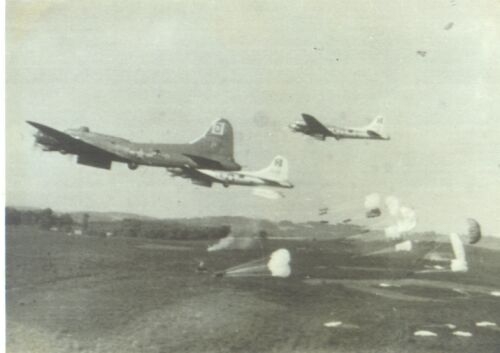
Maquis Supply Drop
Supply drop at Maquis June/July 1944 (100th Photo Archives)