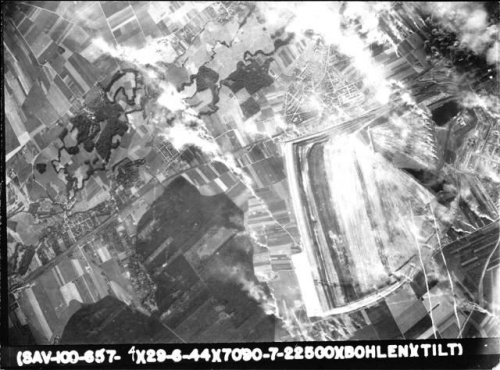
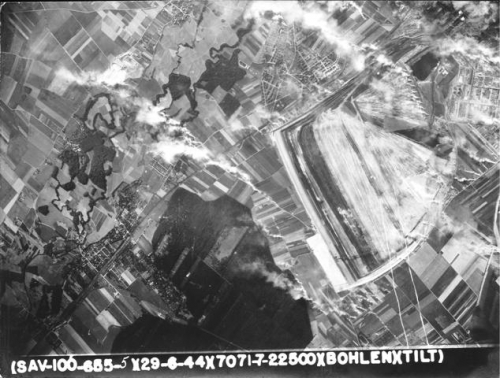
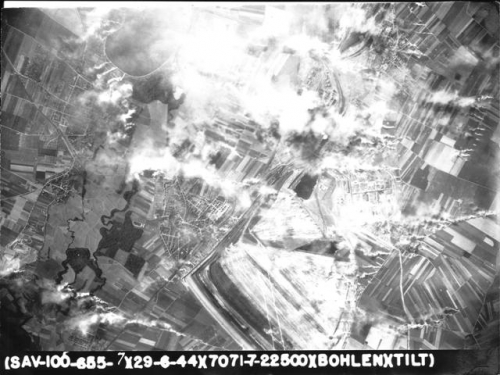
Mission Date: June 29, 1944
BOHLEN, OIL REFINERY
100th BG Mission #: 150
Mission Summary
ON THIS DAY...JUNE 29, 1944
Now back at their home base at Thorpe Abbotts, fourteen crews were seated in the briefing room. With the base’s cooks getting back into the flying crew’s early eating times, some of the airmen were irritated that morning. Food mattered on a long mission and some of the enlisted men were not awakened early enough to even eat breakfast and for the officers, the pancakes were only ready five minutes before the scheduled briefing time.
Field Order 295 would send the 100th deep into Germany where they would attack a synthetic oil plant at Böhlen, ten miles south of Leipzig. Their Secondary target would be an aircraft component plant at Wittenburg. The 13CBW would fly in the 8th’s first force between the 4th and 45th CBWs, with the 4CBW leading. The 100th’s wing, led by the 390BG, would fly the 95BG as its High squadron and the 100th as its Low and would also include an additional six ships and crews supplied by the 390th.
Scheduled to lead the 100th’s formation was Herbert Howard, flying as Command pilot with James Noble. Completing the first element lead would be Anthony Gallagher and John Keys. William Ryan would lead the second element with Murray Johnson and Eden Jones as his wingmen. The Low flight, led by John Gibbons would have Neal Scott and Stanley Major as his wingmen while their second element led by Harold Tiahrt, would be completed by William Kennedy and Paul Kohler. The 100th’s Harvey Rowland and Dale Darby would fly as spares. The 390th’s flight would contain the crews of McKee, Weaver, Chandler, Lackey, Hill and Brown.
Loaded up with the maximum about of fuel and twenty 250 lb bombs, all fourteen ships took off from Thorpe Abbotts as briefed. Successfully assembling in the early morning haze and cloud over England, at 0631 hours, Gallagher aborted five miles N of Orfordness due to an oil pressure problem in his #4 engine and Darby took his position. The wing encountered 10/10 clouds as it crossed the channel with Kohler returning to base when he was unable to catch the formation due to a runaway prop slowing his speed.
As the formation neared the target area, 8/10 cloud coverage was encountered and the flak could be viewed coming up ahead. In Kennedy’s ship, ROG Norman Edwards remembered, “I vividly remember saying to myself ‘What am I doing here and looked out my window and saw flak as thick as clouds and I called Al, the engineer, and asked if we’re going through that and he replied ‘yep’ and I thought ‘a man can get hurt up here.’"
At 0850 hours, as the formation neared their turn at the Initial Point, “15-20 ME 109’s climbed and positioned for a mass attack from 12 o’clock high. Lead Wing turned at IP onto run, the e/a came in. P 51’s intercepted, broke up their formation and only 3 e/a attacked.”
The gunners on Ryan’s ship focused on the three ME-109s that had pressed the attack. TTE Kenneth Foster tells us, “I saw three e/a coming in at 11 o’clock, a little high and abreast. I picked the e/a on the outside to my left and started firing at a distance of a thousand yards. The e/a came to 500 yard where pieces began falling off and then he exploded. I then picked the center one but he got on through.” At the same time, BOM Robert Nietz “Saw three e/a coming in abreast. Picked out one on the inside of my right and opened fire at 700 yards. I tracked him in and he blew up when he was about even with us.” And Ryan’s BTG Joseph Keenan took care of the last one, telling us, “Tail Gunner (Joseph Robstock) called my attention to e/a and I drew on him. I opened fire at 800 yards as he came in at 5 o’clock low. He fell away in a steep bank @ 600 yards smoking badly and fell straight through the clouds.”
In only three minutes, Ryan’s gunners had destroyed the German fighters while the formation continued flying into the intense flak bursting on all sides of the formation. Making the turn at 0854, the flak continued all the way through the bomb run. Able to find a hole in the clouds, bombs were away between 0859-0900 hours from 22500-23000 feet. After making a sharp turn and losing one thousand feet in altitude, evasive action was taken and Keys tells us, “Lost altitude, zig-zagging to evade flak for 6 miles S of target.”
Making the Rally Point, the 13CBW headed back to England with the 100th landing back at Thorpe Abbotts, bringing five of its ships back with battle damage. Although recorded as minor, the ships of Johnson, Tiahrt, Major, Scott and Gibbons all were damaged by flak. Ryan’s gunners were ultimately credited with two destroyed and one probable.
That evening, a Stand Down order came. Bad weather over the continent would keep the Group grounded until July 3.
Meanwhile in Italy, Red Bowman tells us, “Colonel Jeffrey, Clarke's crew and several others were flown to Naples by Colonel Kurze, the Swoose Group Commanding Officer. Spent the day sightseeing and visited Pompeii and other points, including an Allied Officer's Club on the mountains overlooking Naples and the bay. Best day of the shuttle raid. At night we were alerted again - for a target worse than Naples according to the 5th. Again we scrubbed - saved by the bell.”
And the three shuttle crews after having landed in Tehran, were on the move again. TG Vincent Wood on Mylius’ crew recorded, “Left for Cairo, Egypt and got there at 3:30pm (7hrs 45 min flight). We stayed in Cairo for 6 days and had quite a time.”
Bombing Results
Bombing Results: HIT T.A.
Aircraft Lost: 0
Crew Lost: 0
Claims of Enemy Losses (CLS): 2
Aircraft Returned: