Mission Date: July 3, 1944
ARAD, MY (RUMANIA) RUSSIAN SHUTTLE
100th BG Mission #: 151
Mission Summary
ON THIS DAY...JULY 3-4, 1944
From England to Italy, the 100th’s crews had been on a stand down for three days due to poor weather over the continent, continuing into a fourth day for those at Thorpe Abbotts.
In Italy however, twenty-five crews from the 100BG were awakened at 0400 hours for the day’s briefing where they learned that the 13CBW would fly with the 15th Air Force to attack the marshalling yards at Arad, Romania.
With the 100BG leading the formation, the 390BG would fly as its High and the 95 BG as its Low in a composite group with five ships from the 100th and two from the 96BG. The 100th’s crews as the 95th’s Low flight would be led by Zeller and Helmick.
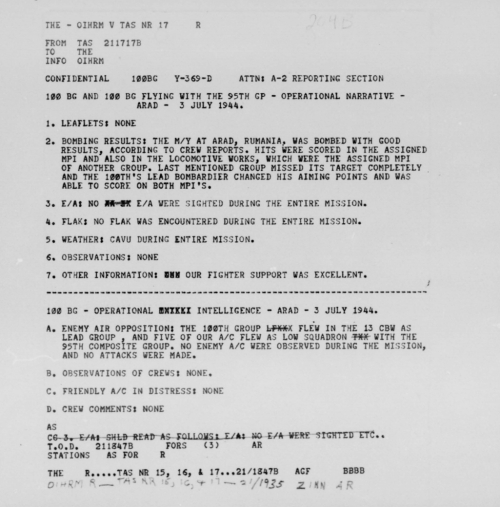
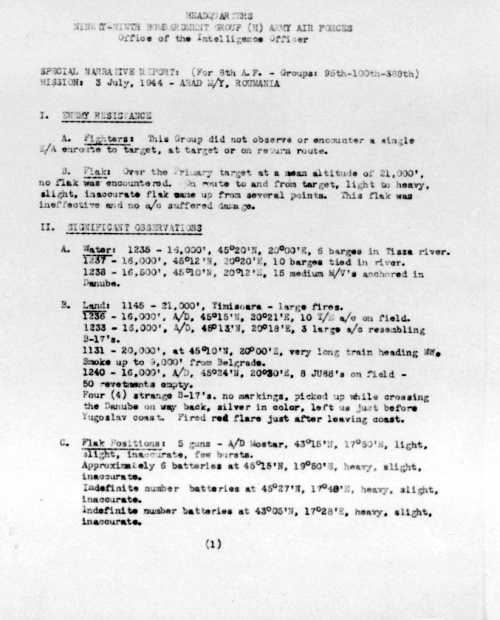
Loaded with twelve 500 lb bombs, a successful take-off and assembly was made and the Italian coast was crossed at 0955 hours where the climb to bombing altitude started. Crossing the enemy coast, the formation followed their route to their IP, reaching bombing altitude at 1146 hours. Encountering little flak and no enemy fighters, ROG Emmett Schmitt on Ransom’s crew remembered, “This was our easiest mission as we only saw 34 bursts of flak over a town in Rumania. Saw the Danube River again, which looked very muddy.”
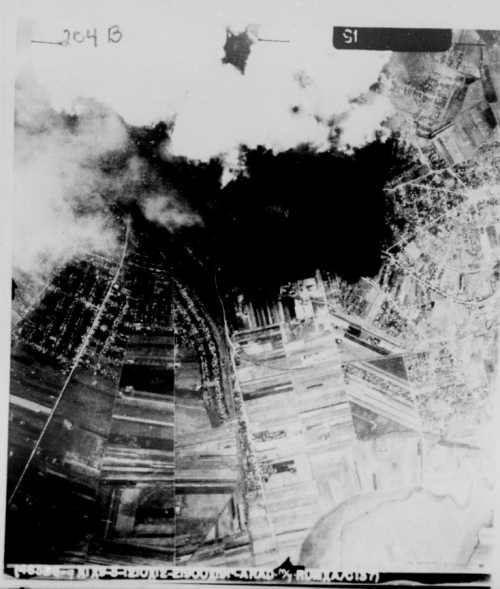
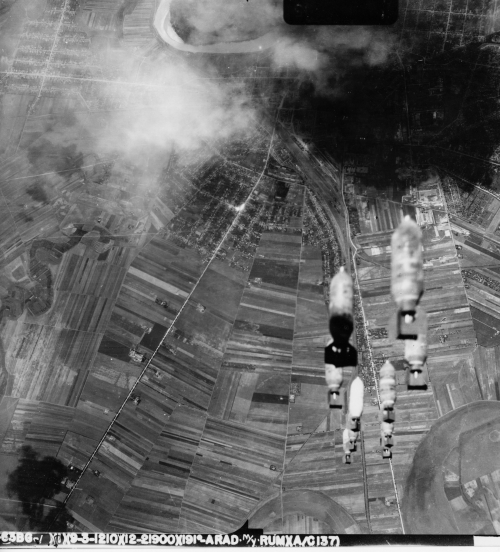
As it followed the 15th Air Force under CAVU conditions at the target, the 13CBW dropped their bombs. It was reported that the 100th’s lead BOM, “changed his aiming points and was able to score on both MPIs.” Bombs were successfully away at 1213 hours, demolishing the target. S-2 Officer Red Bowman, proud of the 100th’s results wrote, “The 100th journeyed to Rumania with the rest of the 13th Combat Wing to show the 15th AF how things are done in the Big Leagues. Target was a marshaling yard at Arad. No flak, no fighters and no marshaling yard anymore.”
With the Rally Point made as briefed, the formation followed the route out, crossing the enemy coast at 1340 hours. All B17s returned safely to Italy after a seven hour flight. Harry Crosby tells us, “It was a milk run, and all the 8th Air Force boys joshed the 15th Air Force types that they had it so good. I kept whistling to myself the entire mission, which was so easy we did not even go to altitude and put on our oxygen masks.”
The next day, the crews in Italy were stood down and enjoyed their surroundings and the Italian sun for another day. Emmett Schmitt on Ransom's crew tells us, “We spent the 4th of July by sleeping late and went to a rodeo in Foggia in the afternoon. At nite we went to the Club and drank cherry brandy as usual.” His CP Keith Lamb tells us a bit about the conditions. “Foggia was a dirty, starving town. They said that Rome was better, but Naples was even worse. Tex and I were walking down the street when I stopped to buy a dime's worth of apricots. We had time to eat only a couple of them when we were besieged by a mob of little kids holding out their hands, begging, "Please, Joe..." I started to pass them around, but decided it was no use, so I laid the whole sack down on the cobblestones in the center of the street and we backed away. That was a mistake, because what followed was the meanest, most savage fight I ever saw--kids biting and kicking each other. I had to pull one little girl about nine off the back of a little boy about six, who was face down on the cobblestones. She had her two hands wrapped in his hair and was bashing his face into the street. On July Fourth a rodeo was held at the Benito Mussolini Fairgrounds. It was strictly American style, and the Italians got a big kick out of it…”
That night, the crews were alerted to finally prepare for their return trip to Thorpe Abbotts.
Meanwhile that day in England, Headquarters thought the weather good enough to fly so twelve crews at Thorpe Abbotts were briefed for a tactical mission at 0145 hours to be flown by the 45CBW and the 13CBW. Their primary target would be a railroad bridge at Gien, France, SE of Orléans in the Loire with the purpose to “seal up rail corridor between Orleans and Paris so as to prevent movement of rail of men and material from So France N to battle front.”
For this mission, it would be the 95BG flying as the Lead with the 100BG flying as the High and the 390BG as the Low squadron. Maurice Youngs would fly as the Command Pilot with Charles Harris. Jones and Johnson would be their wingmen. William Greiner would lead the 2nd element with Bennett and Ricci. The High would be led by Austin Dunlap with Waters and E.C. Jones as his wingmen. Dunlap was also designated as the Deputy Wing Leader. And Glenn Rake would lead the Low with Roediger and Gallagher, with Roediger on his #1 mission.
Loaded with two thousand three hundred gallons of gasoline and two 2000 lb bombs, the ships made a successful take-off and the 13CBW assembled at 0530 hours. At 0632 hours, five miles off the English Coast, Miller returned as the unneeded spare.
Flying through solid cloud coverage, at Gien, the multiple layers of clouds made the target visually unidentifiable. With orders to bomb in Group formation, all ships held their bombs as the formation flew over at 0803 hours. Making a 360 degree turn and then on a N heading, the formation made a run on the B target at 0831 but again clouds prevented a visual bombing. Unable to find any targets of opportunity, the Wing followed the briefed route out and returned to their respective bases with their bombs.
With the Russian shuttle crews scheduled to return the next day, the crews at Thorpe Abbotts were alerted that evening for another stand down day.
Bombing Results
Bombing Results: EXCELLENT
Aircraft Lost: 0
Crew Lost: 0
Claims of Enemy Losses (CLS): 0
Aircraft Returned: