Mission Date: July 7, 1944
MERSEBURG & BOHLEN, GOTTINGEN
100th BG Mission #: 155
Mission Summary
ON THIS DAY...JULY 7, 1944
Throughout the evening of July 6, orders were coming into Headquarters at Thorpe Abbotts and the Intelligence and Operations staffs began preparing the materials needed and identifying crews for the 100th’s next mission. A pre-briefing would be held at 0045 hours while the two main briefings were to commence at 0145 hours and 0230 hours the next morning.
At 0145, the first group of twenty-one crews had checked in. When S-2-Officer Paul Mackesey pulled the curtain back from the hidden map, the whistles and moans started as the men quickly followed the red line all the way across Germany to Leuna, three miles south of Merseburg and twenty miles west of Leipzig. Mackesey informed the crews that their target for the day would be the synthetic oil plant and ammonia and nitrogen work of the IG Farben plant. “It has an output of 600,000 tons of oil a year which represents 9.5% of Germany’s synthetic oil production.” Their Secondary target would be the Kölleda air depot, thirty-five miles southwest of Leuna which they’d be able to identify by its circular shaped airfield with no runways. The designated Last Resort target would be an airfield equipment depot at Göttingen, ninety-five miles west of Kölleda.
Leading the 13CBW’s formation would be the 95BG with the 100A flying as its High group and the 390th as its Low. The formation sheet showed that Sumner Reeder would fly as the 100th’s Command Pilot with Noble and Reeder’s position designated as Deputy Wing Leader. Gallagher and Allen would fly as their wingmen. Rake would lead the second element with Streed and Phelps. The High squadron would be led by Wallick flying with Herres with Roediger and Scott as wingmen. Terminello would lead its second element with Townsend and Williams. The Low squadron would be led by Gibbons with Kassebaum and Brewer as wingmen with Tiahrt as its second element lead, flying with Lambert and Clark. Trommer, Waters and Rogers were scheduled to fly as spares.
Orders also dictated that one Group from the 13CBW would be attached to each of the 4th and 45th’s wing formations. The 100th’s second formation (100B) would fly as the High group with the 45B formation. In the Division column, flying at a two minute interval between wings, the 13th would fly between the 45B, and the 4A’s formations.
With the briefed route taking the ships over the North Sea, the crews were warned to avoid Imjuiden at the Dutch coast when crossing into enemy territory due to its heavy flak defenses. The briefed course would take the formations first east, then south through the Dümmer Lake area over the guns at Diepholz so orders also suggested “avoidance action.” With a scheduled take-off time at 0430 hours, the crews filed out to ready their ships which had been loaded with twenty 250 lb bombs and the maximum amount of fuel.
The second briefing that morning commenced at 0230 hours. S-2 Officer Jack Bauman briefed the next group of twenty-one crews. As he revealed the map, a new set of moans and whistles were heard. They too would be flying deep into Germany, to a synthetic oil plant, located one and one-half miles southwest of Böhlen, eleven miles south of the center of Leipzig.
With CAVU conditions expected, Bauman told the crews that although the plant had been “bombed out of operation some time ago it is now almost ready to resume production again and supply oil and gas vital to German war needs… experts estimate that this plant will be able to resume production of synthetic oil by July 21st. While this estimate leaves two weeks in which to attack the target, there is no assurance that weather will permit visual bombing again within that period and the target’s priority is such that no chance must be taken of its resuming production.”
Their Secondary target would be the synthetic oil plant located at Lutzendorf about thirteen miles south southwest of Halle, Germany while the designated Last Resort target would be the air depot located one and one-half miles south southwest of Nordhausen.
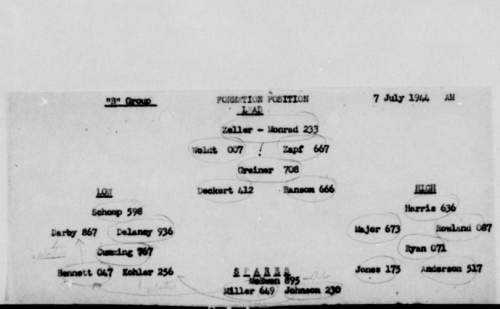
Briefed that they would be flying with the 96BG in the 45CBW’s formation as its High group, the 100B formation would be led by Joseph Zeller flying as Command Pilot along with Monrad. Woldt and Zapf would fly as their wingmen. Greiner would lead the second element with Dickert and Ransom. The High squadron would be led by Harris with Major and Rowland as wingmen. Ryan would lead its second element with Paul Jones and Anderson. The Low squadron would be led by Schomp with Darby and Delaney while Cumming would fly as second element lead with Bennett and Kohler. Miller, Johnson and Mcewen would all fly as spares.
Bauman further briefed the crews that the 45CBW was ordered to “give way to the 4th Wings if there is danger of collision courses” at Bad Sulza, Germany. At the end of the second briefing, the crews were taken to their Fortresses, which had been loaded with maximum fuel levels and ten 500 lb bombs.
With the 100B’s B17s taking off first to allow for their rendezvous with the 96BG, the 100A ships soon followed. Between 0545 hours and 0749 hours, seven ships including the unneeded spares had turned back to base: four from the ‘A’ formation and three from the ‘B,’ including the ill Townsend who had just returned from the Russian shuttle mission.
Weather conditions in England plus the number of aircraft in the air made assembly and formation flying difficult. As the wings merged into the Division line, pilot Harvey Dickert tells us, “Big pile up at division assembly one group ran right through us.” And pilots struggled to keep their formation. Pilot William Terminello tells us, “…This was quite a mission…But what an awful time we had flying formation. I was number four in the High SQ and was stalled out once. We climbed too slow.”
With the gunners on alert as the formations crossed into enemy territory at the Dutch coast, German fighters were seen and fortunately were attacked by two P-51s. With so many planes on the course, prop wash was causing problems for the pilots and at 0804 hours, the 100th's crews observed two of the 390th’s ships collide. One ship, caught in the prop wash, rammed the other, starting a fire in both ships. One exploded while the other exploded upon hitting the ground. Trained to look for chutes, seven chutes were observed.
Nearing the targets, the conditions improved to CAVU and the 100th’s B17s encountered accurate flak as it passed over the Merseburg defenses. Those in Ransom’s ship were nervous. On their #13 mission, ROG Emmett Schmitt remembered, “Our Altitude was 27,000 feet, some rockets and a heavy barrage of flak at the target. The Heaviest flak we have seen yet. Lost a couple ships out of one of our formations. Flak knocked out one of our superchargers.” And Harvey Dickert recalled, “Flak over the target was intense, heavy and moderately accurate…”
Two of the 100B B17s were absorbing serious flak as they continued to fly through the exploding fire. Jones’ aircraft received several holes in the right inner and outer wing panel, tokio tank punctures, a hold in the leading edge of his wing between the fuselage and the #3 engine, a hole in his leading edge or right horizontal stabilizer and skin damage while Anderson’s Fortress received a hole in bomb bay, skin damage, a hole in the vertical stabilizer and a hole in the left inner wing panel.
Continuing to the Böhlen target, bombs were away at 1000 hours from 27000 feet altitude. The 100th’s assigned MPI had been covered by heavy smoke so the power plant was sited on. Heavily hit, a large explosion resulted and by 1005, the Rally Point had been successfully made.
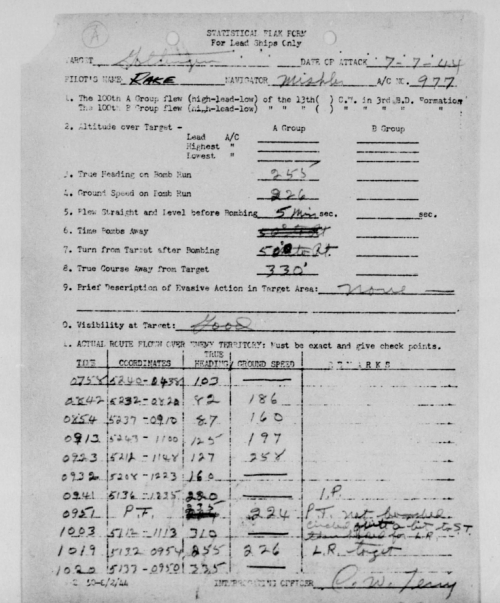
For the 100A formation, the IP for the Primary Leuna target was made at 0941 hours but bombs were held due to heavy smoke screens. At 1005, they had circled to the Secondary target where the 95th dropped but the 100th did not, again due to smoke coverage. By 1019 hours, the 100th's formation was over the target of last resort at Göttingen where pilot Leslie Kassebaum remembered, “Rough as hell-Hit third target-Ship shot up-Cut 4 engines over target.” Bombs were away from 25000-26300 feet.
Meanwhile at Thorpe Abbotts, preparations were under way for the mission’s de-briefing. The Red Cross girls had been notified, lunch had been ordered for 420 men and a guard was ordered for the briefing room door for 1200 hours. With the number of crews returning, the Interrogation officers of Johnson, Hutchinson, Arick, Shirley, Sheets, Paine, Hollingsworth, Scharding and Bauman were all on hand.
After a rough nine hour mission, all of the 100th’s aircraft returned safely. Harvey Dickert remembered, “I was very tired when I got home but glad to get there.” Flying in the 100A formation, Anthony Gallagher brought his B17 back with slight battle damage but twenty-five year-old Jackson Phelps returned with serious battle damage: a hole in #4 cowling, racker box hit, hole in #4 nacelle, oil tank hit, two holes in right elevator, several holes in right inner wing, hole in bombay door, two holes in left outer wing panel, hole in right inner wing panel, tokio tank hit, hole in #2 cowl flap and skin damage as well as holes on both side of fuselage at waist gun. Feeling lucky to be alive, twenty-four year-old Lewis Payne flying as Phelps’ BTG that day rather than WG recorded, “Saw plenty of flak. Was in the ball 4 hrs-9 hr mission. Saw 2 burning planes go down in Holland. We prayed going and coming.”
That evening, the 100th was alerted for another mission.
Meanwhile in French Moracco, the last three crews from the Russian shuttle mission had been preparing for their final flight back to England. Having started out from Thorpe Abbotts on June 21, they were to leave Moracco at 2130 hours that night, arriving back to England on July 8, seventeen days after they had left English soil.
Bombing Results
Bombing Results: MISSED
Aircraft Lost: 0
Crew Lost: 0
Claims of Enemy Losses (CLS): 0
Aircraft Returned: