Mission Date: July 12, 1944
MUNICH, INDUSTRIAL AREA
100th BG Mission #: 158
Mission Summary
ON THIS DAY...JULY 12,1944
Forty-three crews were awakened across Thorpe Abotts on the morning of the 12th. George Tolbert, NAV on Lloyd Delaney’s crew remembered, “…after a mission to Munich the day before, we were supposed to get a stand-down so we celebrated at the club. It was quite a shock when they roused us out on the 12th to go to Munich again.”
S-2 Officer Shirley would deliver two briefings that morning, the first at 0530 for the crews who were scheduled to fly in the 13B CBW formation and then again at 0615 hours for those scheduled for the 13A formation. When the curtain was pulled back, confirmation was made for those who had already guessed that they would be going back to Munich. Pilot William Terminello recorded, “Oh my nerves - there again…”
Missing their target the previous day, their primary would again be the Bayerische Motoren Werke AG, (BMW) plant, currently producing fighter jet engines. Only to be attacked under a clear visual sighting, their MPI would be its machining and assembly shop. If the weather required bombing via PFF, then the bombers’ primary target would be a group of industrial buildings just east of Munich’s railroad station. The secondary target would be any military objective positively identified as being in Germany. In addition, Shirley relayed to the men that orders called for all targets to be attacked in wing formation.
The 13CBW would fly ‘A’ and ‘B’ wing formations. Flying lead position in the 3rd Division’s line the previous day, the 13th would now move to the back of the line.
Leading the 13A formation would be the 95A BG, with the 95B flying as its High and the 100A as its Low and led by Captain Robert Rosenthal as Command Pilot with John Giles. Three of the 100th’s B17s would also fly in the 95A lead formation’s Low Squadron, as its second element.
The 13B formation would be led by the 390A BG, with the 100B flying as its High group and the 390B as its Low. Studying hotel management at State College of Washington before the war, twenty-eight year old Major Maurice Youngs would fly in a PFF ship as Command Pilot with Francis Kincannon and as the designated Deputy Wing Leader.
The Field Order had directed all of the 100th’s bombers to be loaded with four 500 lb GP bombs and six incendiaries and topped off with the maximum amount of fuel. Due to the forced landing the previous day of Rosine’s ship and others returning low on gas, the orders also specified that, “Pilots will be briefed on the use of R.P.M. for fuel economy.”
Reviewing the route in, Shirley warned the men about the intense flak expected at the target. Spares would be flying with each formation and they were instructed to fill in anywhere in the combat box wing. If unneeded, they were to return at mid-channel.
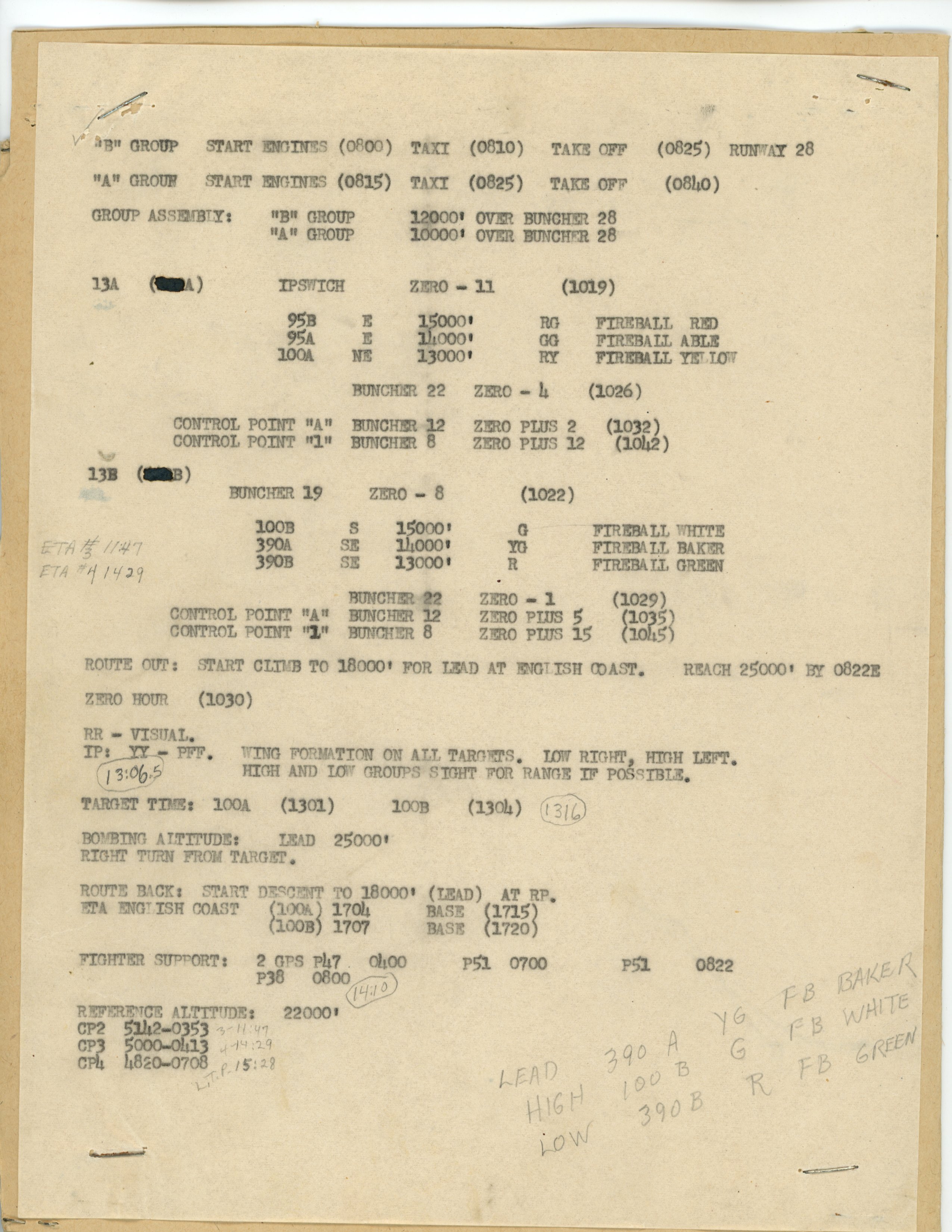
The 100th’s B17s departed the base between 0825-0856 hours, forming up over Buncher 28 by 1005 hours. Wing assembly was made over Ipswich.
Crossing over enemy lines, both of the 100th’s formations reported flak coming up from Antwerp and Brussels as level, meager but out of range to the left. Encountering meager flak at Saarbrucken, moderate continuous fire was reported from Mannheim but more accurate on another group. Finally, meager and inaccurate fire was seen off in the distance from Karlsruhe and Stuttgart.
Flying through the 10/10 undercast all the way to the target, a visual bombing would not be possible, so the PFF ships would be utilized on the bomb run forcing an attack on the second primary target, the industrial buildings near Munich's railroad station. Before reaching the turn at the IP, Maurice Youngs’ PFF ship had taken over as the 13B lead ship, due to faulty equipment on the 390A’s lead PFF.
At 1301 hours, the formations made their turn at the IP on to the fourteen minute long bomb run. On Delaney’s ship, NAV George Tolbert and BOM Owen Moore were feeling the effects of their previous night at the Officer’s club. Tolbert tells us, “I'm afraid we broke into our escape kits and took a pep pill to try to overcome a serious hangover. It worked as expected on me, but apparently Spud is one of those on whom it has an opposite effect. I can remember writing in my log, looking out both sides for fighters, and kicking Spud to try to keep him awake on the bomb run until we could get rid of our bombs….”
On Edgar Wolf’s bomber, Harry Bethea was flying as copilot and John Bryce as his BOM that day. Experiencing Munich’s flak the previous day, Robert Stachel tells us, “Wolf was the type of person that was serious. Anyway, starting the bomb run, Wolf said to Bethea ‘I will Fly the ship on the bomb run, hook up your chute, which he did, and put your steel helmet on’. There was a silence. Then Bethea said ‘Pilot, the helmet comes over my eyes’. Wolf replied ‘You'll wish it would come over your ass before we get through this.’”
That is when the expected intense barrages and continuous pointed fire started. Fairly accurate and mostly low, red and black flak was level with the formations while white flak burst high. In addition, three to six rockets were reported coming up slightly ahead of the 100th with one bursting two hundred feet above one of their planes.
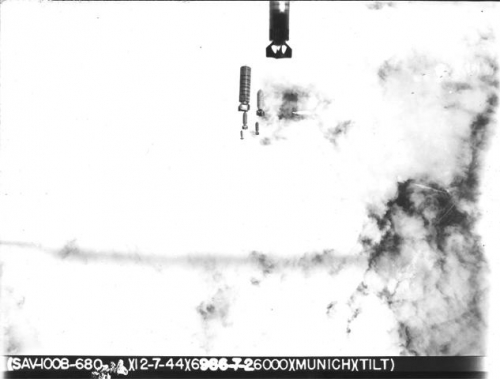
Smoke screens were over the entire target in addition to it being camouflaged but bombs were away at 1314 hours from 24,000 feet from the 100A and 1316 hours from 26000 feet from the 100B formations. Fory and Mcewen were having difficulty dropping bombs due to frozen bomb bay doors. Fory recorded, “1316 over Munich, cranked door open and jettisoned thru 10/10 cover.” Charles Streed on his #5 mission believed the target was hit. “Saw city through hole in clouds - dropped in midst of flak.” Norman Edwards, ROG on Kennedy’s crew tells us, “Took birthday present from Dad to Hitler” and William Terminello flying in the 100A remembered, “Captain Williams rode in Traps (Trapnell CP) place and this time I feel like we hit the target, at least I know the flak hit us. WG James Jones was hit by a piece, but by luck it hit him on the flat side and just broke his skin. His lips look like a baseball bat had hit him…”
Ultimately five ships in the 100A would be damaged by the flak and two men wounded. TG, Alfonse Fiore on Roger’s seriously damaged ship had also been wounded by the flak.
After bombs away, the Rally Point was made good and the formations started their slow descent. The 100A formation was over the base at 1722 hours while the 100B was seen at 1730 hours, weather having forced their wing north of the briefed course. Terminello tells us, “Another real long mission 9 hours, 20 minutes this time and how tired you can get on oxygen all the time…Stewart Gillison did a wonderful job navigating and all went well. We had 400 gallons of gas left again and had to let down thru an undercast on return to Base.”
At Interrogation, the crews filled in their flak and mission sheets and Bowman summarized the crew’s additional comments for his report. Other than commenting that the 95BG talked too much over the VHF radio, the main complaint was about the bases’s food, with many of the returning hungry crews not happy. Bowman reported, “Seventeen crews complained bitterly about poor food being served at mess hall and lack of silverware. Given cold salami and cheese after long mission yesterday and for breakfast this morning, French toast was served without butter or syrup; also powdered eggs. All these crews feel that they should have a good warm meal after returning from a long mission as their last meal was at approx. 0400 hours.”
The 100th was fortunate as the 3rd Division lost six ships and crews that day. The 13CBW would lose two ships, one from the 390th and one flying as a spare with the 100BG, receiving a direct hit in its waist by flak over the target. Seen to catch fire, it was last seen heading into the clouds.
With no enemy fighters encountered, Headquarters believed however, that something was brewing with the Luftwaffe when they summarized, “For the second consecutive day, large scale heavy bomber attacks on Munich were unopposed by e/a. Although undoubtedly adverse weather conditions restricted enemy activity, it seems plausible that GAF policy was involved in this unusual lack of opposition. No sightings were reported by bombers with the exception of one group of B-17s which reported seeing 6 ME-410s in the target area.”
That evening, the mission alert light indicated to the crews that another mission was on and soon crew names were being listed on the squadron's boards. The 3rd Division would be sending all of their B-17s back to Munich.
Crews scheduled for the July 12 mission-
100A:
Rosenthal-Giles with Brewer and Lambert, Steussy with Jones and David
High: Led by Terminello with Gallagher and Keys and Townsend with Kemp and Harding.
Low: Tiart with Waters and Kassebaum, Rogers with Phelps and Streed
Spares: Williams and Gustafson. (Unneeded and returned to base)
Aborted - Kassebaum mechanical failure
Composite with 95A in Lead Group:
Rake, Ricci and Rowland
100B:
Youngs- Kincannon with Cummings and Zapf, Greiner with Darby and Delaney.
High: Fory with McEwen and Jones and Ryan with Miller and Johnson.
Low: Wolf with Kennedy and Ransom and Schomp with Lischer and Major.
Spares: Anderson and Farcht (unneeded and returned to back to base
Bombing Results
Bombing Results: GOOD
Aircraft Lost: 0
Crew Lost: 0
Claims of Enemy Losses (CLS): 0
Aircraft Returned: