Mission Date: July 13, 1944
MUNICH, JET ENGINES
100th BG Mission #: 159
Mission Summary
ON THIS DAY...JULY 13, 1944
Forty crews would ultimately be briefed for the 100th’s third mission in a row to Munich. Hampered by poor weather over the city for the previous two missions, the 3rd Division had been unsuccessful in destroying the aero engine plant which would again be the 100th’s primary visual target. If the weather prohibited a visual sighting, their primary target would be Munich’s marshalling yards, used as a rail hub for moving supplies and troops toward the Brenner pass on the Italian front and west toward France. Their secondary target would be any military objective in Germany.
The 45 CBW would lead the 3rd Division’s column, split into two wing formations. The 13CBW would follow in one formation while the trailing 4CBW would be split into two. The 13CBW’s formation would be led by the 390A with the 390B flying the High and the 100A flying as its Low group, led by twenty-six year-old Major Sumner Reeder flying with Merle Ehorn. A second formation of 100th’s bombers (100B) would fly as the High group with the 4A CBW and would be led by Captain Henry Smith flying with Ferdinand Herres.
Taxied into position, the forty B-17s, each loaded with four 1000 lb bombs and six 500 lb incendiaries, took off from Thorpe Abbotts to begin the two hour assembly process, eventually folding into their proper positions within the Division line at 0719 hours. Both Rice and Darby’s B17s, unneeded spares for the 100A formation, returned to base.
On course, the formations crossed the enemy coast, reaching bombing altitude four hours after their take-off. The flak defenses at Mannheim, Karlsruhe, and Stuttgart ranged from meager to intense, although all at a distance from their route and the 100th’s ships continued on towards the target, flying through 10/10 clouds all the way to the IP.
Turning onto the bomb run still in the 10/10 clouds, the Munich defenses were sending up intense, barrage and tracking flak, including a few rockets. Lewis Payne, WG on Jackson Phelp’s ship and on his second mission to Munich, recorded, “Flak was dense…picked up quite a bit of flak in radio room.”
Norm Fuller, BTG in Charles Harding’s ship in the 100B formation remembered, “Around Augsburg, the IP, our engines began detonating and we were unable to keep speed up with the others in formation. After given clearance, we dropped some of the bombs and proceeded to drop all of them, then started throwing all available weighty things out of the waist. Guns, ammo, anything that could be thrown out, was. Then with the ongoing problem of not being able to maintain speed or altitude, we made a 180 heading westwards towards, England. Immediately, we were hit, direct hit, behind #3 engine with a hole so big you cannot believe it size…We were actually fighting for our lives since we did not know what circumstances might be forthcoming…”
Meanwhile, the rest of the formation continued to the target, where the bombers dropped off their Pathfinder ship onto Munich’s marshalling yards. At 0945 hours, as the 13CBW’s formation was dropping, a 390BG ship was shot down by flak with only two chutes seen.
After bombs away, due to the intense flak, evasive action was taken to the Rally Point. Flying behind in the 4A’s formation and flying through the flak on the ten minute bomb run, the 100B’s ships dropped on the marshalling yards at 0954 hours from a 26,800 altitude.
Damaged by flak just after bombs away, twenty-three year-old Donald Water’s ship ‘Cahepit’ was loosing gasoline and his #4 engine was feathered when he pulled out of 100B formation and turned left, last seen going toward the Alps. Andrew Chianis, his TTE remembered, “Flak caught our number four engine and we had to feather it. The number three engine was also hit and on fire. We threw out everything that was loose, including clothes and guns. Because we were over the Alps and could not bail out and survive, we headed for Switzerland. When we reached the borders and were falling fast, a couple of Swiss ME109s escorted us through the mountains to a valley. Coming down, we hit some high tension wires and CAHEPIT broke in half at the radio room. We landed badly and skidded for along way. It was amazing, we all got out with only three wounded and with only three injured. Through the years, I have looked back so many times and still believe that God was our pilot that day.”
Struggling, Harding’s flak damaged ship was also headed for Switzerland. Norm Fuller continued, “When we got hit, our Togglier from Boston (Cravens) in his typical accent said over the intercom, “We’ve just lost all our erl” meaning oil. Also, Harding asked Hunt, the Navigator for a fix or location. Nonchalantly and without any anxiety in his voice, said, “Sure, we are over Europe.” We all broke up over that and really laughed, it broke any tension that might become evident. God was there in that plane with us and had his protective hand on us…Then a ‘bail out’ order was given but not one of us did. Into our view came 2 ME-109 fighters at 3 & 9 o’clock high. They pulled up to our wing and motioned to follow, we did and they took us to their base…We were tense and hopeful. We made it and were then told that the war for us was over since we were in Switzerland, a neutral country. We all dropped to the ground and I think we all kissed it.”
Meanwhile on the route back, the remainder of the formation was jumped by “fifteen to twenty fighters…but were beaten off without loss for us. Staff SGT C.K. Platkin, BTG in one of the Squadron's planes, did more than his share in whipping the Jerries in this encounter; he blew up one Messerschmitt and damaged another.” Carl Platkin flew on Woodall’s ship. copilot Bertram Lobdell, flying with Gerald Brewer remembered, “They made one pass at 12 o’clock on one and 6 o’clock. My first glimpse of an enemy fighter and hope my last one.” And NAV James Wright on Albert Trommer’s ship recorded, “We were attacked by Me 109s. Wilson (TG) sent one into a spin.”
Ransom’s ship had lost his #3 engine after they left the target. His ROG, Emmett Schmitt remembered, “Started throwing oil so had to feather the prop and come back on 3 engines. Able to stay up with the rest of the group fairly well but at a lower altitude.”
After a ten hour mission, the 100th’s remaining ships landed at Thorpe Abbotts between 1332-1354 hours.
Donald A. Waters was interned in a camp in Davos with the rest of his crew for one year before escaping across Lake Geneva in a rowboat with the help of Swiss and Yugoslav resistance fighters and the French underground. He would go on to write the book, “Hitler’s Secret Ally, Switzerland” His copilot, William Conselman had been an actor and screen writer before the war and returned to that occupation after being freed. Waters’ NAV, Alfred M. Shearer, Jr would die in Switzerland on August 19,1944. His father was Colonel Alfred Shearer, who was stationed in London at the time as Chief of Signal Supply in the ETO. Shearer would be repatriated and buried in Arlington National Cemetery.
Crews scheduled for the July 13 mission: Ehorn, Scott, Tiahrt, David, Keys, Kemp, Lambert, Ogg, JD Williams, Gallagher, Steussy, Rogers, Herres, Harding, Brewer, Jones, Woodall, Phelps, Trommer, Waters, Greiner, Schomp, McEwen, Miller, Cumming, Holmick, Major, Rice, LG Bennett, Kennedy, Bethea, Jones, Wolf, Darby, Rowland, Evans, Ransom, Ricci, MD Johnson, Fory
Bombing Results
Bombing Results:
Aircraft Lost: 2
Crew Lost: 20
Claims of Enemy Losses (CLS): 5
Aircraft Returned:
Photos
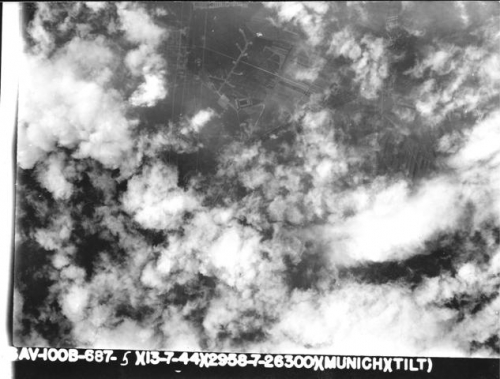
MUNICH July 13, 1944
100th B Group, taken from 42-102958. Courtesy of Capt Tong