Mission Date: July 14, 1944
"CADILLAC", FRANCE, MAQUIS SUPPLIES
100th BG Mission #: 160
Mission Summary
ON THIS DAY...July 14, 1944
A second supply drop planned by the 8th Air Force to the French Maquis had been delayed for several days due to weather but on July 13, members of the French Resistance tuned in to illegal short wave radios to listen to the program ‘Ici Londres,’ broadcast from England every night to the French people. The announcer, speaking in French to the people of France, was heard to read odd personal messages such as “The mosquito dances on the roof” or “The red and white wheelbarrow belongs to Geneviève” which were in fact code words meant for the various Maquis groups, signaling a drop for the next day and its time. July 14, would be France’s national day of independence.
The next morning, forty crews at Thorpe Abbotts had checked in with the attendance man stationed at the door for the 0130 briefing. When briefed on the secret mission, some of the crews present recalled the previous Maquis supply drop they had made on June 25, when the majority of the others had been in Russia. Today’s plan, code named, ‘Operation Cadillac,’ called for the 3rd Bomb Division’s B-17s to drop their “bombs” or canisters of supplies to seven points in three regions in Southern France. The 100th’s bombers would drop at an unknown location codenamed, “Digger” and which would actually be in the hamlet of Moustoulat in the Corrèze area, sixty miles south of Limoges.
The 3rd Division would fly all of its B-17s in the 4CBW, 45CBW and 13CBWs with each Wing flying a three group formation, with thirty-six planes in each BG. The 13CBW would fly a total of one hundred and eight ships, each loaded with twelve containers of ammunition and supplies.
The 100BG’s formation would be led by Major Magee Fuller flying in a PFF ship with Francis Kincannon, the High led by Captain Rosenthal flying with John Giles and the Low by Captain Williams flying with William Terminello. Pilot James Williams remembered, “During the briefing we were given our flight positions, altitudes and routes to and from the target. Instead of carrying bombs we were carrying canisters of guns, ammunition, medical supplies, food, counterfeit German money as well as French money.”
All B17s took-off successfully in the darkness, starting at 0400 hours. Assembling over Buncher 28 at 0545 hours at 13000 feet, the 100th’s formation then successfully folded into the Division’s line of B-17s. The spare planes flown by Lischer, Kennedy and Kassebaum had returned as unneeded while Wolf pulled his ship from the formation at 0609 hours due to engine troubles. His TG, Robert Satchel remembered, “We took-off after a few hundred feet we were in thick clouds and at times, couldn’t see the end of the wings. We climbed in this cloud coverage…All of a sudden, we went into a dive with a runaway engine - crew didn’t know what was happening and we kept calling our pilots - they were too busy trying to get the engine under control. Being we couldn't get an answer, we were getting ready to disconnect our intercom and bail out. But our Pilot caught us in time and we returned back to our base - we aborted the mission.”
The Division’s line of B-17s continued across the channel, crossing the enemy coast between Caen and Le Havre where they picked up their escort fighters and eventually split into three formations in the Loire area, with one continuing south and west past Limoges, one headed towards Vichy and the remainder towards the Vercors plateau.
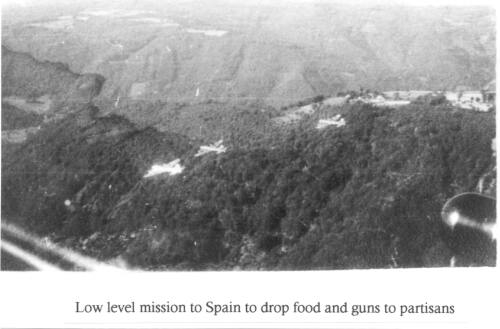
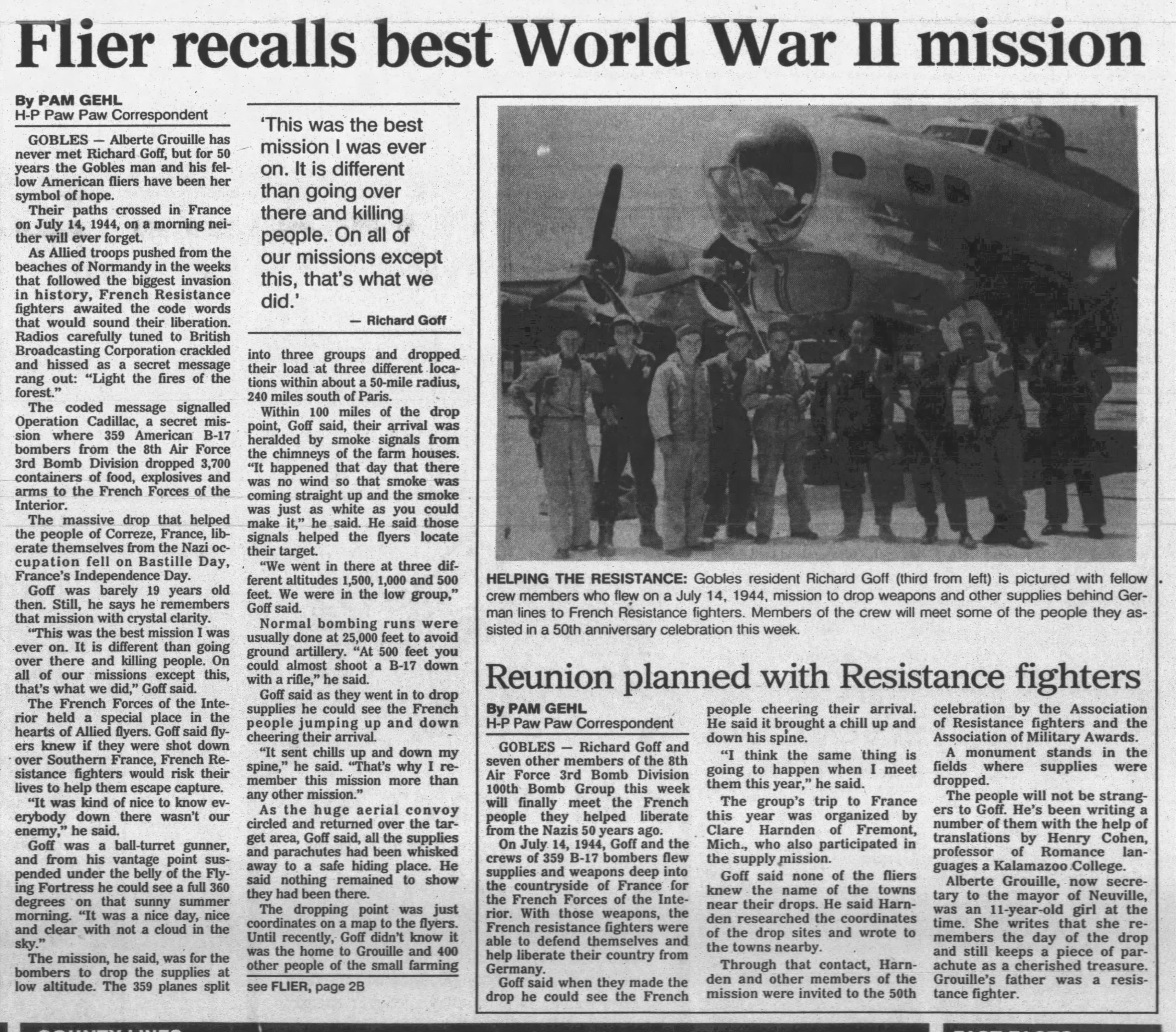
Encountering no flak or enemy fighters, as they neared the target location, the 100th and two other group formations began their slow descent. James Williams continues, “50 miles from our drop zone we dropped down from 25,000 ft. to 500 ft. and formed into a 3 ship "V" formation in trail, giving us an 18, 3 ship formation in trail. This type of formation was essential due to the terrain and location of the drop zone which was in box canyon and once we were in the canyon we dropped down to 50 ft. Smoke signals were also coming from farm houses within 100 miles and Richard Goff, BTG with an unobstructed view that day tells us, “It was a nice day, nice and clear with not a cloud in the sky. It happened that day that there was no wind so that smoke was coming straight up and the smoke was just as white as you could make it.”
Meanwhile on the ground, the Maquis for the secret “Digger” location had confirmed they were ready and were preparing for the drop. It was a beautiful clear day at the target and the Maquis had lit their smoke pots as a signal to the approaching bombers. Soon, the bombers were heard and the sound was deafening as the one hundred thirty B-17s flew over the drop zone at the low altitude. “It was sheer madness” recounted a witness.“We cried, we waved our hankies, emotional in every sense, we didn’t know what to do.”
As they had been briefed, the B-17s had made an impressive dry run first over the drop zone to ensure the correct target and their own safety. Afterwards, the formation was reported to have split again with one formation heading toward Carennac, another heading in the direction of Saint-Privat and one continuing on, all accompanied by the numerous escort fighters.
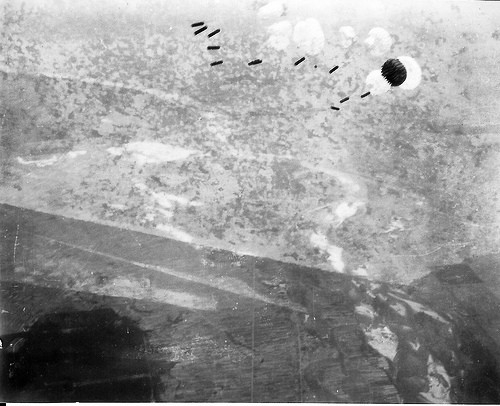
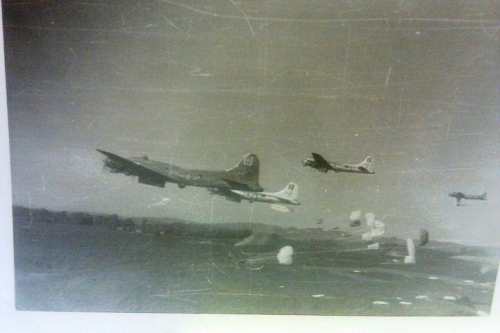
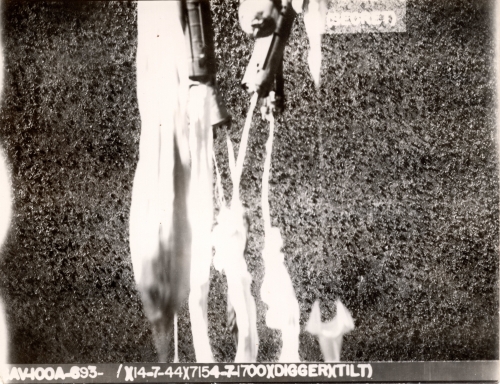
The 100BG’s thirty-five ships however, made their turn and made another run over their target area. The first of three waves of drops were completed with the first set of containers dropping with red, blue, orange, green, white and black parachutes signifying their contents. The second wave dropped its containers with parachutes in the French national colors of blue, white and red while the final drop had all colored parachutes again. Pilot, William Terminello tells us, “We dropped guns and fighting material to the Free French. They parachuted out and we dropped from very low altitude at 140 Indicated Air Speed. We flew wonderful formation, letting down and climbing over France and Traps flew on my left wing as a first pilot. He did a splendid job. ..It was a good opportunity for Stew. And he also did well. Yes, we led the low group of the 13th B combat wing. I sure was happy to see all those Frenchmen on the ground. They must have been happy at what we delivered.” After seeing the French people “jumping up and down cheering their arrival,” Goff remembered, “It sent chills up and down my spine. That’s why I remember this mission more than any other mission.”
James Williams adds “…as soon as we dropped the canisters we had to make a sharp turn to the left. I was on the outside left and when we turned my wing tip brushed the tree tops and shrubs…During the maneuver my co-pilot flew the ship while I watched the ground to be sure that we did not crash. We were so close to the Marque, French Underground Freedom Fighters, that we could see their teeth when they smiled. One Frenchman tried to catch a canister before it hit the ground and it knocked him a good 100 ft. It didn't seem to hurt him because he got right up and got the canister…” And Ralph Bates recorded, “The stuff we were to deliver was packed in our bomb bay…We had been flying just over the trees when we came to a great big open field. We dropped our stuff right where we were supposed to. When we circled back over the drop zone, we could see hundreds of people on the ground picking up the stuff.”
On the ground, Alberte Grouille was experiencing a morning that she would never forget. She wrote, “I was an 11-year old girl in 1944, and I keep the dream-like memory of your parachute drop right near our house on that sunny morning of July 14, those planes, those wings that seemed to touch the ground and in an impeccable order had amazed me. My sister, who was taking care of the flocks on the hill, saw the parachutes fall. You should have seen the indescribable joy of all our good resistance fighters, that of my relatives, of the entire population, and which you observed from above. Your arrival one July 14 symbolized hope, imminent freedom, My husband, who was 15 years old then, and who lived in Neuville, went to help his relatives and his neighbors gather up the containers with their carts.” She ends with “If I had to illustrate hope and courage, I would picture it as a sky filled with gigantic flying fortresses on a beautiful summer morning, planes whose mysterious flyers were announcing to us, by the throbbing of their machines, the freedom that had finally come.”
After all of the containers had been dropped, the pilots majestically regrouped their planes into a perfect formation and flew once again over the field, gaining altitude and disappearing into the sky. All of the 100th’s planes would return safely that day to Thorpe Abbotts by 1237-1252 hours, after a long but rewarding nine hour mission. Each of the men were grateful to receive word that evening of a Stand Down for the next day.
Six weeks after the historic and successful supply drop, most of the Corrèze region had been liberated, making it the first department of France to be liberated by the Maquis.
Fifty years later, after a lot of investigatve work done by Clare Harnden, eleven of the 100th’s airmen would return to Moustoulat and be honored at a ceremony where a second plaque was added to the location’s monument dedicated to the parachute drop. It reads, “16 July 1994. Homage to the American Airmen who came to commemorate with the Resistance the 50th anniversary of this historic parachute drop.”
Those in attendance were:
Mac Barash - NAV on Tiarht’s ship that day
Lloyd Coartney - NAV on Harris’ PFF ship crew to another location
John Eschbach - TG on Bert Scott’s ship
Richard Goff - BTG on Bert Scott’s ship
Butch Goodwin - CP on Tiarht’s ship
Clare Harnden - TG flew on Trapnell’s
Warren “Fireball” McCoy - CP on Mylius crew but flew as 1st Pilot that day
Louis Quijada - ROG on Terminello crew. He would also write a book titled “Red, White and Blue Parachutes” about the experience
Mike Spiller - NAV on Lambert’s crew
William Terminello - Pilot
Harold Tiahrt - Pilot
Crews assigned to fly the July 14,1944 mission:
Keys, Trapnell, Tiahrt, David, JD Williams, Terminello, Lambert, Rosine, Scott, Woodall, Brewer, Rogers, Townsend, Kemp, Rosenthal with Giles, Kassebaum, Roediger, Gallagher, Trommer, EC Jones, Greiner, Wolf, Major, Miller, Kennedy, Ransom, Bethea, Rice, Cumming, Schomp, Ryan, Jones, McCoy(Dickerts crew), Kennedy, Rowland, Lischer, Bennett, Ricci, Johnson, MC Fuller PFF Ship (From 100th’s operational summary report)
A second supply drop planned by the 8th Air Force to the French Maquis had been delayed for several days due to weather but on July 13, members of the French Resistance tuned in to illegal short wave radios to listen to the program ‘Ici Londres,’ broadcast from England every night to the French people. The announcer, speaking in French to the people of France, was heard to read odd personal messages such as “The mosquito dances on the roof” or “The red and white wheelbarrow belongs to Geneviève” which were in fact code words meant for the various Maquis groups, signaling a drop for the next day and its time. July 14, would be France’s national day of independence.
The next morning, forty crews at Thorpe Abbotts had checked in with the attendance man stationed at the door for the 0130 briefing. When briefed on the secret mission, some of the crews present recalled the previous Maquis supply drop they had made on June 25, when the majority of the others had been in Russia. Today’s plan, code named, ‘Operation Cadillac,’ called for the 3rd Bomb Division’s B-17s to drop their “bombs” or canisters of supplies to seven points in three regions in Southern France. The 100th’s bombers would drop at an unknown location codenamed, “Digger” and which would actually be in the hamlet of Moustoulat in the Corrèze area, sixty miles south of Limoges.
The 3rd Division would fly all of its B-17s in the 4CBW, 45CBW and 13CBWs with each Wing flying a three group formation, with thirty-six planes in each BG. The 13CBW would fly a total of one hundred and eight ships, each loaded with twelve containers of ammunition and supplies.
The 100BG’s formation would be led by Major Magee Fuller flying in a PFF ship with Francis Kincannon, the High led by Captain Rosenthal flying with John Giles and the Low by Captain Williams flying with William Terminello. Pilot James Williams remembered, “During the briefing we were given our flight positions, altitudes and routes to and from the target. Instead of carrying bombs we were carrying canisters of guns, ammunition, medical supplies, food, counterfeit German money as well as French money.”
All B17s took-off successfully in the darkness, starting at 0400 hours. Assembling over Buncher 28 at 0545 hours at 13000 feet, the 100th’s formation then successfully folded into the Division’s line of B-17s. The spare planes flown by Lischer, Kennedy and Kassebaum had returned as unneeded while Wolf pulled his ship from the formation at 0609 hours due to engine troubles. His TG, Robert Satchel remembered, “We took-off after a few hundred feet we were in thick clouds and at times, couldn’t see the end of the wings. We climbed in this cloud coverage…All of a sudden, we went into a dive with a runaway engine - crew didn’t know what was happening and we kept calling our pilots - they were too busy trying to get the engine under control. Being we couldn't get an answer, we were getting ready to disconnect our intercom and bail out. But our Pilot caught us in time and we returned back to our base - we aborted the mission.”
The Division’s line of B-17s continued across the channel, crossing the enemy coast between Caen and Le Havre where they picked up their escort fighters and eventually split into three formations in the Loire area, with one continuing south and west past Limoges, one headed towards Vichy and the remainder towards the Vercors plateau.
Encountering no flak or enemy fighters, as they neared the target location, the 100th and two other group formations began their slow descent. James Williams continues, “50 miles from our drop zone we dropped down from 25,000 ft. to 500 ft. and formed into a 3 ship "V" formation in trail, giving us an 18, 3 ship formation in trail. This type of formation was essential due to the terrain and location of the drop zone which was in box canyon and once we were in the canyon we dropped down to 50 ft. Smoke signals were also coming from farm houses within 100 miles and Richard Goff, BTG with an unobstructed view that day tells us, “It was a nice day, nice and clear with not a cloud in the sky. It happened that day that there was no wind so that smoke was coming straight up and the smoke was just as white as you could make it.”
Meanwhile on the ground, the Maquis for the secret “Digger” location had confirmed they were ready and were preparing for the drop. It was a beautiful clear day at the target and the Maquis had lit their smoke pots as a signal to the approaching bombers. Soon, the bombers were heard and the sound was deafening as the one hundred thirty B-17s flew over the drop zone at the low altitude. “It was sheer madness” recounted a witness.“We cried, we waved our hankies, emotional in every sense, we didn’t know what to do.”
As they had been briefed, the B-17s had made an impressive dry run first over the drop zone to ensure the correct target and their own safety. Afterwards, the formation was reported to have split again with one formation heading toward Carennac, another heading in the direction of Saint-Privat and one continuing on, all accompanied by the numerous escort fighters.
The 100BG’s thirty-five ships however, made their turn and made another run over their target area. The first of three waves of drops were completed with the first set of containers dropping with red, blue, orange, green, white and black parachutes signifying their contents. The second wave dropped its containers with parachutes in the French national colors of blue, white and red while the final drop had all colored parachutes again. Pilot, William Terminello tells us, “We dropped guns and fighting material to the Free French. They parachuted out and we dropped from very low altitude at 140 Indicated Air Speed. We flew wonderful formation, letting down and climbing over France and Traps flew on my left wing as a first pilot. He did a splendid job. ..It was a good opportunity for Stew. And he also did well. Yes, we led the low group of the 13th B combat wing. I sure was happy to see all those Frenchmen on the ground. They must have been happy at what we delivered.” After seeing the French people “jumping up and down cheering their arrival,” Goff remembered, “It sent chills up and down my spine. That’s why I remember this mission more than any other mission.”
James Williams adds “…as soon as we dropped the canisters we had to make a sharp turn to the left. I was on the outside left and when we turned my wing tip brushed the tree tops and shrubs…During the maneuver my co-pilot flew the ship while I watched the ground to be sure that we did not crash. We were so close to the Marque, French Underground Freedom Fighters, that we could see their teeth when they smiled. One Frenchman tried to catch a canister before it hit the ground and it knocked him a good 100 ft. It didn't seem to hurt him because he got right up and got the canister…” And Ralph Bates recorded, “The stuff we were to deliver was packed in our bomb bay…We had been flying just over the trees when we came to a great big open field. We dropped our stuff right where we were supposed to. When we circled back over the drop zone, we could see hundreds of people on the ground picking up the stuff.”
On the ground, Alberte Grouille was experiencing a morning that she would never forget. She wrote, “I was an 11-year old girl in 1944, and I keep the dream-like memory of your parachute drop right near our house on that sunny morning of July 14, those planes, those wings that seemed to touch the ground and in an impeccable order had amazed me. My sister, who was taking care of the flocks on the hill, saw the parachutes fall. You should have seen the indescribable joy of all our good resistance fighters, that of my relatives, of the entire population, and which you observed from above. Your arrival one July 14 symbolized hope, imminent freedom, My husband, who was 15 years old then, and who lived in Neuville, went to help his relatives and his neighbors gather up the containers with their carts.” She ends with “If I had to illustrate hope and courage, I would picture it as a sky filled with gigantic flying fortresses on a beautiful summer morning, planes whose mysterious flyers were announcing to us, by the throbbing of their machines, the freedom that had finally come.”
After all of the containers had been dropped, the pilots majestically regrouped their planes into a perfect formation and flew once again over the field, gaining altitude and disappearing into the sky. All of the 100th’s planes would return safely that day to Thorpe Abbotts by 1237-1252 hours, after a long but rewarding nine hour mission. Each of the men were grateful to receive word that evening of a Stand Down for the next day.
Six weeks after the historic and successful supply drop, most of the Corrèze region had been liberated, making it the first department of France to be liberated by the Maquis.
Fifty years later, after a lot of investigatve work done by Clare Harnden, eleven of the 100th’s airmen would return to Moustoulat and be honored at a ceremony where a second plaque was added to the location’s monument dedicated to the parachute drop. It reads, “16 July 1994. Homage to the American Airmen who came to commemorate with the Resistance the 50th anniversary of this historic parachute drop.”
Those in attendance were:
Mac Barash - NAV on Tiarht’s ship that day
Lloyd Coartney - NAV on Harris’ PFF ship crew to another location
John Eschbach - TG on Bert Scott’s ship
Richard Goff - BTG on Bert Scott’s ship
Butch Goodwin - CP on Tiarht’s ship
Clare Harnden - TG flew on Trapnell’s
Warren “Fireball” McCoy - CP on Mylius crew but flew as 1st Pilot that day
Louis Quijada - ROG on Terminello crew. He would also write a book titled “Red, White and Blue Parachutes” about the experience
Mike Spiller - NAV on Lambert’s crew
William Terminello - Pilot
Harold Tiahrt - Pilot
Crews assigned to fly the July 14,1944 mission:
Keys, Trapnell, Tiahrt, David, JD Williams, Terminello, Lambert, Rosine, Scott, Woodall, Brewer, Rogers, Townsend, Kemp, Rosenthal with Giles, Kassebaum, Roediger, Gallagher, Trommer, EC Jones, Greiner, Wolf, Major, Miller, Kennedy, Ransom, Bethea, Rice, Cumming, Schomp, Ryan, Jones, McCoy(Dickerts crew), Kennedy, Rowland, Lischer, Bennett, Ricci, Johnson, MC Fuller PFF Ship (From 100th’s operational summary report)
Bombing Results
Bombing Results: EXCELLENT
Aircraft Lost: 0
Crew Lost: 0
Claims of Enemy Losses (CLS): 0
Aircraft Returned:
Media Articles
Use your thumb to scroll through the results box below.
| Media Item | Type | Page | Volume/Issue | Broadcast Source | Time | Description | File |
|---|---|---|---|---|---|---|---|
| Richard Goff recalls Maquis drop part 1 | The Herald Palladium July 10 1994 | 12:00 am | |||||
| Richard Goff flier recalls Maquis drop part 2 | The Herald Palladium July 10 1944 | 12:00 am | |||||
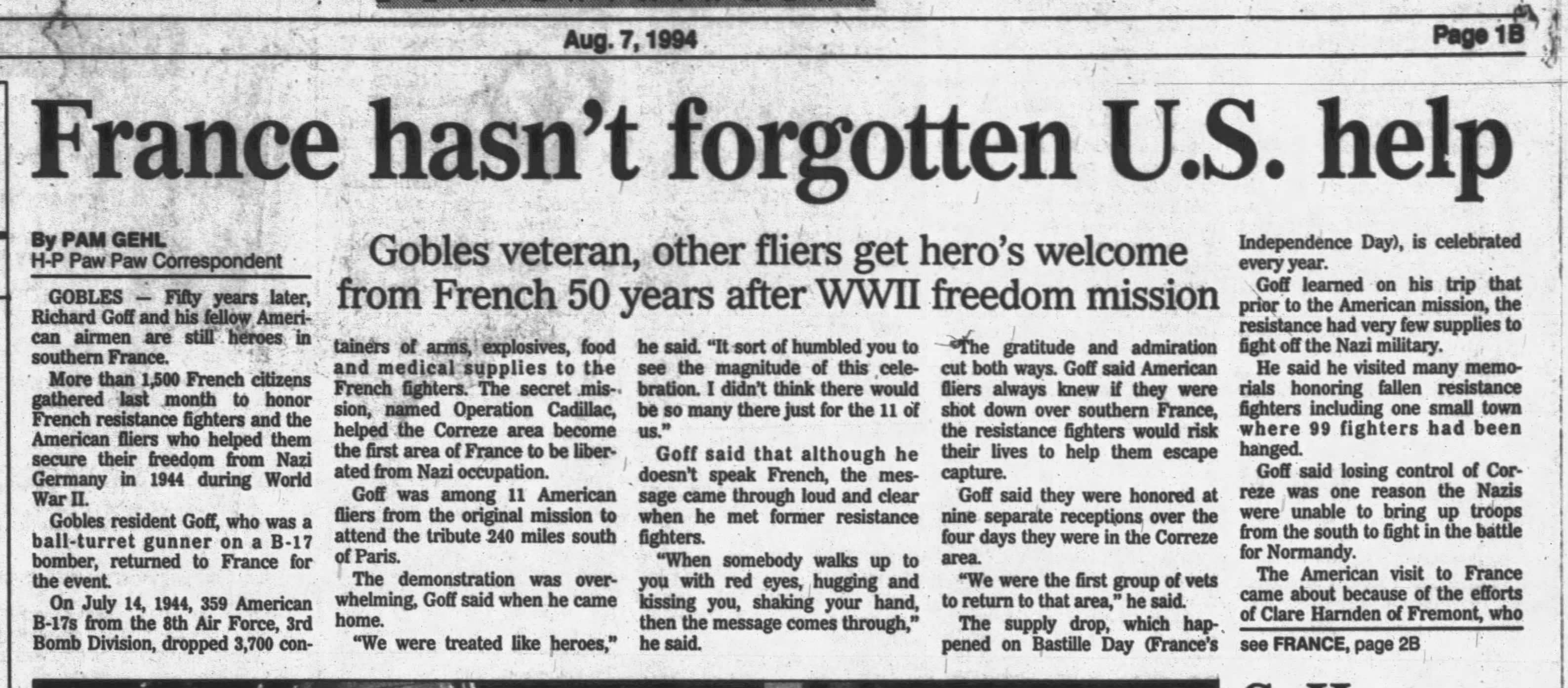
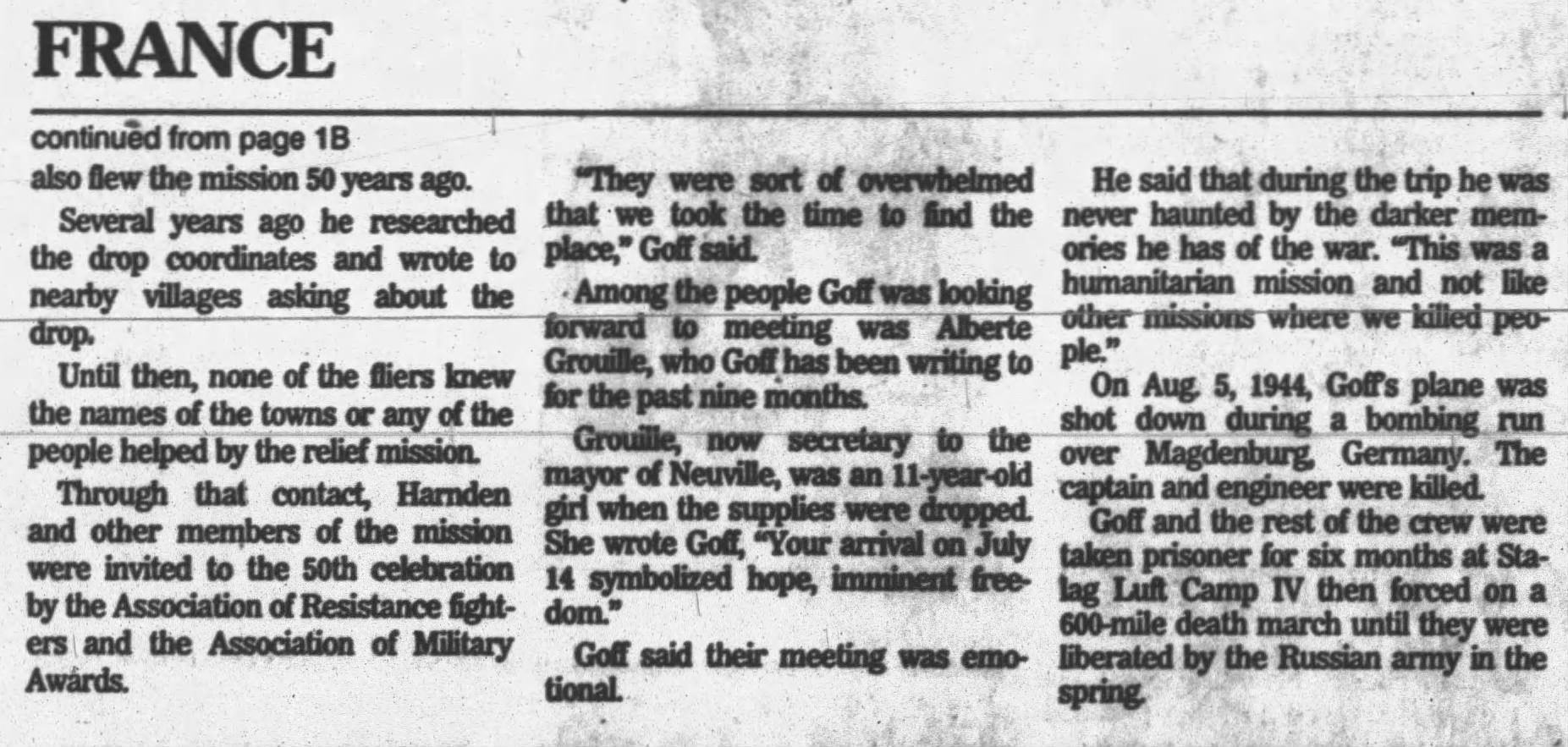
| Richard Goff France hasn’t forgotten US help part 1 | The Herald Palladium Aug 7 1994 | 12:00 am | |||||
| Richard Goff France hasn’t forgotten US help part 2 | The Herald Palladium Aug 7 1994 | 12:00 am |

Notes
Mission Stories
Translated French website dedicated to July 14, 1944 mission
http://resistancefrancaise.blogspot.fr/2011/12/le-parachutage-du-14-juillet-1944.html