Mission Date: July 17, 1944
AUXERRE, RAIL BRIDGE
100th BG Mission #: 161
Mission Summary
ON THIS DAY...JULY 17, 1944
On the 15 and 16 of July, the aircrews of the 100BG had a two day break from flying missions. Intelligence Officer, Red Bowman wrote into his journal, “And high time too. Three flights in a row to Munich proved fatiguing to the crews. They feel that the Fifteenth Air Force could take care of the targets right at their front door without the Eighth having to fly one thousand miles to hit the same place. Seems to be the penalty of being the Major league air force.”
Colonel Jeffrey continued his constant practice pace for new crews. Joseph Ricker’s WG, Raymond Mainka, wrote on the 16th, “Had two practice missions today. Came down from the second about 10:30 in the evening.”
The #1 combat mission had to come sometime, and that evening, both Ricker’s and Riegel’s crews were alerted while pilots James Seamans and Frederick Schaffhausen were scheduled to fly their #1, as CP “observers” with the Rice and PG Jones’ crews.
Awakened at 0215 hours like the others, Schaffhausen remembered that he too only had three hours of sleep before the first briefing of the day, where he and thirty-eight other crews were seated. Relieved to see the red string stop in France, the crews learned that their primary target would be a railroad bridge at Auxerre, France one hundred five miles southwest of Paris and across the Yonne river. The bridges were a critical tactical mission, to stop any enemy movement towards Normandy.
The 100th BG would lead the 13CBW, with the 95BG flying as the 13B and targeting a RR bridge at Joigny and the 390BG as 13C targeting a RR bridge at Nogent. Leading the 100th would be Colonel Jack Kidd in a PFF ship, with the High squadron led by Captain Floyd Mason and the Low by Captain Earl Williams.
With the original take-off delayed by an hour due to weather, the B-17s took off between 0640 and 0710 hours, loaded down with two 2000 lb bombs each. Wing records show that this mission for the 390BG was cancelled due to the weather at their base making it “impossible to take-off.”
The 100th's High squadron’s ships were having their own troubles. Having engine troubles, Trommer's ship would not take off on time so his position was filled by one of the two spares. When the formation had reached seven thousand feet, Joseph Trapnell’s B17 had an oil leak and Trapnell tells us, “The oil sprayed out so fast that I was unable to feather the propeller before it started windmilling violently. We left the formation and letdown through the heavy overcast over Buncher #28.” Making a turn over the water, Trapnell jettisoned the bombs then headed back over land to return to base. When his engine caught fire, he gave the bailout order after lowering altitude and all crew members jumped. After resetting the AFCE to make a slow turn to put the B17 back over the water, Trapnell himself bailed out. His plane however, crashed near the coast between Leiston and Framlingham on land after fortunately only ruining a small beet crop. Only his TOG, Byron Greene, was slightly injured, breaking his ankle.
Over France, the weather had turned favorable for the 100th's bombers and as they neared their target, the clear skies made it easier for the enemy gunners below and Lambert’s aircraft took a hit. WG Gordon Winkler remembered, “Fayette, our Bombardier was shot in the front of the plane…Bates (TG) left his station and put his hand on his chest. Fayette was hit by flak over the target, finished mission…”
Bombs were away from the 100th’s bomb bays, destroying the target at 1049 hours. Lambert immediately descended to a lower altitude to save his BOM’s life and returned to base, where Fayette “was taken away in an ambulance.” After seeing so many bunk mates not come back from missions, Ralph Bates had made it through his #35 and he remembered that when he landed, “…all bunk buddies in their barracks were waiting for them along the flight line. It was a big deal for all of them…”
It would also be a red letter day for John A. Miller, who flew as WG on Townsend’s crew. He too had finished his thirty-five missions - survived six missions to Berlin, watched as a ship blew up in front of him, flew the Russian-Italy shuttle mission, was credited with shooting down a ME 410 and had been awarded the Distinguished Flying Cross. The amazing fact was that this young airman was only seventeen years old! Miller would celebrate his eighteenth birthday on July 22, 1944 and would live to be eighty-seven years old.
During the mission flown by the 100th’s A,B and C crews, nine 100D crews had been briefed for a mission to a coastal battery at Gravelines but were recalled after they had already departed the field. According to James Wright from the Trommer crew, who had aborted the first mission of the day, “Got up at noon for a rush mission. It was scrubbed when we got in the air. We were briefed at 1600 for a noball in France. For the third time we climbed aboard. This time we made the trip…”
At 1600 hours, the nine crews of Roediger, Trommer, Mcewen, Terminello, Kassebaum, Ryan, Steussy, Ransom and Rowland were seated in the briefing room where they were told that they would be flying to France, to a “noball” pilotless bomb target at Foucarmont, thirty miles from the coast at the Strait of Dover at Dieppe. They would be led by Herbert Howard who would fly with William Terminello in the lead ship. Four formations of twelve planes would form the 13CBW and three B-17s from the 95BG would fly with the 100th.
All ships departed Thorpe Abbotts between 1805-1815 hours. Although the distance was short, the mission was not without problems. As they neared the target, the dense ground haze prohibited them finding the target. William Terminello wrote, “We were leading a twelve ship group late in the afternoon for a no-ball base. Stew Gillison led us directly into the Initial Point and Frank Rubick started the bombing run. We couldn't open our door but we were going salvo and the rest of the ships bombs then. Frank couldn’t see the target and never did drop, but some John dropped his bombs and everyone dropped on him. We had plenty of flak coming out. We were hit and our hydraulic lines were shot out but it was okay.”
Due to the flak encountered, evasive action was required to get out of its way but some bombers were hit. Emmett Schmitt on Ransom’s crew recorded, “…a battery opened up on us that was very accurate. One new ship on its first mission was badly shot up, one shell exploded in the bomb bay, knocking the bomb racks off. Another came through the nose and put a large hole through the astrodome. Our ship got a direct hit, had a tiny 3 inch hole in the wing, one in the bomb bay and another through the floor in the waist that put a large hole in the top above the ball turret. That one also went through a brace throwing a lot of metal in the radio room on the table ahead of me. One piece went through the top of the radio room through the Plexiglas. I got a piece of Plexiglas in my left eye, one piece went through the ball turret mans A-3 bag and ruined his coveralls. There were dozens of smaller holes in the fuselage and wings but we didn't take time to count them…” Keith Lamb, Ransom’s CP adds, “…We didn’t see the first burst but felt it hit our ship. We couldn’t shake them, they had us down perfect. We were only at 15000 ft…Bad flak was to be expected over a target: it was unavoidable, but getting it on the way back when we weren't expecting it, was too much. We lost one ship and when we got back we had to have both our outer wing panels changed, because they were so badly riddled with flak.”
After a four and one-half hour mission, all planes landed safely at Thorpe Abbotts in the dark, between 2228-2237 hours. Headquarters was not happy about the missed target, especially when it was later learned that the 100D had bombed a farm instead of the intended target. The words “fiasco” and “badly messed up” were used in the Squadron journal entries to describe that afternoon’s mission.
That night, the mission light indicated that a mission was on for the next day, and several of the crews having just landed were alerted again.
Crews fro morning mission: Ehorn, Trapnell, Riegel, Fitzroy, Keys, Ricker, Lambert, Clark, Scott, Kemp, Giles, Rogers, Townsend, Streed, Trommer, EC Jones, Gustafson, Phelps, David, Greiner, Kennedy, Schomp, Farcht, Forsythe, Delaney, McCoy, Rowland, Lischer, Scott, Darby, Johnson, Evans, Cumming, Ricci, Rice, Benett, Major, PG Jones with Schaffhausen
PFF - LT Col KiDD, other lead officers Captain Floyd Mason, Captain Earl Williams
Bombing Results
Bombing Results: HIT TARGET
Aircraft Lost: 0
Crew Lost: 0
Claims of Enemy Losses (CLS): 0
Aircraft Returned:
Photos
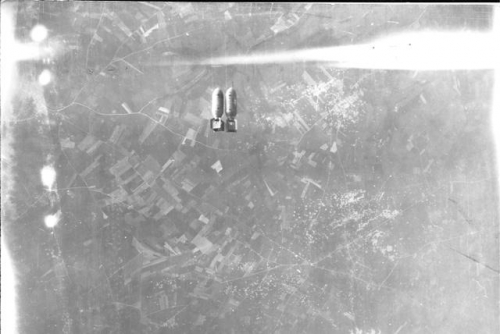
AUXERRE July 17, 1944