Mission Date: July 19, 1944
SCHWEINFURT & DUREN
100th BG Mission #: 164
Mission Summary
ON THIS DAY...JULY 19,1944
0200 hours came early for the crews flying that morning, especially for those that had never fallen asleep and by 0315 hours, they were all seated for the start of the mission’s briefing. When the map was unveiled, the string went past Aachen and stopped east of Frankfurt at Schweinfurt. The moans made by some of the men seated were shared by all, as everyone in the room was well aware of the 100th’s history at Schweinfurt.
The Group’s primary visual target for the day would be one of the five ball bearing plants located in Schweinfurt and whose millions of ball bearings produced each month were critical to the Luftwaffe. The secondary target would be the chemical plant at Darmstadt, south of Frankfurt while a target of last resort would be the metal casing works at Düren, halfway between Cologne and Aachen and on the route out.
The 3rd Division’s line would be led by the 4CBW, followed by two wing formations from both the 45CBW and the 13CBW. Leading the 13A would be the 100BG, with LT Colonel John Bennett flying as the Command pilot and Captain William Dishion as lead NAV. The 100th’s second formation would fly as its High group and would be led by Major Sam Barr, who was scheduled to fly the first combat mission of his second tour of duty, after being back in the States for a well earned rest and relaxation period. Barr would be flying in the PFF ship with Frank Valesh’s lead crew. The 95A would fly as the 13A’s Low group. Bringing up the rear of the entire Division line would be the 13th’s second wing formation. Led by the 390th, it would also fly as the Low group while the 95B would fly as its High.
Loaded with five 1000 lb bombs, the B17s had a successful take-off from Thorpe Abbotts between 0520-0555 hours. However, at 0535 hours at 1500 feet, Bert Scott had to abort the mission due to engine troubles and the spare aircraft flown by Albert Trommer took his place.
Two hours later, the 13A wing assembly was made and “At this point, another group came into our wing formation, head-on, causing us to split up.” The remainder of the 100th’s spares flown by Riegel, Delaney and Cumming all returned to base unneeded. For the 13th’s trailing wing, its assembly did not occur until the Division assembly point due to one of the 390th’s formations tacking on to the wrong combat wing.
Thirty minutes after crossing the enemy cost, the formation encountered its first round of flak but the course plotters had kept the formation safe. At Aachen, flak was reported as meager and inaccurate while at Liege, it was meager and out of range. At Koblenz however, it was heavier but tracking on the formation’s escort fighters. Just past Koblenz, the bomber flown by John Keys dropped out of Barr’s High group formation, subsequently dropping on a target of opportunity before returning to base. Unable to keep up with the formation, a second pilot, George Allen pulled out of the same formation, also dropping on a target of opportunity before returning.
As the formation neared Frankfurt, the flak intensified, described as an intense barrage, but again fortunately out of range and to the left. Two minutes prior to reaching the IP, Bennett gave the command to fan out in group formation for the bombing run but inside his PFF aircraft, “at IP there was a mix-up in the cockpit as to whom was to make the turn - pilot or bombardier,” resulting in the formation taken beyond their briefed IP.
Making the turn at 0938 hours, the bomb run commenced. Seven miles out from the target, the 13B’s formation, under the 390th’s lead, “was seen approaching from right,” on a collision course with the 13A but “It came out alright,”
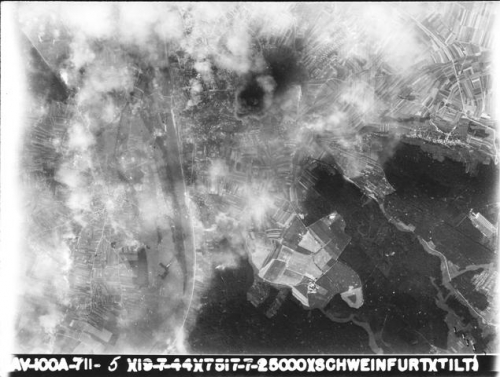
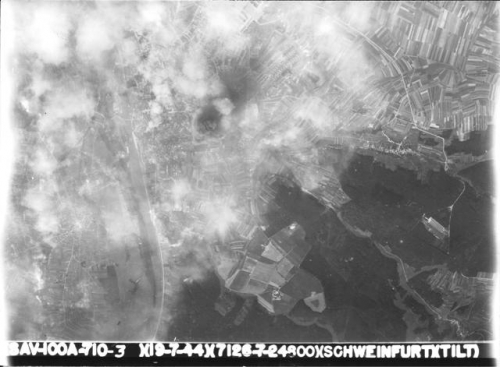
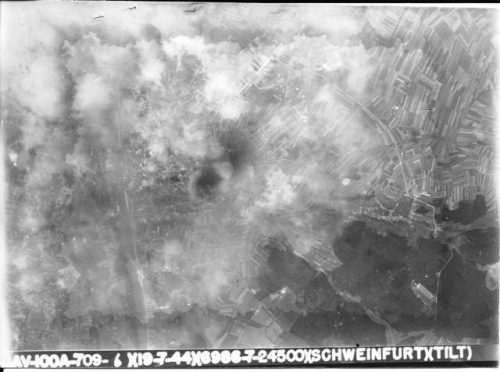
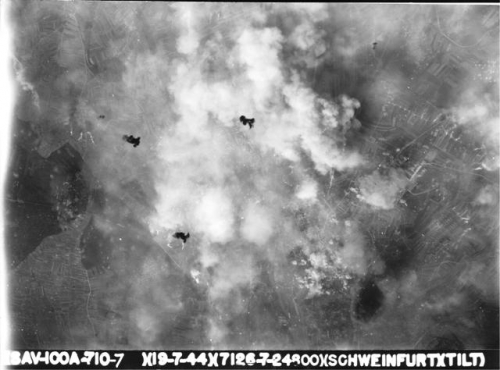
As the approach was made on Schweinfurt, the B17s were met with intense, barrage, tracking flak and this time, it was accurate. Although there was a heavy smoke screen covering the target, the bomb bay doors were opened and the Lead(100) and Low groups(95) dropped, but not before the majority of its aircraft had sustained flak damage.
Ransom’s B-17 was hit and his TG Emmett Schmitt recorded, “We got some holes in the wing fuselage and horizontal stabilizer. Two small pieces came through the waist above the ball turret, one piece cut a wire and the other smashed the emergency power switch for the ball turret, which made that inoperative.” In Harvey Dickert’s bomber, he remembered, “Quite a few holes in ship….It broke one of our deicer boot lines. Put big holes in #2 gas tank, both wings one big hole in left wing leading edge, holes in fuselage from nose to tail. Jack’s position was hit right at bombs away. Both Collier and Patterson were in their metal helmets. Pat was hit in the face by flying wood splinters – a piece of his ammunition box.” And Leonard Coleman, flying copilot in Farcht’s Fortress felt lucky when he remembered, “The flak was really good & don't think I ever had so many bursts come so close. We got quite a few holes in our ship but no serious damage.”
Also in the Lead group, the newer crews of Schaffhausen and Seamans were getting quite a combat indoctrination. Anthony Schimmel, WG in James Seaman’s aircraft recorded, “Rough, heavy flak, 31 holes, no enemy fighters, good escort, John Sheehan hit in left foot…No. 3 engine feathered, radio shot up. Flak thick enough to walk on, large piece of flak stuck in windshield right in front of co-pilot.” Pilot, Fred Schaffhausen flying in the Tail End Charlie position remembered, “Opened bomb bay door, started to sweat. Flak so heavy, couldn't possibly see safe passage though it. Flak burst completely surrounded the plane. Schaffhausen’s bomber had entered the “sea of black fiery smoke from the bursting flak shells. They were hit with numerous shell fragments. The right waist gunner was hit with a piece of metal from an exploding shell that penetrated his upper thigh, the right rear door was blown off, the pilot's windshield was shattered sending Plexiglas fragments into Fred's eyes (In the future he wore protective goggles). The co-pilot took over until he could regain his sight.”
At 0945, immediately after bombs away, Bennett’s formation took evasive action due to the intensive flak, and headed to the Rally Point. William Kennedy’s bomber had been trailing behind the formation after experiencing engine problems. Joseph Carlin, his NAV recalled, “I remember a lot of talk on the interphone, you, the co-pilot, and engineer talking about whether we could continue on…We had lots of excitement as the crew were reporting the higher group of planes had overtaken us and were opening their bomb bay doors.” Pilot Kennedy added, “We twisted and turned our way out of the area, with the ack ack explosions twisting and turning with us, but fortunately, 180 degrees out of phase. We finally cleared the area with no serious damage.” After dropping their bombs and flying along on three engines, an escort fighter came along side and Carlin added.“The whole crew was thankful and that made our trip home more pleasant.”
Meanwhile, flying in Barr’s formation, William Crozier, BTG in Joseph Ricker’s B17 tells us, “Flak was so heavy that our group turned off the target run before we got to the target… One piece of flak hit our right wing.” NAV James Wright on Trommer’s B-17 remembered, “Made dry run on target. Flew to Darmstadt and made dry run. Finally dropped bombs at Duren.” And Mickey Operator, Dick Johnson from Valesh’s PFF aircraft adds, “This was scheduled to be our last mission and we were not enthusiastic about the assigned target. We were flying with the 100th B.G. and we drew the one and only Sammy Barr as command pilot…Much to our surprise things went smoothly. It was a visual mission so my only job was to provide fixes upon request. The flak wasn't too bad, our formation good, and the fighter escort efficient. It was my 23rd birthday and I couldn't think of a nicer present.” Bombs were away on the marshalling yards at Duren at 1047 hours.
Knowing that the 100th’s High group had not dropped and was heading toward the secondary, Bennett’s formation “’S’d’ off course wherever possible to allow them to choose their target, bomb and resume position in the wing,” which it did, assembling at the half-way point. On the way out, the wing’s formation saw more flak and rockets over Belgium and Holland but no further damage was done.
Although both the 95BG and 390BG would lose two aircraft and crews that day, all of the 100th’s B17s returned safely to base, landing between 1218-1254 hours after a seven and one-half hour mission. Having left the formation at the coast, the B17s carrying wounded were given priority landing. Schaffhausen, coming in with twenty-seven flak holes and a wounded LWG, Joseph Walters, landed and pulled over to the waiting ambulance. Seaman’s bomber carried the wounded WG John Sheehan and the 418th's squadron diary tells us about the gunners, “They came back from the mission tucked inside the electric sleeping bags with which each ship is equipment these were developed to combat shock.” Seamans’ B17 had a flat tire on landing and Anthony Schimmel stated, “did a big loop on the grass without touching a wing to the ground.”
That evening, the 100th was alerted again and the mission light told everyone to make it an early night.
Crews on mission - Keys, Ricker, Riegel, Rosine, JD Williams, Allen, Dunlap, Rogers, B Scott, Gallagher, Trommer, Kassebaum,Townsend, Streed, Fitzroy, EC Jones, Roediger, Phelps, Clark, Delaney, N Scott, Ransom, Major, Anderson, Dille, Kennedy, Farcht, Cook, Cumming, Ricci, Rowland, Bethea, Dickert, Mcewen, Miller, Bennett, Schaffhausen, Seamanshis
Bombing Results
Bombing Results: POOR
Aircraft Lost: 0
Crew Lost: 0
Claims of Enemy Losses (CLS): 0
Aircraft Returned: