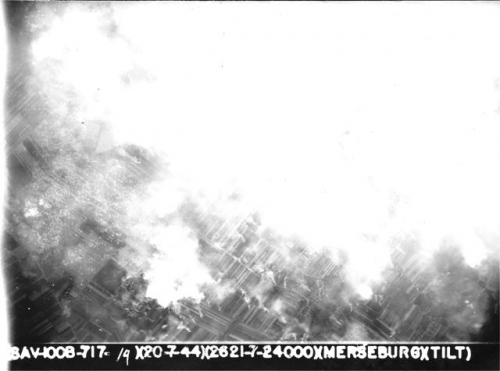
Mission Date: July 20, 1944
MERSEBURG, OIL REFINERY
100th BG Mission #: 165
Mission Summary
ON THIS DAY...JULY 20,1944
Forty crews were seated for that morning’s 0400 briefing when the unveiled map showed the red line stopping in Germany. When the S-2 Officer vocalized ‘synthetic oil production’ and ‘Merseburg,’ in the same sentence, they all knew that they would be for a long and rough mission. The Keys crew was seated in yet another mission briefing and Joe Costanza was feeling the strain from lack of sleep. “Its been pretty rough these last few days because of this steady flying. We barely make four hours a night sleep.”
The 13CBW would fly two wing formations, each with a separate primary target. The 95BG and 390BG, flying in 13A would target the oil plant at Lutzkendorf while the 13B lead by the 100BG, and also flying the Low squadron, would target Merseburg. The 390BG would also fly as their High squadron. The secondary target for the day would be an airfield while the target of last resort would be the marshalling yards at Koblenz.
Leading the 13B wing and the 100th in a PFF ship would be twenty-six year-old Major Magee Fuller flying as Command Pilot with twenty-six year-old Captain Francis Kincannon. Captain Herbert Howard would lead the 100th in the Low squadron formation.
All aircraft, each loaded down with twenty 250 lb bombs, took-off successfully between 0635-0708 hours. Forming into groups first, wing assembly was accomplished and the 13B folded into the 3rd Division’s line behind the 45CBW’s lead formation and the 13A with the 4 CBW flying last in the stream.
As the long line of heavy bombers headed across the water, the 100th’s unneeded spares flown by Bennett, Kennedy, Gallagher and Streed all returned back to base.
Making landfall on the enemy coast at 0930 hours, the gunners already having test fired their guns over the water, were scanning the sky for enemy fighters, which gratefully never came. Reaching the IP at 1111 hours, the 13B made its turn onto the bomb run. Although there was no cloud coverage as Merseberg was neared, its smoke screen and ground haze prohibited a visual sighting on the MPI and nineteen year-old Mickey Operator, Henry Griffis set up for the target.
Flak was exploding all around the formation, intense and accurate. James Wright tells us, “Flack and rockets were all over the sky.” Pilot Harvey Dickert adds, “Flak was rough but we only got a few holes. In fact we were in the stuff quite a while and they were right on us.” Joe Costanza in Keys’ B17 recorded, “The flak was a bit rough. Quite a bit…The nose got one hole in the chin turrett and one in the plexiglass. They shot a few rockets at us but rockets aren’t very accurate.”
Receiving damage, Leslie Kassebaum had his trim tabs shot out. In James Seaman’s ship, Anthony Schimmel reported, “No 3 engine hit. Flak stuck in cowling and box cover. Engine ok.” And James Ransom’s aircraft received holes in the wings. Copilot Keith Lamb remembered, “About that time I had a change of heart about combat flying in a bomber. For the first 10 missions or so I had considered it a lark—nothing but a lot of fun. During the next 10, I gave up all hope of ever coming out alive…I would have bet ten-to-one that I would never see Sacramento again—but I wouldn't have found any takers.”
Flying through the intense flak, bombs were successfully away at 1120 hours. Just after releasing its load, Fuller and Kincannon’s lead ship, “received a direct hit by AA fire between #2 engine and fuselage. Shell did not explode but a large hole was torn in the wing and gasoline poured from the tanks.” Pulling his B17 out of formation, Magee Fuller directed the deputy leader from the High squadron to take over as the command ship, so the two squadrons switched positions.
Making the Rally Point eight minutes later, the 100th’s formations now flying as the High and Low squadrons, started their descent and headed for home, landing safely between 1411-1439 hours, after a long nine hour mission and no further incidents. Missing was the Fuller and Kincannon aircraft and everyone had hoped that they would report in, having landed safely elsewhere.
However, after dropping out and lagging behind the exiting formation, the lead ship had called for fighter support. Able to fly their bomber another four fundred miles west of Merseberg, the pilots crash landed in a field at Breda, Holland, on the border of Belgium. All crew members quickly cleared the aircraft, and ran for cover while the PFF equipment on board was destroyed. Under a pre-arranged scenario with their P-51 escort, the fighter pilot strafed the crashed B17, causing a large enough fire to destroy the plane and all of its contents.
Twenty-five year old BOM, Robert Nance, the last to leave the ship, had left his parachute, harness and Mae West inside the B17 to burn with the rest of the aircraft. With injuries to his ankle and right side of his body, he hid out alone until eventually heading towards the Belgian border where the next day, he encountered help and was given food and further directions. Aided by resistance fighters, Nance was reunited with his crew members, twenty-three year-old Louis Abromowitz (NAV) and twenty-three year-old George Bonitz (NAV) in Antwerp. The three airmen were unbelievably lucky, as they had all been hidden with a Father Pierre Cools while in Antwerp, but had been quickly moved under the request of another resistance fighter Marthe Delbeke. Cools and Delbeke were both later arrested on July 22 and 25 due to a traitor infiltrating their escape line. The airmen were then transferred to Brussels, where they were split up, Nance going to one location while Abromowitz and Bonitz went to another and where they all remained hidden until the Liberation of Brussels on September 2 by the British 2nd Army. Nance reported, “We fought with the White Army until the arrival of British troops. Contacted the English at the Hotel Metropole on September 4, 1944.”
Having buried their gear, nineteen year-old LWG Daniel Cargile and nineteen year-old RAD NAV Henry Griffis, paired up and ran towards the closest woods. With a German bicycle patrol searching for them, they managed to hide in a ditch, covering themselves with foliage and grass and remained unnoticed for twelve hours, while German aircraft strafed the surrounding area. Moving at night through fields and woods, they encountered a farmer who provided them clothes and food, allowing them to hide in his haystack. On July 22, having crossed into Belgium and traveled to the outskirts of Lille, one hundred nine miles away from their crash site, a farmer named Antoon Neefs, helped them and contact was made to arrange their organized escape. Also hidden in Antwerp and Brussels, both crew members ended up in the Ardennes where they eventually encountered American troops.
Ultimately seven of the crew, Command Pilot Magee Fuller, Pilot Francis Kincannon, Copilot Bernard Farnum (23), TTE Donald Deason (21), ROG Oscar Edge (21), RWG Glen Snider (31) and TG Robert Chavez (25) were captured and became POWs.
Crews scheduled that day: Keys, Woodall, Tiahrt, Rogers, JD Williams, Kemp, Riegel, Kassebaum, Scott, Gallagher, Trommer, Carlton, Roediger, Herres, Fitzroy, EC Jones, Streed, Phelps, Rosine, Delaney, N Scott, Ransom, Major, Seamans, Dille, Kennedy, Farcht, Anderson, Cumming, Ricci, Rowland, Cook, Dickert, Schwank, Miller, Bennett, Schaffhausen, Bethea
Bombing Results
Bombing Results: GOOD
Aircraft Lost: 1
Crew Lost: 12
Claims of Enemy Losses (CLS): 0
Aircraft Returned: