Mission Date: July 21, 1944
REGENSBURG & LUDWIGSBURG
100th BG Mission #: 166
Mission Summary
ON THIS DAY...JULY 21,1944
Headquarters received the 3rd Division’s Field Order 341 throughout the evening hours, detailing a ‘Plan A’ and a ‘Plan B’ for the next day’s mission. ‘A’ would eventually be cancelled and it would be Plan B’s details divulged when the S-2 Officer pulled the curtain from the map at the start of the 0230 briefing. The 100th would be flying into southern Germany where their primary target would be an aircraft assembly factory at Regensburg, fifty miles north of Munich. Their secondary target would be an aircraft factory located at Fürth, seventy-one miles northwest of Regensburg while a target of last resort would be the chemical works at Ludwigshafen, one hundred fifty miles further west of Fürth.
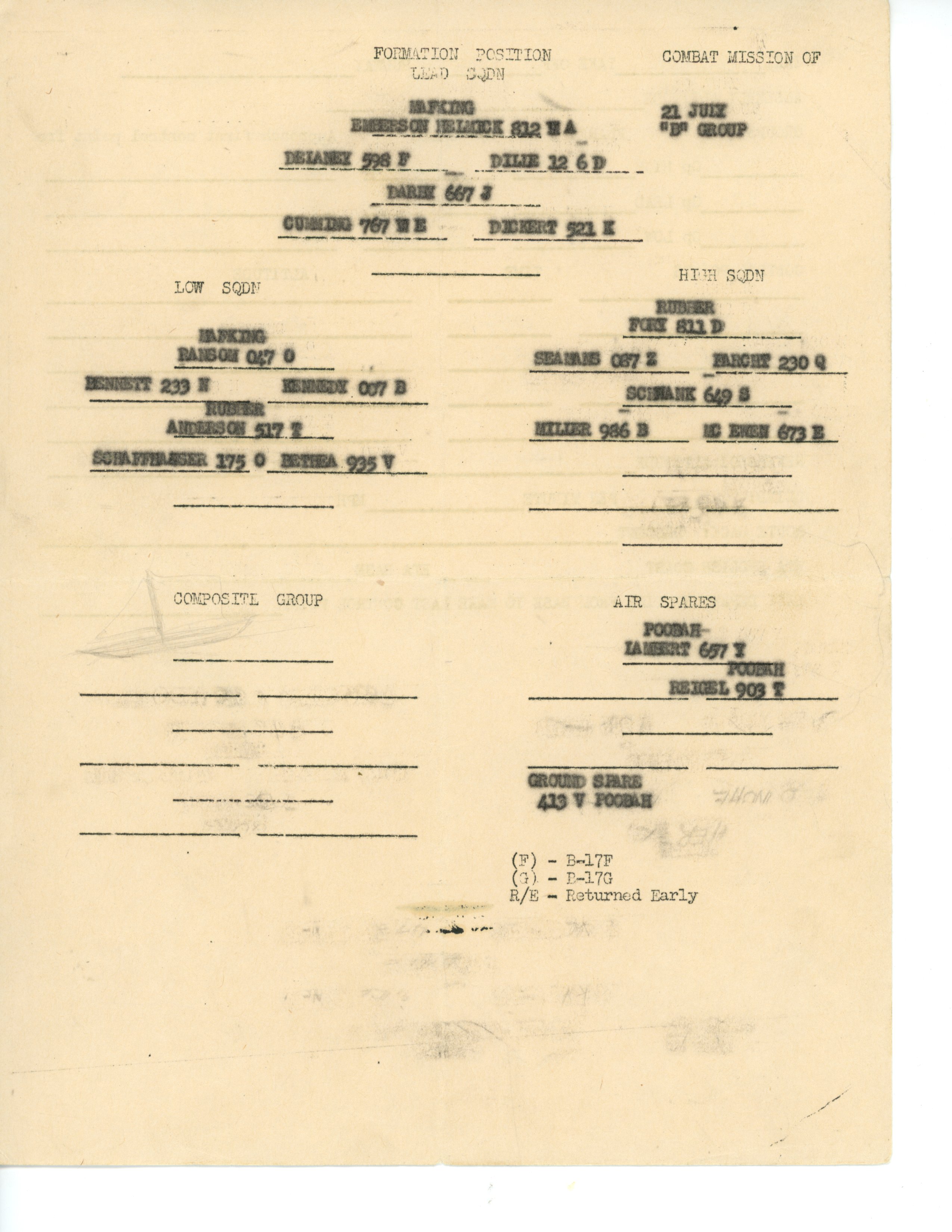
The orders called for the 13CBW’s Groups to fly in composite formations. The 95BG was scheduled to fly as the 45B Wing’s High group, two wing positions ahead in the Divisional line. The 13CBW’s single wing formation, flying last in the Division’s line, would be made up predominately of 100BG’s crews. The wing would be led by the 390BG in a composite with the 100BG providing six crews as its Low flight. The High and Low group formations would both be led by the 100BG, with the High containing six aircraft from the 390BG flying as its Low flight. The 100th’s High formation would be led by Captain Maurice Youngs in a PFF ship flown with George Fory while the Low would be led by Major Emberson flying with Richard Helmick that day as copilot.
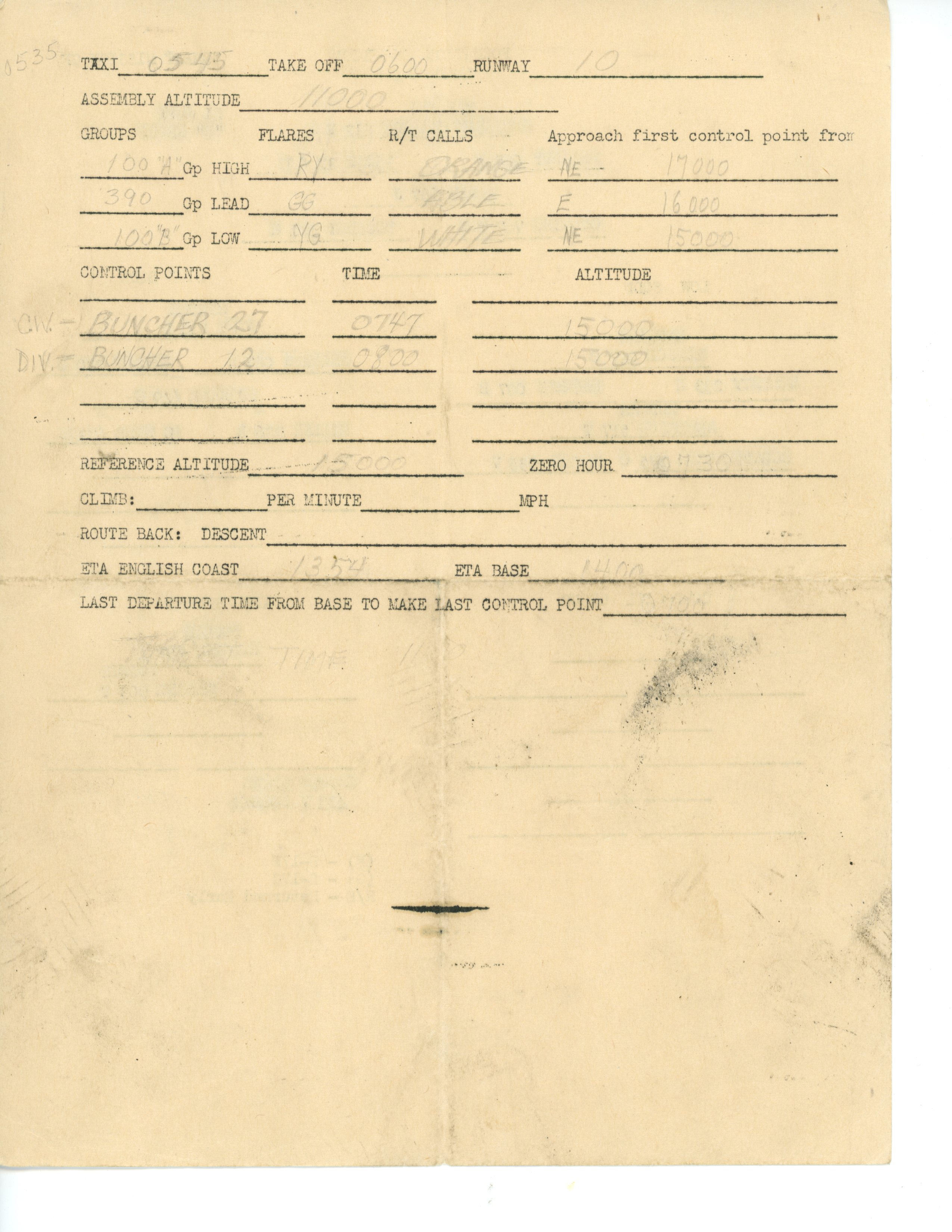
Orders called for the 100th’s B17s in the High group to be loaded with ten 500 lb bombs while those flying in the Low would carry the maximum load of M17 incendiairies. With all of the 100th’s pilots making a successful take-off between 0540-0616 hours, they formed up over Buncher #28 and had assembled into the 13CBW over Buncher #11 by 0747 hours. Not needed to fill any open spots left by aborting pilots, the three spare bombers flown by Williams, Elbel and Lambert returned back to base.
After departing the English coast, the 13CBW formation started their climb over the North Sea where the cloud coverage grew heavier due to a raging northeaster storm forming. With visibility difficulties, the 13CBW entered the Division line in the wrong position which was corrected back to last in line as the enemy coast was crossed at 0845 and by which time, twelve out of the twenty-four 390BG’s bombers put up that morning had already aborted.
The Wing’s route was flown short of their briefed check points, taking all of the bombers within range of flak coming up from Aachen, Kaiserlautern and Karlsruhe, over which “the wing lead was hit again.” The 100th’s formations switched from one side of the Lead formation to the other to try and avoid the flak and reported, “After reforming, we were taken over Heilbronn and again forced to cut away from the wing formation and flak area in this vicinity. By this time the low and lead groups were scattered all over the sky because of clouds.” Losing their formation in the clouds, four of the bombers from 100th’s Low group, flown by Mcewen, Cumming, Schaffhausen and Farcht had tacked on to the 1st Division’s formations.
The 13CBW had flown into a deck of heavy clouds, scattering all of the aircraft due to lack of visibility and forcing the wing leader to make three 360 degree turns taking twenty-two minutes to reform the wing. Twenty-one year-old Joe Costanza, WG in Keys ship echoed the thoughts of many of the men that day when he wrote, “This could of been a field day for the Luftwaffe.” And Keith Lamb, flying copilot in Ransom’s plane tells us, “On my twentieth mission, to Regensburg, we went through a large bank of clouds. When we finally emerged from them, there were only five of us left in the Group; so we proceeded to circle, in an effort to reassemble. It was rumored that there were many enemy fighters in and around the clouds in which our Group was floundering, so naturally our Group Leader began to get excited. Ten miles off to our left was a large flak barrage, which he figured all of our planes could see--even if we couldn't see the rest of our formation. So he radioed us to assemble over the flak area. It was a drastic idea, but it worked. Everyone could see the flak bursting, and after we had flown around in it and over it a while, we had our Group back together… After assembling, we started out for our target, but the Group Leader decided we no longer had sufficient fuel to get there and back to England; so we flew back to the same flak in which we had assembled and dropped our bombs, knowing that there was something of importance underneath. That's gratitude for you.“
Having climbed to 28000 feet altitude rather than the briefed 23000, the bombers back in a very weak wing formation, flew through heavy flak for three minutes over Stuttgart where the 390th’s ships ultimately dropped. The 100th’s ships however, continued north of Stuttgart, attacking Ludwigsburg at 1102-1103.
After bombs were away, the 100th headed for home, departing the enemy coast after close to four hours of flying around blindly in enemy territory. Letting down over the North Sea, all of their bombers returned safely to base, landing between 1334-1351 hours, after an eight hour mission. The 349th’s Squadron Diary entry for that day aptly recorded, “Today’s mission was another fubar (fouled up beyond all recognition)…The special equipment on the pathfinder didn’t seem to be very positive about what it saw with the magic eye. Incidentally, the popular item finally adopted for this miraculous service was “Mickey,” although no one could explain why. We lost no planes nor men, but battle damage was extensive from the hail of flak at Stuttgart and other points.”
Without an official battle damage report, we know that Kennedy landed his plane with seven flak holes. Phelps had a feathered #1 engine and holes in gas tank and oxygen bottle and Keys had his #4 engine knocked out. Most grateful for his safe return was Leslie Moore, BTG on Dale Darby’s crew. He had just survived his #7 mission when he recorded into his diary, ”My Birthday One of the roughest days we had.” Leslie had just turned twenty-three years old.
That evening, the northeaster closed in over East Anglia and the weather would turn so bad that the bombers would be grounded for two days.
Crews scheduled for mission:
Keys, Streed, Elbel, Delaney, JD Williams, Phelps, Fitzroy, Dille, Allen, Riegel, Rosine, Cumming, Gallagher, Lambert, Rogers, Dickert, Herres, Trommer, Carlton, Bennett,Ransom, Schwank, Anderson, Helmick, Schaffhausen, Fory, Kennedy, Farcht, Bethea, Darby, Miller, McEwen, Seamans,
Bombing Results
Bombing Results:
Aircraft Lost: 0
Crew Lost: 0
Claims of Enemy Losses (CLS): 0
Aircraft Returned: