Mission Date: July 24, 1944
ST. LO, GROUND SUPPORT
100th BG Mission #: 167
Mission Summary
ON THIS DAY...JULY 24,1944
After two days of torrential rain in France and two days of being grounded from flying out of England, Field Order 343 would take the 3rd Division to the Cherbourg peninsula where the heavy bombers were needed to blast a hole in the German line, in aid of Allied ground troops whose offensive movement had been bogged down in six inches of mud.
At Thorpe Abbotts, forty-two crews had been seated for the 0800 briefing when they were told that they would be flying a tactical mission to Saint-Lô, France in support of their ‘brothers’ on the ground. Secondary and last resort targets were stated as any military objective.
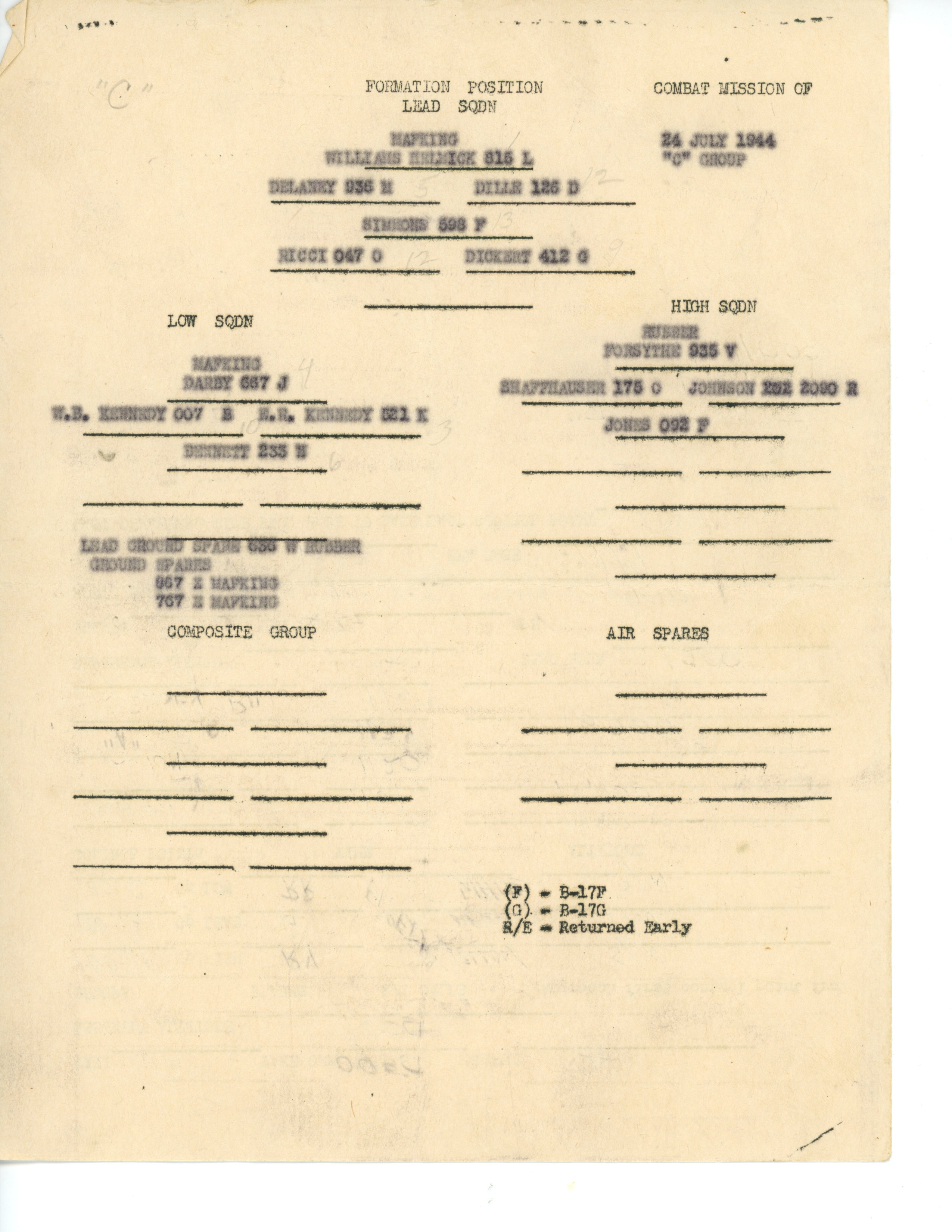
The 13CBW, flying three wing formations would lead the entire Division line, with the 4th, 45th and 93rd CBWs heavy bombers following. The 100BG would lead the 3rd Division and the 13A wing formation with Colonel Thomas Jeffrey flying as the Command pilot with twenty-five year-old Merle Ehorn and his crew. Jospeh Zeller would fly with John Giles while Richard Helmick would fly with Earl Williams as lead ships in the High and Low formations.
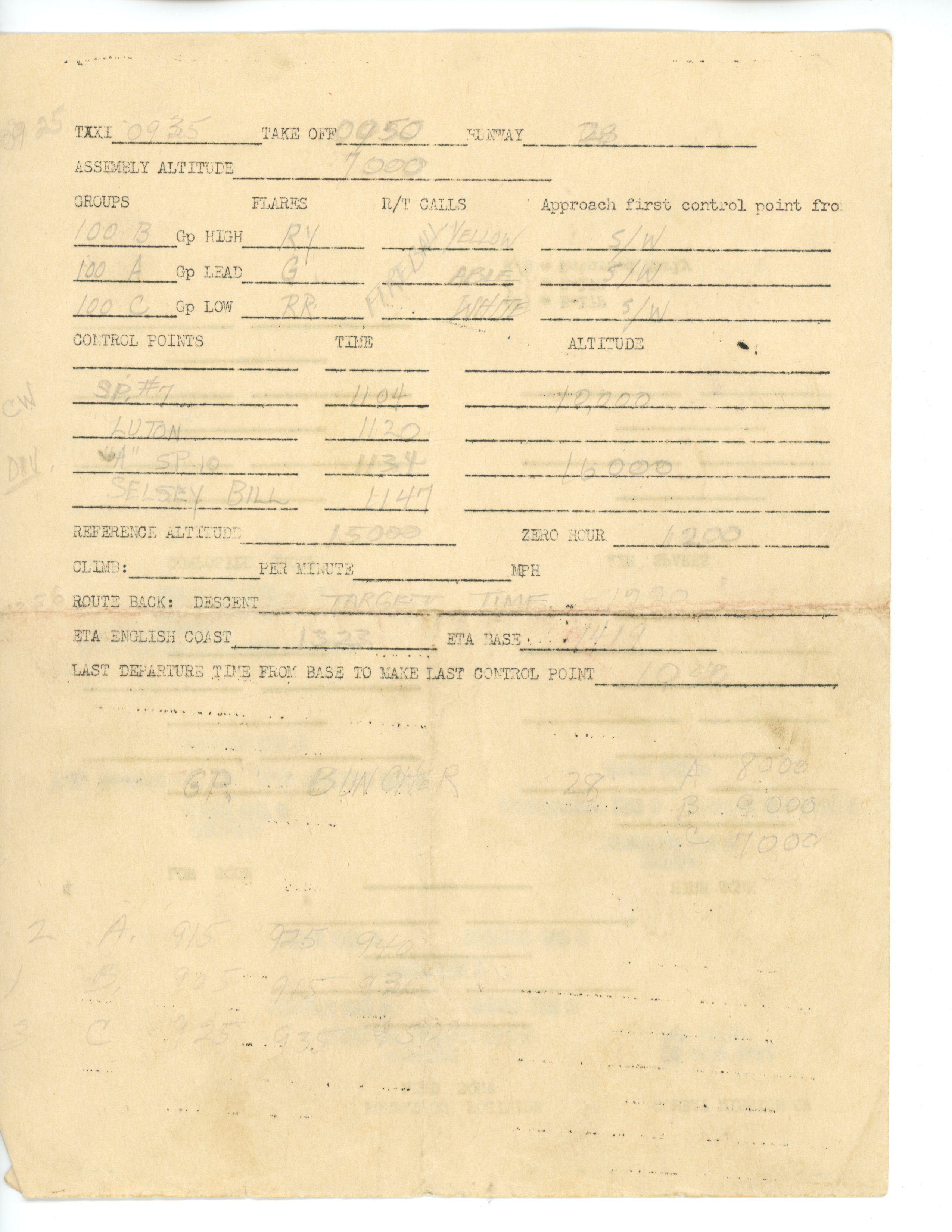
With the lead B17s loaded with fragmentation bombs, the remainder had been loaded with thirty-eight 100 lb GP bombs and two thousand two hundred gallons of fuel. All aircraft successfully departed the base and formed over Buncher 28 under 10/10 cloud coverage.
Thirty minutes after leaving the English coast, the 100th’s formations had crossed into France and were over the target at 1220 hours, still in the thick 10/10 clouds. William ‘Red’ Crozier, BTG in Joseph Ricker’s B-17 tells us, “Clouds kept us from seeing the target area, and we were afraid we would hit our own lines so we came back with our bombs. I saw an airplane about 2000 yards off get a hit with flak. It burst into a huge sheet of fire, dropped below its formation and exploded again into small burning pieces. I saw no parachutes. The flak was thin but very accurate.” And pilot Harvey Dickert recorded, “Saw one B-17 go down by flak. Fighters hit wing behind us, but left us alone. No holes in our ship.” Although it was a short mission, anything could still happen, “even on a milk run.”
Although a hole had appeared in the clouds, there was no time for the PFF’s proper sighting so the bombs had been held and the 100th completed a “dry run” over the target. The 349th squadron diary tells us, “Pathfinder technique could not be relied upon when the objective lay so close to our own troops.” The formation returned to base, still loaded with their bombs, landing safely between 1507-1521 hours.
That day would bring opposing emotions to two of the airmen who had returned safely from the mission. After cleaning his guns, eating and returning to his hut in the 349th squadron area, nineteen year-old William ‘Red’ Crozier from Fort Worth, Texas, was opening his mail, a highlight of each Airman’s day, especially when reading news from home so far away. Through his diary entry, 'Red' tells us, “After the mission, I came back to the squadron area, got my mail, only to bad news. Very bad news. A letter from my sister told me that our mother had passed on. Heart attack. It hit me pretty hard. She had not even been sick, but I guess she had worried too much about me and my three brothers in the army. It is hard for me to realize she is gone. It doesn't seem right somehow. Our whole family depended on her for so much - Rick (Joseph Ricker) told me I would not have to go on the missions for a couple of days. Maybe I can pull myself together.” It would take eighteen days for the devastating news of his mother's death to reach William in England. That evening, the Ricker crew was alerted again and BTG Marvin Ollhoff, from the newly arrived Julius Geller crew, would fly in ‘Red’s place.
Meanwhile in the 350th squadron area, the ecstatic Henry ‘Hank’ Rosine had just returned from his 35th mission and his tour of duty had been completed, a few missions ahead of the rest of his crew. Becoming a first pilot at nineteen years-old, the now twenty year-old experienced combat flier had completed his #1 mission back in April and survived a particularly rough mission to Berlin where his B17 was heavily damaged by exploding flak, damaging three engines and wounding three of his crew. As all families of soldiers did during wartime, Hank’s parents in Michigan would share Mrs. Crozier’s worry about their sons in uniform. Soon however, the feeling of relief and gratefulness would be felt when they heard that Hank, their youngest of three sons in uniform, would soon be home.
Crews scheduled to fly on July 23:
Ehorn, Ricker, Streed, Riegel, Scott, Allen, Phelps, Lambert, Townsend, Gallagher, Williams, Giles, Woodall, Herres, Tiahrt, Trommer, Elbel, Carlton, Dille, Helmick, David, EC Jones, Dickert, WR Kennedy, Fitzroy, ER Kennedy, Bennett, Darby, Rosine, Delaney, Simmons, Ricci, Schaffhausen, Johnson, Anderson, Major, PG Jones, Fory, Farcht, Rowland, Forsythe, Seamans
Bombing Results
Bombing Results: RECALL
Aircraft Lost: 0
Crew Lost: 0
Claims of Enemy Losses (CLS): 0
Aircraft Returned: