Mission Date: July 25, 1944
ST. LO, GROUND SUPPORT
100th BG Mission #: 168
Mission Summary
ON THIS DAY...JULY 25,1944
Having checked in with the attendance man at the briefing room door, the majority of the forty-two crews in attendance would hear the same briefing details as they had heard the previous day. The 100th would again fly a tactical mission to the front lines at Saint-Lô. Seated in both briefings, pilot Frederick Schaffhausen recorded, “Another mission like yesterday. 1st Army starting a major offensive 8 minutes after our bomb release. Our purpose is to make an opening in German lines for troops…” and once again, the S-2 Intelligence Officer reiterated the need for accuracy and proper timing.
The 13CBW would again lead the 3rd Division, but it would be the 95BG flying as its lead wing with the 100BG flying as its second and the 390BG as its third, ahead of the 4th, 45th and 93rd CBWs.
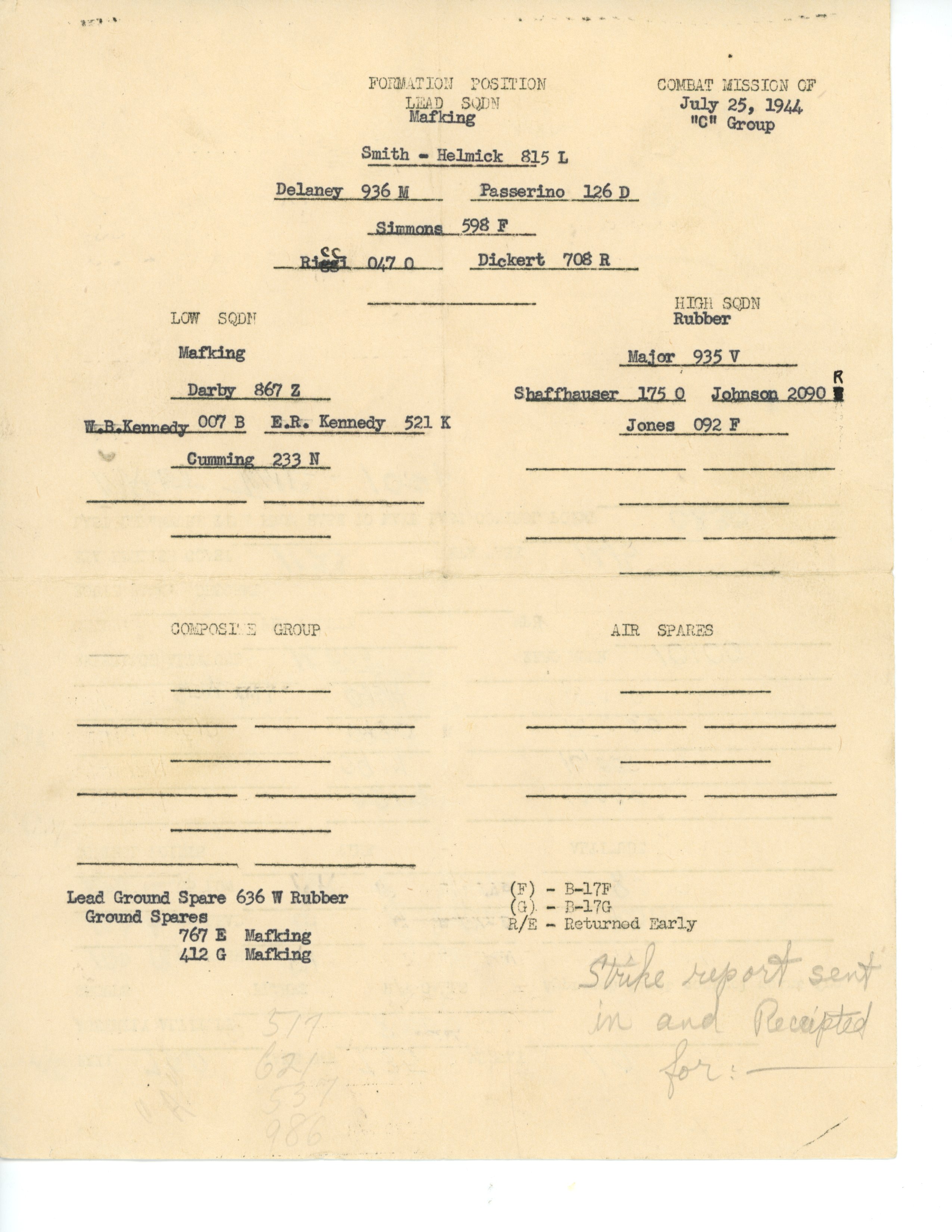
The 100BG would fly three formations, with its command ship flown by Major Robert Rosenthal flying with Merle Ehorn as copilot. Major William Thompson, the 100th’s Flying Control Officer, would also fly in the lead ship, this time in a WG position. Major Sam Barr would lead the High group and Captain Richard Helmick, on his last mission, would lead the Low with Captain Henry Smith.
With changes made to the B17s and crews reduced by one waist gunner position, WG Joe Coztanza tells us, “…they took out the radio man’s gun and only one waist gunner flys at a mission. I flew today, the left waist gunner will fly on the next mission.” The armorers had spent the early morning loading the bombs into the forty-two Fortresses, with the Lead and High aircraft carrying thirty-eight 100 lb GP bombs and the Low the maximum number of fragmentation bombs. With each plane fueled up with two thousand two hundred gallons of gas, all of the 100th’s bombers safely departed Thorpe Abbotts between 0715-0747 hours.
As the 100th left the English coast in wing formation, the weather at the other side of the channel was not as briefed. Similar to the previous day, the planes lowered to a bombing altitude of 12000 feet to get under the clouds, crossing the French coast at 1013 hours with bomb bay doors open. However, visibility was considered good by the time they reached the target area.
On the ground, a NYT’s reporter, Harold Denny, watched as the more than one thousand five hundred Fortresses and Liberators flew overhead in the “most concentrated air support ever given American ground forces.” He wrote, “I was riding toward the front in a jeep when the heavy bombers came over at 10 o’clock, and their bombing rocked the earth for miles back, even when it was too far away for me to hear the explosions. They came in group after group, each in box formation and at unusually low height of 10,000 to 12,000 feet. Their unpainted aluminum bodies glistened in the sunlight. They marched across the sky at precise intervals and for that whole hour there was never a moment when two or more groups were not in view at once. The air vibrated with the drum of their motors. German anti-aircraft guns fired heavily on the early formation of these heavies and I saw three of our planes shot down, two of them in flames but with the crews escaping by parachute.”
In the air as part of that force, the 100th’s ships were experiencing rough air conditions and flak as they flew over their target. Pilot, Harvey Dickert tells us, “The very heavy artillery was out again this morning. Today the visibility was better but we had to go in at 12,000 feet. We laid down a very good bomb pattern and the results were excellent. I hope the infantry coordinated attack is going as well….” Over the target area, the Lead formation held its bombs a moment longer while the High and Low formations dropped first and early, all aiming for the area south of the St Lô-Perieres road.
Immediately after bombs were away, the 100th made the turn to the right to get out of the flak, paralleling the road when Lawrence Townsend’s bomber was hit by flak. With a fire inside of the plane and a wing on fire, Townsend gave the bail-out order and nine parachutes were counted as all men jumped from their burning B-17. WG Coztanza tells us, “Flak was fair. Our neighbored crew next door to us were on their last mission. Their ship got hit and nine men bailed out on German lines. They were swell guys…”
Making the Rally Point, the remainder of the bombers departed the French coast with the weather over the channel forcing the pilots down to 7000 feet. Reaching Thorpe Abbotts, all but Townsend had landed safely between 1226-1301 after a five hour mission.
At Interrogation, due to the early release of their bombs, many of the “crews voiced their concerns that their bombs had fallen into the forbidden zone,” killing American soldiers. Although HQ was not happy about the early release, Senior S-2 Officer, Red Bowman would record “…Blame was attached to medium bombers, not the heavies, in later investigations.” Harold Denny’s reporting continued, “Our air attack proper began at 10 o’clock sharp this morning and ended at 12:30. It was not an unmarred success, however. Some bombs fell among our own troops and caused casualties. This was probably due to the fact that a high wind blew the smoke of earlier bombing waves back over our lines and succeeding waves were deceived into thinking that was the bomb line.”
With a short mission flown, the 100th was scheduled for yet another mission that same day. Joseph Constanza on Ricker’s crew tells us, “As soon as we came down, we had to leave our guns in the plane and heated clothing on because they were loading up the plane again and as soon as we finished eating we’d have to go on another mission. But weather closed in and prevented us.” And Lewis Payne, from Jackson Phelps crew recorded, “At 4:00 PM went on another mission but was called back. This was #13.” The weather would have the 100th's next two days of missions scrubbed.
Meanwhile after bailing out over the German lines, Townsend’s NAV Arnold Holmes tells us, “At 2000 ft. Germans started shooting with rifles and then with auto weapons.” Passing out, Holmes came to on the ground. Surrounded by German soldiers, he was taken to a tent where he was reunited with this ROG, twenty year-old Louis Glasser who tells us, “I did not delay my jump since I thought I could work my way by manipulating my chute across the lines into American area. At about 200 to 300 feet the Germans began to shoot at me, hitting my shroud line. I fell limp to imitate being dead, and the shooting stopped. A few moments later I landed in a wheat field, rolled up my chute and Mae West, hiding them in some nearby bushes, and wandered out onto a road where I met a Frenchman who gave me some directions. I hopped over a fence and immediately ran into three Germans who took me prisoner…”
Moved to a farmhouse, the two airmen prisoners are then reunited with their captured pilot Townsend and TG Earl Milam. Moved again to a schoolhouse, at 4AM the next morning, the Germans had captured BOM George Gardner, CP Andrew Burkhart and BTG Chalmers Anderson. Only their TTE, Walter Kolar would never be captured. Walking for days with many other prisoners, the men were fed by French civilians and the French Red Cross and eventually separated with all airmen moved to a Stalag at Chartres and then elsewhere. While in Chartres, Arnold Holmes, delirious with fever, was moved to several hospitals in multiple cities, eventually ending up in a hospital in Paris from where he was eventually liberated.
Only the crew’s TTE, twenty-one year old Walter Kolar would evade capture, aided first by the French Resistance who would provide him food, clothing and a false identity as a deaf mute. Kolar would connect with a forward moving American tank crew, riding with them until he volunteered to escort German prisoners back to the American lines. Ambushed by German soldiers, Kohler and his driver were shot in the throat and chest. The next thing Kohler remembered, he was being treated by an Army medic. After passing out again, he eventually woke up in an American hospital where he convalesced for several months.
Crews scheduled to fly on July 24:
Rosenthal/Ehorn, Woodall, Herres, Riegel, Keys, Ricker, Streed, Lambert, Scott, Allen, Phelps, Giles, Townsend, Gallagher, Tiahrt, Trommer, Elbel, Jones, Passerino, Helmick/H Smith, David, Spear, Cumming, WR Kennedy, Fitzroy, ER Kennedy, Dickert, Darby, Carlton, Delaney, Simmons, Ricci, Mcewen, Farcht, Anderson, Lischer, Rowland, Fory, Schaffhausen, Johnson, Major, Jones
Bombing Results
Bombing Results:
Aircraft Lost: 1
Crew Lost: 9
Claims of Enemy Losses (CLS): 0
Aircraft Returned: