Mission Date: July 28, 1944
MERSEBURG, OIL REFINERY
100th BG Mission #: 169
Mission Summary
ON THIS DAY...JULY 28,1944
Enlisted crew members were a tight knit group and it tore them up when they were unable to fly a mission together. With a few days off after learning that his mother had died, William Crozier, BTG on Joseph Ricker’s crew was scheduled to fly on July 28. Awakened at 1230 hours, Crozier tells us, “…before briefing we were in line to get breakfast when the noise in the mess hall seemed so loud I could not stand it. I guess I turned pretty white and I suddenly felt weak and I sat down on a bench. When Dell (ROG) looked at me he said you are not going on any mission today, and he took off in a run to operations to get a replacement for me. In a few minutes Dell came back and said the operations officer said I should not have tried to go on the mission. Dell told me to go back to our hut so I did. I feel terrible. I feel worse about their going on a mission without me than I do from my nerves tearing me up…They have to come back. If there is a mission tomorrow I am going!!!!!”
At the early morning briefing, forty crews had been seated. When the S-2 Officer pulled the curtain back from the large map, the attendance man outside the room could hear the moans and whistles let out by those inside. With the red string going deep into Germany, stopping close to Leipzig, the crews were told that their mission would take them to Merseberg, where they would attack the Leuna synthetic oil refinery, both as their primary visual target and as their secondary by PFF, if required. Any military objective could be hit as a last resort target.
Every flier seated had either experienced or had heard about Merseberg and even the veteran fliers were edgy. Flying his #11 mission, James Wright, NAV on Trommer’s crew, having just returned from leave in London, remembered, “We were briefed to fly to Merseburg. I had a strange feeling about the mission. Something kept telling me I’d be sorry.” The six new crews seated of Stansbury, Stevenson, Spear, Coccia and Dobrogowski and Lundquist all flying their #1 that day, would not have an easy target as their introduction to combat.
Again, the 13CBW would lead the 3rd Division’s line, flying two wings ahead of the 4CBW’s formation and the two wings flown by the 45CBW. Leading the 13A wing would be the 95BG, also flying as its High group. The 100th would fly as its Low group, led by Major Channing Emberson. In the 13th’s second wing formation, the 390BG would fly both the Lead and Low groups while the 100BG would fly as its High, led by Captain Floyd Mason flying in the PFF ship with George Fory’s lead crew.
With the aircrafts loaded up with ten 500 lb. GP bombs, all pilots took off successfully between 0444-0515 hours. With Emberson’s group experiencing some difficulty forming up, it lagged behind its wing for several miles as they crossed the North Sea. Aborting the mission would be Jackson Phelps, who pulled his B17 out of formation due to a failure in their oxygen equipment.
Crossing the enemy coast at Kouderkerke, Holland, the message was received that the Primary was covered and PFF bombing would be required. The formations made the turn south at Monreal.
Twenty minutes before hitting the IP, Mason and Noble’s lead ship experienced a fire, thought to have been started by a flare. Nosing down twice, the rest of their group followed, losing 2000 feet in altitude. Noble lowered his wheels, signaling he was leaving the formation when the fire started in the radio compartment, filled the cockpit with smoke. As Noble peeled off to the right, “a small explosion was seen in the right wing between #3 engine and the fuselage…The fire in the A/C appeared to be out when it plunged into the undercast flying steadily under AFCE control.” With chutes seen, NAV Robert Barry tells us that Captain Mason, the first to bail out “…departed with his harness on, but not fastened and his parachute in his left hand approximately 2.5 minutes after the explosion.”
With the loss of the High’s lead aircraft and flying at a lower altitude, the 13A’s wing leader had the 100th’s remaining formation fly as the Low group while the 390BG’s Low replaced the 100th as the High group. Continuing on to the IP, the turn onto the bomb run was made, just east of Mühlhausen.
Seven minutes into the bomb run, the heavy and anticipated flak commenced, continuing for the remainder of the run with several of the Fortresses taking flak hits, but none severely damaged and none lost. NAV Buddy Wright tells us, “We had a hell of a time too. There was more flak at Merseburg than I ever saw before. I hope I never see it again.” Bombs were away between 0923 and 0934 from the 100th’s aircraft through the cloud coverage.
After bombs away, evasive action was taken until the Rally Point and no further damage from flak was incurred. Departing the enemy coast at 1200 hours, having survived another mission to Merseburg, the remaining bombers continued over the North Sea and were almost to the English coast when tragedy struck.
Albert Spear, in the #7 position of the Low squadron, pulled his B17 up, with his propellers hitting the vertical fin of Wesley Stansbury’s B-17, flying in the #5 position. In Spear’s ship WG, twenty-one year-old Robbie Gill tells us, “I was thrown forward in the ship between the ammunition boxes. There was quite a bit of noise and the ship seemed to be thrown around alot. I pulled the door off the tail…” Just before he jumped, Gill “could look down and see the front part of his bomber, that had carried his eight crewmates, burning on the surface of the water.” Then he bailed out. Meanwhile, Stansbury’s bomber had broken in half at the waist from the collision and fell down into the clouds with no chutes seen.
The 100A formation crossed the English Coast at Cromer, in Norfolk at 1259 hours while the 100B’s formation crossed fifteen minutes later, having circled back to look for Stansbury and Spear’s aircraft in the North Sea.
However, that would not be the end of the 100th's misfortunes as two landing accidents caused by hitting mistaken switches would cause damage to two additional B17s. Landing at 1320 hours, after the eight hour mission, James Ransom’s bomber was two-thirds down the runway when his copilot Keith Lamb, mistakenly hit the gear switch instead of the flap switch, collapsing the landing gear. Sliding down the runway on its belly, the ship’s props were bent, the chin turret damaged and most of the ball turret was torn off but thankfully, there were no injuries. With a crash crew and ambulance sent out to the aircraft, the rest of the returning bombers were landed on a different runway. And later in the afternoon at 1509 hours, pilot Merle Ehorn was returning from a cross country non-operational flight. In light rain and 5/10-6/10 visibility, his copilot, Paul Mitchell also accidentally raised the gear switch instead of the flaps, collapsing his wheels and causing nose and belly damage.
A loss of any crew member impacted not only their crew but friends left behind. Charles Slaght, who had flown as the BTG on Noble’s crew, flew that day as TG on Paul Jones’ bomber. Upon his safe return, Charles recorded into his diary, “…The flak was heavy at the target but it would have been a milk run except for one thing. I saw Jim Noble and the rest of old crew go down in flames. When I got back Mac was waiting for me and he was crying like a baby. I could hardly hold the tears back myself. I didn’t even go to interrogation. Mac and I went to the barrack to talk things over. I only hope they all got out. Today we also lost a crew with two best men on it. One was Inskeep (BTG from Lt Stansbury Crew) He graduated with Taggert and I.”
Worried about his crew’s return, William Crozier tells us, "I went out on the line to see the planes come back from the mission to Merseburg to meet the guys coming in. It was a real bad mission. I was so nervous I was about to die until I finally saw our airplane coming in for a landing."
It had been an extremely bad day for the 100BG. Alerted for their next mission, the Group had no way of knowing that tomorrow would be even worse.
Robbie Gill was later rescued from the sea by the Air/Sea rescue organization and returned to Thorpe Abbotts later in the week. He tells us, “By the time my chute opened I was below the clouds. I saw the tail from which I had bailed out spiraling slowly down to the sea. That was all there was left of the ship. Directly below me was a large fire and there were numerous small pieces of aircraft floating in the air. I saw no other chutes before or after landing in the sea. I was picked up by Air-Sea rescue approximately one and one half hours after landing in the water."
Crews scheduled to fly: Keys, Kemp, Steussy, Rogers, Roediger, Chamberlain, Stansbury, Trommer, Gustafson, Phelps, Giles, Kassebaum, Ricker, Geller, Elbel, EC Jones, Allen, Riegel, Fitzroy, Spear, ER Kennedy, RL Stevenson, Major, PG Jones, Dickert, WB Kennedy, Coleman, Lundquist, Coccia, Darby, Rowland, Emberson/Fory, Wolf, Ricci, Johnson, Dobrogowski, Ransom, Mcewen, Miller, Captain Mason in PFF
Enlisted crew members were a tight knit group and it tore them up when they were unable to fly a mission together. With a few days off after learning that his mother had died, William Crozier, BTG on Joseph Ricker’s crew was scheduled to fly on July 28. Awakened at 1230 hours, Crozier tells us, “…before briefing we were in line to get breakfast when the noise in the mess hall seemed so loud I could not stand it. I guess I turned pretty white and I suddenly felt weak and I sat down on a bench. When Dell (ROG) looked at me he said you are not going on any mission today, and he took off in a run to operations to get a replacement for me. In a few minutes Dell came back and said the operations officer said I should not have tried to go on the mission. Dell told me to go back to our hut so I did. I feel terrible. I feel worse about their going on a mission without me than I do from my nerves tearing me up…They have to come back. If there is a mission tomorrow I am going!!!!!”
At the early morning briefing, forty crews had been seated. When the S-2 Officer pulled the curtain back from the large map, the attendance man outside the room could hear the moans and whistles let out by those inside. With the red string going deep into Germany, stopping close to Leipzig, the crews were told that their mission would take them to Merseberg, where they would attack the Leuna synthetic oil refinery, both as their primary visual target and as their secondary by PFF, if required. Any military objective could be hit as a last resort target.
Every flier seated had either experienced or had heard about Merseberg and even the veteran fliers were edgy. Flying his #11 mission, James Wright, NAV on Trommer’s crew, having just returned from leave in London, remembered, “We were briefed to fly to Merseburg. I had a strange feeling about the mission. Something kept telling me I’d be sorry.” The six new crews seated of Stansbury, Stevenson, Spear, Coccia and Dobrogowski and Lundquist all flying their #1 that day, would not have an easy target as their introduction to combat.
Again, the 13CBW would lead the 3rd Division’s line, flying two wings ahead of the 4CBW’s formation and the two wings flown by the 45CBW. Leading the 13A wing would be the 95BG, also flying as its High group. The 100th would fly as its Low group, led by Major Channing Emberson. In the 13th’s second wing formation, the 390BG would fly both the Lead and Low groups while the 100BG would fly as its High, led by Captain Floyd Mason flying in the PFF ship with George Fory’s lead crew.
With the aircrafts loaded up with ten 500 lb. GP bombs, all pilots took off successfully between 0444-0515 hours. With Emberson’s group experiencing some difficulty forming up, it lagged behind its wing for several miles as they crossed the North Sea. Aborting the mission would be Jackson Phelps, who pulled his B17 out of formation due to a failure in their oxygen equipment.
Crossing the enemy coast at Kouderkerke, Holland, the message was received that the Primary was covered and PFF bombing would be required. The formations made the turn south at Monreal.
Twenty minutes before hitting the IP, Mason and Noble’s lead ship experienced a fire, thought to have been started by a flare. Nosing down twice, the rest of their group followed, losing 2000 feet in altitude. Noble lowered his wheels, signaling he was leaving the formation when the fire started in the radio compartment, filled the cockpit with smoke. As Noble peeled off to the right, “a small explosion was seen in the right wing between #3 engine and the fuselage…The fire in the A/C appeared to be out when it plunged into the undercast flying steadily under AFCE control.” With chutes seen, NAV Robert Barry tells us that Captain Mason, the first to bail out “…departed with his harness on, but not fastened and his parachute in his left hand approximately 2.5 minutes after the explosion.”
With the loss of the High’s lead aircraft and flying at a lower altitude, the 13A’s wing leader had the 100th’s remaining formation fly as the Low group while the 390BG’s Low replaced the 100th as the High group. Continuing on to the IP, the turn onto the bomb run was made, just east of Mühlhausen.
Seven minutes into the bomb run, the heavy and anticipated flak commenced, continuing for the remainder of the run with several of the Fortresses taking flak hits, but none severely damaged and none lost. NAV Buddy Wright tells us, “We had a hell of a time too. There was more flak at Merseburg than I ever saw before. I hope I never see it again.” Bombs were away between 0923 and 0934 from the 100th’s aircraft through the cloud coverage.
After bombs away, evasive action was taken until the Rally Point and no further damage from flak was incurred. Departing the enemy coast at 1200 hours, having survived another mission to Merseburg, the remaining bombers continued over the North Sea and were almost to the English coast when tragedy struck.
Albert Spear, in the #7 position of the Low squadron, pulled his B17 up, with his propellers hitting the vertical fin of Wesley Stansbury’s B-17, flying in the #5 position. In Spear’s ship WG, twenty-one year-old Robbie Gill tells us, “I was thrown forward in the ship between the ammunition boxes. There was quite a bit of noise and the ship seemed to be thrown around alot. I pulled the door off the tail…” Just before he jumped, Gill “could look down and see the front part of his bomber, that had carried his eight crewmates, burning on the surface of the water.” Then he bailed out. Meanwhile, Stansbury’s bomber had broken in half at the waist from the collision and fell down into the clouds with no chutes seen.
The 100A formation crossed the English Coast at Cromer, in Norfolk at 1259 hours while the 100B’s formation crossed fifteen minutes later, having circled back to look for Stansbury and Spear’s aircraft in the North Sea.
However, that would not be the end of the 100th's misfortunes as two landing accidents caused by hitting mistaken switches would cause damage to two additional B17s. Landing at 1320 hours, after the eight hour mission, James Ransom’s bomber was two-thirds down the runway when his copilot Keith Lamb, mistakenly hit the gear switch instead of the flap switch, collapsing the landing gear. Sliding down the runway on its belly, the ship’s props were bent, the chin turret damaged and most of the ball turret was torn off but thankfully, there were no injuries. With a crash crew and ambulance sent out to the aircraft, the rest of the returning bombers were landed on a different runway. And later in the afternoon at 1509 hours, pilot Merle Ehorn was returning from a cross country non-operational flight. In light rain and 5/10-6/10 visibility, his copilot, Paul Mitchell also accidentally raised the gear switch instead of the flaps, collapsing his wheels and causing nose and belly damage.
A loss of any crew member impacted not only their crew but friends left behind. Charles Slaght, who had flown as the BTG on Noble’s crew, flew that day as TG on Paul Jones’ bomber. Upon his safe return, Charles recorded into his diary, “…The flak was heavy at the target but it would have been a milk run except for one thing. I saw Jim Noble and the rest of old crew go down in flames. When I got back Mac was waiting for me and he was crying like a baby. I could hardly hold the tears back myself. I didn’t even go to interrogation. Mac and I went to the barrack to talk things over. I only hope they all got out. Today we also lost a crew with two best men on it. One was Inskeep (BTG from Lt Stansbury Crew) He graduated with Taggert and I.”
Worried about his crew’s return, William Crozier tells us, "I went out on the line to see the planes come back from the mission to Merseburg to meet the guys coming in. It was a real bad mission. I was so nervous I was about to die until I finally saw our airplane coming in for a landing."
It had been an extremely bad day for the 100BG. Alerted for their next mission, the Group had no way of knowing that tomorrow would be even worse.
Robbie Gill was later rescued from the sea by the Air/Sea rescue organization and returned to Thorpe Abbotts later in the week. He tells us, “By the time my chute opened I was below the clouds. I saw the tail from which I had bailed out spiraling slowly down to the sea. That was all there was left of the ship. Directly below me was a large fire and there were numerous small pieces of aircraft floating in the air. I saw no other chutes before or after landing in the sea. I was picked up by Air-Sea rescue approximately one and one half hours after landing in the water."
Crews scheduled to fly: Keys, Kemp, Steussy, Rogers, Roediger, Chamberlain, Stansbury, Trommer, Gustafson, Phelps, Giles, Kassebaum, Ricker, Geller, Elbel, EC Jones, Allen, Riegel, Fitzroy, Spear, ER Kennedy, RL Stevenson, Major, PG Jones, Dickert, WB Kennedy, Coleman, Lundquist, Coccia, Darby, Rowland, Emberson/Fory, Wolf, Ricci, Johnson, Dobrogowski, Ransom, Mcewen, Miller, Captain Mason in PFF
Bombing Results
Bombing Results: POOR
Aircraft Lost: 3
Crew Lost: 28
Claims of Enemy Losses (CLS): 0
Aircraft Returned:
Photos
John Knapp
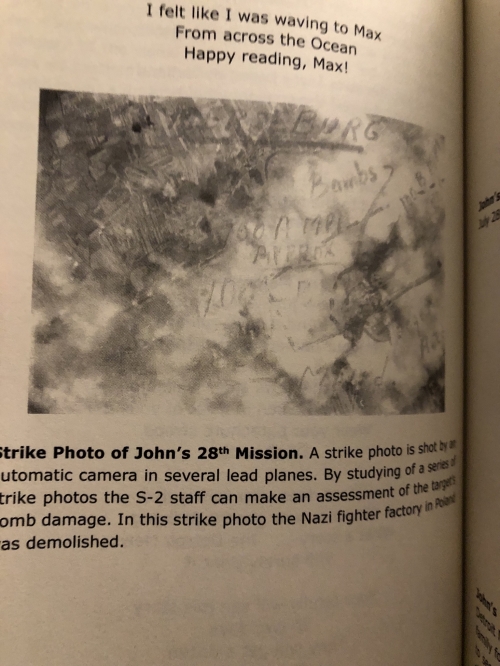
28th Mission strike photob