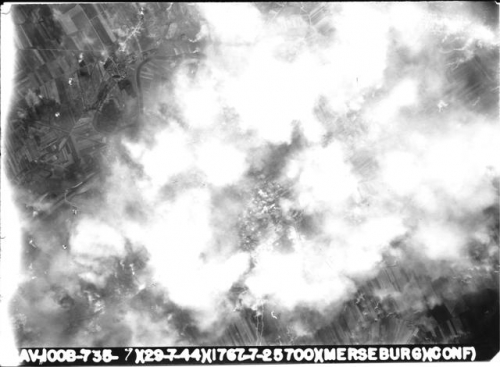
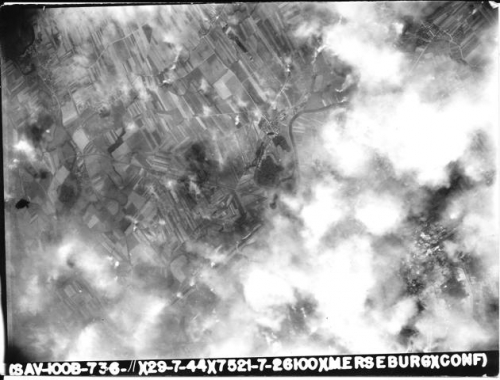
Mission Date: July 29, 1944
MERSEBURG, OIL REF & HILDESHEIM
100th BG Mission #: 170
Mission Summary
ON THIS DAY…JULY 29,1944
Field Order 356 would send the 3rd Division’s B17s back to the Leuna Werke synthetic oil plant at Merseburg. The majority of the crews seated in the morning’s briefing would be making back-to-back attacks to the dreaded target. Heavily defended, the 100th’s crews would be flying into the hell produced by the one thousand seven hundred 88mm guns and 105mm flak guns that protected the “crown jewel” of Germany’s oil production.
The 3rd Division‘s column of six hundred fifty-seven B-17s would be led by the 4CBW while the 13CBW would fly last in the column. Only the 95BG and the 447BG would not fly that day.
The 100BG would fly two High group formations, split between the two wings. One group of crews would fly in the lead formation with the 4CBW and would be led by Major Joseph Zeller while the second group would be led by Captain Herbert Howard with Austin Dunlap in the 13CBW’s formation. The 13CBW would be led by the 390BG which would also fly as the Low group.
With many of the men attending chapel or mass before their take-off, each airman was quietly apprehensive as they loaded in their equipment, wondering if today would be the day they didn’t come home. Loaded up with twenty 250 lb bombs, all aircraft departed the base with those flying with the 4CBW taking off first between 0525-0556 and the others following shortly thereafter between 0542-0556 hours.
Formed into their respective wings, four of the 100th’s pilots ultimately aborted the mission due to engine troubles. Flying with the 4CBW, both Robert Stevenson and James Seamans returned early due to engine problems. In the 13CBW, Orville Everitt also experienced engine problems while Joseph Ricker’s first B17 of the morning prevented his take-off due to engine issues. With his crew and equipment loaded into a second B17, he was unable to catch up with the departed formation and returned back to base. True to his word, BTG William Crozier flew with his crew that day.
As the Division column followed the briefed route in to the target, they encountered 8/10-10/10 cloud coverage throughout most of the time in the air. At 0944, the 4CBW had arrived at the IP and made the turn on to the bomb run where the anticipated and dreaded flak began. Flying through the intense, barrage, tracking and accurate flak, the Fortresses took on battle damage but their bombs were successfully away under a “visual” attack on the primary target at 0956 hours and where “nearly all bombs hit within the refinery area” under a 3/10 cloud coverage.
As the 100th’s aircraft absorbed the unrelenting exploding shrapnel, most of the crews considered themselves lucky to get through it as they made the turn off the target and headed to the Rally Point. TG Charles Slaght, flying in Paul Jones’ aircraft tells us, “Today we really wiped those refineries out. For over an hour after we left the target I could still see black smoke from those refineries coming up. Groups that hit the target after us passed through it at 25,000 ft. We were really lucky to get through that flak as it was worse than I ever saw before even at Berlin. I had five holes right by my head — I don’t know how it missed me.” Emmett Schmitt on James Ransom’s crew recorded, “Ran into about the heaviest flak we have seen yet at the target. We got a large flak hole in the roof of the right wing and 2 small ones in the tail making the 9th time we have been hit.”
The B-17 piloted by William Grenier and James Coccia received a direct hit in the waist from flak, severely wounding twenty year-old WG, Bernard Baumgarten. In addition, NAV Robert Fulkerson tells us, “Flak had knocked out the oxygen in the nose of the aircraft forcing the bombardier and me to retreat to the radio room…Upon entering the entrance to the bomb bay my parachute harness caught on to something and became entangled. Still being at altitude and without oxygen, I soon passed out. Fortunately for me, John Vuchetich, our flight engineer, who was in the top turret saw me and plugged in my oxygen mask. Upon recovering, I noticed that the bomb bay doors had not completely closed and upon passing out I had dropped most of my navigational aids out the bomb bay doors. With a map or two I proceeded to the radio room…” Greiner had dropped his damaged B17 back to fly with the Low squadron but continued to lag further and further behind it.
The exiting 4CBW formation continued on the briefed route out, leaving the enemy coast at 1126 hours. Observing a German fighter jet tailing Greiner’s straggling bomber, a hidden squadron of P-38’s gave chase, shot the fighter down and escorted Greiner as far as the Frisian Islands, where they left him heading home at 10,000 feet with all four engines working.
Meanwhile at the end of the Divisional line, the 13CBW’s formation had been flying fifteen minutes behind the 4CBW, having made its turn at the IP at 1000 hours, nine minutes late due to a wind change. Although the heavy unrelenting flak and black smoke from the earlier bombings climbed to 25000 feet, the 390BG dropped on the Primary target at Merseburg while the 100th’s High formation “passed directly over the primary target at 25,600 feet,” making a dry run. Making the right turn off the target as briefed, problems with the 100th’s PFF “mickey” forced the formation‘s leader to search out a target of opportunity on the route out.
The flak encountered over Merseburg had knocked out an engine on the Low squadron’s lead ship flown by George Allen, forcing him to jettison his bombs before the target. Allen’s TTE, William Oberman tells us, “Our pilot radioed planes in our squadron to catch up with the main group, since we only had 3 engines and could not keep up. Once squadron leader Allen had fallen out of formation, the Squadron broke apart and never reformed.
On the route out to a target of opportunity, approximately forty ME-109s and FW 190s were laying in wait to attack the stragglers. Observed breaking into smaller groups to begin an attack, the 100th’s Low squadron was in trouble. In Allen’s B-17, Oberman remembered, “The leader of the jets came in first…They began to fire, I gave him a few short bursts and he was gone. He flew out of range to our left and a little high. He must of radioed his buddies and told them our tail guns were not operating. Then they came at us one at a time, directly behind the tail. I gave each one a short burst, then I'd have to pick up the next attacker. By the time Matz (WG) got back into the tail (filling in for injured TG), they were gone…Our pilot probably saved us by putting the plane in a shallow dive and using evasive maneuvers… Jets formed up again and attacked the five planes that were flying with us. They knocked every one of the five planes out of the sky and left…”
Attacked by a FW-190, Steussy’s aircraft had been fired on at close range. NAV Howard Leech remembered, “one shell went through the waist and the second hit in the left wing starting a fire between No. 1 and No. 2 engines.” With Steussy fearing an explosion, he gave the bail out order at 1025 and all crew members bailed out.
In William Fitzroy’s bomber, his ROG Carmine Roberto had been killed and their oxygen system was shot out. After Fitzroy had given his bail out order, WG Frank Buschmeier and BTG Bernard Spragg were soon pinned down inside their B-17 after it went into a flat spin. Finally under control at a lower altitude, the crew bailed out.
Morris Clark’s ship exploded in mid air after an onboard fire started from the attack. Carl Gustafson gave his men the bail out order after his left wing tank was hit by fire and Eden Jones and Jackson Phelps and their crews were also shot down.
Credited with destroying one of the fighters at 1025 hours was TG Ralph Greenwood in James Williams B-17. He stated, “First saw E/A at 1500 yards. There were 12 of them. One E/A started coming up toward our A/C at 700 yards and I immediately opened fire on him. E/A came to within 500 yards and I let him have 3 bursts between 700 and 500 yards . At 500 yards black oily smoke began to stream out of engine, flames began to shoot out of left side of engine and E/A peeled off to his left and went straight down. Couldn’t watch him any longer because of preoccupation with other E/A.” And at 1031 hours, also credited with destroying a fighter, BTG Charles Platkin in Henry Woodall’s aircraft, recalled, “Fighter called out by TG and I turned to 6 o’clock and E/A was coming in at 400 yards. I opened up on him and gave him a long burst. E/A came within 100 yards of our A/C and then disintegrated in mid-air. The Waist gunner saw a ball of smoke at time BTG said E/A exploded.”
On Allen’s B17, Oberman continued, “Flying by ourselves was very lonely. Pilot then asked me to fire the vari pistol for fighter protection…After firing a few shots at a few minute intervals, 2 P-47's (our little friends as we called them) pulled up along side and they circled around us until their gas supply ran low and they had to leave. What a beautiful sight that was having the 47's with us…”
The remainder of the 100th’s formation flying ahead found their target of opportunity at Hildesheim, where bombs were away at 1055 hours from 25,800 feet, one hour after their ‘brothers’ flying with the 4CBW had dropped on Merseburg.
Meanwhile, Greiner and Coccia’s straggling B-17, was last seen at 10000 feet but they too eventually ditched in the North Sea. With vain attempts to load their severely wounded and unconscious WG Baumgarten into their life rafts, Fullerton tells us, “John Vuchetich our flight engineer and I were the last two of the crew to leave the aircraft. We had remained in the radio room in hopes of saving the wounded gunner. Since the nose hatch had been opened earlier and the ball turret repositioned for ditching water was rushing in fast and furiously. I soon realized the situation was hopeless and told John to exit the top hatch. As I climbed out the top hatch, Bernie, half covered with water, called out my name. What a feeling! From the top hatch I could see that the B-17 was at about a forty-five degree angle to the sea and the wings were half covered with water. As I dove into the sea and started swimming towards the two dinghies, something touched my feet. Looking back I saw it had been the tip of the B-17’s rudder that had touched my feet and the aircraft disappeared from sight. Eight of us survived the ditching and Bernie went down with the B-17.”
As the final group of the 100th’s returning B17s came in over the field that day, the men at the tower and those on the ground waiting realized what a devastating mission it had been for the 100BG. Fortunately, they would later learn that Bert Scott had landed at Bentwater and Julius Geller had landed at North Pickenham but the seven aircrafts carrying the Steussy, Fitzroy, Coccia, Phelps, E.Jones, Clark and Gustafson crews would never return.
Feeling the devastation of the lost men, Joe Costanza from John Keys’ crew recorded into his diary that evening, “The crew didn’t go on a mission today. But the other two crew’s that shared the hut with us went…Both of these crew’s were hit and went down over the middle of Germany. One crew was on the “13th” and the other was on their “19”. They shared the hut with us a long time and were some of my swell buddies. I hope they bailed out safely and are prisoners of war. The hut is once more empty.”
Williams, Allen, Geller, Fitzroy, Scott, Everitt, Reigel, Rogers, Gustafson, Chamberlain, Steussy, Kassebaum, Woodall, Phelps, Trommer, EC Jones, Ricker, Clark, Elbel, Kennedy, Cumming, Schomp, Rowland, Lundquist, Bennett, Stevenson, Johnson, Fory, Greiner, WB Kennedy, Miller, Dobrogowski, Wolf, Schaffhausen, PG Jones. Ransom, Major, Seamans
Bombing Results
Bombing Results: GOOD
Aircraft Lost: 8
Crew Lost: 72
Claims of Enemy Losses (CLS): 1
Aircraft Returned: