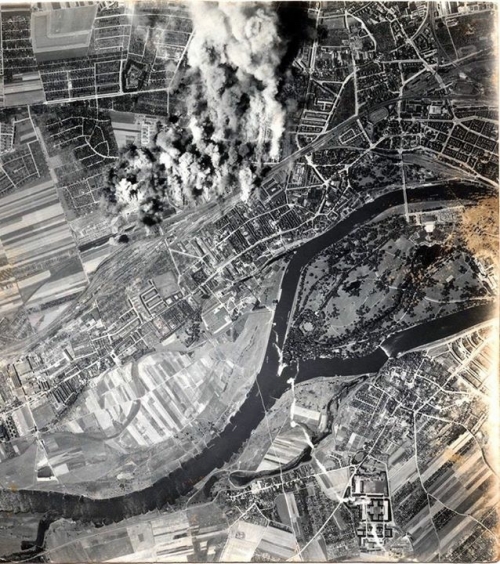
Mission Date: August 5, 1944
MAGDEBURG, KRUPP TANK, AC
100th BG Mission #: 175
Target Type: Primary
Secondary Target: Helmstadt
Mission Summary
ON THIS DAY...AUGUST 5,1944
With the American forces on the ground in Brittany making swift advances, the 3rd Division planned for another strategic mission for its heavy bombers into Germany. Awakened for the 0500 briefing that Saturday morning, thirty-eight crews, including the two PFF crews arrived from Horham, were called to attention as the 100th’s air executives filed in. This would be the #1 combat briefing for the now “operational” crews of John Ernst and Cecil Daniels.
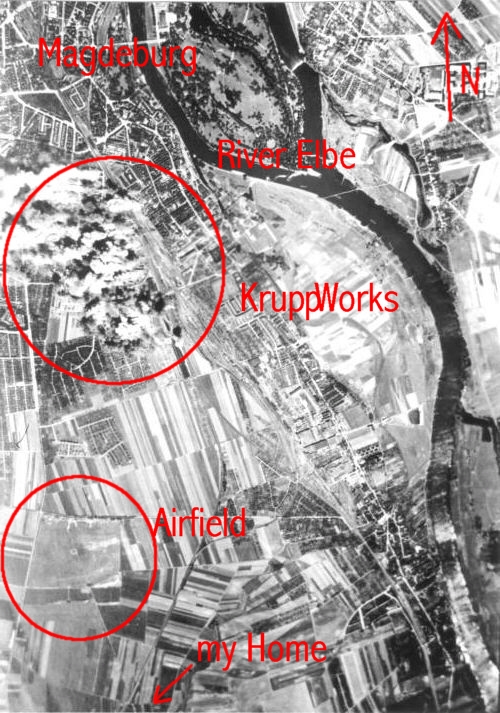
Getting right down to business, low murmurs rippled through the rows from the fliers as the S-2 officer divulged the target - Magdeburg, located on the Elbe river and just one hundred eighteen miles southwest of Berlin. The 3rd Division would be sending its B-17s to the city with the 13CBW targeting its tank factory. Their Secondary target would be the airfield at Helmstadt.
Only the 100BG would fly from the 13CBW’s groups that day. The 100BG would fly as both the lead and low groups in the 13CBW, echeloned left off the 45CBW and reportedly the last group over the target. Leading the 100th’s formation would be Major Robert Rosenthal, flying in one of the Pathfinder ships. The 100th’s lower group formation would be led by Major Joseph Zeller, who would fly with William Terminello and his PFF crew. Bert Scott would fly as Terminello’s right wing man. The 95BG and the 390BG, confined to their bases, were underway with preparations for the second Russian shuttle mission scheduled for the next day.
Warned about the various flak corridors, the airmen did not take additional comfort from the weather officer’s report. Although the weather would require the use of instruments over England, it would be clear over Germany, making it easier for the enemy artillery aiming at them from below. Until the bombs were released over the target, each of the 100th’s B17s would be carrying 5000 pounds of explosives; those flying in the lead formation loaded with ten 500 lb bombs while the Fortresses flying in the lower group, loaded with five 1000 lb bombs.
All aircraft departed the base between 0755-0828 hours, except for John Keys. Scheduled to fly in the low group formation, he was unable to take-off due to engine troubles. As the lower group assembled over Buncher 28, a second B-17, flown by Wesley Carlton returned to base at 0851 hours.
With take-off and assembly requiring the use of instruments by the pilots and assembly slowly completed over Buncher 28 with 1000 feet between the two formations, the 100BG departed the English Coast at Lowestoft. Although the 45CBW had been reported late, the 100th’s formations “S’d” over the North Sea until the proper interval had been assumed.
Before the enemy coast was crossed, a second aircraft in the 100th’s lead formation aborted the mission when Dale McEwen pulled his Fortress out at 1037 hours. Passing west of the Frisian Islands, the formation made landfall at the enemy coast at 1145 hours, east of Wilhelmshaven after climbing to 25000 feet altitude. Ten minutes after crossing the enemy coast, a second aircraft from the lower group flown by Frederick Ricci pulled out of formation and returned to base.
As the formation continued over Germany in the good weather, 1/10-2/10 low cumulous clouds, the challenge of flying through heavy prop wash coupled with the presence of a number of enemy fighters tested the crews. Pilot, William Terminello tells us, “We had to fight prop wash the whole trip…” while pilot Harvey Dickert adds, “Visibility was the best I ever saw over Germany, no haze. Wings flew two groups one minute apart. Entirely too close, prop wash was terrific. Too many slips trying to get through flak corridors at the same time. Prop-wash kept the formations loose. Not good especially with all the bandits in the area. Good fighter support. Lots of enemy fighters all around today. Saw my first enemy aircraft up close today. A Me-109 went right through our group going straight down. He wasn’t shooting and no one got a shot at him. It happened too quick. I didn’t see it but was told that a P-51 was right on his tail. Saw about 20 enemy aircraft go through Wing in front of us. Saw seventeen new German jet propelled fighters about two thousand feet above. We were at 25,000 feet. They failed to hit us but tried to hit the Wing behind us but their attack was broken up by P-38’s…” Charles Slaght, riding as TG on Paul Jones’ Fortress remembered, “ There were bandits around us in and out of the target. They got a couple passes in on the boys in front of us but then our fighters happened thru and there were countless dog-fights going on all the time and I saw quite a few fighters go down.”
At 1246, with no successful fighter attacks on the 100BG, its formation turned slightly east off the IP to assure its proper interval for the bombing run. Nearing the target, the artillery put up over Madgeburg and aimed at the bombers above was “intense, accurate and continuous pointed” but the 100th kept on with their bomb bay doors now open.
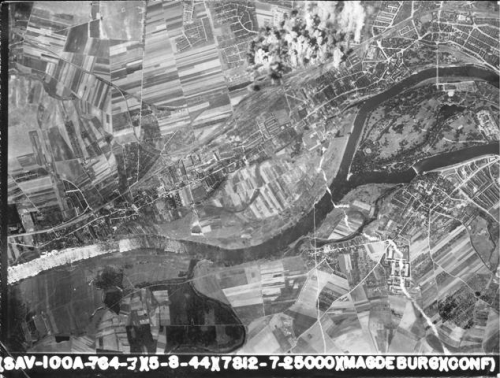
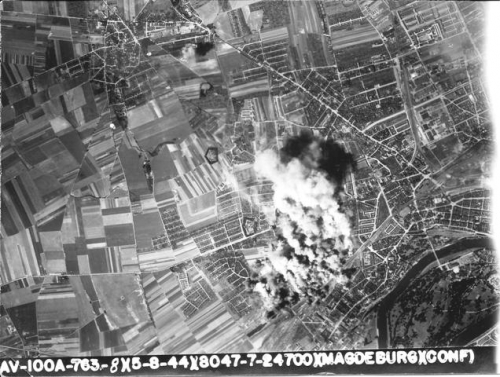
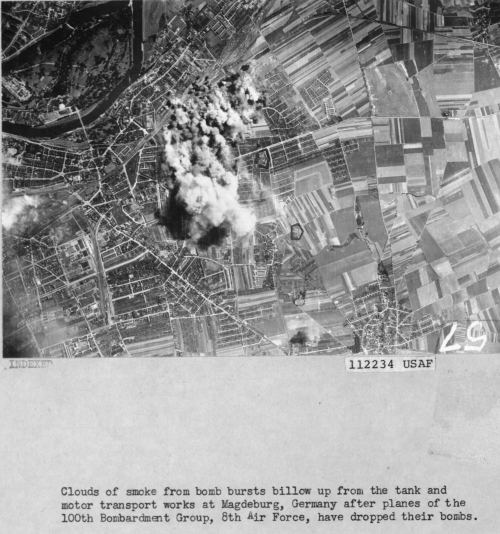
At 1254, bombs were away from the lead formation from 25000 ft as they continued to absorb the chilling flak bursting all around them.
Meanwhile just before bombs were away, flying 1000 feet below the lead group, the right wing man on Terminello and Zeller’s lead ship, Bert Scott, was forced out of position by prop wash and Julius Geller moved his B-17 up “to fill in the formation.” Armed and ready to drop, Scott salvoed his bombs which only dropped seventy-five feet before all five 1000 lb bombs exploded. “At the same time it was observed that #2 engine was flaming. Wings and fuselage soon began to flame and two chutes came out the waist door.” Flying his #14 mission that day, Scott’s BTG, Richard Goff tells us, “Just before the target we were forced out of formation by another aircraft. At that time we were hit by flak near the upper turret and behind the pilot. The plane began to burn. Just before being hit we had salvoed the bombs. There was a hell of an explosion and then the plane caught fire. We were at 24,000 feet. I managed to get out of the ball. The Waist Gunner and Radio Operator went out of the plane first, then me, followed by the Tail Gunner. There was no bail out signal because the plane was destroyed when first hit by flak.” It was reported that, “the A/C continued straight and level going down on fire. It did not explode.” The pilot, twenty-seven year-old Bert Scott and his TTE, twenty-three year-old Lloyd Maltbie would not survive but the rest of his crew would, becoming POWs.
Two of Joseph Ricker’s gunners, worried about their own aircraft, described the intensity of the flak and its devastating results. TG, Raymond Mainka recorded, “Bombed Magdeburg, Germany with five 1,000 pound bombs. Our plane has been hit in a good many places. One plane right off our tail blew up to bits and another went down in flames. The shells burst all around us so much it was awful. But honestly I was scared. I mean no one could pray any more then I did.” WG, William Crozier added, “The flak was the heaviest and most accurate I have ever seen. Three airplanes behind us in our formation blew up on the bomb run. Flak hit us all over our ship including in #2 engine and gas tank, and we had to feather our #1 engine which went dead. That is the most scared I have ever been. I was doing nothing but praying the whole time and so was everybody else. Ralph Ingles in our hut was on one of the ships that went down. His troubles are over. It's bad because he had a wife and child. He was really a swell guy. I hope they don't get any rougher than today’s.”
Anthony Gallagher and his crew, also in the lower formation, were not as fortunate as Bert Scott’s crew. Appearing to have taken a direct flak hit through the open bomb bay doors to his bombs, Gallagher’s entire ship blew up. Watching in horror, Frank Barili, TTE on John David’s B-17 tells us, “It blew up bombs and everything. Bounced our ship around. It made an orange burst of fire. I couldn’t see the ship, only the huge sheet of orange and brown gray smoke. It was hit just under us. When it exploded it set afire another ship that went down in flames. Two chutes came out of the one that blew up, but Wally, our tail gunner, said that they both looked dead. No-one could have lived through that. I thought it got our tail gunner it was so close. Bomb load was five 1000 lbs”
The flak had caused total mayhem in the lower formation. William Terminello adds, “As Gallagher’s ship blew up, the blast sent Henry Woodall’s over on its back and straight down with the bits of Gallagher’s ship. A few moments after Gallagher’s Fortress was lost, Ralph Greenwood in James Williams’ bomber was hit by flak. He tells us, “I was hit just before the bombs were released. The pilot came back and took me up to the radio room and gave me first aid and stopped the bleeding.”
Lewis Payne flying as a replacement BTG gunner that day in Charles Streed’s crew, was wounded by flak in his left ankle. Not yet finished with the mayhem, as he was flying in the “purple heart corner” position, David Armstrong’s aircraft also took a direct flak hit, setting off the ammunition carried inside for the flexible nose guns. Armstrong’s copilot Allen “Andy” Andrews and NAV Ross Cheney were wounded while his Bombardier Lon L. Livsey was killed.
With bombs away by the 100th, the turn was made off the target and out of the devastating flak and the remaining ships headed for the Rally Point. As the formation followed the briefed route out, enemy aircraft were poised for further attacks on the exiting formations. “Dogfights at 1200 hours near N of Rotenburg between our escort and ME 109s and FW 190’s. An estimated 40 AC were engaged in this encounter,” kept the gunners itchy, the entire route out.
At 1300 hours in the vicinity of Hanover, unable to keep up with the formation as it made its way out of enemy territory, Harry Hempy’s bomber was returning alone when it was attacked by two ME 109’s and one FW 190. His TG, Charles Emerson, tells us, “Several E/A made passes at us and a FW 190 coming in from 11 o’clock low came in under our ship. I picked him up as he was about 400 yards at 5 o’clock and gave him several short bursts. I then saw him explode.”
Finally departing the enemy coast at Holland, the beat-up 100BG made its way over the water and back to England. Harvey Dickert remembered, “Magdeburg was still seen burning when we left the enemy coast due to the good visibility. Don’t think we will have to go back there very soon. Big fires today all over Northern and Central Germany throughout the Hanover area.”
Encountering rough weather as the Group returned back to England, the remaining aircraft came in over the field with ambulances once again waiting for the planes carrying wounded aboard to land.
William Terminello recorded, “Luckily Woodall survived and came back with an incredible story that his togglier had salvoed the bombs as the plane pulled out of the dive...” Many of the crews felt fortunate to have returned safely that day but not enthralled with going up again so soon the next day. William Crozier recorded that evening into his diary, “I think the red flag is up. I hope we don't fly tomorrow, but we probably will. They don't have much consideration for us. I am so tired I am half dead.”
Crews:
Keys, Ricker, Riegel, Carlton, Williams, Everitt, Daniels, Kohler, Scott, Gallagher, Giles, Delaney, Roediger, Streed, Elbel, Scott, Woodall, Geller, David, Dickert, Bennett, Darby, Rowland, Seamans, Simmons, Ricci, Miller, Armstrong, Ernst, McEwen, Hempy, Aske, Kennedy, Schaffhausen, Jones, Lundquist, (36 crews + 2 PFF)
With the American forces on the ground in Brittany making swift advances, the 3rd Division planned for another strategic mission for its heavy bombers into Germany. Awakened for the 0500 briefing that Saturday morning, thirty-eight crews, including the two PFF crews arrived from Horham, were called to attention as the 100th’s air executives filed in. This would be the #1 combat briefing for the now “operational” crews of John Ernst and Cecil Daniels.
Getting right down to business, low murmurs rippled through the rows from the fliers as the S-2 officer divulged the target - Magdeburg, located on the Elbe river and just one hundred eighteen miles southwest of Berlin. The 3rd Division would be sending its B-17s to the city with the 13CBW targeting its tank factory. Their Secondary target would be the airfield at Helmstadt.
Only the 100BG would fly from the 13CBW’s groups that day. The 100BG would fly as both the lead and low groups in the 13CBW, echeloned left off the 45CBW and reportedly the last group over the target. Leading the 100th’s formation would be Major Robert Rosenthal, flying in one of the Pathfinder ships. The 100th’s lower group formation would be led by Major Joseph Zeller, who would fly with William Terminello and his PFF crew. Bert Scott would fly as Terminello’s right wing man. The 95BG and the 390BG, confined to their bases, were underway with preparations for the second Russian shuttle mission scheduled for the next day.
Warned about the various flak corridors, the airmen did not take additional comfort from the weather officer’s report. Although the weather would require the use of instruments over England, it would be clear over Germany, making it easier for the enemy artillery aiming at them from below. Until the bombs were released over the target, each of the 100th’s B17s would be carrying 5000 pounds of explosives; those flying in the lead formation loaded with ten 500 lb bombs while the Fortresses flying in the lower group, loaded with five 1000 lb bombs.
All aircraft departed the base between 0755-0828 hours, except for John Keys. Scheduled to fly in the low group formation, he was unable to take-off due to engine troubles. As the lower group assembled over Buncher 28, a second B-17, flown by Wesley Carlton returned to base at 0851 hours.
With take-off and assembly requiring the use of instruments by the pilots and assembly slowly completed over Buncher 28 with 1000 feet between the two formations, the 100BG departed the English Coast at Lowestoft. Although the 45CBW had been reported late, the 100th’s formations “S’d” over the North Sea until the proper interval had been assumed.
Before the enemy coast was crossed, a second aircraft in the 100th’s lead formation aborted the mission when Dale McEwen pulled his Fortress out at 1037 hours. Passing west of the Frisian Islands, the formation made landfall at the enemy coast at 1145 hours, east of Wilhelmshaven after climbing to 25000 feet altitude. Ten minutes after crossing the enemy coast, a second aircraft from the lower group flown by Frederick Ricci pulled out of formation and returned to base.
As the formation continued over Germany in the good weather, 1/10-2/10 low cumulous clouds, the challenge of flying through heavy prop wash coupled with the presence of a number of enemy fighters tested the crews. Pilot, William Terminello tells us, “We had to fight prop wash the whole trip…” while pilot Harvey Dickert adds, “Visibility was the best I ever saw over Germany, no haze. Wings flew two groups one minute apart. Entirely too close, prop wash was terrific. Too many slips trying to get through flak corridors at the same time. Prop-wash kept the formations loose. Not good especially with all the bandits in the area. Good fighter support. Lots of enemy fighters all around today. Saw my first enemy aircraft up close today. A Me-109 went right through our group going straight down. He wasn’t shooting and no one got a shot at him. It happened too quick. I didn’t see it but was told that a P-51 was right on his tail. Saw about 20 enemy aircraft go through Wing in front of us. Saw seventeen new German jet propelled fighters about two thousand feet above. We were at 25,000 feet. They failed to hit us but tried to hit the Wing behind us but their attack was broken up by P-38’s…” Charles Slaght, riding as TG on Paul Jones’ Fortress remembered, “ There were bandits around us in and out of the target. They got a couple passes in on the boys in front of us but then our fighters happened thru and there were countless dog-fights going on all the time and I saw quite a few fighters go down.”
At 1246, with no successful fighter attacks on the 100BG, its formation turned slightly east off the IP to assure its proper interval for the bombing run. Nearing the target, the artillery put up over Madgeburg and aimed at the bombers above was “intense, accurate and continuous pointed” but the 100th kept on with their bomb bay doors now open.
At 1254, bombs were away from the lead formation from 25000 ft as they continued to absorb the chilling flak bursting all around them.
Meanwhile just before bombs were away, flying 1000 feet below the lead group, the right wing man on Terminello and Zeller’s lead ship, Bert Scott, was forced out of position by prop wash and Julius Geller moved his B-17 up “to fill in the formation.” Armed and ready to drop, Scott salvoed his bombs which only dropped seventy-five feet before all five 1000 lb bombs exploded. “At the same time it was observed that #2 engine was flaming. Wings and fuselage soon began to flame and two chutes came out the waist door.” Flying his #14 mission that day, Scott’s BTG, Richard Goff tells us, “Just before the target we were forced out of formation by another aircraft. At that time we were hit by flak near the upper turret and behind the pilot. The plane began to burn. Just before being hit we had salvoed the bombs. There was a hell of an explosion and then the plane caught fire. We were at 24,000 feet. I managed to get out of the ball. The Waist Gunner and Radio Operator went out of the plane first, then me, followed by the Tail Gunner. There was no bail out signal because the plane was destroyed when first hit by flak.” It was reported that, “the A/C continued straight and level going down on fire. It did not explode.” The pilot, twenty-seven year-old Bert Scott and his TTE, twenty-three year-old Lloyd Maltbie would not survive but the rest of his crew would, becoming POWs.
Two of Joseph Ricker’s gunners, worried about their own aircraft, described the intensity of the flak and its devastating results. TG, Raymond Mainka recorded, “Bombed Magdeburg, Germany with five 1,000 pound bombs. Our plane has been hit in a good many places. One plane right off our tail blew up to bits and another went down in flames. The shells burst all around us so much it was awful. But honestly I was scared. I mean no one could pray any more then I did.” WG, William Crozier added, “The flak was the heaviest and most accurate I have ever seen. Three airplanes behind us in our formation blew up on the bomb run. Flak hit us all over our ship including in #2 engine and gas tank, and we had to feather our #1 engine which went dead. That is the most scared I have ever been. I was doing nothing but praying the whole time and so was everybody else. Ralph Ingles in our hut was on one of the ships that went down. His troubles are over. It's bad because he had a wife and child. He was really a swell guy. I hope they don't get any rougher than today’s.”
Anthony Gallagher and his crew, also in the lower formation, were not as fortunate as Bert Scott’s crew. Appearing to have taken a direct flak hit through the open bomb bay doors to his bombs, Gallagher’s entire ship blew up. Watching in horror, Frank Barili, TTE on John David’s B-17 tells us, “It blew up bombs and everything. Bounced our ship around. It made an orange burst of fire. I couldn’t see the ship, only the huge sheet of orange and brown gray smoke. It was hit just under us. When it exploded it set afire another ship that went down in flames. Two chutes came out of the one that blew up, but Wally, our tail gunner, said that they both looked dead. No-one could have lived through that. I thought it got our tail gunner it was so close. Bomb load was five 1000 lbs”
The flak had caused total mayhem in the lower formation. William Terminello adds, “As Gallagher’s ship blew up, the blast sent Henry Woodall’s over on its back and straight down with the bits of Gallagher’s ship. A few moments after Gallagher’s Fortress was lost, Ralph Greenwood in James Williams’ bomber was hit by flak. He tells us, “I was hit just before the bombs were released. The pilot came back and took me up to the radio room and gave me first aid and stopped the bleeding.”
Lewis Payne flying as a replacement BTG gunner that day in Charles Streed’s crew, was wounded by flak in his left ankle. Not yet finished with the mayhem, as he was flying in the “purple heart corner” position, David Armstrong’s aircraft also took a direct flak hit, setting off the ammunition carried inside for the flexible nose guns. Armstrong’s copilot Allen “Andy” Andrews and NAV Ross Cheney were wounded while his Bombardier Lon L. Livsey was killed.
With bombs away by the 100th, the turn was made off the target and out of the devastating flak and the remaining ships headed for the Rally Point. As the formation followed the briefed route out, enemy aircraft were poised for further attacks on the exiting formations. “Dogfights at 1200 hours near N of Rotenburg between our escort and ME 109s and FW 190’s. An estimated 40 AC were engaged in this encounter,” kept the gunners itchy, the entire route out.
At 1300 hours in the vicinity of Hanover, unable to keep up with the formation as it made its way out of enemy territory, Harry Hempy’s bomber was returning alone when it was attacked by two ME 109’s and one FW 190. His TG, Charles Emerson, tells us, “Several E/A made passes at us and a FW 190 coming in from 11 o’clock low came in under our ship. I picked him up as he was about 400 yards at 5 o’clock and gave him several short bursts. I then saw him explode.”
Finally departing the enemy coast at Holland, the beat-up 100BG made its way over the water and back to England. Harvey Dickert remembered, “Magdeburg was still seen burning when we left the enemy coast due to the good visibility. Don’t think we will have to go back there very soon. Big fires today all over Northern and Central Germany throughout the Hanover area.”
Encountering rough weather as the Group returned back to England, the remaining aircraft came in over the field with ambulances once again waiting for the planes carrying wounded aboard to land.
William Terminello recorded, “Luckily Woodall survived and came back with an incredible story that his togglier had salvoed the bombs as the plane pulled out of the dive...” Many of the crews felt fortunate to have returned safely that day but not enthralled with going up again so soon the next day. William Crozier recorded that evening into his diary, “I think the red flag is up. I hope we don't fly tomorrow, but we probably will. They don't have much consideration for us. I am so tired I am half dead.”
Crews:
Keys, Ricker, Riegel, Carlton, Williams, Everitt, Daniels, Kohler, Scott, Gallagher, Giles, Delaney, Roediger, Streed, Elbel, Scott, Woodall, Geller, David, Dickert, Bennett, Darby, Rowland, Seamans, Simmons, Ricci, Miller, Armstrong, Ernst, McEwen, Hempy, Aske, Kennedy, Schaffhausen, Jones, Lundquist, (36 crews + 2 PFF)
Bombing Results
Bombing Results: EXCELLENT
Aircraft Lost: 2
Crew Lost: 19
Claims of Enemy Losses (CLS): 0
Aircraft Returned:
Media Articles
Use your thumb to scroll through the results box below.
| Media Item | Type | Page | Volume/Issue | Broadcast Source | Time | Description | File |
|---|---|---|---|---|---|---|---|
| Charles J. Baker flies upside down Magdeburg mission | Altoona Tribune Jan 9 1945 | 12:00 am |