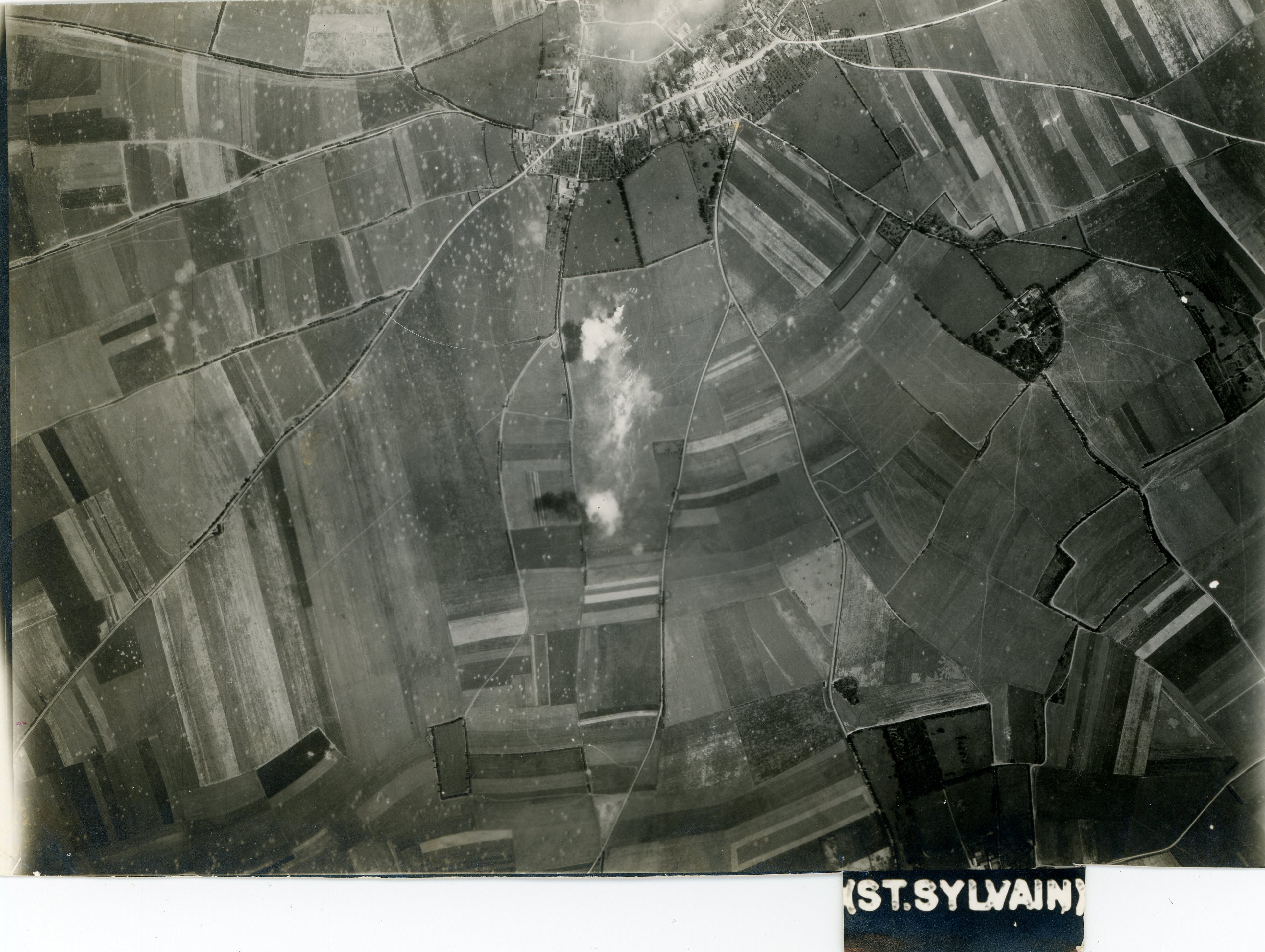
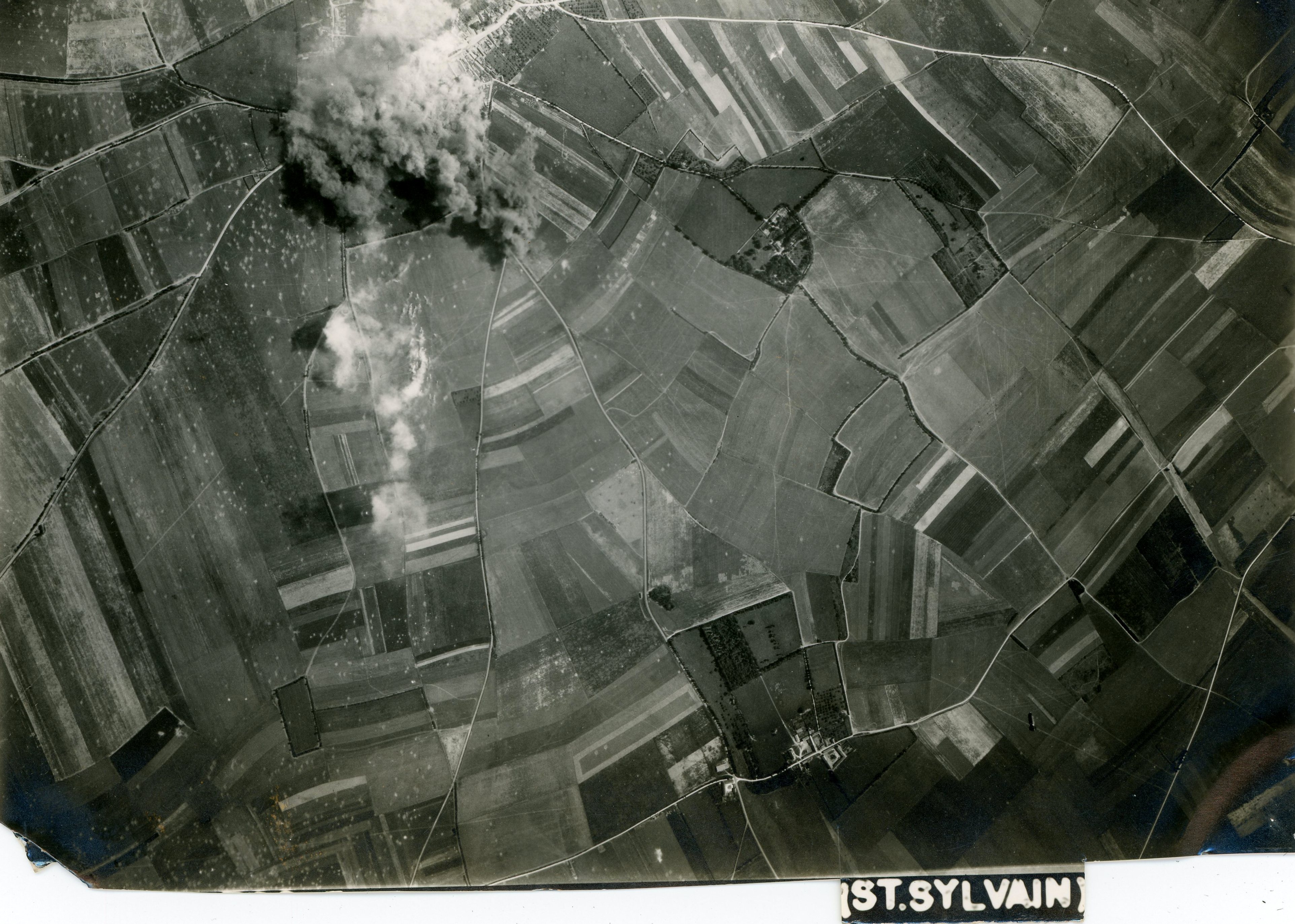
Mission Date: August 8, 1944
ST. SYLVAIN, GROUND DEFENSES
100th BG Mission #: 178
Mission Summary
ON THIS DAY...August 8, 1944
On the ground in Normandy, the British and Canadian forces under the command of General Bernard Montgomery had been stalled and Montgomery called for the First Canadian Army to open a ground offensive southward to Falaise with the objective of breaking through “the hinge” in the German lines south of Caen. On the night of August 7, RAF Lancasters had bombed the German lines ahead of the soon to be advancing First Canadian Army. The 8th Air Force would give its support to the Allied troops by sending its heavy bombers to also attack the German front lines and other tactical targets in Northern France.
At 0615 hours on 8 August, twenty-nine crews were called to attention as the 100BG’s air executives entered the briefing room. When the large map was unveiled, the S-2 Officer informed those seated that the 100BG would be flying a tactical mission in support of the Canadian and British troops. They would be leading the 8th Air Force and the 3rd Division’s line of B-17s headed to France, flying as the Lead and Low formations in the 13A CBW’s formation. The 100th would also supply an additional three crews from the 418th squadron to fly as the second element in the 390BG’s formation which would fly as the 13th’s High group.
With a Primary target of the German ground troop headquarters located at Saint-Sylvain, fifteen miles southeast of Caen, the crews were briefed by the weather officer for excellent conditions over France. Briefed for an altitude of 11,000-12,000 feet would allow for a clear visual distinction between the German and Allied troop lines and other targets.
The crews of Paul Spurgeon and Harold Taylor seated that morning thought they had pulled a good mission for their #1 combat run. William Crozier, Joseph Ricker’s BTG recorded into his diary, “Our target was over Normandy to help the Limies. They told us it would be a milk run and only a few flak guns if any. We would not even need to wear oxygen masks because the bomb run would be at 11,000 feet.”
The 100th’s own Commanding Officer, Colonel Thomas Jeffrey would lead the 8th Air Force, flying with Neal Scott and his lead crew. William Dishion would fly as Command Navigator for the 4th time with Jeffrey and Fred Chapin would fly as the Lead Bombardier. In his story about this mission, author John R. Nilsson wrote about Jeffrey’s confidence in Scott’s flying abilities and expectation of an easy mission. “‘Colonel Jeff’ summoned LT Scott. ‘The ship is yours Scott, I’m going along for the ride – I'll just answer the ‘telephone.'" The Low formation would be led by Major Joseph Zeller, flying with Merle Ehorn while Lt Colonel Eugene Price would fly as Arlon Elbel’s copilot. The 390BG would fly as the wing’s High formation under the command of LT Colonel Dolan.
With each Fortress loaded with twelve 500 pound bombs carried on the internal racks and two 1000 lb bombs carried on external racks mounted on the wings, all of the 100th’s B-17s took off from Thorpe Abbots between 0840-0907 loaded with an unprecedented 8000 pounds of explosives. On top of the additional weight, the poor weather over the base added a greater challenge for the pilots taking off that morning. Harvey Dickert taking off on his #21 mission recorded, “Instrument take-off this morning. Ground fog, visibility about 100 yards. Most bombs we ever carried and first experience with external bombs.” There were no take-off incidents and the Group assembled over Buncher 28. Completing its wing formation successfully, it departed the English coast.
With the quick trip over the English Channel, the enemy coast was crossed at Cherbourg, at 1158 hours and the formation made its turn toward Coutances at 1202. The IP was reached at Vire, and the fan-out procedure commenced.
Three minutes after the turn was made at the IP, the bomb bay doors were opened and the 100BG began its long bomb run over the German lines, flying south to north against a north wind. John R. Nilssen wrote, “It was smooth flying til the 100th turned to make the bomb run at 12000 feet, when German 88's began rampantly to throw up the flak, through which the 100th flew for 17 minutes, possibly the most harrowing flak every encountered anywhere by any air force.”
Flak hit Jeffrey’s and Scott’s lead B-17 and pierced through the leg of their Bombardier, Fred Chapin. Nilsson continued his story, “and as blood poured down to his shoes, Dishion command navigator, and Koury, navigator, tried to aid the 21 year-old bombardier. But "Fearless Freddie' shook his head. As the blood oozed, his attention was fixed on bombing, for it was precisely 12:30 pm, time for bombs away and he aimed the bombs on regimental headquarters of the Wehrmacht…”
With bombs away at 1233 hours, the lead formation “lost 2000 feet doing violent evasive action after release” with the heavy bombers flying through intense flak all the way to the Rally Point. Unnerved by the intensity of the flak, Harvey Dickert tells us, “Went in on left wing of Lt. Colonel Jeffrey and Lt. Neal Scott, was in most accurate ever for twenty minutes…Hit MPI dead center…We escaped with just a few holes and Shipman (TG) has a few scratches on his face and hands when his glass was hit and broken in the tail. 8th also dropped fragmentation and 100 pounders in same area southeast of Caen. In hopes of British break out toward Paris. Hope it works as well as St. Lo did – same deal. We did our part but I am still shaking.”
The 390BG’s lead ship in the High formation took a direct flak hit in its tail, killing the copilot riding as the formation officer. Flak had knocked its Bombardier away from the bombsight injured. With the Group’s Bombardier riding extra in the aircraft, he took over and all aircraft, including the three 100BG B-17s, hit the primary target at Saint-Sylvain.
Meanwhile, the 100BG’s Low formation flying at 11,000 feet was taking a beating from the flak. Wayne Page, twenty year-old gunner on Gerald Brown’s crew on their #2 mission tells us, “…the Jerries must have turned every gun they had on us. The sky was black with flak puffs. We got through lucky, but one piece of flak opened a hole in my heated suit, without hurting me.”
Three minutes after their turn at the IP, the Lead B-17 flown by Zeller and Ehorn was hit by flak, damaging their tail assembly. Pulling out of formation, the second element lead believed to be Charles Streed, took over as the lead ship. John Key’s B-17 then took a flak hit in his #2 engine, another near his waist escape hatch and yet another burst knocking off his tail assembly. The aircraft broke apart, nosing down before disappearing with no chutes seen.
Just before bombs away, Streed’s B-17 took a direct flak hit severely injuring his copilot Edward Lindsay in his leg as well as his BOM Norman Griffin. They too pulled out of the formation and the mayhem continued in most of the Fortresses. On Joseph Ricker’s B-17, TG “Monk” Mainka remembered, “We had the ship shot up in the nose, the windshield on one side [copilot's] was shattered. Some holes in the waist and also in the tail. One gas tank was hit but it sealed up. Chuck (20 year-old Charles Winter WG) went into shock over the target.” Their BTG William Crozier added, “The bomb run was eleven minutes long and that was the longest eleven minutes I ever spent in my life. Just one continuous wham, wham against our ship. I don't see how we stayed up with so many hits….At our altitude we were like clay pigeons. I don't understand how, but none of us in our ship was hit, but Chuck got a very bad case of shock when a piece of flak came up right by his head as he bent over the chaff chute. I thought he was hit, but he had just passed out from the near miss. It made a pretty good size hole in the catwalk by the chaff chute. If it had been a few inches to his left, the flak would have taken his head off. I made him lie down again and gave him oxygen after he came to. He was pretty hysterical for awhile, crying, etc. I put a blanket around him and he settled down some. He had fever when we got back to the base and they put him in the hospital. I did not fly in the ball because of a malfunction, but my ball was hit with flak. Glad I was not in it.”
Losing their lead and deputy lead aircraft over the target, the Low formation was then led by its High squadron, with only eight aircraft left in its formation. Bombs were finally away but at a point twenty miles west of the target, on a target of opportunity.
Finally out of the flak after the Rally Point, the lead formation departed the French coast between Le Havre and Caen at 1240 hours with the Low formation following six minutes behind. Coming in over the field at Thorpe Abbotts and shooting flares from their roofs signaling wounded, those aircraft were given priority in landing. Major Zeller’s and John Keys B-17s were missing.
With the bombers landed, inspections were done and the flak had left its mark on the ships and crews. William Kennedy’s B17 returned with forty flak holes. Pilots Dobrowgowski and Ryan returned with flak damage and Coleman returned safely but his B17 “Royal Flush” received major flak damage requiring sub-depot repairs. Flak had injured Trommer’s TG, Charles E. Wilson in his arm and hand and Pilot Frederick Schaffhausen recorded this mission as his second roughest mission out of the fourteen flown to date, having “bursts close enough for us to see flame and shrapnel flying through the air.”
Even the 100BG’s mission hardened Commander had been unnerved. John Nilsson wrote, “Colonel Jeff back from St Sylvain, called Streed into the S-2 room where the CO was drinking a mug of coffee, and said as the pilot entered. "Streed, did you ever see such BIG, BLACK, LOUD flak in all your life? - his hands trembling slightly as he set down his mug. When Streed noticed that, he didn't feel so bad, because he was shaking himself."
Fortunately, twenty-four year-old Major Zeller and the Ehorn crew would return to Thorpe Abbotts three days later, after having made a forced landing in France, near the front lines. Sadly, John Keys and all but one crew member would be killed in action that day.
Crews flying that day: Ehorn, Chamberlain, Spurgeon, Taylor, Keys, Streed, Trommer, Delaney, Woodall, Tiahrt, Elbel, Scott, Ricker, Riegel, David, Dickert, Brown, Schaffhausen, Johnson, Jones, Stevenson, Coleman, Miller, Aske, Kennedy, Ryan, Hempy, Dobrogowski, Darby (29 crews)
Killed In Action:
P John P. Keys, CP Elvin W. Samuelson, NAV Patrick H. Lollis, BOM, Elton W. Dickens, ROG Frank O. Thomas, TTE Harry D. Park, BTG Peter P. Martin, TG Donald V. Rieger
POW: WG Gilbert A. Borba
John Nilsson was a SGT in S-2 Intelligence. A newspaper man before the war, while at the 100BG, he wrote stories about the 100th’s men to be used in their home town newspapers among other duties. He published “The Story of the Century” in 1946 after returning home from the war.
Bombing Results
Bombing Results: HIT T.A.
Aircraft Lost: 1
Crew Lost: 9
Claims of Enemy Losses (CLS): 0
Aircraft Returned: