Mission Date: August 11, 1944
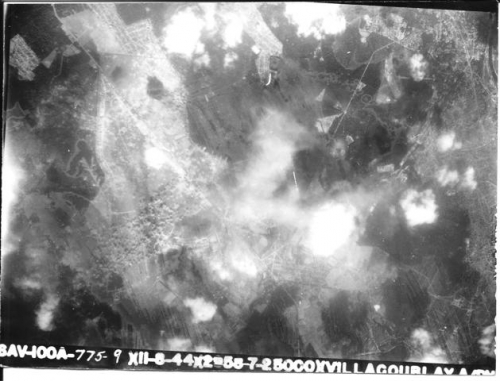
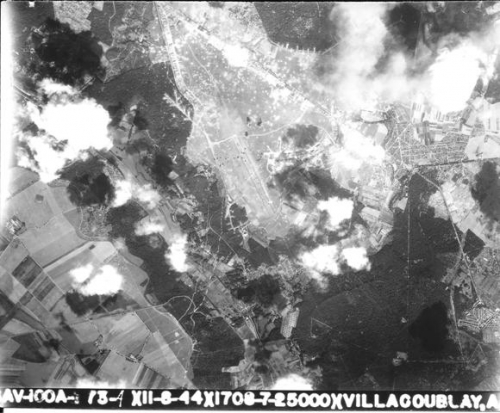
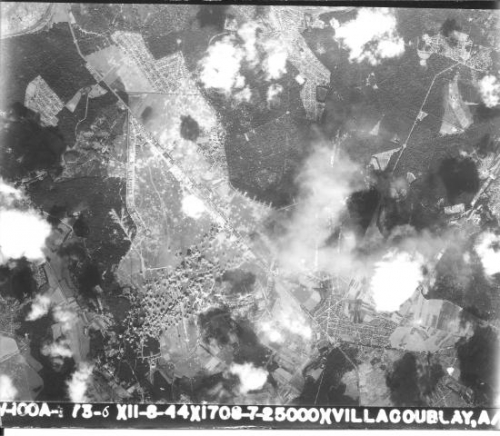
VILLACOUBLAY, AF
100th BG Mission #: 179
Mission Summary
ON THIS DAY...AUGUST 9-11,1944
Although a mission was ordered for August 9, it was scrubbed before take-off and the air crews were sent up for two practice missions instead. TG Raymond Mainka from Joseph Ricker’s crew, tells us, “Had two practice missions today so we were up again all day in the air. We never eat more than two meals a day lately.”
The next day, a Stand Down order gave the 100BG a needed rest. S-2 Officer, Red Bowman recorded, “A welcome break for all hands as missions have been coming steadily. Crews have been getting very tired.” BTG William Crozier entered into his diary, “Did nothing but rest. Sure does feel good. I was about to believe my body was going to go on strike.
The 349th’s Commanding Officer, twenty-seven year-old Major Sam L. Barr and flight surgeon, twenty-five year-old Dr. Carroll E. McCarthy, both Mississippians, checked in on three of the 349th’s wounded men at the 65th General Hospital, located ten miles away from base. Streed’s TG, Lewis Payne, injured from flak on August 5 tells us, “LT Streed was over and brought some candy and gum. “Doc” McCarthy and Major Barr were also over to see me…Went up to see LT Lindsay…” Streed’s copilot, Edward Lindsay had been severely wounded by flak in his leg two days prior. On that same mission, Joseph Ricker’s WG, Charles Winters had such a close call that he went into shock. Released from the hospital that day, fellow crew member, William Crozier recorded into his diary, “Glad to see Chuck out of hospital. He says Mack the Quack got our crew a three day pass because of Chuck's shock. Said Chuck had what in World War I was called shell shock. He said for Chuck to go somewhere and rest his nerves or he would ground Chuck permanently. Chuck begged him not to ground him.” As a flight surgeon, McCarthy was responsible for getting the 349th’s airmen back to flying as quickly as possible. Part family doctor and father confessor the role of a flight surgeon was reported to take more psychology than medicine.
On August 11, twenty-six crews were briefed for a mission to France, with the primary target of a Luftwaffe airdrome located at Villacoublay, eight miles SW of Paris. Flying their #1 combat mission that day would be the six newly operational crews of William Frazier, Albert Grigg, Paul Corley, William Urban, Donald Cielewich and Donald Ellison.
Led by the 390BG, the 100BG would fly as the High and the Low groups, last in the 3rd Division's line of B-17s. Major Emberson would fly as lead of the High group with John Giles while Captain Herbert Howard would fly with Marquard Anderson.
Carrying thirty-eight 100 lb bombs, take-off was successfully accomplished between 0817-0840 hours. Assembled, the English coast was crossed at Selsey Bill after climbing to 21000 feet, seven minutes late after folding into the Division line. Hitting their IP at 1207 hours, the 100BG was soon over the primary target where bombs were away at 1220 hours with good results.
Flying last in the Division line, the enemy gunners below had time to track the 100th’s bombers. Encountering accurate and tracking flak after bombs away, Alf Aske’s B17, ‘Royal Flush’ took four direct flak hits, one on the #2 engine, two in the cockpit and one in the bomb bay where a fire was started. Aske’s twenty year-old NAV was killed and Aske was believed to be injured. With smoke seen coming from the plane, Aske peeled off to the left out of formation and was seen making a slow spiral descent when it passed from view from the remainder of the formation.
Heading to the Rally Point, the wing reformed although some groups were reported as straggling. Leaving the enemy coast and making the quick trip across the English Channel, the 100BG landed back at Thorpe Abbotts between 1435-1445 hours, where for most of the crews, it had been a relatively uneventful mission. However, for the Aske crew known as 'Aske's Angels,' it would be a very different story.
Injured and with smoke filling his aircraft, Aske gave the bailout order. Leon Croulebois, a twelve year-old French boy visiting his Grandmother remembered what he saw from the ground that day. “With fantastic precision the men evacuated the plane, one after another jumping…Flak from many cannons to score direct hits on your plane, already low altitude, in order to disintegrate it in flight…It was a terrible thing to hear the shots fired at you and your comrades. It’s a miracle all were not killed…” Both TTE, Robert Williams and TG Stuart Allison were killed either while parachuting down or on the ground. CP Charles Barber, BOM James Magargee, ROG Charles Nekvasil and WG Armando Consorto were eventually captured as the Germans searched the area for the downed airmen. Charles Barber, wounded, was captured and taken to the Beaujon Hospital outside of Paris. Charles Nekvasil suffered a burned face, fractures in his pelvis and coccyx upon landing and tells us, “I bailed out and landed in a plot of ground next to a large factory near the Eiffel Tower. An old man, though he knew we were surrounded, attempted to lead me away and hide me. He was captured by the Germans and probably shot. His action was one of self-sacrifice.” He continued, “I was taken to a local HQ and interrogated. I was treated very badly when I refused to talk… I was made to walk though I was seriously injured and had difficulty even to crawl on the ground. I was taken to the Beaujon Hospital, where I was forced to parade around the courtyard so that all the German patients could see me. At this hospital I joined LT Barber."
Barber and Nekvasil would eventually escape from the hospital with the aid of the French Resistance. It would be eighteen year-old Norman Fernaays who would evade capture and return to duty on August 29. He tells us, “I baled out at about 4000 feet and delayed the ripcord til 2000. I was right over Meudon and could not swing away from the town. I landed on top of a house which had a tile roof…The french came out of the house and got me down, hid my equipment and gave me civilian clothes.” Fernaays would eventually move to two additional locations, the last in Paris where he would stay until the Americans arrived.
Crews flying on August 11:
Frazier, Chamberlain, Grigg, Corley, Trapnell, Herres, Giles, Urban, Allen, Geller, Elbel, Cumming, Everitt, Daniels, Cielewich, Ellison, Simmons, Stevenson, PJones, Ernst, Johnson, Aske, Brown, Hempy, Anderson, Lundquist
Bombing Results
Bombing Results: EXCELLENT
Aircraft Lost: 1
Crew Lost: 9
Claims of Enemy Losses (CLS): 0
Aircraft Returned: