Mission Date: August 15, 1944
VENLO, AF
100th BG Mission #: 182
Mission Summary
ON THIS DAY...AUGUST 15,1944
With the goal of neutralizing the German Air Force from mounting any major defense against either the advancing Allies in the Argentan-Falaise area or the Allied landing in the south of France planned for August 15, the 8th Air Force planned for mass attacks on Luftwaffe airfields and airdromes in Germany, Belgium and Holland. The 3rd Air Division ordered its B17 Groups to attack the Venlo AirField, Handorf Airfield and the Twente/Enschede Airfield while it would send its B-24s to the Florennes/Juzaine Airfield.
At Thorpe Abbotts, the morning briefing had commenced and thirty-six crews from the 100BG listened intently as the S-2 Officer briefed them on the mission's details. Their primary target would be the Luftwaffe air base located just east of Venlo, Holland. Used primarily as a Luftwaffe night fighter base, the airfield’s runways were in Holland while other buildings important to the airfield were in Germany just across the border. The airfield also contained a large ammunition dump hidden in the woods and had a reported ten flak positions for its defenses.
Relieved to hear that they would not be flying deep into Germany were the crews of twenty-two year-old John Dyatt, twenty-four year-old Carl Hedin and twenty-two year-old Delbert Thompson. This would be their #1 combat mission.
Again, the 13CBW would fly two wing formations with the 100BG flying as the 13A and the 95BG flying as the 13B. The 100BG would be led by Major Robert Rosenthal, flying with William Terminello in the lead Pathfinder aircraft. The High would be led by Major Emberson who would fly with Neal Scott while the Low group would be led by Captain Mark Cope flying with Merle Ehorn.
In clear skies, the pilots began their take-offs and spiraled up for group formation. By 1045, they had climbed to 20000 feet and had assembled into the 13A wing formation. Taking its position as 6th in the Division line, the 100BG crossed the English coast at Southwald.
As the North Sea was crossed, the formation continued its climb to bombing altitude when just before crossing the enemy coast, Walter Bailey, on his #2 mission pulled his B-17 out of formation due to engine troubles and returned to base. Bailey’s TTE Calvin Dollar tells us through his diary entry, “Aborted, lost No. 4 engine turned back 10 min from target. No 2 &3 engine also bad expected more trouble but got back OK. Had to land with 38 100lb bombs aboard.”
At 1118 hours, the 100th's formation made landfall at the enemy coast between Holland and Belgium. Encountering light flak at the coast, Rosenthal and Scott took the 100th’s formation through several of its first turns to avoid the flak and then again when they made a dog-left turn to avoid the defenses coming up from Amsterdam.
Two minutes before arriving at the assigned Initial Point, the signal was given by Scott’s lead ship for the group peel off and each formation prepared for the commencement of its bomb run. With great relief, no enemy fighters had been encountered before the IP and no flak was encountered on the bomb run.
At 1149 hours, through a break in the haze, bombs were successfully away on the primary target. Flying his #2 combat mission, Walter Radke’s NAV Rowland Hetrick tells us, “Today we got what is known as a "Milk Run.” It was just like a practice mission except that we went to Germany… We had no flak over the target and we saw no fighters except our own. The RAF gave us a show. They came over and bombed other fields on our route. We got to watch them come and go. We also saw their bombs fall on a couple of fields on the way out. They were like a swarm of bees because they didn't fly formation like we do. They were at all altitudes and spaced unevenly. It was really a beautiful sight.” William Crozier seconded the visual impact of the RAF's bombers that day when he recorded, “The RAF, not flying in any kind of formation, was at all altitudes everywhere. They look like a swarm of mosquitoes coming out of a swamp. I saw a number of German airfields completely destroyed.”
Hitting the Rally Point, the 100th’s group formations reformed into the 13A wing and followed the briefed route out, again with no encounters with enemy fighters or flak. Over the North Sea, the pilots began their descent and as the ROGs were able to receive the radio which played the music they liked, the crews heard the news of the Allied landing in the south of France, giving that day further cause for celebration.
Soon, the heavy bombers were spotted coming in over Thorpe Abbotts and by 1322 hours, all ships began landing. After the short four and one-half hour mission, pilot Everett Kennedy was bringing his B17 back from his last combat mission but not without a moment of ‘sweating it out.’ Kennedy, now with his own crew, had been the original copilot on Edgar Wolf’s crew. With most of the crew finishing on the July 29 Merseberg mission, Everett would be the last member of Wolf’s original crew to finish his tour of duty. Complete it he did and TG, Robert Stachel recorded, “Kennedy’s final mission could have been a disaster for him. He said a standard milk run until the final approach, almost landed on top of another aircraft after being cleared to land. All of Ed Wolf's crew, with the help of God looking over us, made it possible to complete our tour safely.”
The mission light that evening indicated a Stand Down for August 16.
Crews flying that day:
Ehorn, Kemp, Riegel, David, Bailey, Everitt, Dyatt, Schulte, Woodall, Chamberlain, Daniels, Radke, Ricker, Streed, Trommer, Thompson, Allen, Heironimus, Elbel, Hedin, Kennedy, Simmons, Coleman, Harris, N Scott, Ernst, Miller, Lundquist, Bennett, Stevenson, P Jones, Dobrogowski, Ransom, Ricci, Armstrong
Bombing Results
Bombing Results: HIT T.A.
Aircraft Lost: 0
Crew Lost: 0
Claims of Enemy Losses (CLS): 0
Aircraft Returned:
Photos
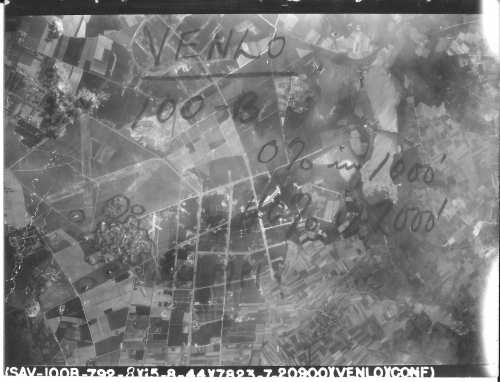
Venlo Strike Photo Aug 15, 1944
Courtesy of Capt Tong