Mission Date: August 18, 1944
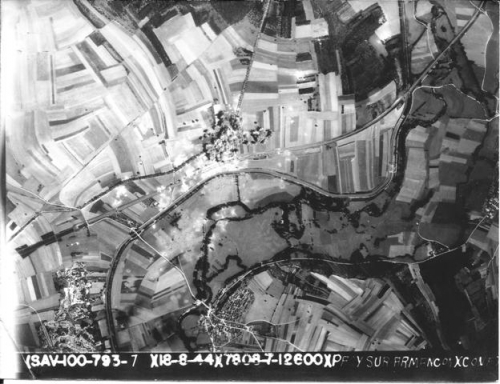
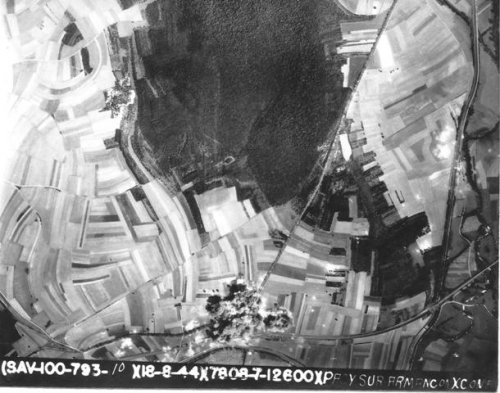
PACY sur ARMANCON, OIL DUMP
100th BG Mission #: 183
Mission Summary
ON THIS DAY...AUGUST 16-18,1944
After its mission to attack the Venlo airfield, the 100BG enjoyed a Stand Down order and the 418th squadron diary entry for that day provides us a snapshot into life on base for August 16. “The day was clear with occasional overcast, not bad flying weather so up went a practice mission.”
Especially pleasing to the men, the Enlisted Men’s mess hall was serving up real ice-cream but not without a price. The Squadron diary continued, “Before you came to the two mess sergeants dishing out this great American dish, you passed by another observant mess sergeant who demanded your ration card and carefully tears off one corner.” A corner gladly given by the men for a taste of home. It also tells us that each soldier at Thorpe Abbotts was given a weekly ration that could be obtained at the P.X. (Post Exchange.) Reported as being “quite liberal” that week, rations were reported to include: “two “Milky Way” bars, two “Dr. I.Q.” bars, two packs of “Biscuits,” a package of gum, a carton of cigarettes and two razor blades.”
On the 17th, bad weather kept all of the 8th Air Force’s heavy bombers grounded and not even Colonel Jeffrey would send up any of his B-17s for practice.
However on August 18, a mission was scheduled and thirteen crews from the 100BG were briefed for a primary target of the Luftwaffe oil storage installation located at Pacy-sur-Armaçon, one hundred twenty-eight miles southeast of Paris, France.
Flying as the High formation in a Composite 13CBW with the 95BG flying as its Lead and the 390BG flying as its Low, the 100BG would be led by Major William Thompson flying with John Giles. The remaining crews of Everitt, Dyatt, Delaney, Streed, Dickert, Heironimus, Kassebaum, Wm Kennedy, Schaffhausen, Hempy, Harris and Ludquist reviewed their formation sheet. Schaffhausen, in his first squadron lead, would lead the other 418th crews of Hempy, Harris and Lundquist in the Low, while the 349th, 350th and 351st Squadrons would each furnish an element of ships and crews.
Loaded with twelve 500# bombs, the Fortresses departed Thorpe Abbotts between 1016-1025 hours. After forming up over Buncher 28, the 100BG proceeded to Horham where they were to join up with the 95BG, who had already departed, ten minutes earlier than originally communicated. With both the 95BG and the 100BG’s formations making 360 degree turns, the two Groups finally connected over Splasher 10 at 1208 hours.
Flying fourth in the 3rd Division’s line to northern France that morning, the 13CBW fully formed, departed England at Selsey Bill at 10000 feet and started their climb to bombing altitude over the channel. Thirty minutes later, the French coast was crossed east of Cherbourg. With the briefed route taking them over the front lines, with good fighter support, there were no encounters with fighters or even flak.
At 1432, the 13CBW hit the briefed IP and made its turn onto the bomb run. Unable to get a visual sighting on the target, the 95BG and the 390BG held its bombs on the first run while only the 100BG was able to successfully drop at 1440 hours. Going around to the IP again, a second run was made on the target, where the 390BG dropped at 1505 hours. Still unable to make a visual sighting, the Lead group made a third run over the target, finally making its attack at 1520 hours, forty minutes after the 100BG had originally dropped.
After the 13CBW reformed, it followed the same route out, this time encountering accurate flak thought to be coming from the vicinity of the Argetan-Falaise pocket. Although not seriously damaged, some of the 100th’s Fortresses picked up battle damage: John Lundquist’s B-17 received minor flak damage, William Kennedy’s Fortress picked up three holes, Leslie Kassebaum’s aircraft had its trim tabs shot out and pilot Harvey Dickert, flying #6 position off of Lloyd Delaney’s aircraft tells us, “Several men on other crews wounded, Delaney’s tail gunner (John Tomaszewski) about a 100 feet from us. We had a few skin holes. Sweated out gas. 95th took three runs to drop their bombs and wasted an hour.”
Departing the French coast, the formations began their descent over the channel. Back at the base, the maintenance crews waited for the return of their B-17s. The 351st squadron diary tells us, “The ground echelon gets no chance to fly but in the long period of work, watch and wait, since the Squadron has been in this theater, it has come to look eagerly each time the flight is due back. It would be well to point out that here in over a period of 15 or more months a very closely welded co-operation has become the order of the day between the airmen and ground crews.”
Landing successfully between 1819-1832 hours, after an eight and one-half hour mission, the 100BG’s thirteen ships had all returned safely and the crews were one mission closer to going home.
While the mission was being flown, Captain Neil P. Scott became the Operations Officer for the 351st SQ and was respectfully described. “To those who really know him, he has a way of being nice and tough at the same time which quality really comes in handy when it comes to getting the crews to do their work and at the same time keeping griping down to a dull roar.”
That night, the 100BG received another Stand Down order.
Bombing Results
Bombing Results: GOOD
Aircraft Lost: 0
Crew Lost: 0
Claims of Enemy Losses (CLS): 0
Aircraft Returned: