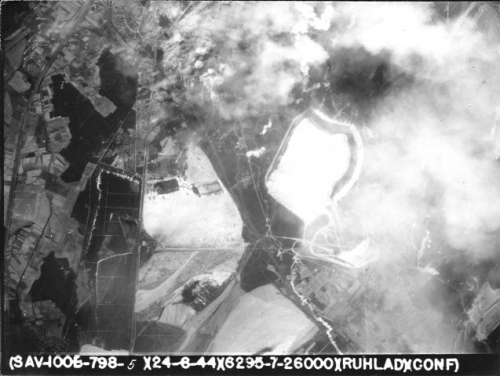
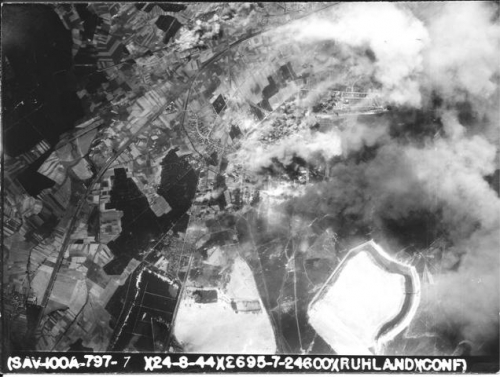
Mission Date: August 24, 1944
RUHLAND, OIL REFINERY
100th BG Mission #: 184
Mission Summary
ON THIS DAY...AUG 19-24,1944
For five days, from Aug 19 - Aug 23, the 100BG did not fly a combat mission either due to stand downs or missions scrubbed due to poor flying conditions. However, the Allied ground troops in France had been successful in their offensive maneuvers and the Germans in France were in retreat.
On August 21, S-2 Intelligence Officer ‘Red’ Bowman, recorded, “Bremen oil refinery came in at 0853 hours as a strategic target. Scrubbed before 0930 hours. Wing explained that the recent stand downs were ordered because fighters were so busy attacking the retreating Germans in France that none could be spared for escort. News from France today puts US forces on the Seine both north and south of Paris city limits. German radio saying the Americans are in Paris. Anything can happen.”
On August 22, the 100BG was Stood Down again and the mission order received that night was soon scrubbed.
On August 23, Paris had been liberated and Bowman recorded, “Great news today - Paris has been liberated, with Maquis troops first to enter the city. Rumania chose today to get out of the war. Quite a day.” Four years earlier, German troops had marched into Paris on June 14,1940 and the city was finally back in French hands.
For the 100BG, August 23 saw newly arrived crews processed while the others continued mandatory training. The newly arrived crews of Walter Charles, John Furrer, Raymond Harney, Andrew Downing and Harold Bucklew were assigned to Squadrons while the 418th squadron diary tells us about training. ”Still another day without combat flying. Training schedules are full up to take advantage of this lull. Link trainer, Bomb. trainers, radio trainers, Gunnery trainers, "Gee" Navigational trainer. A recent measure was taken to improve attendance may cause a combat crew man with five "Cuts" to have an extra mission tacked onto his tour.” That same afternoon, with the weather finally improving, a low altitude practice mission went up and the 100th’s next mission alert came in at 2230 hours.
On August 24 at 0600 hours, thirty-eight crews including the Pathfinder crews of Austin Dunlap and William Terminello watched as the S-2 Officer pulled the curtain back from the large wall map. With the lead crews already briefed earlier, low whistles emanated from the others as the red string was followed deep into Germany, stopping at Ruhland, eighty-seven miles southeast of Berlin.
The briefing Officer told the men that the 100th’s primary target would be the synthetic oil refinery at Ruhland, a critical resource for the Germans. He warned the crews that the target would be heavily defended by German gunners and fighters. Now marked ‘Operational,’ the new crews of Joseph Raine, Jack Gay, Oren Hopkins, Paul Kramp and Thomas Anderson would all be flying their #1 combat mission and pulses were elevated. Also seated in the briefing was pilot John Shelly. Wounded in the face by flak on the D-Day mission, this would be his first mission back after being grounded for months.
Mission orders called for the 13CBW to fly three wing formations: 390BG flying as the 13A, the 100BG as the 13B and the 95BG as the 13C, echeloned off the 100BG. Flying as the 100BG’s Command pilot would be Major Joseph Zeller in Austin Dunlap’s Pathfinder while the High would have Major Emberson flying as Deputy lead in William Terminello’s Pathfinder. Captain Andrew Gorski would lead the Low with Marquard Anderson.
After the crews had pulled themselves up into their B-17 hatches and readied for take-off, engines were started and the pilots moved into their assigned taxi positions. Between 0750-0819 hours, all of the 100BG’s Fortresses took off successfully. The pilots continued their spiral climb upwards to 8000 feet, where the aircraft assembled into the 13B wing and where Harry Hempy had pulled his B-17 out of the lead formation due to mechanical problems and returned to base. After falling in trail of the 13A wing, the 100BG proceeded to Great Yarmouth where they departed the English coast as the 9th wing in the 3rd Division line.
Over the North Sea, the formation continued its climb to 18000 feet and by 1115 had crossed the enemy coast at Wattenmeer, Germany at 20500 feet, where the first of four flak encounters was met, albeit reported as meager. At 1210 hours after having climbed to 23000 feet, Joseph Raine pulled his B-17 out of the High formation due to engine troubles, dropping his ten 500# bombs on a target of opportunity at Weteritz, Germany before returning home.
Two minutes prior to reaching the IP, the 13B's fan out procedure commenced. At 1244 hours, red flares shot from the Command ship indicated to the others a visual bomb run would be made and the bomb bays were opened as the Fortresses made their turn onto the bomb run.
Although ROG Norman Edwards tells us, “Ample flak 3 times before target but inaccurate,” the bomb run was a different scenario entirely. Encountering medium to heavy barrage flak including rockets, the 100th’s B-17s absorbed the flak with few damaged and continued on where through the smoke coming up from previous bombs, bombs were away from the lead ships first at 25000 feet. William Terminello recorded, “Frank (Rubick) hit the target beautifully…Flak was heavy but we did okay and lost no ships from the formation.”
After bombs away, a left turn was made to the Rally Point. With the 13B wing again in good formation and position, the enemy coast was departed at 1452 hours over Texel, after letting down to 14000 feet. The escort fighters had done an excellent job of covering the formations. NAV Rowland Hetrick on Walter Radke’s B-17 remembered, “We expected to be attacked nby fighters today. We weren’t but saw a few. We were lucky again and it was easier than the first one. We knew more what to expect, so we didn’t imagine so many things.”
At 10000 feet, the irritating masks came off after five and one-half hours on oxygen. Landing in scattered showers between 1558-1606 hours, the mission was a long one - over eight hours. That evening, the Squadrons were alerted for another mission. After such a tiring long mission, lead PFF pilot William Terminello remembered, “We came back at four o’clock and landed at Thorpe Abbotts. Never again, it was real late when we finally got back to the 95th and we had to go right out again.”
Crews flying the mission: J Williams, Kemp, Elbel, Corley, Frazier, Everitt, David, Anderson, Bailey, Heironimus, Shelly, Raine, Ricker, Dyatt, Kassebaum, Radke, Allen, Daniels, Schulte, E L Thompson, Hedin, Kramp, Miller, Dobrogowski, Bennett, W Kennedy, Hempy, Gay, Schaffhauser, P Jones, Hopkins, Coleman, MJ Anderson, E Simmons, Rowland, Lundquist
Bombing Results
Bombing Results: EXCELLENT
Aircraft Lost: 0
Crew Lost: 0
Claims of Enemy Losses (CLS): 0
Aircraft Returned: