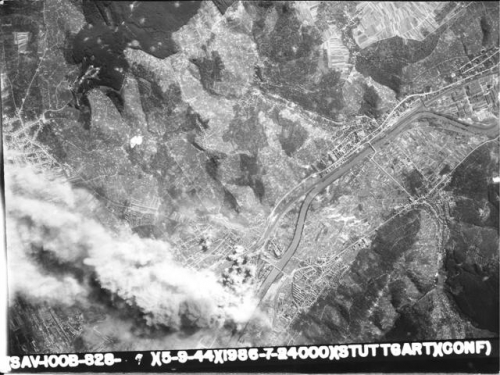
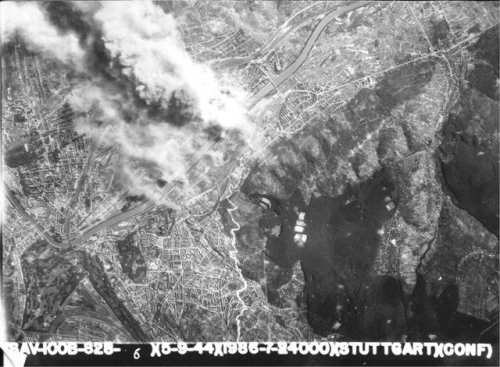
Mission Date: September 5, 1944
STUTTGART, AERO ENGINES
100th BG Mission #: 191
Mission Summary
On this day...September 5,1944
After a weather stand down on September 4, the next morning, thirty-eight crews were seated in the briefing room at Thorpe Abbotts where the S-2 Officer unveiled their target for the day. It would be a strategic mission to Stuttgart, Germany, sixty miles east of Baden-Baden and the Black Forest and where the Primary target would be the Daimler-Benz aero-engine factory.
The 13CBW would fly each of its three Groups with the 390BG flying as the 13A CBW, the 100BG flying as the 13B and the 95BG flying as the 13C. The 100BG would be led by Major Robert Rosenthal, flying Command in the lead PFF flown by Austin Dunlap and his crew with Major J.A. Goodman along as an Observer. Major Sam Barr would fly command in the second Pathfinder flown by James Seamans, with Major C.A. Wallace flying as an observer. Major Channing Emberson would fly with the Gerald Brown.
Ordnance had already moved and loaded over two hundred fifty bombs to the hardstands early that morning in the darkness: five 1000# bombs in the Lead and High planes and ten 500# incendiaries in the low group’s aircraft.
After taxing into their positions, starting at 0640 hours the High group’s pilots took-off first, followed by the Lead and Low groups. By 0710 all thirty-eight B-17s were in the air and after forming into the 13B, proceeded to the assembly point where it fell in behind the 13A while the 13C fell in behind it. Climbing to 14000 feet, the 100BG departed the English Coast at Brighton, as the fourth wing in the Division line.
Crossing the French coast thirty minutes later, as the formations flew deeper into the Continent, clouds were encountered but the formations continued their climb through them to 21,000, causing the Low group to straggle. Between the turn and reaching the IP, John Shelly pulled his B-17 from the Lead formation over France due to mechanical troubles and jettisoned his bombs before returning home. As the 100BG neared the IP at 23,000 feet, the its Lead and High formations ’S’d’ to allow the Low to catch up, thereby not having the time to climb to the briefed 25000 feet bombing altitude.
Over the Black Forest, north of Freiburg, the IP was reached and the 100th’s formation began the group peel-off onto the bomb run. Ahead, the crews could see the barrage of flak opening up on the Groups in front of them. As the 390BG was over the target, one of its B-17s was hit by flak and was observed pulling out of formation and later exploding.
Over the target, the weather was clear, making it easier for the German gunners below to hone in on the formations above. Reported as moderate, tracking and very accurate on the bombers, the 100th’s B-17s now over the target absorbed the bursts and numerous planes were damaged. James Ransom’s ship received a flak hole in the left wing, Joseph Ricker’s Fortress received five flak holes in its wings and fuselage and on Walter Bailey’s B-17, still loaded with its six 1000# GP bombs, his TTE Calvin Dollar tells us, “Got 4 flak hits, one right under Co-pilots seat (William Merchen). Could hear the flak burst, it was so close.” And pilot Harvey Dickert recorded, “…received quite a lot of battle damage, electrical cut to flight deck radios. Some pieces of flak knocked out a main oxygen bottle in my line. #1 propeller governor severed – hole in our new plexiglass nose. Shipman’s PW kit hit and completely ruined. Holes in wings and fuselage, big dent in #2 prop and large hole in stabilizer. Ample flak at 22,000 feet, briefed altitude was 24,000. Had a hard time keeping up with the formation till we got out of the target area.”
However, despite the flak, bombs were successfully away at 1122 hours and NAV James Wright remembered, “We bombed visually from 23,000 ft. We dropped the whole load exactly where it was supposed to be dropped.” After bombs were away, the 100th made a sharp turn to the right to get out of the flak and headed toward the Rally Point, reforming into the 13B CBW. By 1213, they had let down to 17000 feet over Nancy, France, and departed the French coast over Rouen at 1407 hours.
The formation was observed over Thorpe Abbotts at 1539 with all of its aircraft down by 1615. Again waiting at the field for the 100th’s return, the 6' spare gunner Lewis Martin from Millville, NJ, watched as the pilots brought their aircraft in for landings in a bad cross wind and with obvious flak damage. He recorded, "One had holes galore – the lower turret was damaged – flak had entered the left waist and left near the tail, ripping the wires out, leaving a six inch diameter hole – the plexiglass nose was shattered - a supercharger line was shot off...None of the crew were hurt."
After returning from the longest mission that most of the crews had been on, they were hungry and tired as they headed into Interrogation. Pilot Harvey Dickert adds, “Only over German territory three hours on a ten hour mission,” while Robert Kazee recorded, “The ten and a half hour flight was long and we encountered heavy flak over the target and many planes were shot up badly but returned safely.” William Crozier wrote into his mission journal, “Long mission, must have been over 10 hours. Very tiring. I rode in the waist about one half the time. Turret malfunction.”
That evening, another mission alert was sent over from headquarters and the pilot’s to fly were soon marked on their Squadron boards.
Crews flying the mission: W Miller, Everitt, Spurgeon, Holladay, JD Williams, Streed with Furrer as his CP, Trommer, Delaney, Frazier, Heironimus, Shelly, Cumming, Bailey, Riegel, Kassebaum, Dickert, Ricker, Dyatt, Schulte, Ellison, Ransom, Ricci, R Miller, Fabian, Kramp, McLaughlin, Hempy, G Brown, Rumley, Jones, JS Seamans, Stevenson, Rowland, Harris, Kennedy, Johnson, Lundquist
Bombing Results
Bombing Results: VERY GOOD
Aircraft Lost: 0
Crew Lost: 0
Claims of Enemy Losses (CLS): 0
Aircraft Returned: