Mission Date: August 17, 1943
REGENSBURG, AC FACTORY
100th BG Mission #: 16
Mission Summary
ON THIS DAY…AUGUST 17,1943
PLANNING AND TAKE-OFF
Weeks prior to August 17, Colonel Harding and the other 4th Bombardment Wing’s Group Commanders had been brought in for a study of a plan devised by VIII Bomber Command. Targeting a Messerschmitt aircraft factory, the planned mission route would take the crews across Germany, then south over the Alps, across the Mediterranean Sea to landings at airbases in Africa. After refueling, the heavy bombers were to head back to England. Each Group’s lead crew had been already selected and they had been “briefed intensively upon photographs of the target and surrounding area, without divulging names or routes.”
In fact, on August 10, crews had been briefed and had taken off for the secret “big mission,” but the mission was scrubbed one hour in due to poor weather.
On August 16, the 100th’s senior S-2 Officer, Red Bowman recorded,“Most of the day filled with alarms and excursions regarding the mission projected for tomorrow – general impression is both Zebra and Sunflower will be attacked tomorrow…” The excursion Bowman noted was the final mission conference where a change to the original order was discussed. Official records tell us that, “when this change was received, the selected lead crews and group commanders were called into conference for a final and complete briefing on the revised plan which was scheduled for execution the following day.”
The original field order had called for diversionary missions to be flown by the 1st Division and medium bombers while the 4th Bombardment Wing’s heavy bombers would attack the Regensburg target. However, on August 16, a change made to the orders would call for a double strike, with the 1st Division “to follow closely behind the 3rd Air Division forces and attack Schweinfurt while the 3rd Division was attacking Regensburg.”
That day, the base at Thorpe Abotts, was placed on a full alert and Red Bowman recorded, “Crews warned to prepare canteens, extra rations, arms, shelter halves, iron rations and other ominous articles. Afraid it is real.”
In the morning of August 17, twenty-one crews had been checked in at the briefing room door and were brought to attention as their commanding officers entered the room. Twenty-two year old Henry Shotland and his twenty-three year old copilot Charles Thompsen had checked in for their #1 combat mission. Lt Colonel Bernie Lay, also in attendance, would fly his #4 mission with the 100th.
Unveiling the map, Colonel Harding started right in and divulged the target as the Messerschmitt factory located at Regensburg, a single-engine Luftwaffe factory that produced 30% of its fighter output and a critical target. If the mission was successful, they would put German fighter production behind by nine months. The designated secondary target would be the Allach aircraft engine factory, located ten miles north of Munich with a last resort target identified as Munich’s City center.
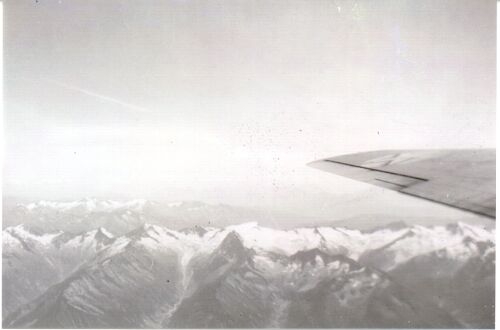
Reviewing the route, the men were told that after the target was hit, the heavy bombers would continue south, over the Brenner Pass in the Alps and over the Mediterranean Sea near Corsica and Sardinia, landing at the Telegram air base in North Africa.
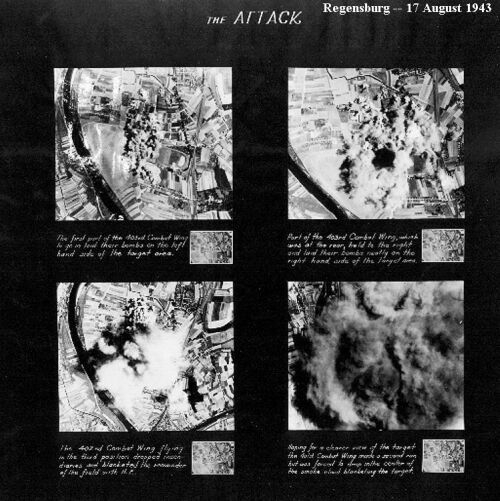
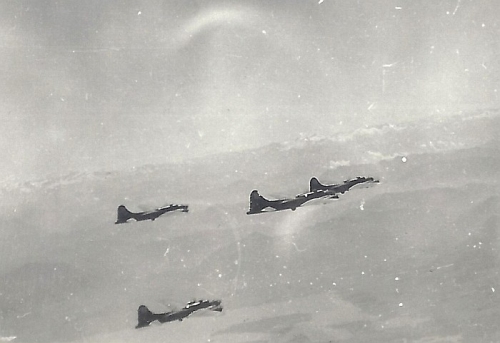
Colonel Curtis LeMay would lead the entire mission with the 96BG and his Division line of heavy bombers would be led by the 403rd CBW, with the 401st CBW flying second, followed by the 402nd CBW flying last. The 100BG would be the last formation in their wing and entire division.
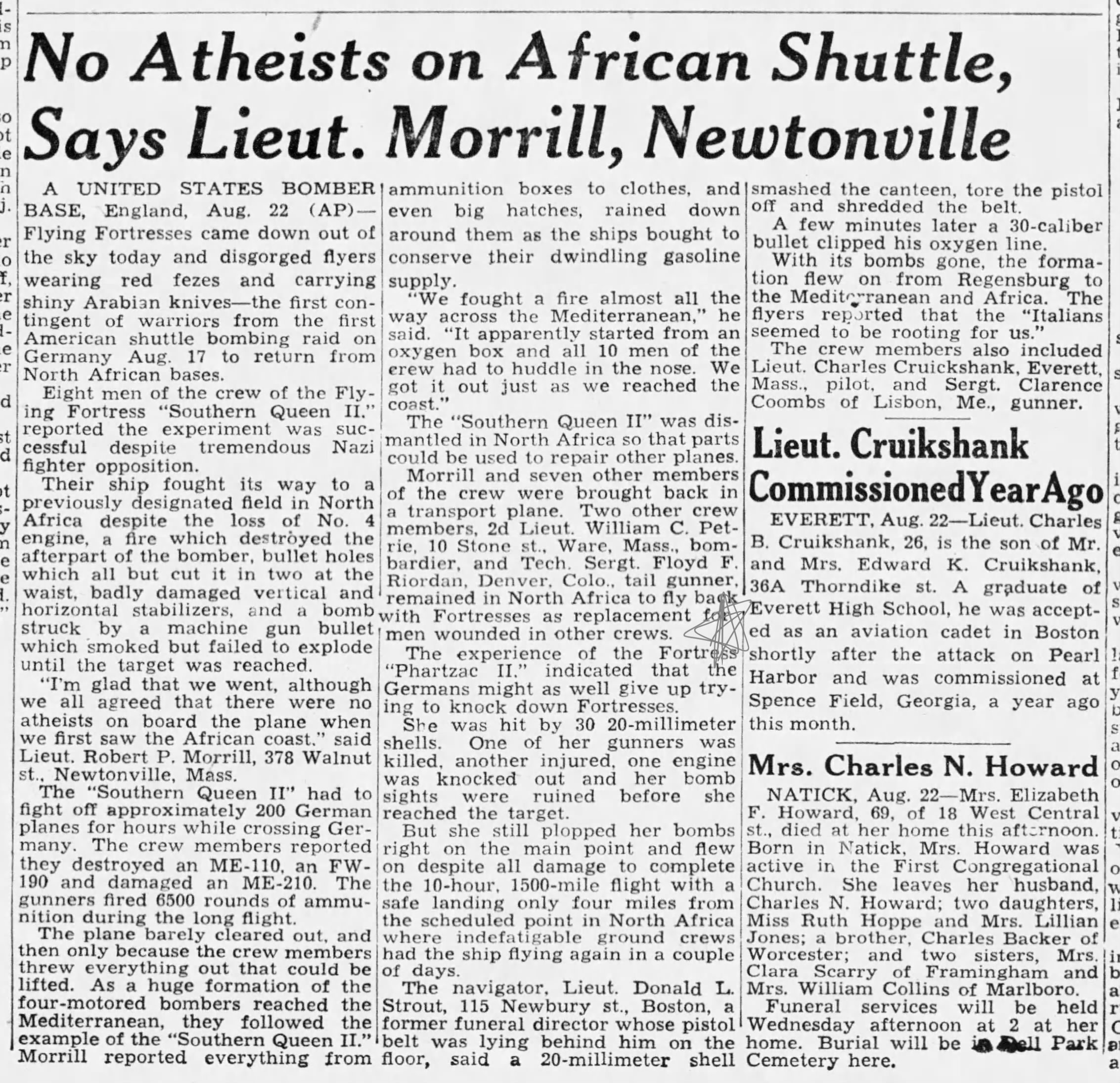
The 100th would be lead by the 418th’s Major Jack Kidd flying as command pilot with Everett Blakely. Crosby and Douglas would fly as the Group’s lead navigator and bombardier. Robert Wolff and John Brady were to fly as Blakely’s wingmen in the 1st Element. This would be the Wolff crew’s #2 mission. John Egan would fly with pilots Charles Cruikshank and Glenn Graham, in the Deputy lead position. Cruikshank’s wingmen would be Robert Knox and Curtis Biddick, who would fly as pilot of the William Flesh crew.
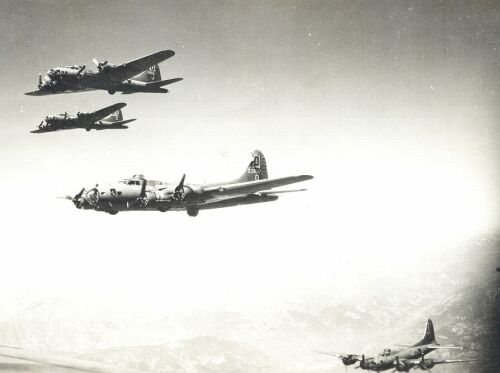
Flying the high formation would be the 349th Squadron, with Major William Veal flying as command pilot with Sam Barr. Henry Henington and Owen Roane would fly as Barr’s wingmen in the 1st Element. Glenn Van Noy would lead the second element with Henry Shotland and John Justice as his wingmen. In the third element of the high squadron would be the 351st Squadron, with Thomas Murphy flying the lead aircraft. Murphy would have as his copilot, Lt Colonel Beirne Lay. Victor Fienup and Donald Oakes would complete the third element.
The 350th Squadron would fly in the unenviable low position of the last group in the Division line. Major Gale Cleven would fly as command pilot with Norman Scott and his crew. Bernie DeMarco and Ronald Hollenbeck would fly as Cleven and Scott’s wingmen. The second element in the low would be lead by Roy Claytor with Ronald Braley and Thomas Hummel as his wingmen. Hummel would fly the worst position of all, as ‘Tail End Charlie’ of his Group, Wing and Division.
Colonel Harding re-enforced the necessity for flying tight defensive formations and was reported to have said, “I told them to stay in formation. I reminded them that missing faces usually belonged to forts that weren’t in formation and I mentioned names. It’s brutal but that’s the way the boys can get home.”
The bombing altitude was planned to be reached twenty minutes before the formation left the English coast. The route was such a long distance and Regensburg was such a critical target to destroy on the first attempt that VIII Bomber Command had chosen lower than usual altitudes. The 100BG flying last would be at the lowest - 17000 feet.
Briefed on the known AA gun positions along their route, the flak was “predicted to be moderate.” Fighter support was to be six interval groups of P-47s, which would rendezvous with the bombers at a point over the North Sea before they were to cross the Dutch coast, continuing on with the bombers for as long as possible.
Once at the target, if the first bomb run was unsuccessful, the men were told that a second bomb run had been authorized, as the fighter opposition was “expected to be slight in the vicinity of the target.”
Two rally points were identified on the map; one on the North side of the Alps if a second run was required and one on the South side if the weather forced the separation of the bombers as they crossed the Alps. As the route over the Mediterranean was reviewed, the men were reminded of the importance of staying in good defensive formation due to the fighters anticipated at Corsica and Sardinia.
Dismissed from the briefing, the men readied their ships and steadied their nerves. After taxiing into position, the heavy overcast over East Anglia caused a one-hour delay during which time another one of HQ’s brass would join the men. Colonel William L. Kennedy, the first Air Field Commander of Laredo Army Air Field, and now an HQ armorer and gunnery expert who wanted to get first hand knowledge of the problems the gunners experienced on a combat mission, had joined Glen Van Noy’s crew, talking himself into the position of Van Noy’s left waist gunner.
The green light for the mission was finally given after the one and one-half hour delay and Colonel LeMay would later state, “The mission itself started off under a cloud of doubt and we didn't know until the last minute whether it would be scrubbed or not. Finally 26 minutes before the take off, we received word from Bomber Command that the mission would go on. I was still at Headquarters and the plane I was to ride on was on the runway waiting, so when I arrived at the 96th, I was thrown in the back door of the plane with my belongings on top of me, and away we went…”
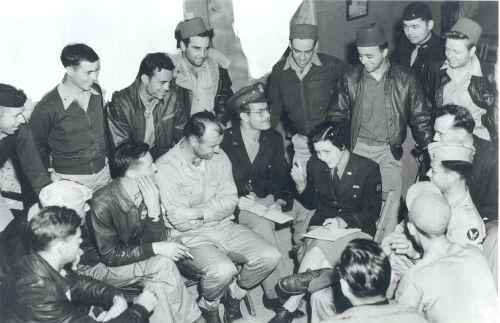
Meanwhile at Thorpe Abbotts by 0730 hours, each of the 100BG’s aircraft, loaded with sixteen 250# incendiary bombs, had made a successful take-off and the Group reported an excellent assembly within the two layers of overcast. Watching from the tower as the Group’s formation departed from sight, Red Bowman would record, “Hunch was correct. The Group took off, maximum strength at 0730 hours on the long awaited shuttle trip to North Africa. Twenty-one (21) aircraft took off – Major Kidd leading, Major Egan second in command, Major Cleven and Major Veal led their Squadrons. A good many eggs in one basket. The Bombardier and Navigator had been studying the target for weeks, but did not know its name or location until the briefing. Objective was characterized in the annex to the Field Order as “The most important ever bombed anywhere.” Entire station is sweating this one out – Doris Flesson back on the field with Walter Logan of IP to interview the crews when they return – expected in three days.”
TAKE-OFF TO THE TARGET
Two hours later, bombing altitude had been reached by the division’s line of heavy bombers before they left the English coast at Lowestoft. Official records tell us, “Because of adverse weather at the take-off, the details of the assembly were not good, but under the existing conditions it was almost miraculous that the entire division succeeded in getting into the proper formation. Smoke signals were used for the first time during assembly, and while not perfect were generally regarded as helpful.”
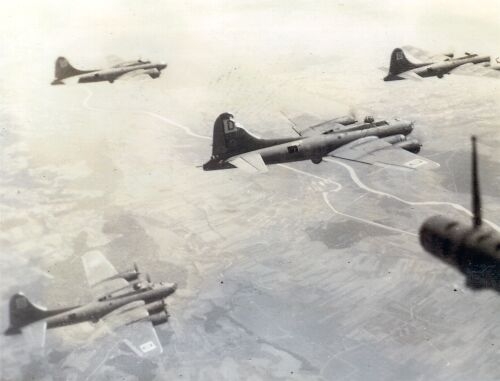
At 17000 feet altitude, the 100BG was in its position behind the 95BG. Lt Colonel Beirne Lay observed from his high squadron position, “the Group had all of its 21 B-17s tucked in tightly and was within handy supporting distance of the 95BG ahead of us at 18000 feet....Wide gaps separated the three combat wings.”
The bomber stream, late as it neared the Dutch coast and the friendly fighter rendezvous point, crossed into enemy territory without its escorts. Lay continued, “At 1017 hours, near Woensdrecht, I saw the first flak blossom out in our vicinity, light and inaccurate. At 1025 hours, two FW 190s appeared at 1 o’clock level and whizzed through the formation ahead of us in a frontal attack, nicking two B-17s of the 95BG in the wings and breaking away beneath us in half rolls...Three minutes later, the gunners reported fighters climbing up from all around the clock, singly and in pairs, both FW 190s and ME 109s…A coordinated attack followed, with the head-on fighters coming in from slightly above, the 9 and 3 o'clock attackers approaching from about level, and the rear attackers from slightly below. Every gun from every B-17 in our Group and the 95th were firing, criss-crossing our patch of sky with tracers to match the time-fuze cannon shell puffs that squirted from the wings of the Jerry single-seater…Our group leader, Major John Kidd, pulled us nearer to the 95th Group for mutual support."
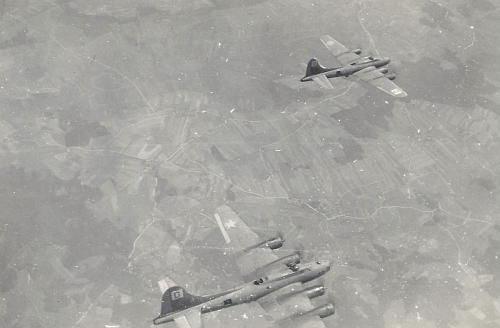
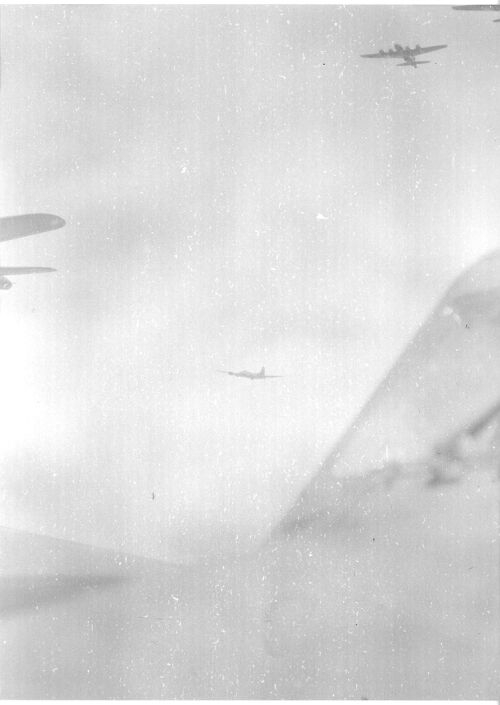
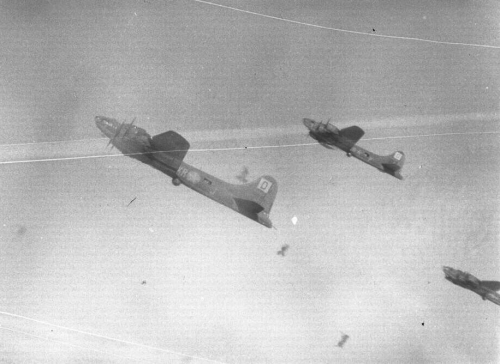
The 100th’s formation flying last would be relentlessly attacked from its entry into enemy territory through to its rendezvous point after bombing Regensburg. Official records tell us, “No less than 275 German aircraft of all descriptions making attacks from the Channel to the Alps. The severity of these attacks rose steadily from Antwerp to Frankfurt, falling off from there to the IP, with no planes seen at the target and few from there on to the Alps. In all, 24 of our aircraft fell to the Nazi fighters, the 100th Group, in low position in the last wing, taking the heaviest punishment with a loss of nine aircraft, but the crews, for their part, did good execution on the Nazi fighters, turning in the astonishing score of 165-22-44.”
What happened within the 100th Bomb Group’s formation during the relentless attacks was the worst the crews had seen to date and the lucky ones surviving would remember that mission for the rest of their lives.
Low squadron second element (Claytor, Braley, Hummel)
X - Roy Claytor’s aircraft, ‘Alice from Dallas’ was taking on damage from all sides. His copilot, twenty-five year old Ray Nutting, tells us, “Our group was flying too close to the group ahead, their empty tail cartridges broke the glass in the nose, making holes large enough to put one’s head through. Three bursts of flak hit us almost tearing off the left horizontal stabilizer. The left wing caught fire and blazed. The right wing had a hole two feet in diameter, directly behind #4 engine nacelle and caught fire. The aircraft started to dive and climb, completely out of the pilot’s control. He gave the bale-out order as an FW came in to attack.” The bombardier salvoed the bomb-load and then bailed out with the navigator, and the engineer. Claytor and Nutting, were pinned inside the spinning aircraft but eventually crawled their way to an exit. Seven chutes were observed as the aircraft spiraled down and exploded at 8000 feet.
X - During the attacks, Ronald Braley’s radio operator, James Bair, had been wounded but continued to man his gun when a 20 mm shell blew up in the radio room, killing Bair. With Braley’s number one engine and tail section on fire, Braley was forced to ring the bailout bell and slipped sideways so his crew could avoid the streamers of fire while bailing out.
X - Thomas Hummel’s aircraft was attacked from the front by a unit of ME-109s. His aircraft blew up with only three chutes seen.
Low squadron first element (Cleven/Scott, Hollenbeck, DeMarco)
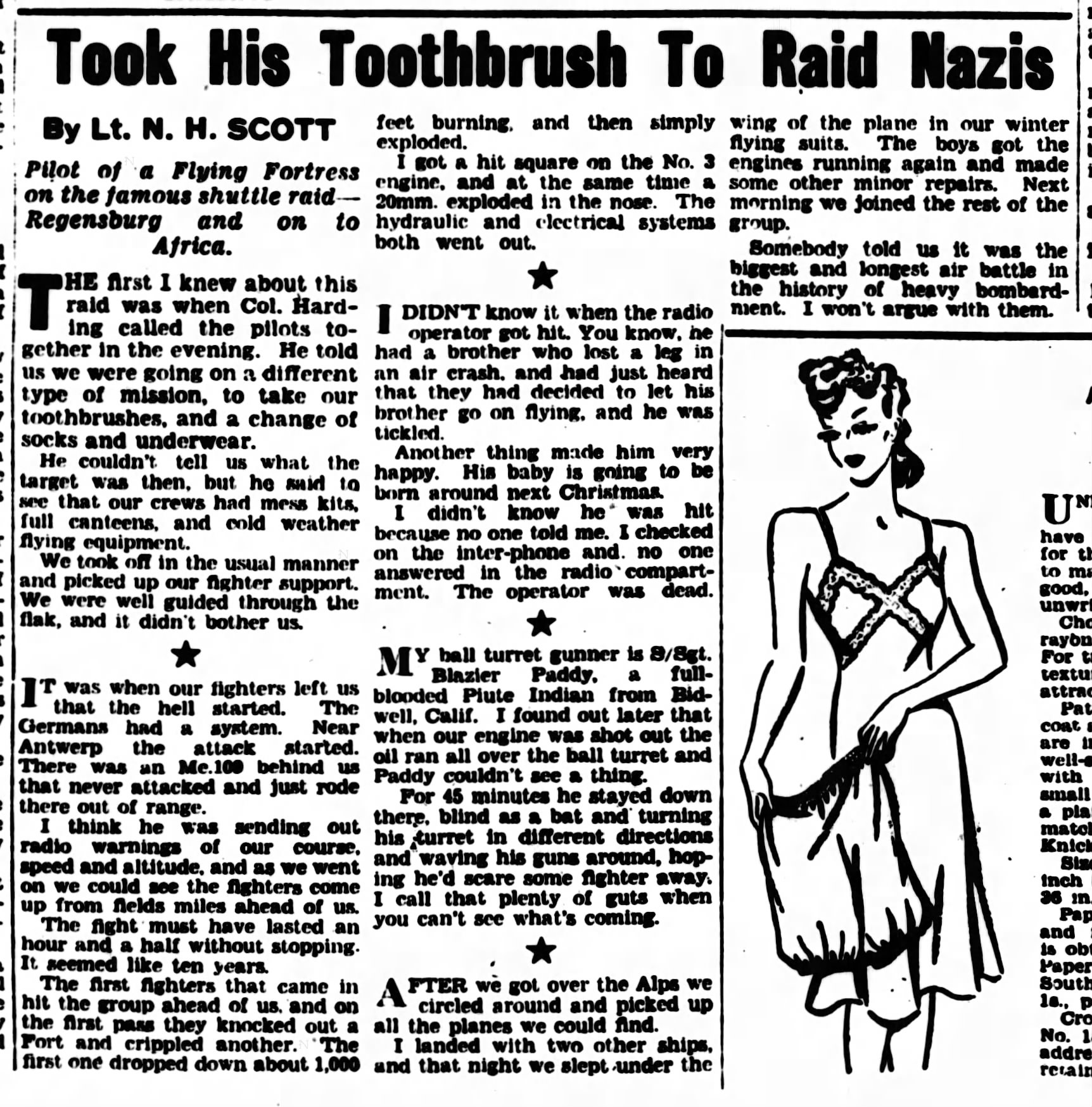
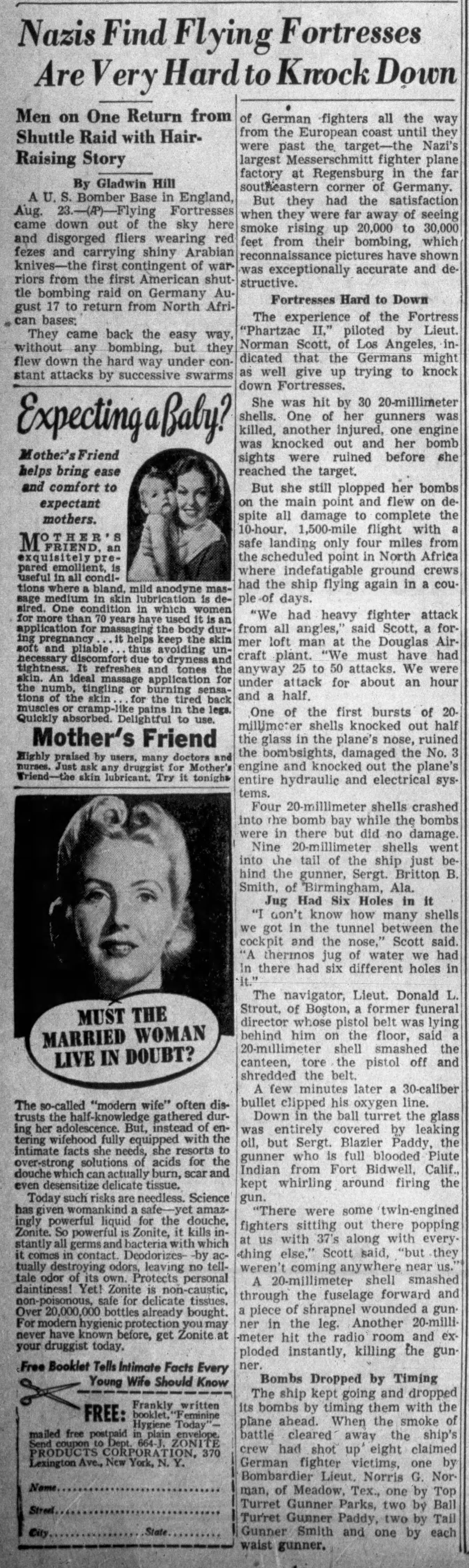
During the mayhem in the sky, twenty-four year-old Gale Cleven and his co-pilot twenty-seven year old Norman Hugh Scott’s B-17 had taken on extensive battle damage. Scott tells us, “We had heavy fighters attack from all angles. We must have had anyway 25 to 50 attacks. We were under attack for about an hour and a half…I lost about 10 pounds and I don’t mean maybe…I don’t know how many shells we got in the tunnel between the cockpit and the nose…” Their Navigator Donald Strout stated, “We must have had at least 100 attacks. Our nose was blown to pieces. Our electrical, radio and hydraulic systems were shot out and our automatic pilot was broken. We had 47 holes in the wings alone.” One of the first bursts of 20 mm shells knocked out half of the glass in the nose, ruined the bombsight, damaged the #3 engine and knocked out the plane’s entire hydraulic and electrical systems. Four 20 mm shells crashed into the bomb bay but did no damage. Nine 20 mm shells went into the tail of the ship just before the tail gunner Britton Smith. A 10 mm shell smashed through the fuselage with its shrapnel wounding a gunner. Another 20 mm shell hit the radio room and exploded, instantly killing the ROG, Norman Smith. A 20 mm shell just behind navigator Donald Strout shredded his pistol belt on the floor while a 30 caliber bullet clipped his oxygen line. When the engine was shot out, leaking oil ran all over the ball turret and BTG Blazier Paddy could not see anything. Scott says of Paddy, “For 45 minutes he stayed down there, blind as a bat and turning his turret in different directions and waving his guns around, hoping he’d scare some fighters away. I call that plenty of guts when you can’t see what’s coming.”
Ronald Hollenbeck’s aircraft had also been hit in the bomb bay. Although Hollenbeck jettisoned his bombs fifteen minutes before the target, he was able to remain with the formation.
And in ‘Our Baby’, Bernard DeMarco’s crew valiantly fought off the German fighters as their aircraft took on damage.
Lead squadron second element (Cruikshank, Knox, Biddick)
Leading the second element and assigned to the deputy lead ship position if Kidd and Blakely were lost, was twenty-six year old Charles Cruikshank, flying with Glenn Graham as his copilot. Major John Egan also flew in this aircraft. Cruikshank’s lead navigator, Frank Murphy vividly tells us, “We were firing constantly. There was never a letup. It was bedlam - a nightmare. What I remember most is the head on attacks and masses of 20 mm time fused shells from the German fighters bursting and walking through our formation. I would turn my head away, close my eyes and await death…John Egan was in the nose with Augie Gaspar and me during the heavy fighting and fired the right nose gun…”
X - ’Picklepuss,’ flown by pilots twenty-seven year old Robert Knox and twenty-five year old John Whitaker had lost an engine during the first attack and was knocked out of formation as they crossed the Moselle River. Climbing back into formation, “fighters came in again and hit a second engine.” With two engines out, Knox dropped out of formation and turned towards England. Three Me-100’s would attack the lone B-17, two from the rear. The third came from the “the front and after firing a burst from its 20 mm cannons, the bomber's right wing snapped off and both the wing and fuselage spiraled down in a dive.” Only three crew were able to bail out and the aircraft is believed to have exploded.
X - Curtis Biddick, flying in ‘Escape Kit,’ was flying as the lead pilot for William Flesh’s crew. Forty miles from the target, Biddick’s aircraft was hit in the nose and fuselage by 20 mm rounds. William Veal reported that, “the last the other fliers saw of the Fortress, a large hole had been blown in the fuselage during a heavy attack…Flames were pouring out of the hole…There seemed to be fire all over the inside of the ship - everywhere you could see in the nose, cockpit and turret there were flames.” The crew prepared to bail out. Copilot Richard Snyder was observed climbing onto the wing and buckling his chute while standing on the burning wing. “Biddick stayed in the ship, which nosed up 200 feet, exploding with metallic scraps spinning out.”
John Egan reported that when Cruikshank’s wingmen were lost, Veal and Cleven moved up to protect him.
Lead squadron first element: (Kidd/Blakely, Brady, Wolff)
Twenty-four year old Jack Kidd and Everett Blakely were leading the 100BG through the mayhem. Kidd reported, “I saw ships from other groups ahead going down. One, afire from cockpit to tail, pancaked over with fire coming out of three gas tanks. Something happened every way I turned my head…”
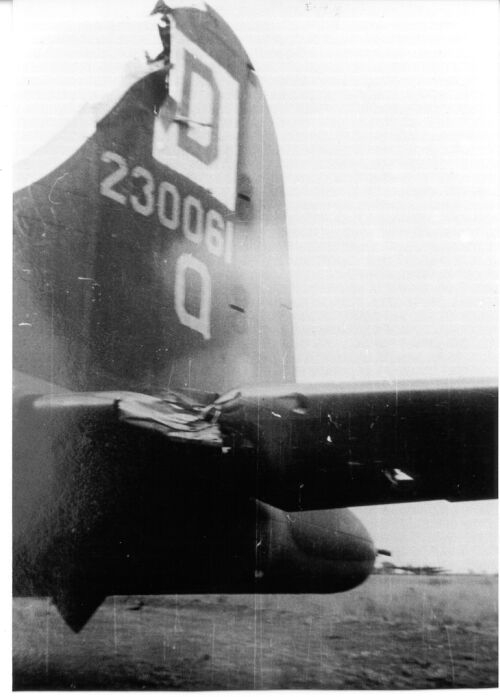
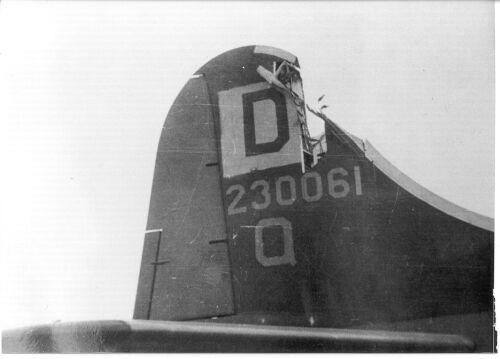
Twenty-one year old Robert Wolff described the events as flying through a “mad-made hell.” He and his copilot, twenty-two year old Charles Stuart had absorbed a 20 mm shell in their plane’s vertical stabilizer. Wolff tells us, “The rudder was vibrating so badly that it was difficult to keep my feet on the rudder pedals. Shortly after that, something, flak or machine gun fire, hit the latch on the port life raft door and out came the raft. It hit the horizontal stabilizer and started into a dive. We were able to pull out and regain formation. Fighter and flak attacks continued until we were about five minutes from the target, and when they quit, it was so quiet…”
John D. Brady and his copilot John Hoerr kept their B-17, 'M’lle Zig Zig' flying through the attacks as their gunners expended most of their ammunition.
High squadron third element: (Murphy/Lay, Fienup, Oakes)
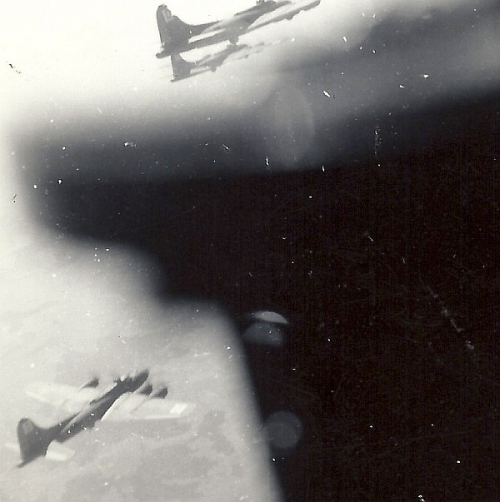
Bringing up the rear of the high squadron was Beirne Lay and Thomas Murphy in ‘Piccadilly Lily’ and a birds-eye view of below. Lay would state, "Our B-17 shook steadily with the fire of its .50’s and the air inside was heavy with smoke. It was cold in the cockpit, but when I looked across at Lt. Thomas Murphy, the pilot, and a good one, sweat was pouring off his forehead and over his oxygen mask." He turned the controls over to me for a while. It was a blessed relief to concentrate on holding station in formation instead of watching those everlasting fighters pouring in. It was possible to forget the fighters. Then the top-turret gunner’s twin muzzles would pound away a foot above my head, giving a realistic imitation of cannon-shells exploding in the cockpit, while I gave an even better imitation of a man jumping six inches out of his seat."
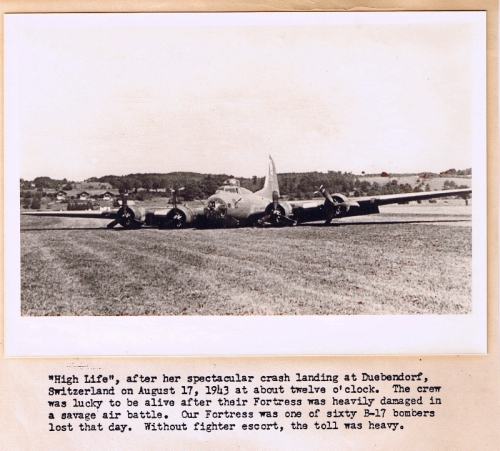
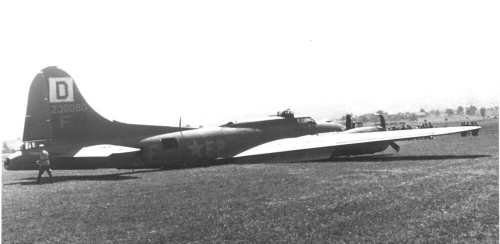
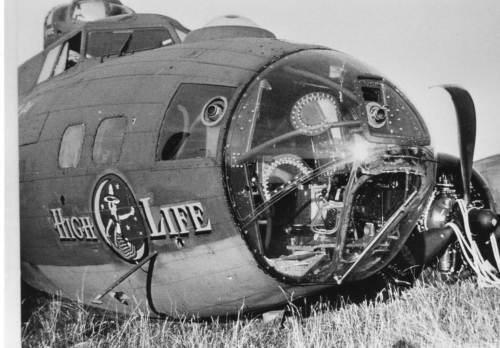
X - Dropping behind his proceeding element, Donald Oakes B-17 had taken on damage. Records tell us that, a “20 MM shell had exploded in the #3 nacelle, cutting the throttle cable and starting a heavy oil leak. Then a heavy oil leak in the #2 engine, prohibited the aircraft to keep up with the rest of the formation.” Falling out of formation, Oakes aircraft had dropped down to 10,000 feet over Lake Constance bordering Germany and Switzerland. Oakes tells us, "We continued to lose altitude as we neared the lake. Suddenly a barrage of flak appeared all around us. The bursting flak shells, plus the dreadful sound of shrapnel hitting “High Life” played a horrible tune on our eardrums. We learned later that Friedrechshafen, Germany, which we were passing over, was the location of a training station for German anti-aircraft gunners. Each battery used different colored smoke to aid in scoring. The sky was filled with bursting shells displaying every color of the rainbow, but we failed to see any beauty in this deadly display of fireworks…” Taking evasive action, Oakes made it across the lake and crash landed in Switzerland.
High squadron second element (Van Noy, Shotland, Justice)
Glen Van Noy leading his element in ‘Oh Naseau’ tells us, “I lost my number one(1) engine, either to a fighter or anti-aircraft fire. I was never able to determine which. The engine caught fire, flame and smoke belched from it. I stopped the engine and the fire burned lower and went out. I maintained our position in the group and flew on toward the target…We were under continuous fighter attack. The IP was reached and then one half minute from the target I lost my number four(4) engine…” Van Noy would stay with the formation as it went over the target.
X - Three fighters had attacked Henry Shotland's B-17 as the formation neared Nurnberg, forcing it to break away with the left wing in flames. Shotland’s CP Charles Thompsen tells us, “Shotland and I were busy fighting to recover from a peel off to the right and being knocked out of our formation position by a Me 109 cannon shell that hit this tail position. We did recover and by the use of throttles were able to keep the plane level and get back in position when we were hit again, the top turret elevating mechanism was jammed, smoke filled the cockpit and bomb bay and in # 2 engine, interphone and radios out, we tried to salvo our bombs but couldn’t open the bomb bay doors or release the bombs, it was time to get out… I gave Shotland his chute and he snapped it on and told me to inform the crew since he had no contact. I alerted Sgt Fields and we threw a hand full of shells back through the bomb bay hitting Sgt Kussmann on the leg and when he looked our way I motioned to dive, he gave me the OK sign then he calmly stowed his gun and started back, then I crawled through the tunnel to the nose section and interrupted their shooting to tell them to bail out. I well remember the jolt we took when Sgt. Fields shouted down to us that the vertical tail was shot off…"
High squadron lead element (Veal/Barr, Henington, Roane)
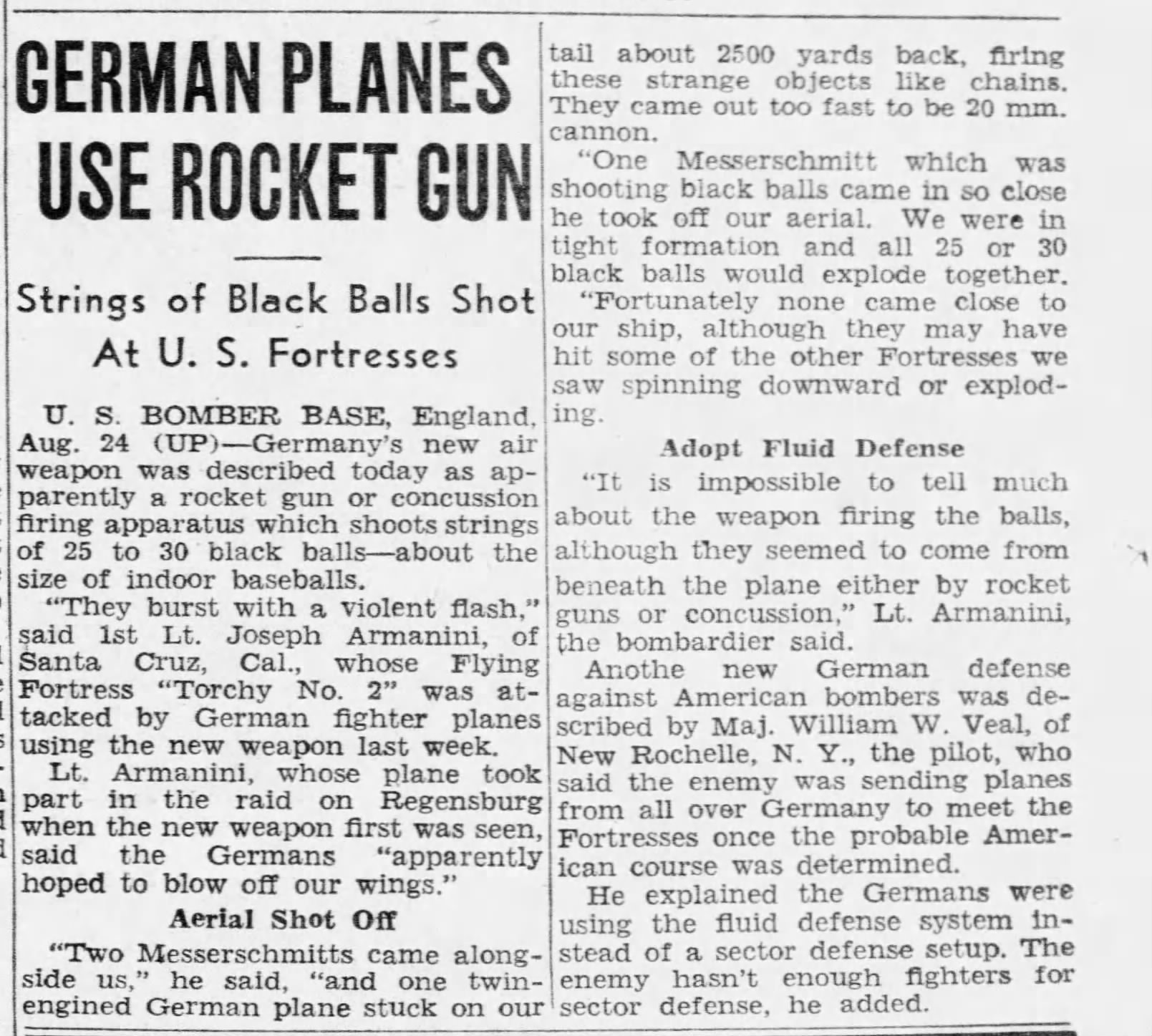
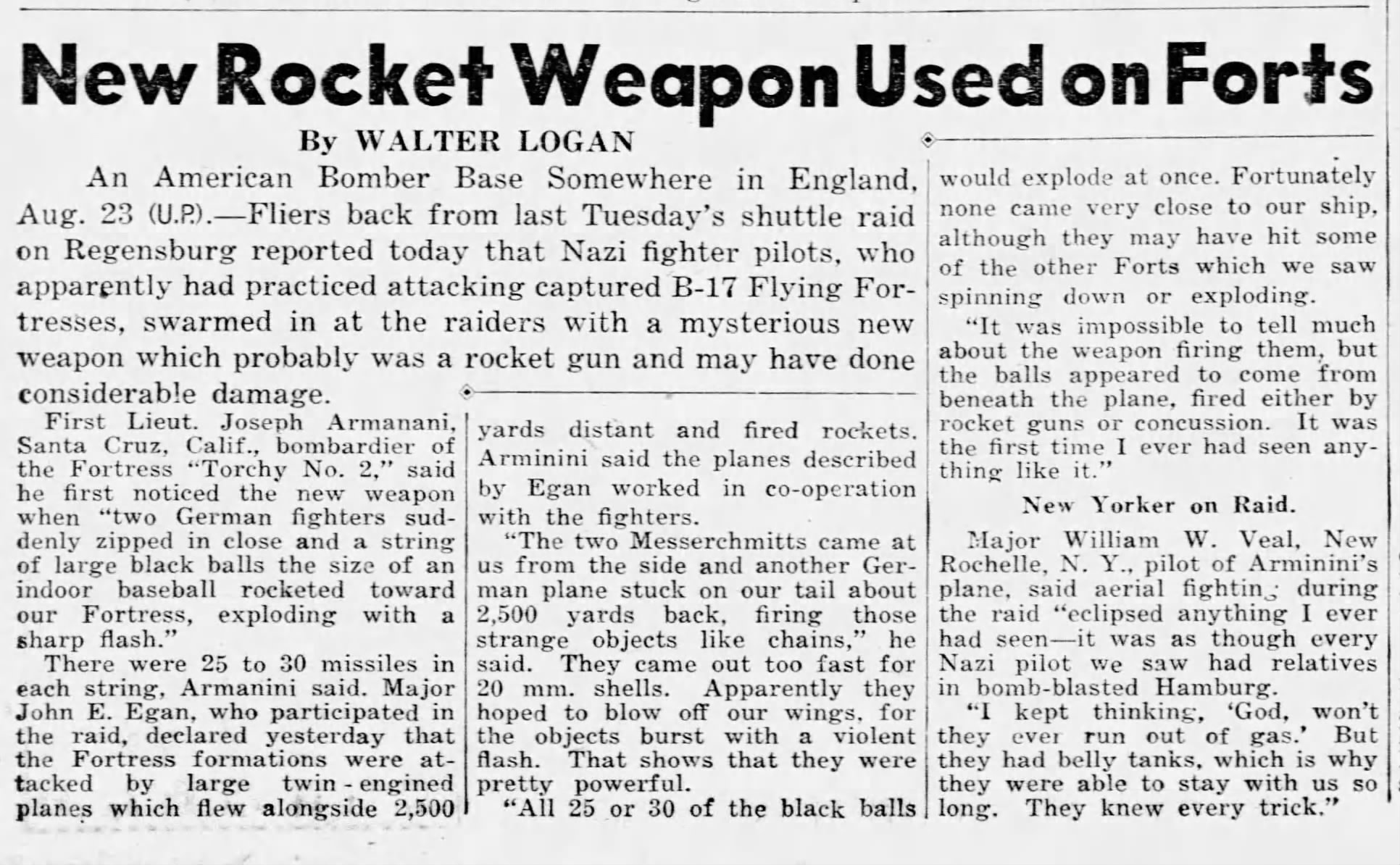
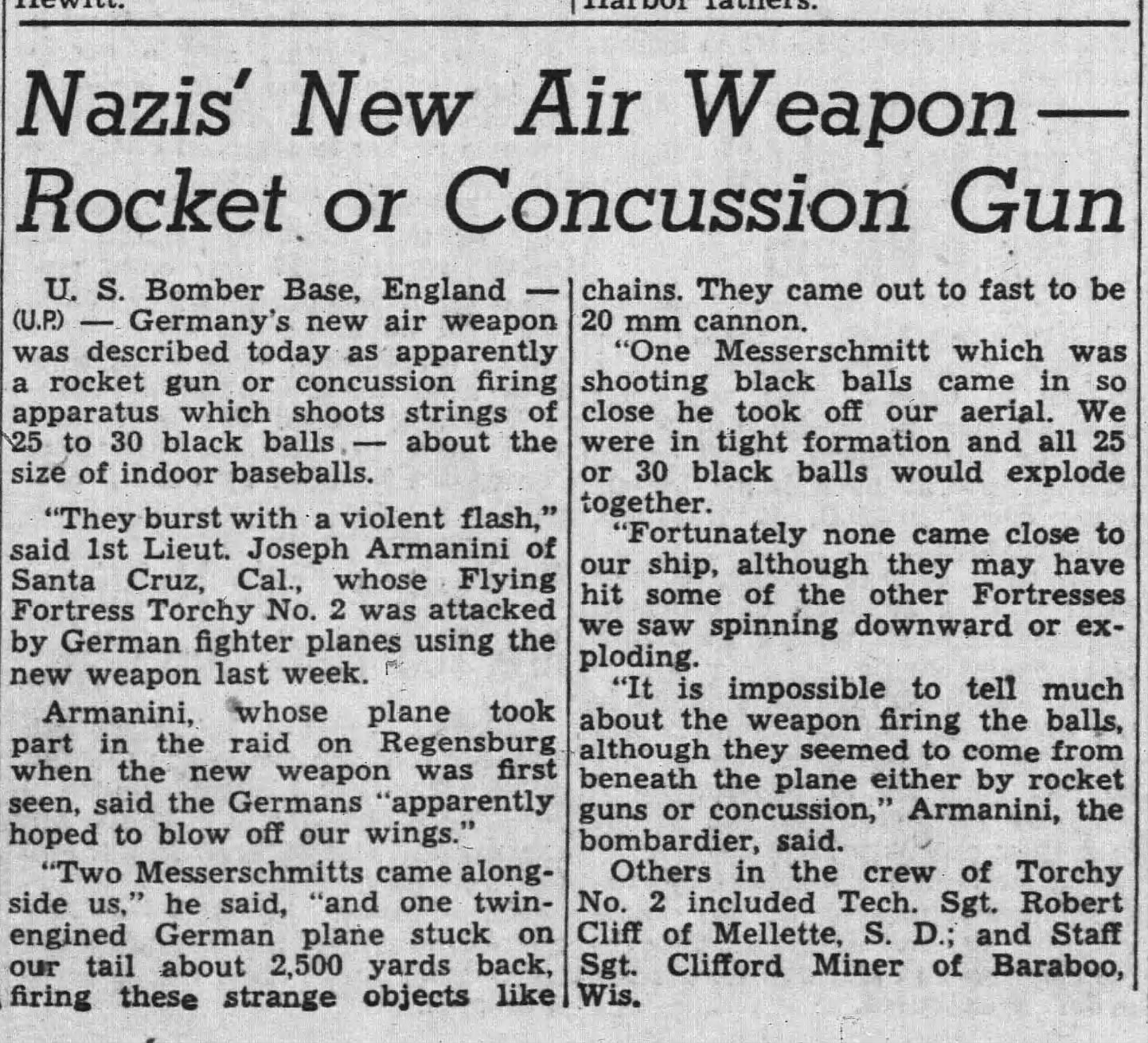
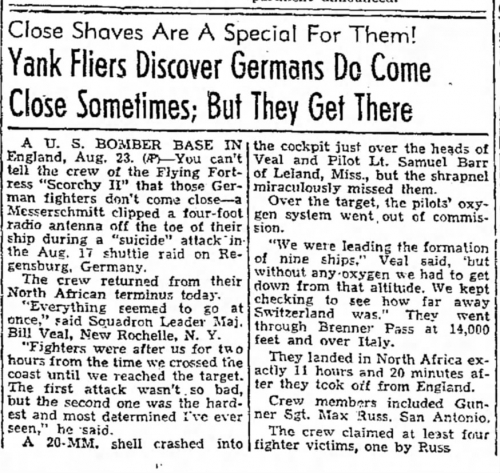
In Torchy II, Veal and Sam Barr had been alternating piloting of their aircraft. Sam Barr tells is, “Trouble started 30 miles out of Antwerp. We had two series of attacks. The first was a normal attack and about 30 or 40 fighters came in three at a time…I think the first one would have rammed us head on if we didn’t dive…” A fighter had come so close that it clipped the four foot antennae on top of the plane. Barr continued, “They were plenty unpleasant about the second attack. They came in at about 13 or 14 at a time.” According to Bombardier Joe Armanini, the Germans were using a new air weapon with which the Germans “apparently hoped to blow off our wings.” Armanini tells us, “Two Messerschmitts came along side us and one twin-engined Germany plane stuck on our tail about 2500 yards back, firing these strange objects like chains. They came out too fast to be 20 mm cannon. One Messerschmitt which was shooting black balls came in so close he took off our aerial. We were in tight formation and all 25 or 30 black balls would explode together. Fortunately none came close to our ship, although they may have hit some of the other Fortresses we saw spinning downward or exploding." Just before turning onto the bomb run, ’Torchy II’ was hit by a cannon shell, setting its #3 engine on fire. All of the instruments on right hand side of panel were out. Feathering the engine, Veal was able to regain his position in the formation and bombed the target.
And twenty-three year old Henry Henington piloting ‘Horny’ was surrounded by seven enemy fighters; three converging on the left and seven to the right. With his gunners fighting them off, ‘Horny’ had one engine out and was badly shot up before reaching the target,
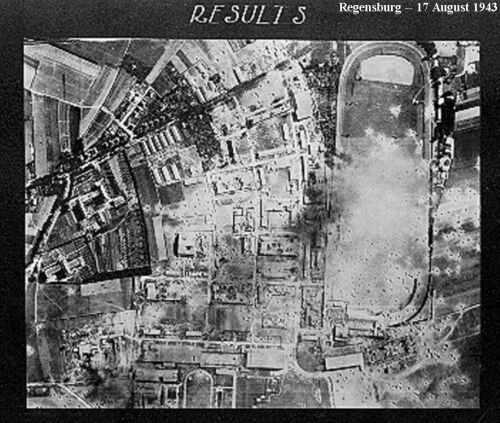
As smoke from the previous group’s bombs obscured the target, the 401st combat wing made its approach by taking a very large 360 degree turn to the left, putting the 402nd combat wing and the 100th Bomb Group as the second wing over the target. The 100BG’s formation, now containing only fourteen of its twenty-one bombers that started out that morning, made its run over the Regensburg target at 1145 hours at 17000 feet. “Over the target the planes, as anticipated, were bothered by neither enemy aircraft nor AA fire, and the bombing was truly outstanding…”
Those making it over the target: Cleven/Scott, Hollenbeck, DeMarco, Cruikshank, Kidd/Blakely, Brady, Wolff, Murphy/Lay, Fienup, Van Noy, Justice, Veal/Barr, Henington and Roane.
TARGET TO THE ALPS
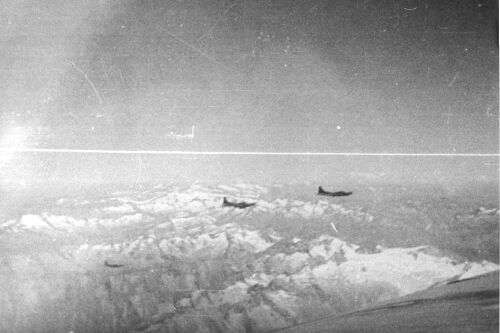
In order to conserve fuel the two combat wings that bombed first immediately proceeded southward after their rally and circled to pick up the 401st Combat Wing at the southern rally point. From the target to the Alps, the fighter attacks were resumed with “moderate intensity.” Bob Wolff tells us, “The target…was successfully plastered and our group, following the other groups, made a right turn and headed for the Alps. Because so many of the planes were shot up, the formation leader, Col. Curtis LeMay circled the formation over Lake Como in Switzerland, to let the stragglers catch up.”
X - According to Bill Rouse, WG in Hollenbeck’s B-17, Hollenbeck was able to stay with the formation until Lake Como where the group started to circle to enable any stragglers to join up. Falling behind with a feathered engine, Hollenbeck tried to make it to Switzerland but was forced to bail out at 3500 feet over Milano with all crew making it out.
X - Glen Van Noy’s #2 engine was feathered and his aircraft pulled away from the formation when it reached the Alps near Munich He was seen disappearing around the side of a mountain and was flying at about 10,000 feet when last seen, being pursued by a JU 88. No chutes were seen. Van Noy tells us, “My left wing man stayed with me until I waved him on two or three times. Finally he saluted and went on up to join the group. That was the last I saw of the 100th Bomb Group…We were the center of attraction for German fighters for the next twenty-five or thirty minutes. Me 109s, Fw 190s and a couple of Me 100s made things pretty hot for us, but violent evasive action and good shooting on the part of my crew kept us from being shot up too much. We were near the Brenner Pass, I had two good engines, no wounded men aboard, enough gas, and the plane was flyable, so since Sicily was the closest allied help territory, I tried to make it there…We flew up the Brenner Pass, dodging fairly heavy anti-aircraft fire by hugging the sides of the mountains and using evasive action. We threw everything overboard we could get loose to lighten the plane…It looked like we couldn’t make it so out went everything else including our parachutes…I had everyone prepare for ditching. We flew between a bunch of German battleships in Genoa Bay, but they didn’t have time to fire. By now everything was overboard except one gun in the top turret and one hundred rounds of ammunition. Everyone was in ditching position except my engineer who stood at my elbow. We discouraged an attack by two fighters and a seaplane by firing a few rounds at the someplace between Genoa and Rome. We reached Rome and tuned south to Sicily. By then our airspeed was way down and we were skimming the water…” South of Rome, Van Noy ditched his aircraft in the Mediterranean with the heavy bomber staying afloat for one hour and 37 minutes.
ALPS TO AFRICA
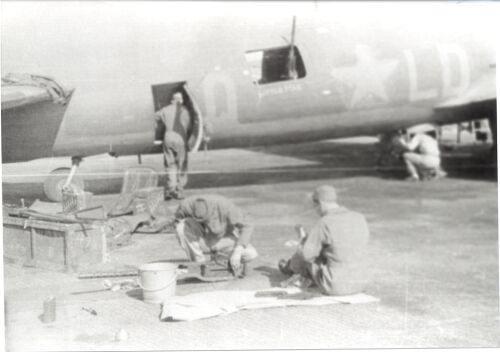
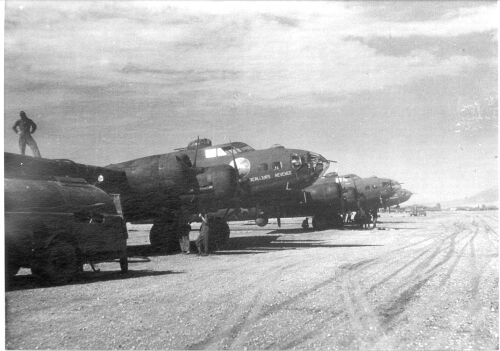
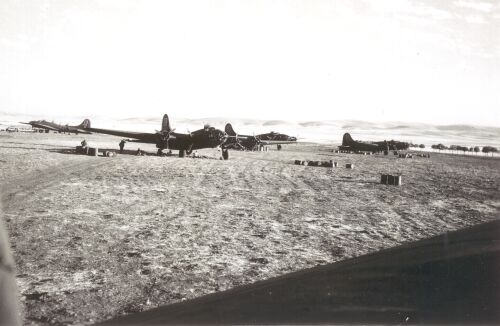
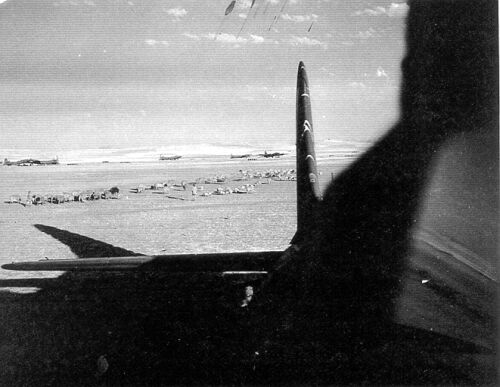
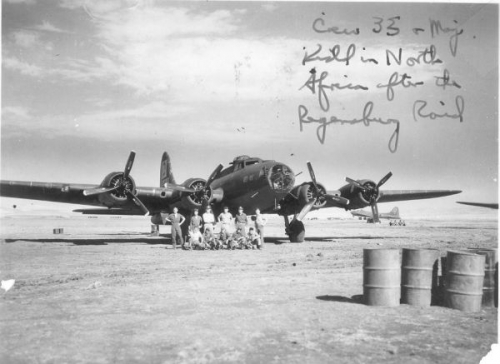
Official records tell us of LeMay’s remaining aircraft. “After leaving the coast of Italy, the formation was not good because of a shortage of fuel. However, all ships were sufficiently stacked in altitude to enable them to dive into defensive position in case of attack. The coast of Africa was reached about 16 miles east of the intended landfall, with four AC making emergency landings here out of gasoline. Forty-four ships landed at Bone short of fuel. At least four ships ditched off the African coast and their crews were picked up. The remainder of the AC landed at Telergma and Berteaux as briefed.” Forty-four aircraft of the Division’s heavy bombers would successfully make it to Africa, eventually landing at Bone, Algeria with the remainder letting down at Telergma (Telerghma), Algeria and Berteaux, Algeria, 9 km east of Berteaux without mishap, despite thunderstorms, heavy dust, and exhaustion from flight…
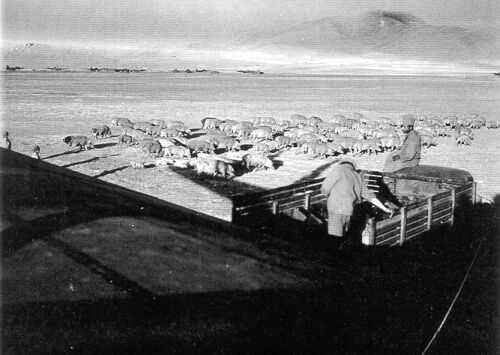
For the 100th Bomb Group, out of the 21 heavy bomber formation that departed Thorpe Abbotts that morning, it "had eight flyable planes on reaching Africa - six operational and two flyable." Landing safely in Thomas Murphy’s ‘Picadilly Lilly’ Bernie Lay tells us “At 1815 hours, with red lights showing on all our fuel tanks in my ship, the seven B-17s of the group who were still in formation circled over Bertoux (Berteaux) and landed in the dust. Our crew was unscratched. Sole damage to the airplane: a bit of ventilation around the tail from flak and 20 MM shells. We slept on the hard ground under the wings of out B-17, but the good earth felt softer than a silk pillow…” And Major Egan was quoted as saying, "You should have seen us when we hit Africa. If that had been American earth we would have kissed it. We leaped out of our ships laughing, slapping each other on the back. We were lucky to be alive and we knew it. Over that target, we were running out of ammunition, oxygen, gas and brains, with the crippled ships also running out of altitude. Everybody was frantically shoveling out masks, kits, shells, flying suits, anything to lighten the ships.”
The lead squadron’s Bob Wolff had landed in Bone, Tunisia. Wolff tells us, “As we flew over the Alps, Italy and Sicily, things were relatively calm. Except for the vibration in the tail, it could have been another training mission. Over the Mediterranean, the red lights began to blink on our fuel gauges. The extra drag caused by the tail damage was using too much of our fuel. Our plane was so badly damaged we could not make the designated field and we had to land at an emergency field at a place called Bone, on the North African coast in Tunisia. The field was made of metal mats laid on the desert sand, and as we made out approach, the tower advised that another plane had cracked up on landing and to 'please go around'. With the damage to our tail, the plane would not respond, so with all the fuel lights blinking, we landed anyway and avoided the damaged aircraft. We taxied off to one side and the engines stopped. I don't remember kissing the ground, but they tell me my face was sure dirty…”
Safely landed, Colonel Curtis Lemay would send a telegram back to England, “Mission flown as planned. Fighter support poor. Wing under constant attack from Antwerp to thirty minutes after leaving target. Objective believed to be totally destroyed. Detailed report impossible at this time. Airplanes have landed at a number of fields other than those scheduled due to battle damage and gas shortage."
Bombing Results
Bombing Results: EXCELLENT
Aircraft Lost: 9
Crew Lost: 90
Claims of Enemy Losses (CLS): 49
Aircraft Returned:
Missing Air Crew Report(s)
Media Articles
Use your thumb to scroll through the results box below.
| Media Item | Type | Page | Volume/Issue | Broadcast Source | Time | Description | File |
|---|---|---|---|---|---|---|---|
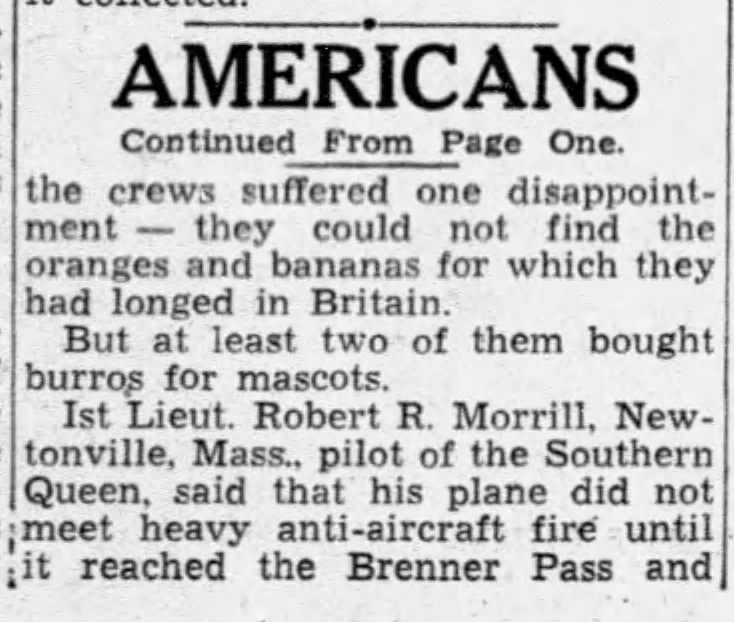
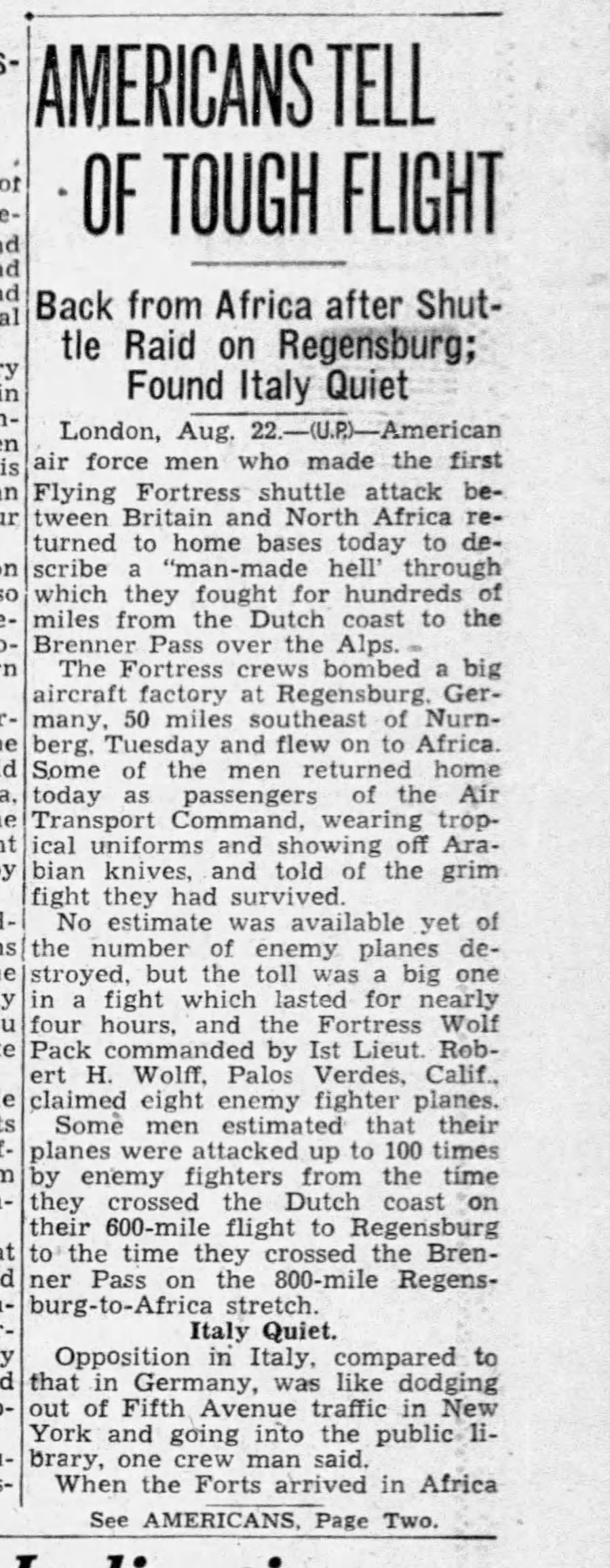
| Curtis LeMay plans Regensburg | The Asheville Times October 23 1943 | 12:00 am | |||||
| Norman Scott writes article on Regensburg mission | Daily Herald August 24 1943 | 12:00 am | |||||
| Norman Scott, Donald Strout, Blazier Paddy, Regensburg mission | The Virginian Pilot September 5 1943 | 12:00 am | |||||
| Norman Scott quote about Hollenbeck on Regensburg mission | Winston Salem Journal August 23 1943 | 12:00 am | |||||
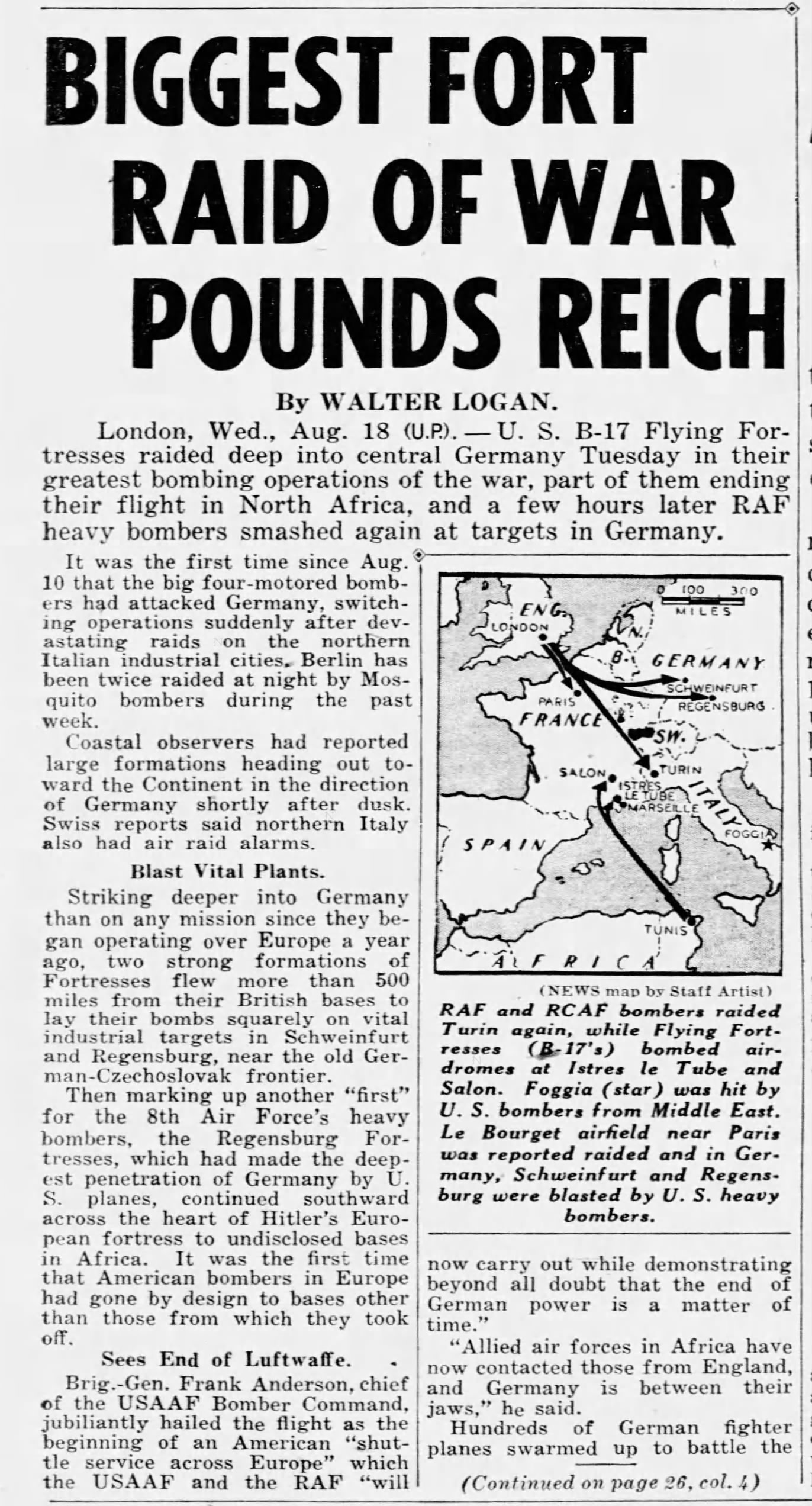
| Walter Logan reports on Regensburg part 1 | Daily News August 18 1943 | 12:00 am | |||||
| Walter Logan reports on Regensburg part 2 | Daily News August 18 1943 | 12:00 am | |||||
| Doris Fleeson article on 100th’s Regensburg raid | The Lamar Democrat November 24 1943 | 12:00 am | |||||
| Leon Castro, DeMarco crew quotes on Regensburg mission | Arizona Daily Star Nov 10 1943 | 12:00 am | |||||
| Donald Strout Phartzac II | The Boston Globe Aug 23 1943 | 12:00 am | |||||
| Joseph Armanini quotes on Regensburg mission | The Pittsburgh Press Aug 24 1943 | 12:00 am | |||||
| Joseph Armanini, William Veal Regensburg quotes | Daily News Aug 24 1943 | 12:00 am | |||||
| Joseph Armnini, Torchy 2, new air weapon | Kenosha News Aug 24 1943 | 12:00 am | |||||
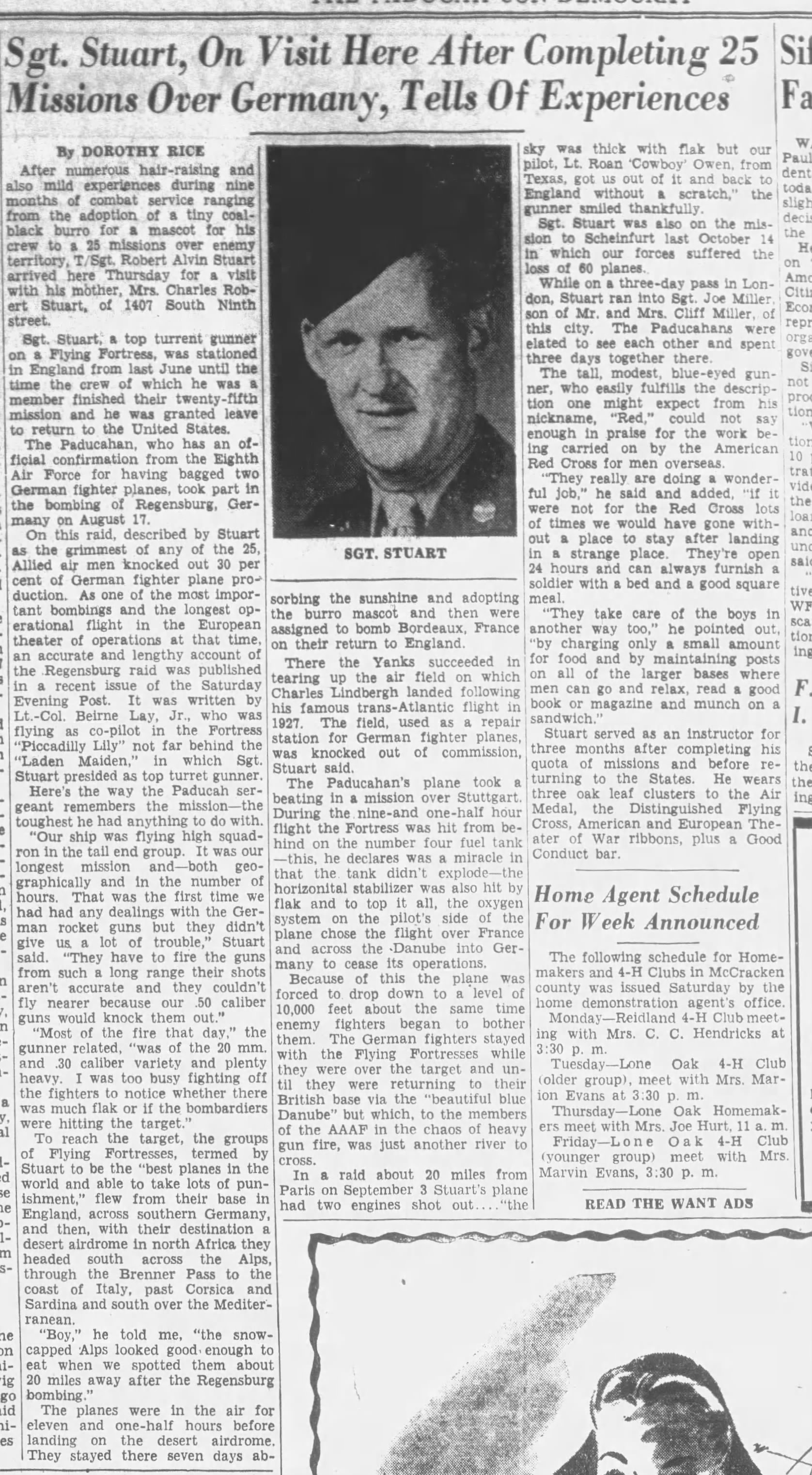
| Robert A. Stuart tells of Regensburg, Stuttgart and Paris | The Paducah Sun Democrat March 5 1944 | 12:00 am | |||||
| Regensburg shuttle raid part 2 | The News and Observer Aug 23 1943 | 12:00 am | |||||
| Regensburg shuttle raid part 3 | The News and Observer Aug 23 1943 | 12:00 am | |||||
| Regensburg shuttle raids part 1 | The News and Observer Aug 23 1943 | 12:00 am |





Notes
Mission Stories
HEADQUARTERS
100th BOMBARDMENT GROUP (H)
APO 634
US Army Station 139
25 August, 1943
SUBJECT: Personal report on the REGENSBURG mission, 17 August, 1943.
TO: Commanding Officers, 100th Bombardment Group (H)
1. This report does not attempt to render a complete summary of the mission. It is merely an eyewitness account of what was seen by the undersigned, together with certain recommendations pertinent thereto, during an ordeal in which the 100th Group fought its way to the target through fierce and prolonged enemy fighter attacks and accurately bombed a vital target.
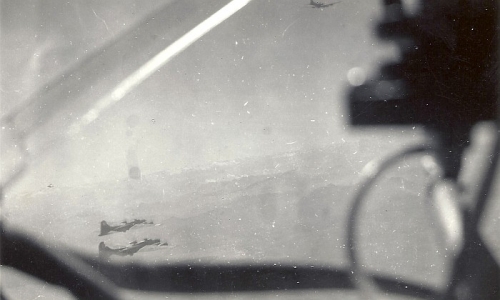
2. When the 100th Group crossed the coast of Holland south of The Hague at 1008 hours at our base altitude of 17,000 feet, I was well situated to watch the proceedings, being copilot in the lead ship of the last element of the high squadron. The Group had all of its 21 B-17F’s tucked in tightly and was within handy supporting distance of the 95th Group, ahead of us at 18,000 feet. We were the last and lowest of the seven groups of the 4th Air Division that were visible ahead on a south-east course, forming a long, loose-linked chain in the bright sunlight — too long, it seemed. Wide gaps separated the three combat wings. As I sat there in the tail-end element of that many miles long procession, gauging the distance to the lead group, I had the lonesome foreboding that might come to the last man about to run a gauntlet lined with spiked clubs. The premonition was well founded.
At 1017 hours, near Woensdrecht, I saw the first flak blossom out in our vicinity, light and inaccurate. A few minutes later, approximately 1025 hours.
two FW-190’s appeared at 1 o’clock level and whizzed through the formation ahead of us in a frontal attack, nicking two B-17’s of the 95th Group in the wings and breaking away beneath us in half-rolls. Smoke immediately trailed from both B-17’s, but they held their stations. As the fighters passed us at a high rate of closure, the guns of our group went into action. The pungent smell of burnt power filled our cockpit, and the B-17 trembled to the recoil of nose and ball-turret guns. I saw pieces fly off the wing and one of the fighters before they passed from view.
Here was early action. The members of the crew sensed trouble. There was something desperate about the way those two fighters came in fast right out of their climb without any preliminaries. For a few seconds the inter-phone was busy with admonitions: “Lead ‘em more” ... “short bursts” ... “don’t throw rounds away” ... “there’ll be more along in a minute”.
Three minutes later, the gunners reported fighters climbing up from all around the clock, singly and in pairs, both FW-190’s and Me-109G’s. This was only my fourth raid, but from what I could see on my side, it looked like too many fighters for sound health. A coordinated attack followed, with the head-on fighters coming in from slightly above, the 9 and 3 o’clock attackers approaching from about level, and the rear attackers from slightly below. Every gun from every B-17 in our group and the 95th was firing, criss-crossing our patch of sky with tracers to match the time-fuse cannon shell puffs that squirted from the wings of the Jerry single-seaters. I would estimate that 75% of our fire was inaccurate, falling astern of the target - particularly the fire from hand-held guns. Nevertheless, both sides got hurt in this clash, with two B-17’s from our low squadron and one from the 95th Group falling out of formation on fire with crews bailing out, several fighters heading for the deck in flames or with their pilots lingering behind under dirty yellow parachutes. Our group leader. Major John Kidd, pulled us up nearer to the 95th Group for mutual support.
I knew that we were already in a lively fight. What I didn’t know was that the real fight, the Anschluss of Luftwaffe 20 mm cannon shells, hadn’t really begun. A few minutes later we absorbed the first wave of a hailstorm of individual fighter attacks that were to engulf us clear to the target. The ensuing action was so rapid and varied that I cannot give a chronological account of it. Instead, I will attempt a fragmentary report of salient details that even now give me a dry mouth and an unpleasant sensation in the stomach to recall. The sight was fantastic and surpassed fiction.
It was 1041 hours, over Eupen, that I looked out of my copilot’s window after a short lull and saw two whole squadrons, 12 Me-109’s and 11 FW-190’s, climbing parallel to us. The first squadron had reached our level and was pulling ahead to turn into us and the second was not far behind. Several thousand feet below us were many more fighters, with their noses cocked at maximum climb. Over the inter-phone came reports of an equal number of enemy aircraft deploying on the other side. For the first time, I noticed an Me-110 sitting out of range on our right. He was to stay with us all the way to the target, apparently reporting our position to fresh squadrons waiting for us down the road. At the sight of all these fighters, I had the distinct feeling of being trapped — that the Hun was tipped off, or at least had guessed our destination and was waiting for us. No P-47’s were visible. The life expectancy of the 100th Group suddenly seemed very short, since it had already appeared that the fighters were passing up the preceding groups, with the exception of the 95th, in order to take a cut at us.
Swinging their yellow noses in a wide U-tum, the 12-ship squadron of Me-109s came in from 12 to 2 o’clock in pairs and in fours and the main event was on.
A shining silver object sailed past over our right wing. I recognized it as a main exit door. Seconds later, a dark object came hurtling through the formation, barely missing several props. It was a man, clasping his knees to his head, revolving like a diver in a triple somersault. I didn’t see his ‘chute open.
A B-17 turned gradually out of the formation to the right, maintaining altitude. In a split second, the B-17 completely disappeared in a brilliant explosion, from which the only remains were four small balls of fire, the fuel tanks, which were quickly consumed as they fell earthward.
Our airplane was endangered by various debris. Emergency hatches, exit doors, prematurely opened parachutes, bodies, and assorted fragments of B-17’s and Hun fighters breezed past us in the slip-stream.
I watched two fighters explode not far beneath, disappearing in sheets of orange flame, B-17’s dropping out in every stage of distress, from engines on fire to control surfaces shot away, friendly and enemy parachutes floating down, and, on the green carpet far behind us, numerous funeral pyres of smoke from fallen fighters, marking their trail.
On we flew through the strewn wake of a desperate air battle, where disintegrating aircraft were commonplace and 60 ‘chutes in the air at one time were hardly worth a second look.
I watched a B-17 turn slowly out of the right with its cockpit a mass of flame. The copilot crawled out of his window, held on with one hand, reached back for his ‘chute, buckled it on, let go and was whisked back into the horizontal stabilizer. I believe the impact killed him. His ‘chute didn’t open.”
Ten minutes, twenty minutes, thirty minutes, and still no let-up in the attack. The fighters queued up like a breadline and let us have it. Each second of time had a cannon shell in it. The strain of being a clay duck in the wrong end of that aerial shooting gallery became almost intolerable as the minutes accumulated towards the first hour.
Our B-17 shook steadily with the fire of its .50’s and the air inside was heavy with smoke. It was cold in the cockpit, but when I looked across at Lt. Thomas Murphy, the pilot, and a good one, sweat was pouring off his forehead and over his oxygen mask." He turned the controls over to me for a while. It was a blessed relief to concentrate on holding station in formation instead of watching those everlasting fighters pouring in. It was possible to forget the fighters. Then the top-turret gunner’s twin muzzles would pound away a foot above my head, giving a realistic imitation of cannon-shells exploding in the cockpit, while I gave an even better imitation of a man jumping six inches out of his seat.
A B-17 of the 95th Group, with its right Tokyo tanks on fire, dropped back about 200 feet above our right wing and stayed there while 7 of the crew successfully bailed out. Four went out the bomb-bay and executed delayed jumps, one bailed from the nose, opened his chute prematurely and nearly fouled the tail. Another went out the left waist-gun opening, delaying his ‘chute opening for a safe interval. The tail gunner dropped out of his hatch, apparently pulling the ripcord before he was clear of the ship. His ‘chute opened instantaneously, barely missing the tail, and jerked him so hard that both his shoes came off He hung limp in the harness, whereas the others had showed immediate signs of life after their ‘chutes opened, shifting around in the harness. The B-17 then dropped back in a medium spiral and I did not see the pilots leave. I saw it just before it passed from view, several thousand feet below us, with its right wing a solid sheet of yellow flame.
After we had been under constant attack for a solid hour, it appeared certain that the 100th Bomb Group was faced with annihilation. Seven of our group had been shot down, the sky was still mottled with rising fighters and it was only 1120 hours, with target-time still 35 minutes away. I doubt if a man in the group visualized the possibility of our getting much further without 100% loss. I know that I had long since mentally accepted the fact of death, and that it was simply a question of the next second or the next minute. I learned firsthand that a man can resign himself to certainty of death without becoming panicky. Our group fire power was reduced 33%, ammunition was running low. Our tail-guns had to be replenished from another gun station. Gunners were becoming exhausted and nerve-tortured from the prolonged strain, and there was an awareness on everybody’s part that something must have gone wrong. We had been the aiming point for what seemed like most of the Luftwaffe and we fully expected to find the rest of it primed for us at the target.
Fighter tactics were running true to form. Frontal attacks hit the low squadron and lead squadron, while rear attackers went for the high. The maimer of their attacks showed that some pilots were old-timers, some amateurs, and that all knew pretty definitely where we were going and were inspired with a fanatical determination to stop us before we got there. The old-timers came in on frontal attacks with a noticeably slower rate of closure, apparently throttled back, obtaining greater accuracy than those that bolted through us wide out. They did some nice shooting at ranges of 500 or more yards, and in many cases seemed able to time their thrusts so as to catch the top and ball turret gunners engaged with rear and side attacks. Less experienced pilots were pressing attacks home to 250 yards and less to get hits, offering point-blank targets on the breakaway, firing long bursts of 20 seconds, and, in some cases, actually pulling up instead of going down and out. Several FW pilots pulled off some first rate deflection shooting on side attacks against the high group, then raked the low group on the break-away out of a side-slip, keeping the nose cocked up in the turn to prolong the period the formation was in their sights.
I observed what I believe was an attempt at air-to-air bombing, although I didn’t see the bombs dropped. A patch of 75 to 100 grey-white bursts, smaller than flak bursts, appeared simultaneously at our level, off to one side.
One B-17 dropped out on fire and put its wheels down while the crew bailed out. Three ME-109’s circled it closely, but held their fire, apparently ensuring that no one stayed in the ship to try for home. I saw Hun fighters hold their fire even when being shot at by a B-17 from which the crew were bailing out.
Near the IP at 1150 hours, one hour and a half after the first of at least 200 individual fighter attacks, the pressure eased off, although hostiles were still in the vicinity. We turned at the IP at 1154 hours with 14 B-17’s left in the group, two of which were badly crippled. They dropped out soon after bombing the target and headed for Switzerland, one of them “042”, carrying Col. William Kennedy as tail-gunner. No. 4 engine was on fire, but not out of control. Major William Veal, leader of the high squadron, received a cannon shell in his #3 engine just before the start of the bombing run and went in to the target with the prop feathered.
Weather over the target, as on the entire trip, was ideal. Flak was negligible. The group got its bombs away promptly on the leader. As we turned and headed for the Alps, I got a grim satisfaction out of seeing a rectangular column of smoke rising straight up from the ME 109 shops, with only one burst in the town of Regensburg.
The rest of the trip was a marked anti-climax. A few more fighters pecked at us on the way to the Alps. A town in the Brenner Pass tossed up a lone burst of futile flak. Colonel LeMay, who had taken excellent care of us all the way, circled the air division over Lake Garda long enough to give the cripples a chance to join the family, and we were on our way toward the Mediterranean in a gradual descent. About 25 fighters on the ground at Verona stayed on the ground. The prospect of ditching as we approached Bone, short of fuel and the sight of other B-17’s falling into the drink, seemed trivial matters after the vicious nightmare of the long trip across southern Germany. We felt the reaction of men who had not expected to see another sunset.
At 1815 hours, with red lights showing on all our fuel tanks in my ship, the seven B-17’s out of the group who were still in formation circled over Bertoux and landed in the dust. Our crew was unscratched. Sole damage to the airplane; a bit of ventilation around the tail from flak and 20 mm shells. We slept on the hard ground under the wings of our B-17, but the good earth felt softer than a silk pillow.
3. Recommendations:
a. That combat wings always comprise three groups, spaced close enough together for mutual support, on deep penetrations and that the interval between combat wings be as close as is flyable in order to cut down the over-all distance from the head to the tail of the column. This should result in a more even distribution of fighter attacks with lower average loss per group. Enemy staffeln near their fuel limits did not try to catch preceding groups but concentrated on the tail of the long column we presented on the Regensburg mission.
b. That fighter escorts give particular attention to protection of rear groups on deep penetrations. I would judge that 17,000 feet, our base altitude, was too low — an awkward altitude for P-47’s — even if fighter escort had covered, which it didn’t.
c. That emphasis on deflection shooting on the part of our gunners be continued and intensified. A B-17 group can put out tremendous fire power, and the 100th Group did some accurate shooting, but too many of the gunners were firing on targets that had just left.
d. That groups expecting to operate on the return trip from North Africa airdromes carry with them engine, gun and radio compartment covers for protection against dust and mud.
e. That continued thought be given to further protective measures in the formation for the low squadron, which in our group, at least, was the A.P. [aiming point] for frontal attacks.
f. That better exchange of information be provided between air divisions. Even several days after a mission, groups in the 4th Air Division have little knowledge of what happened to the 1st Air Division, except through hearsay.
g. That 30 combat missions be reduced to 25 for crews that have engaged in deep penetrations. It takes a rugged constitution to stand up to missions like Regensburg and even the toughest crew members were badly shaken by nearly two hours under persistent attack. The less phlegmatic were already potential candidates for the rest home when we landed in Africa. My four previous missions, in one of which our bombardier was killed, were pieces of cake in comparison to the 11 hour Regensburg show, and I doubt if 20 such normal missions would take the same amount out of a man as one [unreadable] to Regensburg.
4. Awards: The following suggested awards are recommended to the attention of the Group Commander.
a. Distinguished Flying Cross: To every crew member of the 100th Group who participated in the Regensburg mission, for courage and achievement in enabling the group to reach and successfully bomb a vital target against odds that easily could have resulted in 100% loss had it not been for the outstanding air discipline of the group as a whole. A tight formation was held, in spite of reshuffling of the group from consecutive losses, and cool judgment and self- control were exercised by individual crews under prolonged strain.
b. Distinguished Service Cross:
Major John Kidd, group leader, for heroism and skill in his leadership of the group to target and final destination. This 24-year-old officer carried out superbly an assignment above and beyond the call of duty for an officer of his age and experience. He had had only three previous combat missions.
Major William Veal, leader of the high squadron, for heroic and skillful [sic] leadership of his squadron.Just before turning in to the bombing run, a cannon shell hit his #3 engine, setting it on fire, and oxygen failure occurred. Instead of turning toward the safety of the Swiss border, approximately 65 miles distant. Major Veal feathered his #3 prop, a sure tip-off to the fighters in the vicinity, in order to regain position in the formation, he successfully bombed the target, extinguished the engine fire, crossing the Alps and several miles of Mediterranean reached base in North Africa, all on three engines.
c. Lt. Robert Wolff, a wing man in the lead squadron.The under-signed did not have an opportunity to interview Lt. Wolff or his crew, but observed his ship hobbling along with the formation all the way to North Africa in spite of what looked like the worst battle damage of any airplane in the group. Appropriate investigation and award is recommended.
d CONGRESSIONAL MEDAL HONOR:
Major Gale W. Cleven, leader of the low squadron. Throughout approximately two hours of constant fighter attack, Major Cleven’s squadron was the principal focal point of the enemy’s fire. Early in the encounter, south of Antwerp, he lost his entire second element of three B-17’s, yet maintained his vulnerable and exposed position in the formation rigidly in order to keep his guns uncovered. Approximately 30 minutes before reaching the target his airplane received the following battle damage. A 20 mm cannon shell penetrated the right side of the airplane and exploded beneath pilot, damaging the electrical system and injuring the top turret gunner in the leg. A second 20 mm shell entered the radio compartment, killing the radio operator, who bled to death with his legs severed above the knees. A third 20 mm shell entered the left side of the nose, tearing out a section of plexiglass about two feet square, tore away the right hand nose- gun installation and injured the bombardier in the head and shoulder. A fourth 20 mm shell penetrated the right wing into the fuselage and shattered the hydraulic system, releasing fluid all around the cockpit. A fifth 20 mm shell entered the cabin roof and severed the rudder cables to one side of the rudder. A sixth 20 mm cannon shell exploded in the #3 engine, destroying all engine controls. The engine caught fire and lost its power, but eventually died out.
Confronted with structural damage, partial loss of control, fire in the air and serious injuries to personnel, and faced with fresh waves of fighters still rising to the attack, Major Cleven had every justification for abandoning ship. His crew, some of them comparatively inexperienced youngsters, were preparing to bail out, since no other course appeared open. The copilot pleaded repeatedly with Major Cleven to abandon ship. Major Cleven’s reply at this critical juncture, although the odds were overwhelmingly against him, was as follows: “You son of a bitch. You sit there and take it.” These strong words were heard over the interphone and had a magical effect on the crew. They stuck to their guns. The airplane continued to the target, bombed it and reached base in North Africa.
Sgt. Ferroggiaro, left waist gunner and veteran of the war in China in 1932 and of 7 months at the front in Spain in 1938, voiced the opinion of the crew to the under-signed when he stated that the completion of the mission was solely due to the extraordinary heroism and inspired determination of Major Cleven. The under-signed believes that under the circumstances which obtained, Major eleven’s actions were far above and beyond the call of duty, and that the skill, courage and strength of will displayed by him as airplane and squadron commander in the face of hopeless odds have seldom, if ever, been surpassed in the annals of the Army Air Forces.
5. It is requested that should any portion of this report be used for public relations purposes, the name of the under-signed be strictly withheld, and that reference be made only to “an officer.”
Signed Beirne Lay Jr.
LT. COL. A.C.
Photos
Click here to see album - 36 items
Click here to see album - 36 items
Click here to see album - 36 items
Click here to see album - 36 items
Click here to see album - 36 items
Click here to see album - 36 items
Click here to see album - 36 items
Click here to see album - 36 items
Click here to see album - 36 items
Click here to see album - 36 items
Click here to see album - 36 items

Click here to see album - 36 items
Click here to see album - 36 items
Click here to see album - 36 items
Click here to see album - 36 items
Click here to see album - 36 items
Click here to see album - 36 items
Click here to see album - 36 items

Click here to see album - 36 items
Click here to see album - 36 items
Click here to see album - 36 items
Click here to see album - 36 items
Click here to see album - 36 items
Click here to see album - 36 items
Click here to see album - 36 items
Click here to see album - 36 items
Click here to see album - 36 items
Click here to see album - 36 items
Click here to see album - 36 items
Click here to see album - 36 items
Click here to see album - 36 items
Click here to see album - 36 items
Click here to see album - 36 items
Click here to see album - 36 items
Click here to see album - 36 items
Click here to see album - 36 items