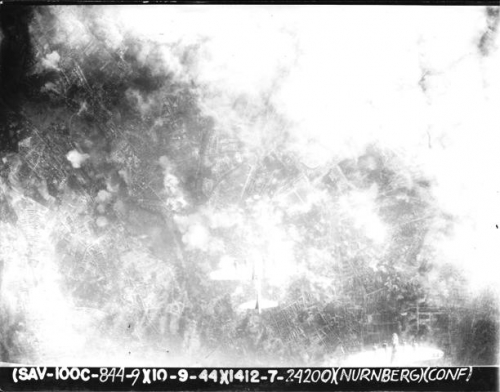
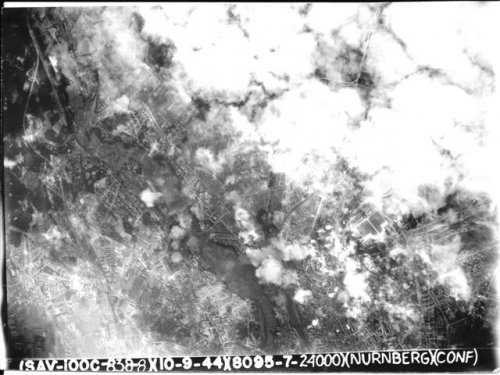
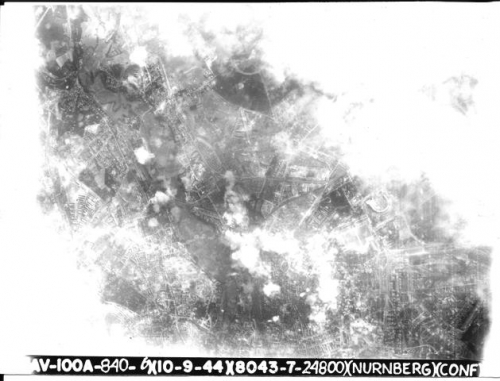
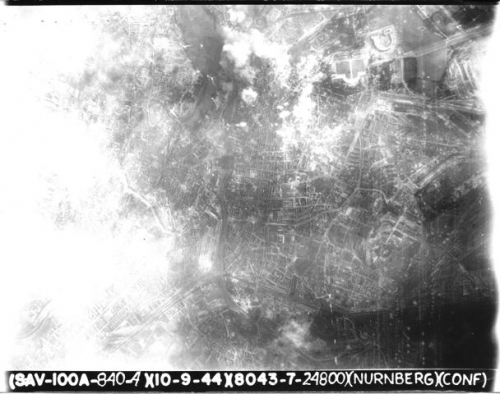
Mission Date: September 10, 1944
NURNBURG, TANK WORKS
100th BG Mission #: 194
Mission Summary
ON THIS DAY...SEPTEMBER 10,1944
With clear flying weather predicted for that Sunday morning, thirty-eight crews had checked in with the attendance man and awaited the start of the morning’s briefing. After the early 0100 wake-up, most of the airmen seated had surmised that the 100th would be heading deep into Germany. Confirmation was made by the S-2 Officer when he unveiled the map showing their route into southern Germany. With the primary target of a tank factory, the 100BG would be heading to Nürnberg (Nuremburg), ninety miles north of Munich and east of Stuttgart.
The 13CBW would fly two wing formations to Nürnberg: the 13A and the 13B to be flown by the 390BG and the 100BG respectively. The 95BG would be stood down. The 13A would be led by the 390BG, which would also fly as the Low group and would have the 388BG as its High.
In the 13B wing formation, the 100BG would fly all three of the groups and would be led by Major Robert Rosenthal, CO of the 350th Squadron flying with PFF pilot, 22 year-old William Terminello and his lead crew. The second Pathfinder would be flown by George Fory who would fly with Major Channing Emberson as Command Pilot of the High group while Captain Andrew Gorski would lead the Low group with Stanley Dobrogowski.
With take-off starting at 0600, it would take several hours for the pilots to form up over buncher 28, first as their groups and then into the 13B wing. After climbing to 14,000 feet, they headed to the Division assembly point. On a collision course with several other groups, the 100th’s leader cut a few corners in avoidance and arrived at the checkpoint as briefed, where it folded into the sixth position within the 3rd Division’s line. Losing two aircraft from its formation before crossing the North Sea, both John Ernst and Luther Bennett had aborted the mission and returned to base after jettisoning their bombs into the water.
Crossing the North Sea, the 100BG crossed the Dutch coast and continued over Belgium, where turning south, it passed over Brussels while continuing its climb to bombing altitude. At 1058 hours, the formation crossed the Rhine River, encountering moderate flak for twenty miles along the river below Frankfurt.
Making its turn at the Initial Point at 1110 hours, the 100BG began its bomb run and soon encountered the moderate but accurate flak coming up from the briefed for guns below.
With the 13A over the target before them, the crews watched as direct flak hits caused several B-17s to explode. Glenn Smiley, ROG on Thomas Anderson’s B-17 recorded, “Saw rockets and plenty white flak (155mms!) and boy was it rough. We saw 3 forts from the group ahead explode over the target and one go down and explode when it hit the ground.”
Nearing the target, the 100th's B-17s absorbed the accurate flak. Although no loss of aircraft was experienced, Pilot Leslie Kassebaum recalled, “Got hell shot out of us - No. 2 out…” Wilbert Ivosevic’s B-17 received a hole in its left wing and waist while Donald Jones’ Fortress lost its #1 engine over the target.
At 1113, thirty-six of the 100th’s B-17s released their ten 500# bombs from 25,000 feet and a sharp turn was made off the target to get out of the flak as quickly as possible. Smiley continued, “Visual bombing and we hit several bad flak spots going in and out. The last spot was really accurate.”
Following the briefed route out, flak was observed ahead coming from both the Manbrunn and Frankfurt defenses. Attempting to fly between the two defenses, the 100BG was caught by surprise by mobile guns that had been set up on the Rhine River. The lead PFF flown by Terminello and Rosenthal was hit first. After their #3 and #4 engines were lost, the pilots pulled out of formation and Rosenthal instructed the Deputy Lead to take-over at which point the Lead and High groups switched positions.
The flak also caught the rest of the formation by surprise and metal armor kept more than one crew member safe. In Thomas Anderson’s B-17, Glenn Smiley tells us, “Were [sic] weren’t expecting this flak so none of us had our flak suits on. A piece of flak came in the radio room and was reflected off by a hard piece of metal - split in small pieces and one lg. one went through the open radio room door and hit the control cables but didn’t have enough speed to cut them. The 2nd piece went through the radio room door and rich. Above the liaison transmitters external tuning unit through the bulkhead and bounced off the waist wall. This piece was supposedly intended for me according to the way it came through the skin but, thank God, it was reflected off by that hard piece of metal or I wouldn’t be here to tell about it. Also got several holes in the horizontal stabilizer.”
In James Ransom’s B-17, CP Keith Lamb was grateful for his extra flak protection. He wrote, “Flak was particularly heavy; the crew chief was able to count over a hundred holes in the plane when we got back. It seemed a miracle to us how many times flak could hit a plane without hurting anyone inside, but when you consider how much armor plate everyone is protected by, plus flak suits and helmets, you can understand why…Each crew member would salvage pieces of armor plate from grounded or wrecked planes to fix up his portion of our plane. Beside the big piece located behind me, there was a piece under my feet--and another that I sat on. That was the one that saved me. A chunk of flak about the size of a baseball came up through the bottom of the plane, through my seat, and hit the armor plate square in the center. This stopped it, but it bounced me up in the air and really stung my fanny…”
Having lost one engine over the target, Donald Jones and Grant Fuller were struggling to keep up with the formation as they encountered the unexpected flak. According to their NAV Art Juhlin, the crew “sweated out some very accurate tracking.”
Departing the Dutch coast at 1335 hours, the 100th's formation made landfall at the English coast at 1415 hours. All but the lead PFF would be counted in as the formation flew over the field. Pilot Robert L. Stevenson would return from the mission wounded in his leg by flak. Ransom’s crew, happy to be down had landed with numerous flak holes and Fabian’s B-17 landed with twenty-five flak holes in its inner wing panel.
Only the lead PFF would not return and it wouldn’t be until later that the 100BG would learn what happened. In the 350th’s Squadron diary was written: “On the tenth in a mission against Nurenburg, the ships all came back safely...and yet the Squadron lost a man...the more important of all. This one, Major Robert Rosenthal, the present commander of the Squadron, was piloting a plane and crew of another Squadron and failed to return. At first it was believed they were missing but later reports bore out the growing suspicion that they had crashed enroute.”
After losing ultimately three out of their four engines, to lighten the plane’s weight and get them further, Rosenthal ordered everything unattached to be thrown overboard. Able to fly fifteen miles inside of the Allied lines before crashing, William Terminello tells us, “The Jerries seemed determined to get us that day. When our three engines were gone we had to make our way back to France on the one and only motor left. We got to an altitude of 10000 feet with that one engine and just made the French lines when that gave out and we had to make a crash landing in a nearby forest.”
After crash landing, the B-17 slammed into a mud bank. Although nobody was killed, all crew members received injuries, some more severe than others. William Terminello was buried under 1,400 pounds of twisted metal and it was reported that the Group Navigator, Woodrow McGill and the TTE, Russell Heger were the only ones conscious. The impact had snapped McGill’s leg at the top of his flight boot so Heger, with “inhuman strength” freed Terminello, “by lifting, shoving and somehow moving the 1400 pounds between bulkhead 4 and 5 beneath which the Captain had been pinned.”
Soon French farmers, smoking cigarettes, approached the area in aid. With gas fumes thick and fearing a fire, McGill, who only knew Spanish, yelled out “No Fumar!” Quickly extinguishing their cigarettes, the farmers aided in getting the wounded airmen out of the plane and into a mule pulled old truck. Getting the men to the nearest road, the Red Cross picked up the wounded crew and took them to a frontline tent hospital where they were treated. Unconscious for two hours, doctors worked on Terminello’s serious head injuries including a crushed cheekbone, broken nose, ripped eyelid and injured right leg and left arm. Robert Rosenthal “suffered a broken nose, broken elbow, facial cuts and other injuries when the top turret crashed down on him.” Eventually, the men were brought back to the 91st General Hospital in England where they continued their convalescence.
It would be the last mission for Terminello’s enlisted men: ROG Louis Quijada, TTE Russell Heger, BTG Thomas Palmer, TG George Hartos. All of the Officers, would return to duty to fly again.
Crews flying the mission: W Miller, Chamberlain, Daniels, Anderson, Harney, Streed, Grigg, Raine, Bailey, Heironimus, Shelly, Thompson, Furrer, Geller, Kassebaum, Jenkins, Everitt, Riegel, Carlton, Dickert, Bennett, Stevenson, R Miller, Fabian, Hopkins, Ivosevic, Hempy, Fory, Ransom, McLaughlin, Armstrong, Terminello, Kramp, Rumley, D Jones, Ernst, M Johnson, Dobrogowski
Bombing Results
Bombing Results: GOOD
Aircraft Lost: 0
Crew Lost: 0
Claims of Enemy Losses (CLS): 0
Aircraft Returned:
Media Articles
Use your thumb to scroll through the results box below.
| Media Item | Type | Page | Volume/Issue | Broadcast Source | Time | Description | File |
|---|---|---|---|---|---|---|---|
| William Terminello Sept 10 mission part 1 | The Record Sept 28 1944 | 12:00 am | |||||
| William Terminello Sept 10 mission part 2 | The Record Sept 28 1944 | 12:00 am |