Mission Date: September 12, 1944
MAGDEBURG, OIL; FULDA, MY
100th BG Mission #: 196
Mission Summary
ON THIS DAY...SEPTEMBER 12,1944
Even after the devastating losses on September 11, there would be no Stand Down for the 100BG as it was alerted for its next mission that same evening. The plans called for the 3rd Division’s B-17s to continue its attacks on Germany’s synthetic oil production.
At Thorpe Abbotts, out of the twenty-six crews awakened the next morning, fifteen of them had survived the previous day’s fighter attacks at Ruhland and only God would know what went through their minds as they sat through their next briefing. In addition, the #13 mission for crews brought heightened anxiety amongst the superstitious ones and rumors had already been swirling about the non-returning Raymond Heironimus’ crew, who had flown their #13 the previous day. Seated and again scheduled to fly in the lead position of a low element, twenty-one year-old David Armstrong and his twenty-four year-old copilot Allen “Andy” Andrews, mentally sturdied themselves for their #13.
The seated crews from the 350th SQ, Anderson, Radke and Spurgeon, also felt apprehensive but very lucky that they had not been scheduled the day before. Roland Hetrick, NAV on Walter Radke’s crew tells us, “Today there were only 3 planes from the 350th in the formation…All of our friends went down. We would have been with them except that we were on pass.” And Glenn Smiley, Thomas Anderson’s ROG thought about his lost friends. “Four (crews) from in our barracks (20 guys) all fellows we knew real well. They flew low group and today we flew low group again.” Anderson’s TG Lewis Herron added, “We were in luck and did not fly on September 11th because our Bombardier was ill…It was a lonely feeling being the only crew in the quarters that night, as the other four crews who lived there were shot down…”
The 13CBW would fly two wings: the 13A CBW led by the 95BG, would fly the 95BG as its High group and the 100A BG fly as its Low group, under the command of Major Sam Barr flying with lead pilot Marquard Anderson. Their target would be the Braunkohle Benzin A.G. refinery at Rothensee, 4 miles outside Magdeburg on the Elbe River. The 13B CBW, flying behind the 13A, would be flown by the 390BG.
A second group of 100BG crews (100B), led by Major William Thompson flying with Leslie Roediger, would fly as the Low group with the 4B CBW flying eighth in the Division line, between the 4A and 4C CBWs. Their primary target would be the oil refinery at Böhlen.The 418th SQ Diary tells us that the crews of Miller, Jones, Johnson, Ivosevic, Harris, Fabian and Armstrong were all scheduled for the 100B.
With each B-17 loaded with ten 500# bombs and fully topped off tokyo’s, the 100A aircraft were airborne first and soon proceeded to Horham for assembly with the 95BG. Soon after, 100B aircraft departed the base and headed out to form up with the 4B CBW. Problems had already began for Armstrong and Andrews at taxi time when issues with their Fortress forced a late take-off.
The 13A CBW departed the English coast at Great Yarmouth, with the 4B CBW departing eight minutes later. The line of B-17s heading to Germany that morning was miles long. Unable to catch the 100B formation and having no reason to abort, David Armstrong tagged his B-17 on to the 351BG flying in the 94CBW, on its way to oil targets in the Ruhland area.
Making the altitude climb over the North Sea, the 13A entered the Dutch coast under 10/10 cloud conditions. Flying deeper into Germany, the weather began to clear and soon the 13A began its turn towards the IP. The fan-out procedure for group bombing was commenced and with bomb bay doors open, the 100A’s Fortresses began the eight-minute long bomb run through the intense flak.
Observing the thick flak ahead, the men watched as four B-17s exploded over the target. Then it was their turn. On his #12 mission, ROG Calvin Dollar on Walter Bailey’s aircraft tells us, “Flak was very intense, we had a malfunction in our bomb racks and we had 5 bombs hung up in the bomb bays. We went through about a minute and a half of flak with those bombs in there. After we got through the flak we pulled out of formation & dropped the bombs. We tried to hit a town but we didn’t have a bomb sight and we missed.” In Thomas Anderson’s B-17, ROG Glenn Smiley tells us, “Got in burst of flak between the lower ball and waist as we were on bomb run. It put several holes in the ship close to the ball tur. Op. (BTG William Jarrell) Also where the waist gunner’s head (Angelo Cioffi) should have been as he was chucking chaff. Got another hole in the nose.”
Absorbing the flak, the 100A’s bombs were away over the Magdeburg MPI at 1108 hours.
Although a heavy smoke screen and smoke from the previous bombs obscured the view, the crews felt they had hit the target when “heavy black smoke was boiling from the target and also flames were seen through the smoke and several large explosions were observed as we left the target area.”
At 1113 hours, on the way to the Rally Point, a FW 190 being chased by a P-51 passed in front of the 100A. The operations narrative tells us, “The FW 190 went down in flames a few seconds later. At the same time a large dog fight was in progress a few miles off to our left with both P-51s and P-47s. At 1152 hours, four jet propelled EA passed high above us headed in opposite direction.” Grateful for their excellent fighter support, Smiley continued, “Fighters were waiting for us as we came off the bomb run but we were all set when our 51’s escort came up and caught them just before they came. We could see the dog fighting and the Jerries go down” And Roland Hetrick in Radke’s Fortress recorded, “Enemy fighters were up again today. We were not attacked thank heavens. Although fighters and dogfights were seen. Again we were lucky because we had trouble with our oxygen. The whole right side was lost when George's regulator went out. I had to hold an emergency bottle all the way to keep Walt's supply from going. We made it o.k. though.”
Meanwhile at 1120 hours, Lady Luck was riding with the Armstrong crew, flying with the 94CBW on its way to the oil plant at Berlin. When they were northeast of Berlin where the turn south to their target would be made, the formation encountered intense and accurate flak coming up from the Berlin defenses. Armstrong, unable to keep up with the formation, dropped his bombs in the northeast outskirts of Berlin. Another group from the 94CBW had been scattered trying to avoid the flak when fifty to sixty enemy aircraft made an attack on the scattered ships. Armstrong's B-17 with bombs already away, tagged on to some of the 457BG’s B-17s and headed west towards home.
At 1122 hours in the vicinity of Leipzig, the 100B formation, flying as the 4B CBW’s vulnerable low group, observed another dog fight in progress but fortunately in the distance. Reaching its target at Böhlen, the group fan-out procedure commenced and the 100B soon flew through the twenty to thirty accurate and tracking antiaircraft guns. A solid smoke screen completely covered the target and due to a malfunction in Roediger’s lead ship, the 100B’s bombs were not released. Art Juhlin in Donald Jones’ Fortress tells us, “Went over target at 25,000’ but failed to drop bombs. Flak was intense.” Wilbert Ivosevic’s Fortress received two holes in his tail and one in the waist. John Fabian, with two engines damaged, soon fell out of formation and headed west with the plan of landing in Brussels.
With the Rally Point made at 1136, the 100B’s command pilot, Thompson, ordered the “C” target to be attacked and bombs were finally away under CAVU conditions on the Fulda marshalling yards at 1219 hours. With their second Rally Point reached at 1224 hours, the 100B headed west towards home, crossing the enemy coast forty minutes behind the 100A formation’s exit.
After close to eight hours airborne, all but Fabian’s ship landed at Thorpe Abotts. That evening, the 100BG was alerted again and the Walter Bailey crew were scheduled to fly their 6th mission in a row. Alerted, his ROG, Calvin Dollar did not get much sleep after he entered into his diary, “Sweating out tomorrow, our 13th & on the 13th too.”
Eventually reporting in safe, John Fabian and his CP Forrest Houdyschell had crash landed at a Belgian field, exited by the Luftwaffe and now in the hands of the RAF. While their Fortress was repaired, the crew headed into Brussels, which had been liberated just ten days earlier. John Fabian tells us, “Everybody was celebrating to beat the band, shaking hands, and we were kept busy kissing all the babies from 18 to 28. We stayed at the Palace Hotel in Brussels, which had just been vacated by the Gestapo…In the cafes, everybody was dancing and singing. They would follow us in crowds, shouting ‘Americain, Americain’”
Crews flying that day:
Williams, Geller, Hedin, Ellison, Bailey, Spurgeon, Jenkins, Hopkins, Kemp, T Anderson, Cumming, Kramp, Chamberlain, Radke, Bennett, Ernst, Darby, R Miller, M Anderson, Ivosevic, Armstrong, C Harris, M Johnson, Jones, Fabian, Roediger
Bombing Results
Bombing Results: FAIR
Aircraft Lost: 0
Crew Lost: 0
Claims of Enemy Losses (CLS): 0
Aircraft Returned:
Photos
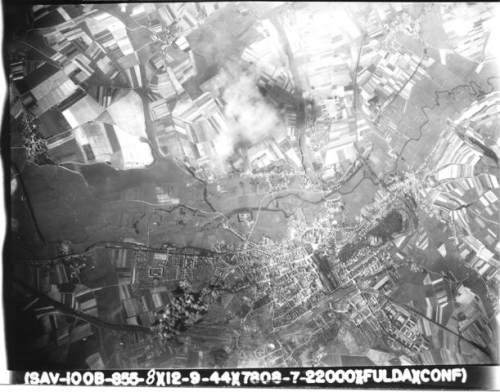
MAGDEBURG, OIL; FULDA, MY 12 Sep 44
100th B Group, photo taken from MILK RUN MABEL, courtesy of Capt Tong