Mission Date: September 18, 1944
WARSAW, SUPPLIES 2nd RUSSIAN SHTL
100th BG Mission #: 198
Mission Summary
ON THIS DAY...SEPTEMBER 18,1944
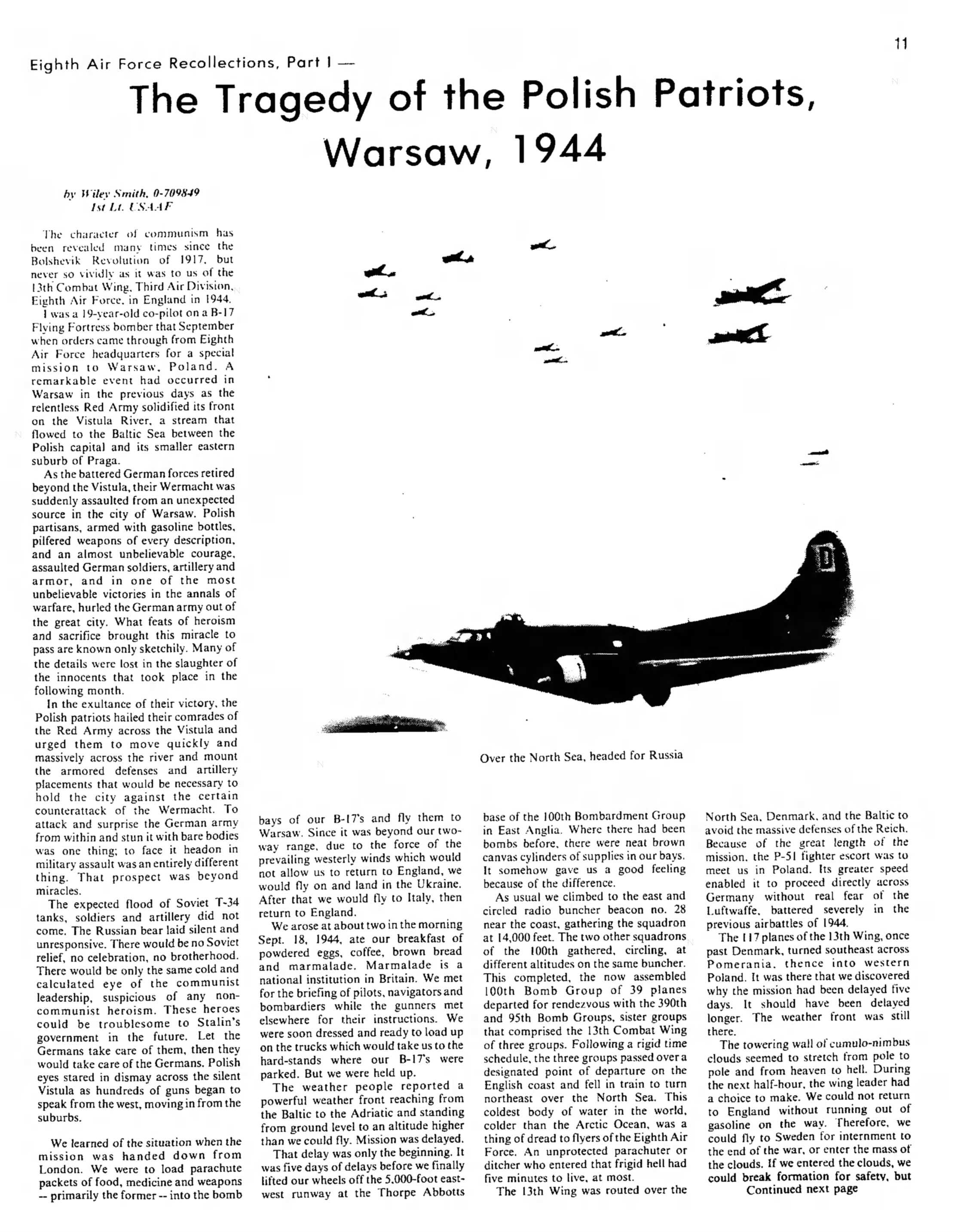
The 8th Air Force would send its heavy bombers on supply transport missions on September 18. With the Allied airborne troops having just landed in Holland, B-24s would be scheduled to drop canisters of supplies and ammunition to them. The 3rd Division would finally fly the 13CBW’s B-17s to Warsaw, Poland where its three Groups would drop canisters filled with food, medical supplies and ammunition to the Polish patriots fighting in the Warsaw uprising.
With two Stand Down days behind them and two previous attempts to execute the next ‘Frantic’ mission, at 0300 hours on the 18th, thirty-eight crews were awakened across Thorpe Abbotts and briefed for the third time for the Warsaw mission. The 13CBW would fly the 95BG as its lead Group in the ‘Task Force.’ The 100BG would fly second in line as the ‘13B’ while the 390BG would fly as the ‘13C’ wing.
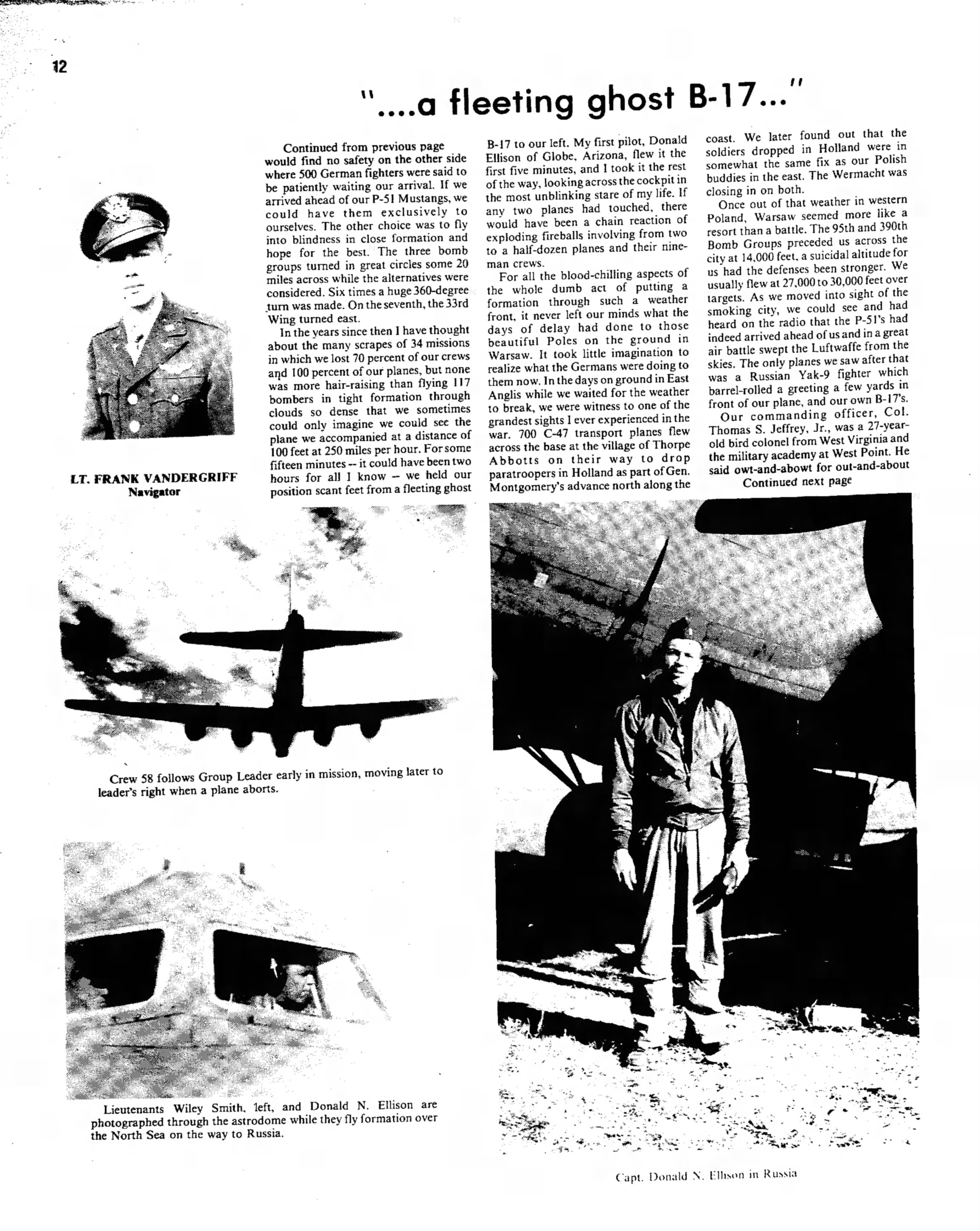
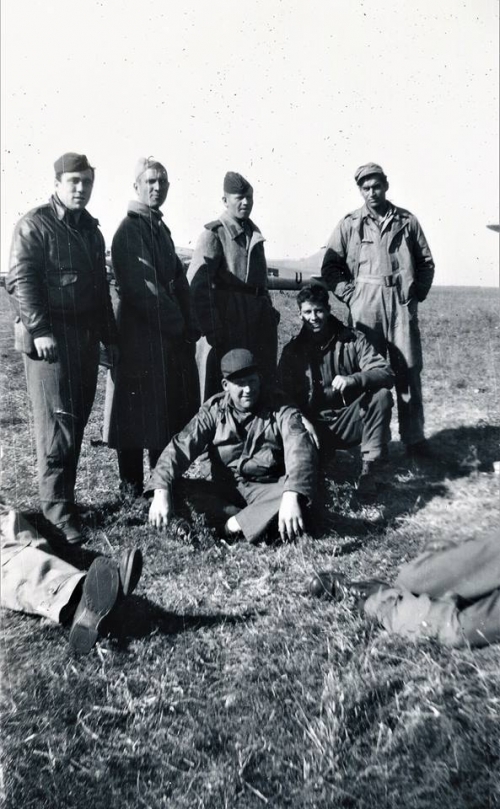
The 100BG would be led by Colonel Thomas Jeffrey, flying with Austin Dunlap in the lead Pathfinder aircraft, with William Dishion as the Group’s Lead Navigator. James Seamons would fly the second Pathfinder with Major Channing Emberson as Command pilot leading the High group. Leslie Roediger would fly with Major Samuel Barr as Command pilot leading the Low group. At least thirty-one additional Ground personnel from Intelligence, Communications, Photo and Maintenance would fly in the various B-17s, many as passengers on their first combat mission, let alone a historic one that would take them to Russia and then on to Italy.
With all of the 100th’s Fortresses taking off without incident, the ‘13B’ was formed and proceeded to Orfordness where the other wings were met. Crossing the English coast at 0731 hours, the climb to 14,000 feet was made over the North Sea. At 0800 hours, the two unneeded spare B-17s, flown by Lloyd Delaney and John Furrer left the formation and returned to base.
Crossing the Danish coast, Warren McCoy, who was flying as First Pilot for the injured Robert Stevenson, experienced a bad oil leak in his #2 engine. Unable to feather the prop, he pulled out of formation and returned back to base.
After crossing the German Peninsula and entering Poland, the formations were greeted by a severe weather front that had been briefed to be over the Baltic Sea, rather than over land. The 100BG followed the lead wing as it began a climb to 19,000 feet in an attempt to get out of the clouds. Advised by the escorting fighters that the tops of the clouds went to 30,000 feet, the 13CBW’s formations then descended in three slow 360 degree turns to 13,000 feet. NAV Roland Hetrick on Walter Radke’s B-17 tells us, “We asked for trouble today. We circled for about an hour over Poland trying to climb over some weather. When they got to 20,000, they changed their minds and come back down. All this time we were circling over a German airfield with about 100 planes on it. None of them took off though”. And NAV Art Juhlin in Donald Jones’ B-17 wrote, “…Weather over target was very poor and we spent an hour circling in the area looking for openings in the undercast and overcast.”
After the descent, the 100BG found itself ahead of the 95BG in the lead wing, so Jeffrey had the 100BG make an additional 360 degree turn to “space our wing behind them,” putting the 100BG “echeloned left of the rest of the wings” by the time it got to the Initial Point of the bomb run.
Flak was reported as intense and accurate starting from the IP all the way to the target and the 100th’s crews observed the 95BG ahead taking evasive action due to the tracking flak. Crews also reported four FW 190s and three Me-109s in the vicinity between the IP and the target. “They came in from 12 o’clock and passed toward 6 o’clock flying high to level, but remaining well away from our formation.”
Making its turn onto the six minute long bomb run, the 100th’s B-17s absorbed the Warsaw flak sent up from barges on the Vistula River as well as from the Warsaw defenders. Even several bursts of bright pink flak was observed. Walter Charles’ B-17 received seven holes on the run and his WG, James Smith remembered, “…We went over the target at about 15,000 and believe me the flak was terrific. Some came close enough to hear which is a little too close for comfort… One piece missed Decker (BOM Raymond Decker) only a few inches in the plexiglass nose.” Art Juhlin flying in the Low group recorded, “Finally went over target at 13,500 feet and Jerry threw up everything he had. Between dodging flak, parachutes and other planes we had a rough time of it…” Wilbert Ivosevic’s Fortress was hit by flak, putting a hole in his radio room, close to ROG Charles Potts.
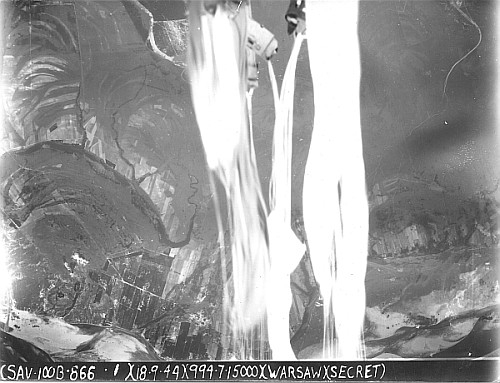
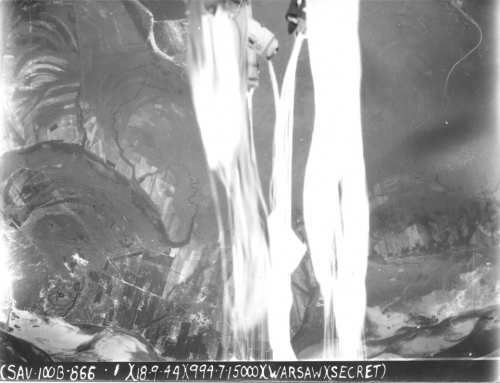
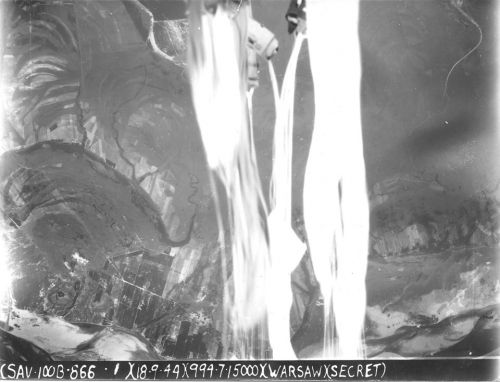
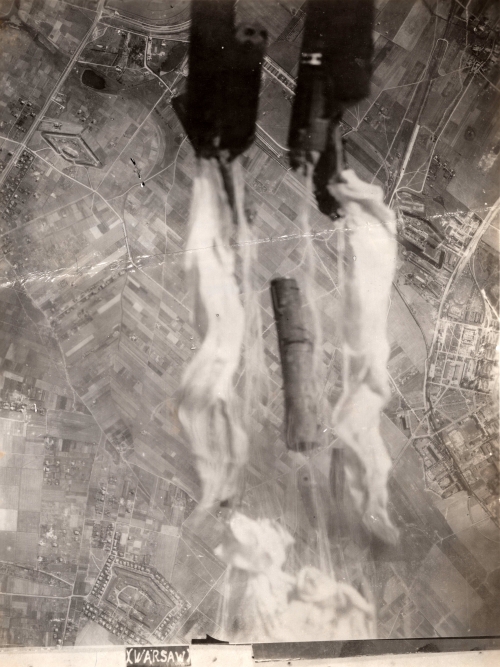
Nearing the smoke obscured target, the bombardiers reportedly had no difficulties visually finding the target aids of the one hundred yard white lines displayed on the streets and rooftops. The 100BG’s containers were away at 1245 hours, parachuting down with reportedly mixed results. Roland Hetrick remembered, “We dropped supplies to the Poles in Warsaw. I don’t believe they got very much. It seems that every one just dropped any old time. It was pretty with all the chutes. Also, there was pink flak to add to the color. It was the first I had seen. The trip over the target was quite a rat race. Everyone was doing evasive action. I guess it did some good because we didn't get hit and there was quite a bit of flak.” Copilot Keith Lamb on James Ransom’s crew wrote in his memoir, “As it turned out, the mission was a flop. Warsaw was as spread out as Los Angeles, and our target was a railroad station in the center of the city. Our low altitude made it possible for us to get shot up pretty badly before we even got there. They shot everything at us: real light stuff, close support antiaircraft, as well as 88s and 105s…Most of the supplies were dropped too soon, and the Germans probably got more of the supplies than the Poles did.”
Briefed to make a sharp left after the target, German fighters were waiting for the formations on the other side of the turn, with many believing that the pink flak, seen earlier and never observed previously, was a signal calling in the attackers. Although the 95BG and 100BG's flak damaged aircraft were safely away and heading toward the Rally Point, a lone Me 109 came through the 100BG’s formation. Lewis Herron on Thomas Anderson’s B-17 wrote, “As we were leaving the drop area, the German Fighters came at us but the U. S. P-51 Fighters prevented them from getting close enough to do any damage.” Copilot Keith Lamb added, “One of their 109s broke through our formation, passing close to our nose, and one of us got him. We couldn't tell whether it was one of the gunners from our ship or someone from another ship…”
TTE, twenty-six year-old Michael Garemko, from Thomas Anderson’s Fortress held his fire in fear of hitting an adjacent B-17. He remembered that the “FW109 came in so close that he flew between the Heaven Sent and their wingman,” and remained convinced of his good decision not to fire. The 390BG however, last through the target was not so lucky. Twenty to thirty ME-109s attacked their formation from all points of the clock, causing “considerable battle damage” and the loss of one ship over the target.
At the Rally Point, the reformed 13CBW continued east to Russia where the 95BG landed at Poltava, while the 100BG landed at Mirgorad. Two of the 390th’s heavily damaged B-17s landed at Poltava while the remainder of its group, including four additional heavily damaged ships, landed at Mirgorad.
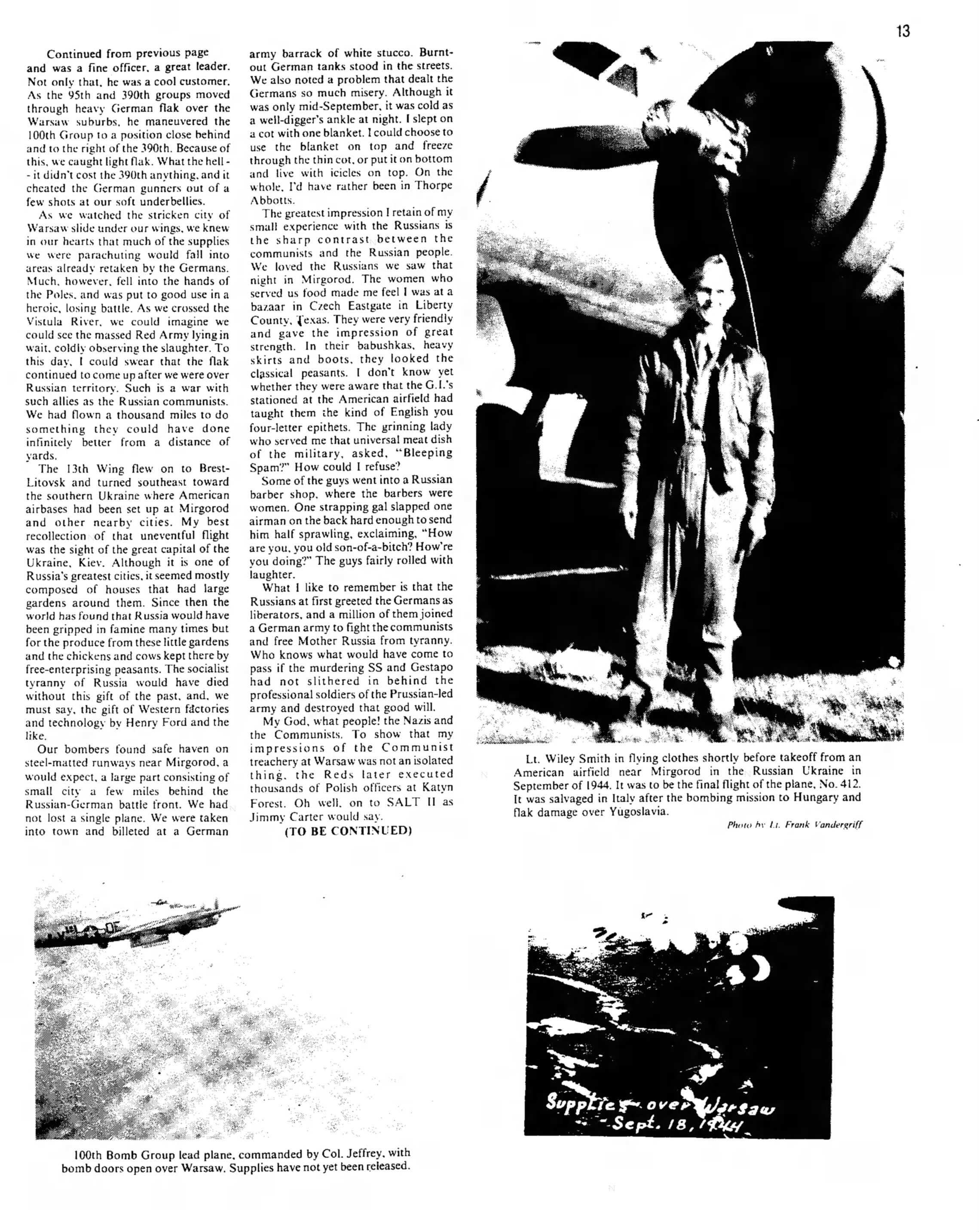
After flying for eleven hours and twenty minutes, the 100BG’s ships and crews were safely on the ground, landing on Mirgorad’s rough, short runway. Glenn Smiley, ROG on Thomas Anderson’s Fortress tells us, “…as we landed I was about half asleep in the waist floor of the plane and was scared out of my wits because we landed on a metal temporary runway. I thought we had crashed…This was quite an adventure for an old hillbilly boy.”
The field was miles away from town, so the men were trucked into Mirgorad where they would be billeted. Finally heading to chow, the 100BG personnel and crews were welcomed by Russian women serving in the chow line and where unlike at Thorpe Abbotts, the officers and the enlisted men ate together. But it wasn’t the Russian women, or the black bread that made an impression on the men. Lewis Herron remembered, “We had a pleasant surprise that night when we entered the Chow Hall. There sat the Flight Surgeon with our 2 ounces of bourbon, just like it was at Thorpe Abbots after a regular mission. The Commanding Officer had to be very thoughtful to bring him and several cases of bourbon along on the trip”
The ground crews that had flown as extra personnel, were busy all night patching up the battle damaged ships. Colonel Jeffrey held a meeting for the pilots where they were told that the 100th would be taking off again the next morning and were advised not to make it a late night. Informing their crew members of the early take-off time, some of the men visited the town while others tried to communicate with the locals. Michael Garemko, who could speak a little Russian, was able to “cajole a bottle of vodka from the locals.” And copilot Keith Lamb tells us, “We stayed in Russia only that night, just long enough to get a bottle of Russian Champagne, some Russian money, and a drink of vodka.”
Although Russian soldiers were guarding the field, each pilot was ordered to assign an enlisted man to stay with their B-17 through the night and “guard it with their lives.” Copilot Wiley Smith on Donald Ellison’s crew tells us, “During the night, our radioman, Robert Wolf of Milwaukee was left at the plane to guard against 'liberation' of goodies, such as morphine, guns, tires or wings. The Russian guards posted about the field might or might not protect us from theft. Trying to speak with the posted Russians, Glenn Smiley and his BTG, Angelo Cioffi, assigned to guard their Fortress remembered “We talked with them but it was a rough deal.”
While the rest of the crews slept in Mirgorad, the others slept inside their very cold B-17s until just before dawn the next morning.
Shuttle Crews: W Miller, Kemp, Grigg, Jenkins, Harney, Chamberlain , Kassebaum, Urban, Frazier, Geller, T Anderson, Cumming, W Charles, Dyatt, Radke, Delaney, Furrer, Spurgeon, Hedin, Bennett, Ellison, McCoy, Downing, Seamans, Gay, Darby, Jones, Dunlap, Ransom, Ivosevic, Harris, Roediger, Kramp, Bucklew, Lundquist, Ernst, Schaffhausen, Dobrogowski
Other personnel on loading lists:
Major D. M. Lewis (Spurgeon)
S-2 Intelligence - Captain Charles Terry (Ernst)
Group Communications Officer - Captain Alfred Iannaconne (Harris)
350th Communications - William M. Jackson (Darby)
Photo - RJ Machart (Gay)
Metro specialist - T.W. Smith (Downing)
Captain E. McMillan (Ransom)
Captain W.D. Clift (Geller)
Neal Scott
Ordnance/Ammunition - Lt. William Harrison (Dobrogowski)
M/SGT R.P. Corner (Schaffhausen)
M/SGT A Egbert (Lundquist)
M/SGT Joseph E. Woodard (Jones)
M/SGT W.C. North (McCoy)
T/SGT R.E. Creitz (Ellison)
M/SGT D. H. Christopher (Bennett)
T/SGT R.E. Bragg (Hedin)
M/SGT W.E. Leopold (Radke)
M/SGT V.R. Pacek (Dyatt)
M/SGT W.H. McClendon (Charles)
S/SGT R.A. Spiller (Cummiing)
MSGT John C. Riffle (Anderson)
MSGT Wilbur Leyplot
MSGT Albert Strainof
T/SGT L. H. Paulsen (Frazier)
Cpl W.F. Bradford (Urban)
M/SGT T.D. Taylor (Kassebaum)
Captain Krezo and T/SGT T.A. Dailey (Chamberlain)
M/SGT R.A. Boyle (Jenkins)
Cpl L.A. Rowton (Grigg)
T/SGT B.J. Cannon (Kemp)
The 8th Air Force would send its heavy bombers on supply transport missions on September 18. With the Allied airborne troops having just landed in Holland, B-24s would be scheduled to drop canisters of supplies and ammunition to them. The 3rd Division would finally fly the 13CBW’s B-17s to Warsaw, Poland where its three Groups would drop canisters filled with food, medical supplies and ammunition to the Polish patriots fighting in the Warsaw uprising.
With two Stand Down days behind them and two previous attempts to execute the next ‘Frantic’ mission, at 0300 hours on the 18th, thirty-eight crews were awakened across Thorpe Abbotts and briefed for the third time for the Warsaw mission. The 13CBW would fly the 95BG as its lead Group in the ‘Task Force.’ The 100BG would fly second in line as the ‘13B’ while the 390BG would fly as the ‘13C’ wing.
The 100BG would be led by Colonel Thomas Jeffrey, flying with Austin Dunlap in the lead Pathfinder aircraft, with William Dishion as the Group’s Lead Navigator. James Seamons would fly the second Pathfinder with Major Channing Emberson as Command pilot leading the High group. Leslie Roediger would fly with Major Samuel Barr as Command pilot leading the Low group. At least thirty-one additional Ground personnel from Intelligence, Communications, Photo and Maintenance would fly in the various B-17s, many as passengers on their first combat mission, let alone a historic one that would take them to Russia and then on to Italy.
With all of the 100th’s Fortresses taking off without incident, the ‘13B’ was formed and proceeded to Orfordness where the other wings were met. Crossing the English coast at 0731 hours, the climb to 14,000 feet was made over the North Sea. At 0800 hours, the two unneeded spare B-17s, flown by Lloyd Delaney and John Furrer left the formation and returned to base.
Crossing the Danish coast, Warren McCoy, who was flying as First Pilot for the injured Robert Stevenson, experienced a bad oil leak in his #2 engine. Unable to feather the prop, he pulled out of formation and returned back to base.
After crossing the German Peninsula and entering Poland, the formations were greeted by a severe weather front that had been briefed to be over the Baltic Sea, rather than over land. The 100BG followed the lead wing as it began a climb to 19,000 feet in an attempt to get out of the clouds. Advised by the escorting fighters that the tops of the clouds went to 30,000 feet, the 13CBW’s formations then descended in three slow 360 degree turns to 13,000 feet. NAV Roland Hetrick on Walter Radke’s B-17 tells us, “We asked for trouble today. We circled for about an hour over Poland trying to climb over some weather. When they got to 20,000, they changed their minds and come back down. All this time we were circling over a German airfield with about 100 planes on it. None of them took off though”. And NAV Art Juhlin in Donald Jones’ B-17 wrote, “…Weather over target was very poor and we spent an hour circling in the area looking for openings in the undercast and overcast.”
After the descent, the 100BG found itself ahead of the 95BG in the lead wing, so Jeffrey had the 100BG make an additional 360 degree turn to “space our wing behind them,” putting the 100BG “echeloned left of the rest of the wings” by the time it got to the Initial Point of the bomb run.
Flak was reported as intense and accurate starting from the IP all the way to the target and the 100th’s crews observed the 95BG ahead taking evasive action due to the tracking flak. Crews also reported four FW 190s and three Me-109s in the vicinity between the IP and the target. “They came in from 12 o’clock and passed toward 6 o’clock flying high to level, but remaining well away from our formation.”
Making its turn onto the six minute long bomb run, the 100th’s B-17s absorbed the Warsaw flak sent up from barges on the Vistula River as well as from the Warsaw defenders. Even several bursts of bright pink flak was observed. Walter Charles’ B-17 received seven holes on the run and his WG, James Smith remembered, “…We went over the target at about 15,000 and believe me the flak was terrific. Some came close enough to hear which is a little too close for comfort… One piece missed Decker (BOM Raymond Decker) only a few inches in the plexiglass nose.” Art Juhlin flying in the Low group recorded, “Finally went over target at 13,500 feet and Jerry threw up everything he had. Between dodging flak, parachutes and other planes we had a rough time of it…” Wilbert Ivosevic’s Fortress was hit by flak, putting a hole in his radio room, close to ROG Charles Potts.
Nearing the smoke obscured target, the bombardiers reportedly had no difficulties visually finding the target aids of the one hundred yard white lines displayed on the streets and rooftops. The 100BG’s containers were away at 1245 hours, parachuting down with reportedly mixed results. Roland Hetrick remembered, “We dropped supplies to the Poles in Warsaw. I don’t believe they got very much. It seems that every one just dropped any old time. It was pretty with all the chutes. Also, there was pink flak to add to the color. It was the first I had seen. The trip over the target was quite a rat race. Everyone was doing evasive action. I guess it did some good because we didn't get hit and there was quite a bit of flak.” Copilot Keith Lamb on James Ransom’s crew wrote in his memoir, “As it turned out, the mission was a flop. Warsaw was as spread out as Los Angeles, and our target was a railroad station in the center of the city. Our low altitude made it possible for us to get shot up pretty badly before we even got there. They shot everything at us: real light stuff, close support antiaircraft, as well as 88s and 105s…Most of the supplies were dropped too soon, and the Germans probably got more of the supplies than the Poles did.”
Briefed to make a sharp left after the target, German fighters were waiting for the formations on the other side of the turn, with many believing that the pink flak, seen earlier and never observed previously, was a signal calling in the attackers. Although the 95BG and 100BG's flak damaged aircraft were safely away and heading toward the Rally Point, a lone Me 109 came through the 100BG’s formation. Lewis Herron on Thomas Anderson’s B-17 wrote, “As we were leaving the drop area, the German Fighters came at us but the U. S. P-51 Fighters prevented them from getting close enough to do any damage.” Copilot Keith Lamb added, “One of their 109s broke through our formation, passing close to our nose, and one of us got him. We couldn't tell whether it was one of the gunners from our ship or someone from another ship…”
TTE, twenty-six year-old Michael Garemko, from Thomas Anderson’s Fortress held his fire in fear of hitting an adjacent B-17. He remembered that the “FW109 came in so close that he flew between the Heaven Sent and their wingman,” and remained convinced of his good decision not to fire. The 390BG however, last through the target was not so lucky. Twenty to thirty ME-109s attacked their formation from all points of the clock, causing “considerable battle damage” and the loss of one ship over the target.
At the Rally Point, the reformed 13CBW continued east to Russia where the 95BG landed at Poltava, while the 100BG landed at Mirgorad. Two of the 390th’s heavily damaged B-17s landed at Poltava while the remainder of its group, including four additional heavily damaged ships, landed at Mirgorad.
After flying for eleven hours and twenty minutes, the 100BG’s ships and crews were safely on the ground, landing on Mirgorad’s rough, short runway. Glenn Smiley, ROG on Thomas Anderson’s Fortress tells us, “…as we landed I was about half asleep in the waist floor of the plane and was scared out of my wits because we landed on a metal temporary runway. I thought we had crashed…This was quite an adventure for an old hillbilly boy.”
The field was miles away from town, so the men were trucked into Mirgorad where they would be billeted. Finally heading to chow, the 100BG personnel and crews were welcomed by Russian women serving in the chow line and where unlike at Thorpe Abbotts, the officers and the enlisted men ate together. But it wasn’t the Russian women, or the black bread that made an impression on the men. Lewis Herron remembered, “We had a pleasant surprise that night when we entered the Chow Hall. There sat the Flight Surgeon with our 2 ounces of bourbon, just like it was at Thorpe Abbots after a regular mission. The Commanding Officer had to be very thoughtful to bring him and several cases of bourbon along on the trip”
The ground crews that had flown as extra personnel, were busy all night patching up the battle damaged ships. Colonel Jeffrey held a meeting for the pilots where they were told that the 100th would be taking off again the next morning and were advised not to make it a late night. Informing their crew members of the early take-off time, some of the men visited the town while others tried to communicate with the locals. Michael Garemko, who could speak a little Russian, was able to “cajole a bottle of vodka from the locals.” And copilot Keith Lamb tells us, “We stayed in Russia only that night, just long enough to get a bottle of Russian Champagne, some Russian money, and a drink of vodka.”
Although Russian soldiers were guarding the field, each pilot was ordered to assign an enlisted man to stay with their B-17 through the night and “guard it with their lives.” Copilot Wiley Smith on Donald Ellison’s crew tells us, “During the night, our radioman, Robert Wolf of Milwaukee was left at the plane to guard against 'liberation' of goodies, such as morphine, guns, tires or wings. The Russian guards posted about the field might or might not protect us from theft. Trying to speak with the posted Russians, Glenn Smiley and his BTG, Angelo Cioffi, assigned to guard their Fortress remembered “We talked with them but it was a rough deal.”
While the rest of the crews slept in Mirgorad, the others slept inside their very cold B-17s until just before dawn the next morning.
Shuttle Crews: W Miller, Kemp, Grigg, Jenkins, Harney, Chamberlain , Kassebaum, Urban, Frazier, Geller, T Anderson, Cumming, W Charles, Dyatt, Radke, Delaney, Furrer, Spurgeon, Hedin, Bennett, Ellison, McCoy, Downing, Seamans, Gay, Darby, Jones, Dunlap, Ransom, Ivosevic, Harris, Roediger, Kramp, Bucklew, Lundquist, Ernst, Schaffhausen, Dobrogowski
Other personnel on loading lists:
Major D. M. Lewis (Spurgeon)
S-2 Intelligence - Captain Charles Terry (Ernst)
Group Communications Officer - Captain Alfred Iannaconne (Harris)
350th Communications - William M. Jackson (Darby)
Photo - RJ Machart (Gay)
Metro specialist - T.W. Smith (Downing)
Captain E. McMillan (Ransom)
Captain W.D. Clift (Geller)
Neal Scott
Ordnance/Ammunition - Lt. William Harrison (Dobrogowski)
M/SGT R.P. Corner (Schaffhausen)
M/SGT A Egbert (Lundquist)
M/SGT Joseph E. Woodard (Jones)
M/SGT W.C. North (McCoy)
T/SGT R.E. Creitz (Ellison)
M/SGT D. H. Christopher (Bennett)
T/SGT R.E. Bragg (Hedin)
M/SGT W.E. Leopold (Radke)
M/SGT V.R. Pacek (Dyatt)
M/SGT W.H. McClendon (Charles)
S/SGT R.A. Spiller (Cummiing)
MSGT John C. Riffle (Anderson)
MSGT Wilbur Leyplot
MSGT Albert Strainof
T/SGT L. H. Paulsen (Frazier)
Cpl W.F. Bradford (Urban)
M/SGT T.D. Taylor (Kassebaum)
Captain Krezo and T/SGT T.A. Dailey (Chamberlain)
M/SGT R.A. Boyle (Jenkins)
Cpl L.A. Rowton (Grigg)
T/SGT B.J. Cannon (Kemp)
Bombing Results
Bombing Results: GOOD
Aircraft Lost: 0
Crew Lost: 0
Claims of Enemy Losses (CLS): 0
Aircraft Returned:
Media Articles
Use your thumb to scroll through the results box below.
| Media Item | Type | Page | Volume/Issue | Broadcast Source | Time | Description | File |
|---|---|---|---|---|---|---|---|
| Wiley Smith Polish Patriots part 1 | New Braunfels Herald Aug 2 1981 | 12:00 am | |||||
| Wiley Smith Polish Patriots part 2 | New Braunfels Herald Aug 2 1981 | 12:00 am | |||||
| Wiley Smith Polish Patriots part 3 | New Braunfels Herald-Zeitung Aug 2 1981 | 12:00 am |