Mission Date: September 19, 1944
SZOLNOK, (HUNGARY, FROM RUSSIA)
100th BG Mission #: 199
Mission Summary
ON THIS DAY...SEPTEMBER 19,1944
During the predawn hours at the Mirgorad field in Russia, (now part of Ukraine) the enlisted men stationed to guard the 100th’s aircrafts during the night were getting a first hand look at how the Russian armorers went about their unique way of loading the Russian bombs into the B-17s. Donald Ellison’s copilot, nineteen year-old Wiley Smith tells us, “All went well through the chill night for Bob (ROG Robert Wolf), until the Russian armorers showed up at dawn to load the bombs. They filled the bomb bay of Number 412, our plane, with some kind of bombs, before discovering that it was the wrong kind. Thereupon, a Russian climbed up into the nose and proceeded to toggle the bombs onto the ground, one by one. The top of a B-17 bomb bay is ten feet or so off the ground, and the crash of these unarmed bombs as they hit the ground was just about too much for radioman Wolf…” TG Robert Kazee at Willis Miller’s B-17 remembered, “…when the Russian ground crew came out to load the bombs, they were Russian bombs and a strange configuration. Of course they didn’t fit too well so they took hammers and started pounding on them to make them fit. That’s when I decided it was time to run for the hills as we used to say in Kentucky. As it turned out they said there was no danger because Russian bombs are not armed the same way US bombs are but who cares? I didn’t wait to see who was right.” And TOG/NG Calvin Korpela guarding Andrew Downing’s B-17 tells us, “A Russian boy, maybe 12 years old, brought the bombs, so small he had to chin himself on the truck's steering wheel. He rolled the bombs off the truck by backing up swiftly and jamming on the brakes, forcing the loaded bombs to roll of onto the ground.”
The morning’s briefing was short and Wiley Smith stated, “Briefing was skimpy compared with the elaborate preparations conducted in England. We were directed to load Russian bombs and strike a railroad marshalling yard in Szolnok, Hungary, and continue to Foggia, Italy. The bombs were of a strange configuration to us, so the bombardiers were somewhat put on a guess basis. The factors that enable a high-flying bomber to hit its target are very complex, and a lack of knowledge about the bomb itself is a handicap.” Charles Terry, the S-2 Officer informed the crews that the target was at the request of the Russians and outside of Budapest, the Szolnok rail complex was the most important in Hungary.
The 95BG would continue as the ‘Task Force’ leader, with the 100BG flying as the 13B wing behind it and then the 390BG as the 13C. Colonel Jeffrey would again fly with Austin Dunlap, with Neal Scott and John Ernst flying this leg in the Deputy Lead position.
Starting at 1030 hours, each of the 100th’s pilots had a successful take-off. Formed one hour later into the ‘13B,’ the 100BG started its climb, falling in behind the 95BG, who had taken off from the base at Poltava. The 390BG which had lost so many B-17s in the Warsaw attack, flew as the 13C but with two group formations instead of three.
Flying west toward Hungary while ’S’ing’ to avoid the weather encountered, the IP was made at 1452 hours. Over the target first at 20,000 feet, the 95BG flew through seven minutes of flak. Just after bombs were away, the 95BG’s Lead aircraft was damaged by flak.
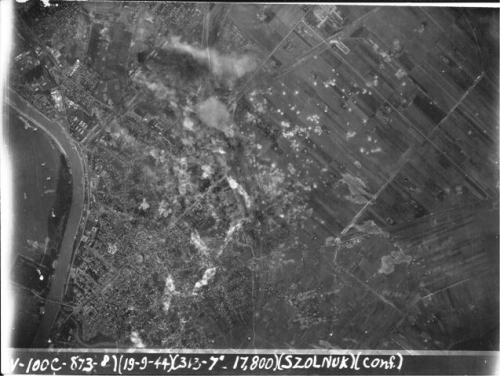
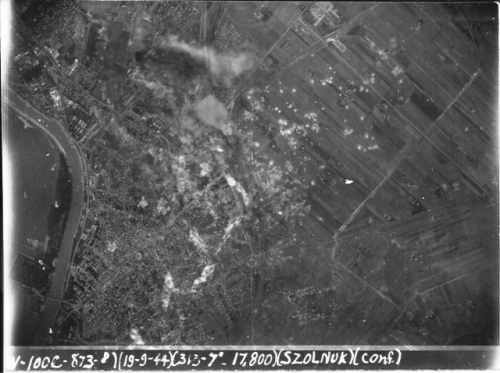
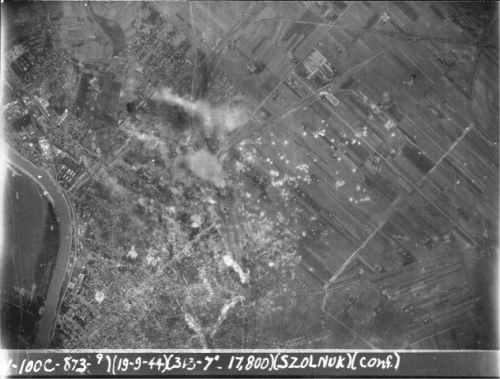
Next over the target, the 100BG, experienced light and inaccurate flak and from 18000 feet, bombs were away three minutes later. Wiley Smith remembered, “Our lead bombardiers swear they put their feet up in the plexiglas nose and sighted on their shoes to drop the bombs. Maybe they should have done that over some of the targets we missed. They scored bullseyes on the train yards.”
Making a left turn off the target and nearing the Rally Point, the 95BG’s and Task Force’s Lead aircraft, flown by Colonel Carl Truesdell with J.M. Miller, aborted from its position due to flak after three of its officers and one enlisted man were seen bailing out. With no PFF aircraft as the 95BG's Deputy Lead, the 100BG took over as the 'Task Force's new leader. The 95BG's formation executed a 360 degree turn to position itself behind the 100BG.
Now flying as the Lead formation, the 100BG encountered very heavy and unexpected flak from twelve guns as it crossed the Drina River at Brod, Yugoslavia. With flak very accurate on the 100BG for close to four minutes, the formations were forced to take heavy evasive action. Ellison’s copilot Wiley Smith remembered, “We turned south over Yugoslavia, almost congratulating ourselves over not only our aiming success but a milkrun mission. ..This contentment was premature, as we soon found as we cruised serenely over the mountains of Yugoslavia, enroute to our destination near the spur of the Italian boot. Near the mountain city of Brod we encountered something reminiscent of our mountain people, Crack shots…Not only were those Brod mountains packed with sharpshooters, but we were flying only at 14000 feet, They could hardly miss. Each flak gun was firing individually and it was the most accurate tracking fire I ever saw in 34 missions over Europe. They were experts, there is no doubt. Something else I had never seen before soon took place too. B-17s in formation making evasive moves so near to vertical turns that there wasn’t a nickel's worth of difference. How we missed colliding with each other I don't know. Nobody in his right mind makes maneuvers like that in close bomber formation. But that tracking barrage did something to one's mind, and the rest came easy. You did what was plainly necessary.” Due to all of the pilots’ flying talents, the 100BG came through the mission without a loss of aircraft.
At 1704 hours, the ‘Task Force’ began its slow let down and the Italian coast was crossed at under seven thousand feet.
Ellison’s CP Wiley continued his memory. “Our nerves had a chance to settle a bit over the blue waters but that ended when we crossed the Italian coast...It was a ride even rougher than the Brod flak alley. The air turbulence rising from the desert-like ground beat us with a violence I don’t understand to this day…."
Each Group peeled off and proceeded to their respective assigned bases belonging to the 15th Air Force. The 100BG landed at 1747 hours on the dusty Celone field, twenty miles from Foggia. NAV Roland Hetrick tells us, “We thought for a while that we were going off the edge but Walt kept it on. Boy was it dusty. Our guns really got dirty.” The safe landing was the conclusion of #35 for James Ransom and his copilot Keith Lamb recorded, “After landing in Italy, we gratefully drank the Russian champagne to celebrate completing our last mission.”
Staying in Italy until September 22, the maintenance crews repaired the damaged aircraft and the crews rested and did some sightseeing. Repairs were made to Wilbert Ivosevic’s B-17, which had landed with nine holes while William Urban had landed without this #2 engine. Donald Ellison’s B-17 received major flak damage when two 88 mm shells went through his left wing and requiring the replacement of his entire wing.
Crews: W Miller, Chamberlain, Kassebaum, Urban, Harney, Geller, Anderson, Cumming, Frazier, Dyatt, Radke, Bennett, Charles Spurgeon, Hedin, Ellison, Kemp, Grigg, Jenkins, Gay, Ransom, Bucklew, Lundquist, Kramp, Schaffhausen, Dobrogowski, Neal Scott Command with John Ernst, Downing, Major Emberson with Seamans, Darby, Jones, Jeffrey with Captain Dunlap, Ivosevic, Harris, Major Barr with Roediger. In addition to the various support personnel.
Bombing Results
Bombing Results: GOOD
Aircraft Lost: 0
Crew Lost: 0
Claims of Enemy Losses (CLS): 0
Aircraft Returned: