Mission Date: September 26, 1944
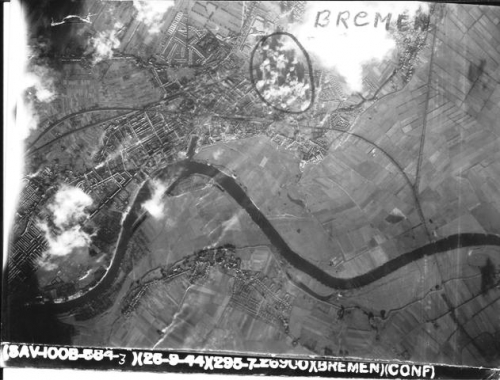
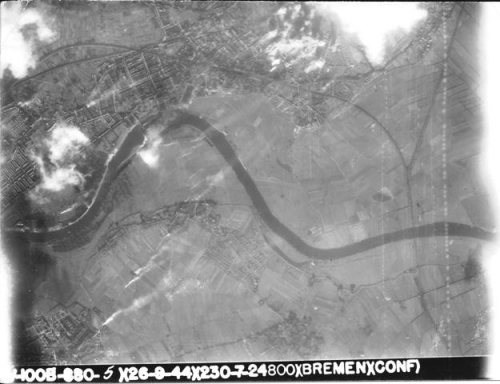
BREMEN, TANK WORKS
100th BG Mission #: 201
Mission Summary
ON THIS DAY...SEPTEMBER 26,1944
At 1900 hours on September 25, a V-2 Rocket landed two miles from Thorpe Abbotts, coming down at Castle Farm, Hoxne and causing damage to houses in the area. Vernon Sheedy tells us, “It sure did make the fellows move when it hit, ‘cause some went under the beds and others just stood in their tracks not knowing what to do.” Gunner Lewis Martin added, “The explosion almost knocked us off - no noise - nothin, just boom…Saw pillar of smoke. Our nerves are bad.” With the rocket as the first to land in East Anglia, mission orders for the next day would have the groups forming at a much higher altitude over their bases than normal.
On the morning of the 26th in the 350th Squadron area, pilot Bill MacNab, a farm boy from Oregon before the war, swung the legs of his 6’2” frame over the edge of his cot upon hearing his name called out for the morning’s mission. MacNab’s copilot, Nelson Vaughan from Vancouver, Washington would be seated to his right that day for his #1 mission. As Vaughan straightened his even taller 6’3” body next to MacNab, the two twenty-year old blue-eyed pilots made a striking pair.
Also awakened were the crew of Albert Willoughby. Flying their #1 combat mission as a crew, Willoughby and his other three officers all hailed from the South. Willoughby and McKinney both from Georgia, had attended rival colleges but after meeting in training, had become a tight pilot-copilot team adding NAV Ralph Nite, from Chattanooga, Tennessee and BOM James Wooten from Finney, Kentucky.
At the 0800 briefing, the S-2 Officer briefed the twenty-six crews seated for Bremen, located in northern Germany, thirty-five miles inland from the North Sea. The primary target would be an armored vehicle factory, the AFV Works of Karl Borgward in Sebaldsbruck, ten miles southeast of Bremen. Seated and relieved to see that they had not pulled a mission deep into Germany for their #1 was “Mac” McGuire and his crew.
Briefed for the North Sea route into the target, the 13CBW would lead the 3rd Division. Although it would be the 95BG leading the 13A in the Lead group with LT Colonel Mumford in Command, the 100BG would fly as its High and Low groups led by Leslie Roediger in a PFF ship with Major Maurice Youngs as Command Pilot in the High and Seamans flying with Stanley Clark as Command pilot of the Low. The 390BG would fly as the 13B CBW.
With the B-17s loaded with five 1000 lb GP bombs and two thousand six hundred gallons of fuel, take-off commenced at 1155 hours and by 1215, all of the 100BG’s B-17s had taken off and were successfully assembled over the base at the high 17000 feet. Enroute to Lowestoft, the 100BG was picked up by the 95BG, forming into the 13A wing at 18,500 feet and departing the English Coast at Cromer at 1403 hours.
Flying over the North Sea and turning south over the Frisian Islands, the 13A formation made landfall on the Dutch Coast at 1505 hours, after having climbed to the bombing altitude of 27000 feet over the sea. With the IP soon reached, the peel off by groups was made onto the bomb run where it would be a visual bombing due to the 5/10 cloud coverage and better weather than had been originally briefed.
With the 95BG over the target first, there was no flak encountered until thirty-seconds before bombs away and the German gunners let loose with “a moderate and very accurate barrage…the first bursts peppering the formation.” The 95BG’s lead Pathfinder had two engines knocked out causing a drop in airspeed and a failure to release its bombs. Its own 2nd element lead aircraft overran the leader, hit prop wash and dropped its bombs, with the rest of the 95BG’s aircraft following suit.
The 100BG following closely behind in its two group formations was soon over the target. Flying the Low group’s low squadron lead B-17, David Armstrong was the first ship of the 100BG’s over the target and reported three enemy aircraft. Fortunately due to the good fighter support, no attacks were made on the 100BG.
Bombs were away at 1531 hours through the intense barrage and tracking flak. Although inaccurate at first, the flak was reported as “very accurate just before we passed out of range. Several ground rockets were fired but were inaccurate.” Pilot, Leslie Kassebaum remembered, “God but there was flak - Holes in ship.”
The 349th’s Joseph Ricker and crew were flying the High group’s High squadron lead and although seemingly above most of the flak, were never totally safe. His TG, Raymond Mainka, tells us, “The bombing was visual and there was quite a good deal of flak…” James Smith, flying as WG in the 349th’s Walter Charles B-17 recorded, “We hit a Bremen tank plant today. We really did hit this one because I got the location well in mind and saw for myself. The flak was pretty thick over the target area. We were over enemy territory only about an hour and were supposed to get flak the entire time. However, we were well routed or well lead and missed the main batteries. I saw some more groups getting it. It was really cold again today. I don’t know about the losses but our group didn’t have much trouble. We got a piece of flak right in the windshield in Dick (CP Richard Ames) and Charley’s (P Walter Charles) faces. Guess they were plenty scared.” In the 349th’s Walter Bailey’s very cold B-17, twenty-six year-old TOG Albert Beauchesne would be filling in for BOM Hank Sees. Bailey’s TTE, Calvin Dollar tells us, “Flak was heavy but we didn’t get hit. Hit target right on the head, temp -40 degrees C at 27,000 ft…” And pilot Harvey Dickert added, “went over target at ground speed of 340 mph. Flak was bad but they tracked lead group and left us pretty much alone. Five ships in 95th group had feathered engines…”
The Rally Point was made first by the 95BG’s leader which released its bombs beyond the Rally Point on a target of opportunity. The 100BG’s formations reached the RP at 1534 hours and reformed with the 95BG before the enemy coast was crossed. The 13A CBW however, would relinquish the Division lead to the 13B CBW due to battle damage received by many of its aircraft, preventing the “SOP airspeed and descent being maintained” The 13A CBW soon dropped in trail of the rest of the 3rd Division over the North Sea.
The 100BG made landfall on the English coast at 1815 hours and soon all Fortresses were accounted for as they flew over the field, landing between 1845-1859 hours. Joseph Ricker and copilot George Tussing landed with battle damage and their TG Raymond Mainka tells us, “Had to leave the plane on the end of the runway as our hydraulic system was out and didn’t have any brakes so couldn’t taxi.”
The 100BG was fortunate that day with no losses of men or aircraft. Three of the Division’s Groups however were not so fortunate, with fours ships and crews lost.
That evening, the base's alert light went on again and the Squadron boards were soon filling with the names of crews and the B-17’s scheduled to fly the next day.
Crews flying this mission: Harney, Ricker, Daniels, Jenkins, Charles, Kemp, Grigg, Cumming, Bailey, MacNab, Willoughby, Dickert, Furrer, Dyatt, Kassebaum, Hopkins, Kennedy, McGuire, Rumley, McLaughliin, Miller, Fabian, Schaffenshausen, Armstrong, Roediger, Seamans
Bombing Results
Bombing Results: GOOD
Aircraft Lost: 0
Crew Lost: 0
Claims of Enemy Losses (CLS): 0
Aircraft Returned: