Mission Date: September 28, 1944
MERSEBURG, OIL REFINERY, PFF
100th BG Mission #: 203
Mission Summary
ON THIS DAY...SEPTEMBER 28, 1944
In the 349th Squadron area, the Baker, Chamberlain, Charles, Furrer, Marmorine and Harney crews were awakened for their next mission. The married Officers of twenty-four year-old Raymond Harney's crew included his twenty-one year-old CP William Kimball, twenty-seven year-old NAV Charles Hamrick and twenty-four year-old BOM Warren French. They had completed their first seven missions that September and were already looking forward to returning home to their wives.
A total of twenty-six crews were awakened in that dark morning and more than a few Officers would ask ’What’s the gas load’ to get some information before the briefing. The response, ’Sir, full tokyo’s topped off’ gave them an answer they dreaded, knowing that it meant a mission deep into Germany.
When the large map was revealed, the whistles and groans heard rippling through the briefing room confirmed the suspicions. The men were briefed for the synthetic oil plant at the dreaded Merseburg. Seated, was twenty-two year-old pilot Leslie Kassebaum. With most of his crew finishing their tour the previous day, Kassebaum was scheduled that morning to fly his last mission as William MacNab’s copilot. Leslie had brought his own crew back safely from Merseburg four times during the month of July and he prayed that his luck would hold out for a fifth and last time.
Also seated were the crews of Bennett, Chamberlain, Jenkins, Dobrogowski and Fory, all who had earned the right to whistle and groan after returning safely from the last mission to Merseburg on July 29. There, the 100BG had lost eight bombers and seventy-two airmen, a fact still very fresh in their minds. In fact, the 100th’s missions to Merseburg that July alone had caused the loss of twelve bombers and one hundred and twelve airmen.
With the Division’s line of B-17s to be led by the 93CBW, the 13CBW would fly as the #5 wing and #6 wings, behind the 45CBW and in front of the 92CBW. It would be the 4CBW’s turn to fly last over Merseburg.
The 13CBW would fly two wings: 13A with 390BG as the Lead and Low and the 100A as its High group and the 13B with 95BG in the Lead and Low and the 100B flying as its High. George Fory’s Pathfinder crew would fly with Neal Scott as its Command Officer while Leslie Roediger would fly with Major Channing Emberson as his Command Pilot.
With all aircraft taking off successfully, the group and wing formations were accomplished as ordered and the 13A and 13B wings fell into proper position within the Division line, departing the English coast at Southwald. As the sea was crossed, the gunners began test firing their guns in preparation for combat while the pilots continued their climb to 17000,’ crossing the Belgian coast at Ostend.
By 1134, the formations were NE of Frankfurt and the 100th’s pilots had leveled off at 27,500 feet. At 1154, the turn at the IP was made fifty miles west of Merseburg and the B-17s started down the dangerous bomb run in wing formation and with bomb bay doors open.
Scanning the skies for fighters, six ME 109s were watched closely as the formations neared the target but were chased off by the Americans fighters before they were able to make an attack. The men were grateful to see their ‘little friends’ and reported the fighter support as excellent.
The anticipated flak nightmare soon began as the target was neared. Intense, tracking, barrage and very accurate cannon fire hammered the formations while the Fortress hulls absorbed the flak. In Thomas Anderson’s B-17, his ROG Glen Smiley recorded, “Heavy flak 200 guns. Several holes in ship many very close bursts near ship. Could hear them. Got holes in wing, gas tank horizontal stabilizers also one in radio room-up through floor about a foot from where I was throwing chaff , but chaff on floor stopped it. Nobody hurt. One oxygen system shot out in upper turret so Pilot (Thomas Anderson), Bombardier (Frederick Schmidt), and upper turret (Michael Garemko) were on emergency system. Fighters were reported in area. Jet-propelled jobs were in vicinity. Big guns were all on us, very accurate…”
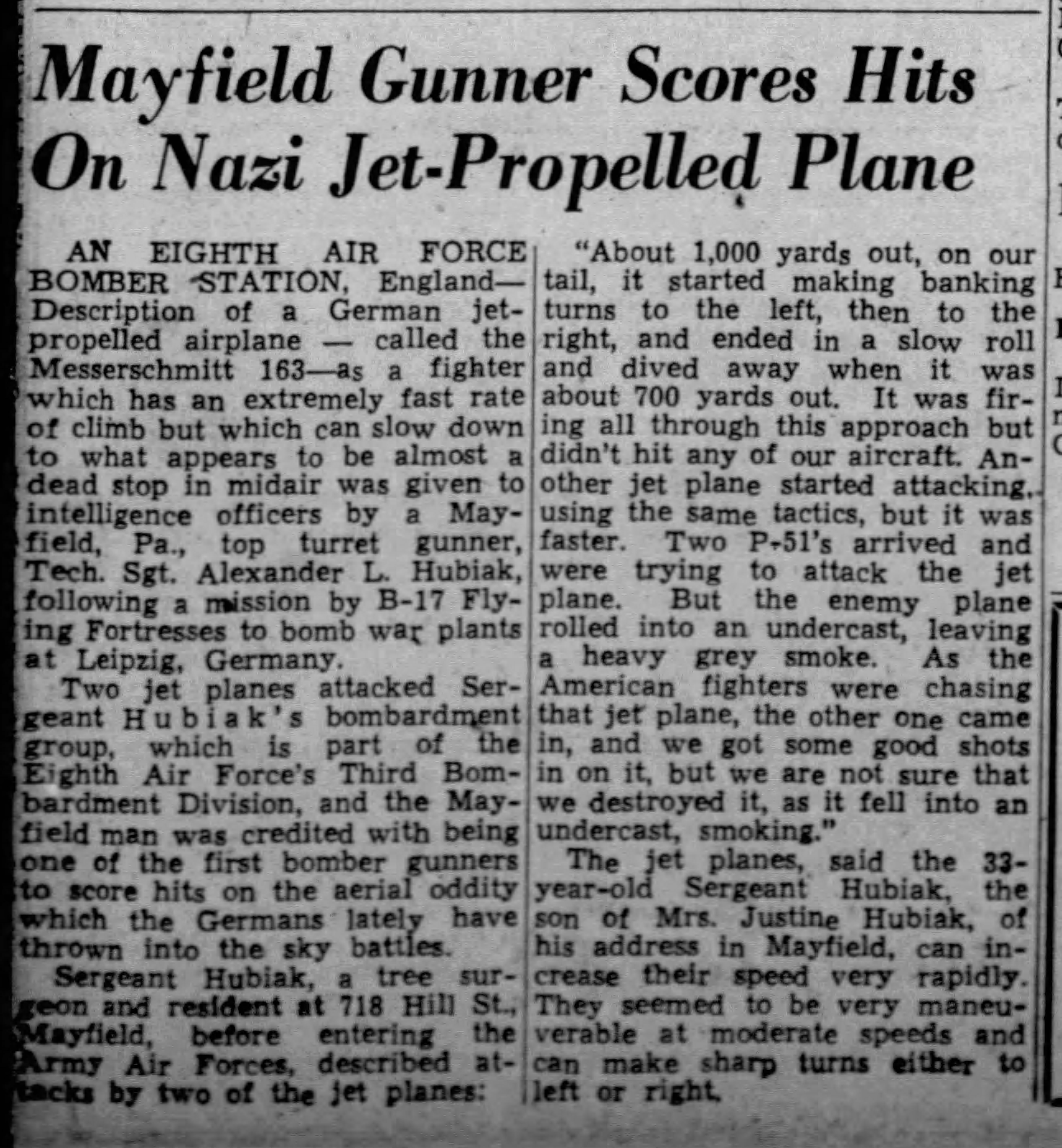
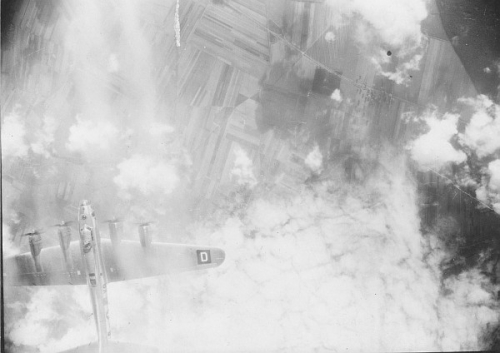
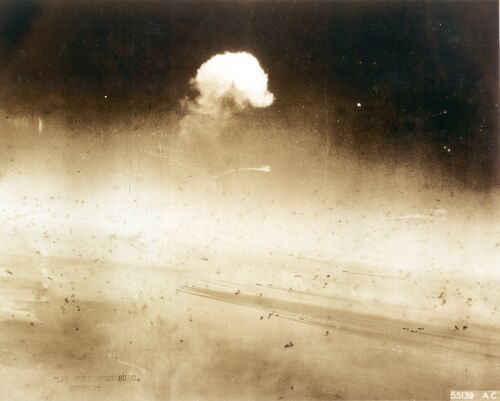
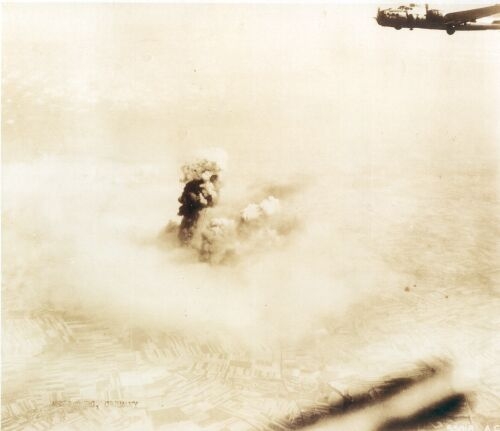
While many of the B-17s took on major battle damage, the target was still attacked with bombs away at 1205 hours through the 9/10 cloud coverage. Minutes after bombs were away, more German fighters pressed an attack. The 100A’s Operational Summary tells us, “At 1210 hours, in the target area, two ME 163’s were seen to climb almost straight up at a 1230 position about 1000 yards from our group formation. They passed from right to left in front of our formation and passed around to our rear. One of them was seen to make two passes at a straggler while the other attacked our High Squadron from 530 to 7 0’clock level. As it came in, it slow rolled. Also, the one that attacked the straggler was seen to take evasive action it came in from the rear. After making the 2nd pass it came on at our Group and closed to about 600 yards…” The gunners sighted on the fighter pressing his attack, letting him close in before shooting one fighter down while the P-51s drove the other fighter off.
William MacNab’s ship took a flak hit and Leslie Kassebaum, thought his luck had run out. He remembered, “Rough as hell, shot out windshield in front of me - Fighter hit.” And in Walter Charles’ B-17, his WG James Smith tells us, “This was my 6th one and makes three straight – and today, we went to Merzbourg. That’s the worse target in Deutshland, next to Berlin. They really did throw up all the ack-ack, that 240 guns could produce and after that the fighters – our ship didn’t get an individual fighter attack but our lead ship got some 20MM holes so they were around. Decker saw a couple of 109’s but they didn’t come in. We were the only ship in the group that didn’t get severe battle damage, only a few holes… The flak was the worst yet. A lot of airplanes went down today. I heard six straight flak bursts right underneath us and when you can hear ‘em, brother, they’re right on you.”
Lloyd Delaney’s Fortress named ‘All American Girl’ had also taken flak hits over the target, causing the loss of his #2 engine and starting a fire. Delaney’s NAV George Tolbert tells us, “Due to loss of oil, we couldn't feather the engine so it was windmilling and the vibration was alarming. Then the prop shaft burned through so the engine stopped turning but the prop still was. Lloyd tried to shake it off by some violent maneuvers but to no avail.” Dropping from formation and falling further behind the exiting B-17s, they soon found themselves alone. Tolbert continued, “More by good luck than by management we avoided any flak areas and did not attract the attention of some Jerry fighter. We were losing altitude all the while and debated whether we should try to make it to a field in the American area of northern France or keep on toward home. The majority voted to go on as long as we could as we wanted to get back for the 200th mission party soon to be held.” Instrumental in helping fly the damaged plane, Delaney’s CP, William Sajonc added, “Merseberg, where we went four times, always seemed tough for us. We came through attacks on targets at Ludwigshafen, Cologne, Munich and other places with little or no trouble - but not Merseberg.”
Lady Luck however, was not riding with Raymond Harney and his crew that day. Between the target and the Rally Point, Harney’s aircraft had taken several direct flak hits and his WG James Sorenson tells us, “there was direct flak hit in #2 engine which caught fire, shortly followed by direct hit to #1 engine and #4 having to be "feathered"... This all happened quickly, and B-17 went from full power of 4 engines to power of only 1 engine, so plane fell out of formation and lost altitude…” James Sorenson, TTE Jack Francisco and BTG Melvin Cordray would be the only three crew members bailing out as the aircraft went into a spin, falling down into the undercast and crashing. Sadly, only the three airmen that bailed out would survive the mission and would become POWs.
After an eight hour mission, with five hours on oxygen masks, the B-17s came in over the field and were counted in, with two missing. As the details of the mission came out in Interrogation, there was still some hope that the missing bombers would be accounted for. Fortunately, Delaney’s B-17 would return later to Thorpe Abbots, thirty minutes after the rest of the bombers had landed, out of fuel and with another engine on fire as they landed.
That evening, the 100BG received a Stand Down order for the next day and preparations throughout the base continued for the big shin-dig to be held at the end of the month celebrating the 100BG's 200th mission.
In the 349th Squadron area, the Baker, Chamberlain, Charles, Furrer, Marmorine and Harney crews were awakened for their next mission. The married Officers of twenty-four year-old Raymond Harney's crew included his twenty-one year-old CP William Kimball, twenty-seven year-old NAV Charles Hamrick and twenty-four year-old BOM Warren French. They had completed their first seven missions that September and were already looking forward to returning home to their wives.
A total of twenty-six crews were awakened in that dark morning and more than a few Officers would ask ’What’s the gas load’ to get some information before the briefing. The response, ’Sir, full tokyo’s topped off’ gave them an answer they dreaded, knowing that it meant a mission deep into Germany.
When the large map was revealed, the whistles and groans heard rippling through the briefing room confirmed the suspicions. The men were briefed for the synthetic oil plant at the dreaded Merseburg. Seated, was twenty-two year-old pilot Leslie Kassebaum. With most of his crew finishing their tour the previous day, Kassebaum was scheduled that morning to fly his last mission as William MacNab’s copilot. Leslie had brought his own crew back safely from Merseburg four times during the month of July and he prayed that his luck would hold out for a fifth and last time.
Also seated were the crews of Bennett, Chamberlain, Jenkins, Dobrogowski and Fory, all who had earned the right to whistle and groan after returning safely from the last mission to Merseburg on July 29. There, the 100BG had lost eight bombers and seventy-two airmen, a fact still very fresh in their minds. In fact, the 100th’s missions to Merseburg that July alone had caused the loss of twelve bombers and one hundred and twelve airmen.
With the Division’s line of B-17s to be led by the 93CBW, the 13CBW would fly as the #5 wing and #6 wings, behind the 45CBW and in front of the 92CBW. It would be the 4CBW’s turn to fly last over Merseburg.
The 13CBW would fly two wings: 13A with 390BG as the Lead and Low and the 100A as its High group and the 13B with 95BG in the Lead and Low and the 100B flying as its High. George Fory’s Pathfinder crew would fly with Neal Scott as its Command Officer while Leslie Roediger would fly with Major Channing Emberson as his Command Pilot.
With all aircraft taking off successfully, the group and wing formations were accomplished as ordered and the 13A and 13B wings fell into proper position within the Division line, departing the English coast at Southwald. As the sea was crossed, the gunners began test firing their guns in preparation for combat while the pilots continued their climb to 17000,’ crossing the Belgian coast at Ostend.
By 1134, the formations were NE of Frankfurt and the 100th’s pilots had leveled off at 27,500 feet. At 1154, the turn at the IP was made fifty miles west of Merseburg and the B-17s started down the dangerous bomb run in wing formation and with bomb bay doors open.
Scanning the skies for fighters, six ME 109s were watched closely as the formations neared the target but were chased off by the Americans fighters before they were able to make an attack. The men were grateful to see their ‘little friends’ and reported the fighter support as excellent.
The anticipated flak nightmare soon began as the target was neared. Intense, tracking, barrage and very accurate cannon fire hammered the formations while the Fortress hulls absorbed the flak. In Thomas Anderson’s B-17, his ROG Glen Smiley recorded, “Heavy flak 200 guns. Several holes in ship many very close bursts near ship. Could hear them. Got holes in wing, gas tank horizontal stabilizers also one in radio room-up through floor about a foot from where I was throwing chaff , but chaff on floor stopped it. Nobody hurt. One oxygen system shot out in upper turret so Pilot (Thomas Anderson), Bombardier (Frederick Schmidt), and upper turret (Michael Garemko) were on emergency system. Fighters were reported in area. Jet-propelled jobs were in vicinity. Big guns were all on us, very accurate…”
While many of the B-17s took on major battle damage, the target was still attacked with bombs away at 1205 hours through the 9/10 cloud coverage. Minutes after bombs were away, more German fighters pressed an attack. The 100A’s Operational Summary tells us, “At 1210 hours, in the target area, two ME 163’s were seen to climb almost straight up at a 1230 position about 1000 yards from our group formation. They passed from right to left in front of our formation and passed around to our rear. One of them was seen to make two passes at a straggler while the other attacked our High Squadron from 530 to 7 0’clock level. As it came in, it slow rolled. Also, the one that attacked the straggler was seen to take evasive action it came in from the rear. After making the 2nd pass it came on at our Group and closed to about 600 yards…” The gunners sighted on the fighter pressing his attack, letting him close in before shooting one fighter down while the P-51s drove the other fighter off.
William MacNab’s ship took a flak hit and Leslie Kassebaum, thought his luck had run out. He remembered, “Rough as hell, shot out windshield in front of me - Fighter hit.” And in Walter Charles’ B-17, his WG James Smith tells us, “This was my 6th one and makes three straight – and today, we went to Merzbourg. That’s the worse target in Deutshland, next to Berlin. They really did throw up all the ack-ack, that 240 guns could produce and after that the fighters – our ship didn’t get an individual fighter attack but our lead ship got some 20MM holes so they were around. Decker saw a couple of 109’s but they didn’t come in. We were the only ship in the group that didn’t get severe battle damage, only a few holes… The flak was the worst yet. A lot of airplanes went down today. I heard six straight flak bursts right underneath us and when you can hear ‘em, brother, they’re right on you.”
Lloyd Delaney’s Fortress named ‘All American Girl’ had also taken flak hits over the target, causing the loss of his #2 engine and starting a fire. Delaney’s NAV George Tolbert tells us, “Due to loss of oil, we couldn't feather the engine so it was windmilling and the vibration was alarming. Then the prop shaft burned through so the engine stopped turning but the prop still was. Lloyd tried to shake it off by some violent maneuvers but to no avail.” Dropping from formation and falling further behind the exiting B-17s, they soon found themselves alone. Tolbert continued, “More by good luck than by management we avoided any flak areas and did not attract the attention of some Jerry fighter. We were losing altitude all the while and debated whether we should try to make it to a field in the American area of northern France or keep on toward home. The majority voted to go on as long as we could as we wanted to get back for the 200th mission party soon to be held.” Instrumental in helping fly the damaged plane, Delaney’s CP, William Sajonc added, “Merseberg, where we went four times, always seemed tough for us. We came through attacks on targets at Ludwigshafen, Cologne, Munich and other places with little or no trouble - but not Merseberg.”
Lady Luck however, was not riding with Raymond Harney and his crew that day. Between the target and the Rally Point, Harney’s aircraft had taken several direct flak hits and his WG James Sorenson tells us, “there was direct flak hit in #2 engine which caught fire, shortly followed by direct hit to #1 engine and #4 having to be "feathered"... This all happened quickly, and B-17 went from full power of 4 engines to power of only 1 engine, so plane fell out of formation and lost altitude…” James Sorenson, TTE Jack Francisco and BTG Melvin Cordray would be the only three crew members bailing out as the aircraft went into a spin, falling down into the undercast and crashing. Sadly, only the three airmen that bailed out would survive the mission and would become POWs.
After an eight hour mission, with five hours on oxygen masks, the B-17s came in over the field and were counted in, with two missing. As the details of the mission came out in Interrogation, there was still some hope that the missing bombers would be accounted for. Fortunately, Delaney’s B-17 would return later to Thorpe Abbots, thirty minutes after the rest of the bombers had landed, out of fuel and with another engine on fire as they landed.
That evening, the 100BG received a Stand Down order for the next day and preparations throughout the base continued for the big shin-dig to be held at the end of the month celebrating the 100BG's 200th mission.
Bombing Results
Bombing Results: UNOBSERVED
Aircraft Lost: 1
Crew Lost: 9
Claims of Enemy Losses (CLS): 0
Aircraft Returned:
Media Articles
Use your thumb to scroll through the results box below.
| Media Item | Type | Page | Volume/Issue | Broadcast Source | Time | Description | File |
|---|---|---|---|---|---|---|---|
| Alexander Hubiak scores hits | The Tribune November 7 1944 | 12:00 am |