Mission Date: October 2, 1944
KASSEL, AERO ENGINE, PFF
100th BG Mission #: 205
Mission Summary
ON THIS DAY...OCTOBER 2,1944
On Sunday evening, the alert light warned the airmen at Thorpe Abbotts of a mission on for the next day. However against their better judgement, some airmen had decided to continue the 200th mission celebration well into the night. As the crews were awakened at 0230 hours the next morning, those that would come to regret their decision, slowly dressed for breakfast. Waist Gunner, James Smith remembered, “This was the day after our two-day celebration, and there were a lot of “hang-overs” over “der Fatherland” today.”
Twenty-two year old Lewis Martin, from Millville, New Jersey, was awakened for his #1 combat mission. Originally arriving to the 100BG as one of two Waist gunners on the Paul Kramp crew, Martin was subsequently assigned to the spare gunners pool when the crews were reduced to nine men. Today, he would be flying with the Donald Ellison crew as their fill-in Tail Gunner.
Thirty-eight scheduled crews had checked in for the briefing where they learned that the target for the day would be Kassel, Germany and where the entire 3rd Division’s B-17s would target Kassel’s industrial factories. The Division line, led by the 92CBW would fly the 13CBW last in the column with a primary target of the aero engine manufacturing plant.
Flying two wings, the 13A wing would be lead by the 100BG, flying all three groups in its formation and led by James Seaman in the lead aircraft with Lt Colonel Frederick Price flying as Command Pilot. The 13B, flying as the twelfth and last wing in the Division column would be flown by the 390BG, also flying all of its groups. The 95BG would be split and fly two Low groups, one with the 4B CBW and the other with the 45C CBW.
Take-off commenced over Thorpe Abbotts at 0730 hours. Wing assembly was accomplished without incident but due to the “prop wash hell” on the entire route of 8/10 to 10/10 undercast, there was difficulty in recognizing groups at the Division assembly point and the briefed order of groups was not in proper position until after crossing the Belgian coast.
Entering Germany, the formations crossed the Rhine River and the battle lines with no opposition. Enemy aircraft were in the area as they neared Kassel, but the crews were grateful once again for their "little friends" with the record stating “two FW 190's were reported in target area, but did not stay after P-51s dropped in. Four ME 410's pointed their noses at the 100 Group at 12 o'clock, but were chased off by thirty P-51s when approx. one mile off.”
Reaching its original IP at 1025 hours at 25000 feet, the 13A CBW was informed of the covered target conditions and enough time was provided to set up properly for a Pathfinder run on the Secondary target. As the 100BG flew over Kassel in wing formation, the aircraft and crews' nerves absorbed the “moderate, mainly tracking, accurate white flak,” reportedly lasting for twenty-five minutes from the IP to the Rally Point.
Bombs were away at 1140 on the Secondary target as the 100th’s Fortresses took on battle damage and the crews witnessed other group’s losses. James Smith, WG on Walter Charles B-17 reported, “We hit the marshalling yards in the center of Kassel and boy, if any of the bombs were off the target the whole town probably went up. The flak was there, from the I.P. to the target and worse onto the Rally point. We got a few holes – one right about 18 inches in front of Dick’s feet and about 4 in. big. Some of the ships bombed the enemy lines when we came over. Charley saw one Fort blow up after diving straight down. Blew up before going into the clouds.” Walter Warner, BOM on John McLaughlin’s crew recorded, “Heavy flak .88, 1.05 and Rockets…Hole in plexiglass inches from my head. Also, in rear of nose…” Raymond Mainka on Joseph Ricker’s Fortress in the Low group tells us, “… The flak was heavy on the target but after we got off the target was heaviest. We got several holes in the plane but no serious damage…” And Glenn Smiley, ROG in Thomas Anderson’s crew reported, “We picked up several holes lots of close bursts, thought our number was up. Some 17’s went down. Fighters were reported but we didn’t see any…luckily.”
The Rally Point was made and although the wings were not in the proper order as briefed, the formations headed home nonetheless. Roland Hetrick, NAV on Walter Radke’s crew tells us, “On the way home we didn't follow the flight plan and almost went though 2 flak areas. I thought our lead Navigator was off the ball, but he wasn't. He was following another group that was lost in order to have more protection from fighters that were reported in the area.”
Re-crossing the Belgian coast at 1358 hours, all of the 100BG’s Fortresses were counted in over the field at 1459 hours. It was a long day for the crews, especially with the six hours of being tied to their irritating but life-saving oxygen masks but all were home safely.
Down from his #1 combat mission, Lewis Martin felt that the flak was fairly benign. It would be his air sickness that would get the better of him that day as he entered into his diary, “On return, was interrogated and had a whisky for nerves. Tail rough, was sick over England."
Crews: Armstrong, Ivosevic, Kennedy, McLaughlin, W Miller, Radke, Ricker, Schaffhausen, Anderson, Charles, Brown, Chamberlain, Daniels, Downing, Dyatt, Fabian, Frazier, Furrer, Hempy, Hopkins, MacNab, Marmorine, McGuire, Ricci, Seamans, Thompson, Williams, Ellison
Missing 10 crew names - *Sadly, the Official records have changed style and detailed information provided once again and the loading lists of crew names are not part of the official record files starting in October 1944.
Bombing Results
Bombing Results: UNOBSERVED
Aircraft Lost: 0
Crew Lost: 0
Claims of Enemy Losses (CLS): 0
Aircraft Returned:
Photos
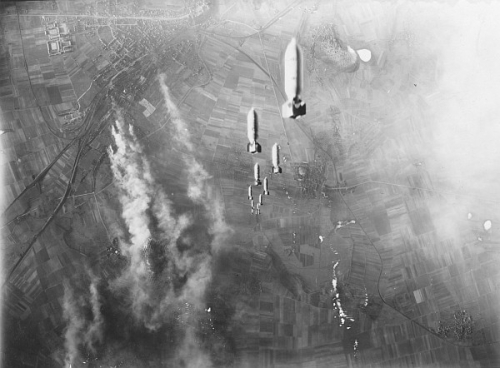
Mission Friedburg strike photo
Mission Friedburg strike photo, 4 Dec. 1944. (Photo courtesy of Raymond Kowalski family)