Mission Date: November 30, 1944
MERSEBURG, OIL REFINERY
100th BG Mission #: 228
Mission Summary
ON THIS DAY…NOVEMBER 30,1944
On the last day of November, thirty-eight crews had been awakened by 0200 hours.
At briefing, the primary target for the day was divulged as the Leuna synthetic oil plant in Merseburg. The production of synthetic oil was critical to keeping the German war machine going and the Leuna plant, a previous target on twelve other missions, was Germany’s largest and most important plant. Due to the critical nature of this resource, the Germans defended their oil production facilities heavily with smoke screens, 88 mm and 105 mm flak guns and Luftwaffe fighters.
Regardless of any destruction caused by bombers on previous missions to Merseburg, the Germans would immediately start to rebuild the plant and commence oil production again. To mislead the Allies, it was reported that the Germans had even built a plywood replica of the Leuna plant, south of the main refinery.
That morning, each of the 100BG’s B-17s carried twenty 250 pound general purpose bombs, hoping to put Merseberg out of action once and for all. ‘Mercilessberg,’ as the airmen called it, was a dangerous and dreaded target. Earlier in July at the Merseburg target, the 100th had lost eight out of its thirty-six aircraft to the German flak guns around the city.
The 13th Combat Wing, flying behind the 93BG and second in the Division column, would be led by the 390th BG, with the 95th flying as the high group and the 100th flying as the low group formation.
Reviewing the formation sheets, the men saw that the 100th's formation would be led by the 349th squadron, followed by the 350th in the high and the 418th, flying as the low squadron. Flying as command pilot for the 100BG would be Neal Scott who would fly with Joseph Trapnell.
After an hour-long delay in the scheduled take-off time due to the 10/10 cloud coverage over East Anglia, the Hundredth’s B17s finally took off between 0835-0902 hours with twelve ships forming into the lead squadron, thirteen into the high and another thirteen into the low.
The bombers flew in the 10/10 weather all the way into Germany where at the Initial Point, the weather finally cleared to CAVU conditions.
The 390BG leading the wing overshot the turn at the IP by twenty miles bringing the wing formation in over Zeitz and a fifty-four mile long bomb run tracked by the heavy flak guns below blazing away. For the seven minutes before bombs were away and four minutes afterwards, the formations endured the barrage flak. In addition, the pilots all agreed that the airspeed measured at 125 mph on the bomb run was much too slow.
Robert E. Fitzgerald, bombardier on the William J. Wilson crew remembered the bomb run vividly. “We over flew the I. P. and had to turn on the wrong heading taking us over the town of Zeitz. They threw a wall of black flak up so thick you couldn’t see through. A ship in front of us blew into nothingness and took its wing man down with it.”
After bombs were away from the 13CBW’s lead ship, it was hit by flak over the target and subsequently collided with another aircraft.
The 95BG flying left of the 390th’s formation was unable to make the turn onto the bomb run so its lead and high squadrons, upon encountering the flak at Zeitz, made a turn to the left and went on to bomb a target of opportunity at Meusel-Witz. Its low squadron went on in alone to bomb the target.
With most of the wing’s high group out of the formation, the 100BG had to continue to the target in a vulnerable position and the 100th’s leader Neal “Scotty” Scott was not happy about the 95BG leaving the target and taking the easy way out. Scott made a smart ass remark so that all of the wing's pilots were able to hear, “Fireball Red. What’s the matter? Are you all a bunch of yellow bellied sons-of-bitches?” The General, who had made that decision for the 95th, snapped back “Who made that remark?” and Scott “contemptuously told him.”
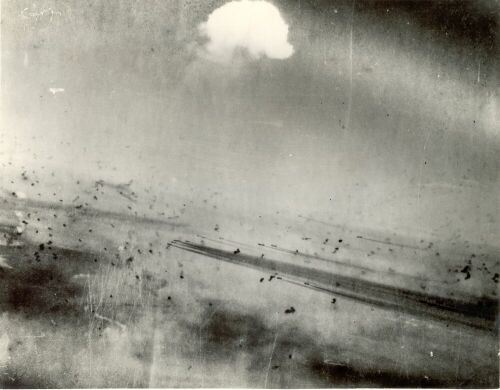
Fitzgerald tells us of the ensuing mayhem. “In about 3 minutes we were over Merseberg with its 3000 anti-aircraft guns. The flak here was 10 times as bad as Zeitz. At one time I could see three bombers going down in a ball of flames plus a couple dozen more falling out of formation…A fighter pilot bailed out of his plane and fell right through our formation…A burning ship passed right in front of us and when we hit its prop wash we fell 3,000 feet before we could pull out. So there we were 3,000 feet below the rest of the planes and they were getting all the flak and we were getting none.”
Over the target, the 100th’s squadrons were in trouble and the men located in the clear plexiglass noses were in a particularly vulnerable position. Flying the lead of the low squadron was John H. McLaughlin and his copilot Winston Hargrave. Their bombardier, Walter Warner, recorded the chaos taking place inside their fortress: “Plane hit just before Bombs Away. FLAK came through armor plate floor boards, Navigator’s helmet and head and then out top of plane. Killed instantly. My helmet and mask were knocked off. had FLAK hit my eye and right hand. Also piece through FLAK suit. Managed to get bombs away and then passed out from lack of oxygen and concussion…Heaviest FLAK ever seen at any target. 30 holes in plane.” The crew’s navigator, twenty-one year old Louis McGimsey, had been killed instantly.
At 1306 hours, togglier William Kilpatrick in Carl K. Baker’s fortress was also hit by a piece of flak, “knocking him from his seat in the nose of the aircraft, disconnecting his inter phone and his oxygen. However, with what could be termed heroic determination, he crawled back to his position, connected his inter phone and oxygen, and despite his broken arm and severe pain, proceeded to carry out his duty and drop the bombs at 1310 which was squadron bombing time.”
Ten minutes after the bombs were dropped, the lead squadron’s fortress named ‘Miss Gail Lynn’, flown by the twenty-eight year-old Minnesotan Vermont Anderson was directly hit by flak. An eyewitness report stated: “The right wing burst into flames and the aircraft fell off on its right side, spinning down into the ground. The aircraft was almost completely in flames when it fell from the formation…” Anderson’s B17 went down in a tight spin at 1320 hours, crashing and exploding into a group of large smoke stacks. The pilot and most of the crew perished, with only his copilot William Sherling, bombardier Herbert Olsen and the top turret engineer Dudley Runnels Jr managing to bail out, becoming POWs. This was the Crew’s #4 mission.
Watching a hut mate go down was a gut punch to the men still flying but there was no time to dwell upon it. Deadly situations were happening at rapid speed in Eugene Jensen’s bomber. His bombardier, Richard Ayesh tells us, “Anderson, who lied in our brk (barrack), was flying on our left wing and got a hit between #1 and #2 and I saw 3 P-51s go down. Ball turret gunner reported he saw a fire in his wing and later it broke off. He saw 3 chutes. I saw a ship covered with flames shoot up ahead then dive down. It was a ball of fire. It was from the group on our left. The 95th group under us just before bombs away. We got hit in #3 oil line and had to feather it. #4 was hit from the top and spilled oil so we feathered it. Flak sheared the connecting rod from B.B. (Bomb Bay) motor to door screw and it was impossible to close doors. We dropped down to 20,000 ft and still losing altitude due to the drag caused by the door being open. Also our turbos were shot out as we lost a lot of the power of the remaining 2 engines. We started #4 again and by this time we had lost the formation…We jettisoned all excess weight, ie., flak suits, guns, ammunition..Our electrical system was shot out and the plane was filled with smoke from the burning hydraulic oil. We were 2 1/2 hours away from friendly territory, solid undercast made navigation a good guess because our G-box and fluxgate compass were out. On way out we flew over Coblenz and they nearly shot us down…We were lost and trying to get to Brussels or Paris. We weren’t particular, however, so we landed at the first airfield near Cambrai, France.’’
Although the Wood and Dickman crews were not yet marked operational for combat, new crews would head over to the field to watch for the formation’s return and landing. At 1625 hours, the formation was observed coming in with red flares shot from the roofs of the B-17s carrying injured on board. They along with the others at the Tower counted the aircraft as they circled the field. Four bombers had not returned and those that had were returning all shot up. It had been fourteen and one-half hours since the crews had first been awakened, flying for close to nine hours under harrowing circumstances, half of that time tethered to their irritating yet critical oxygen masks.
At interrogation, the Intelligence officers were poised for bad news in awaiting any details about the four missing bombers. Eyewitnesses provided statements about Anderson’s fortress, but most were not sure about what had ultimately happened to the others. Fortunately, the 100BG would later learn that the other three aircraft had made emergency landings elsewhere. Twenty-four year old Eugene Jensen and his copilot had landed ‘Reluctant Dragon’ at base A-74 in France, aided by a P-51. Jensen stated, “As we floundered around, groping through heavy clouds, a P-51 finally showed up. He saw we didn’t quite know where we were going, and he proceeded to escort us home by cutting across the nose of our Fortress and pointing out the right direction.” Stanton Lawrence and Jay Powell had landed their fortress at Le Culot airfield in Belgium ( Base A-89) with battle damage. Carl Hedin also landed at Le Culot, escorted by a P-47 and two P-51 fighters after lagging behind the formation, dropping its bombs and losing all of their navigational equipment.
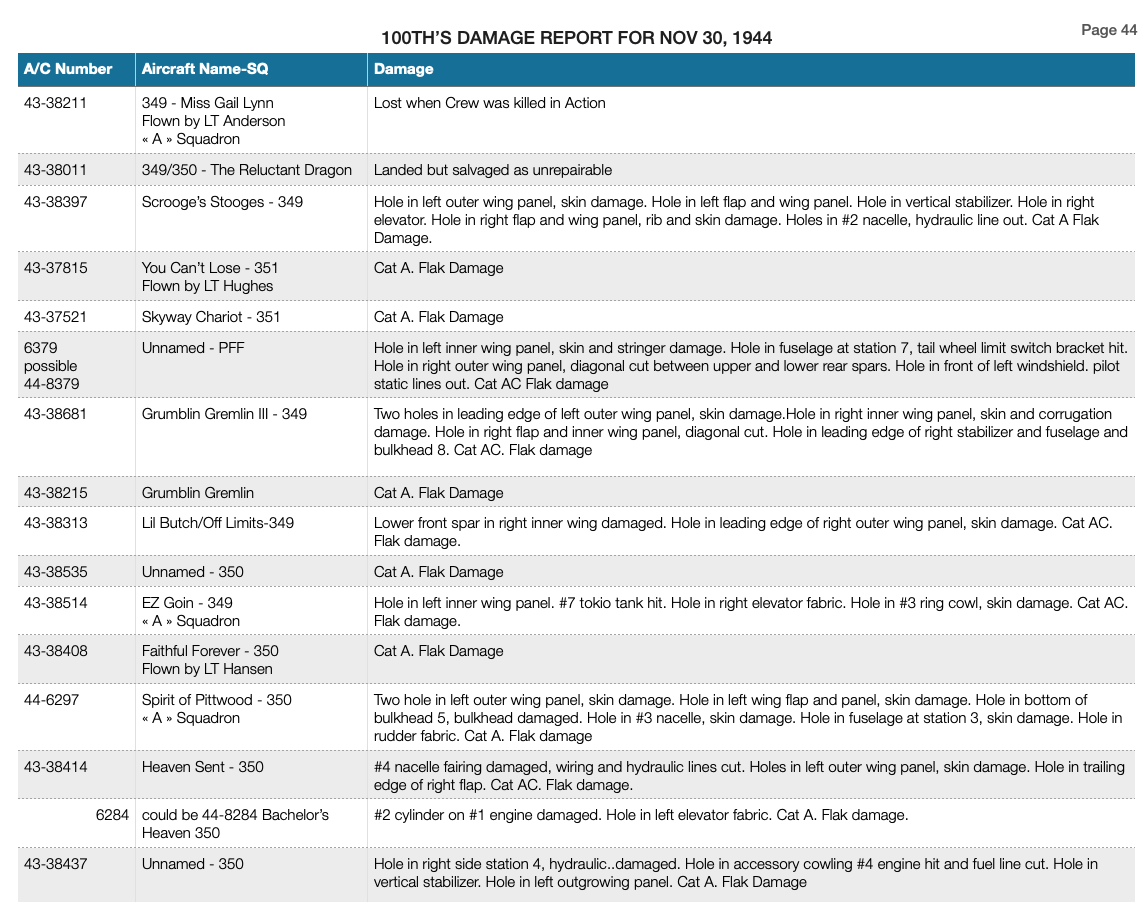
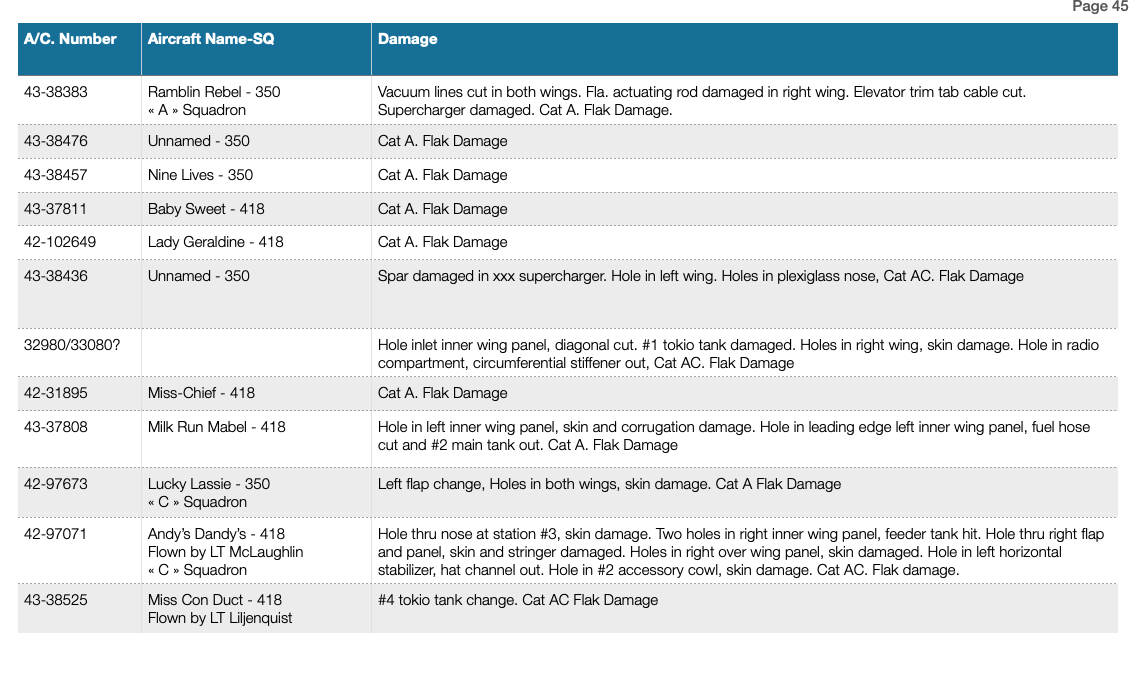
Twenty-eight crews brought their ships home with battle damage. Jensen’s aircraft, 'The Reluctant Dragon', had been so badly damaged from flak that it had to be salvaged. The repair and maintenance crews worked all that evening and through the night to repair their aircraft as quickly as possible so that the ships would be ready as quickly as possible. Maintenance crews would not begrudge their long night’s work — at least their crews and aircraft had returned that day.
A welcomed stand down signal for the next day relieved the exhausted airmen as they straggled back to their huts after chow. It was difficult for most as they closed their eyes and attempted to think of anything but what they had all just lived through. Reinforcing the Group’s reputation as the ‘Bloody Hundredth,’ some of those men lay next to empty and naked cots that earlier that morning had held their fellow airmen.
Some gratefully scratched their thoughts into their diaries that night. Ball turret gunner, nineteen year-old William Crozier flying in Joseph Ricker’s lead crew recorded, “I finally got to go to bloody Merseburg…They told us to expect 600 to 800 German fighters and at least 385 flak guns…I saw one of our squadron spinning down in flames. For the amount of flak we got surprisingly few flak holes, but our other planes were hit hard…I don’t want to go to Merseburg again. This mission was M.E. and we flew leading the low group…I now have 25 missions.’’
Nineteen year-old James H. Smith, had flown as the waist gunner on Walter Charles’ B-17 named ‘Glory Bound’ and was feeling lucky. A 105 mm shell had put a huge hole in the waist “with the explosive force of the shell serving to crumple oxygen bottles, shred shoes and other clothing which had been laid aside in an equipment bag, and slice open .50 caliber shells in the left waist gun.” With holes 12 inches from his head, Smith felt lucky to be alive. He recorded into his diary, “Back to Merzbourg. Looks as if we are going to keep going back to this one until we hit it once and for all. They have twice as much flak as 'Big B' now. 385 guns at target not counting in and out. One outfit really got shot up. Some ships missing. Four men injured. 1 killed. Friend of Jonesy our Navigator. Our No. 3 started cutting up just before target and we fell behind the formation and bombed there. There was a ship right over us until before bombs away. Do we sweat!! Rough !!”
The impact of the Merseburg mission remained with pilot Denzil Naar even years later. “The hardest target was Merseburg!!!!!! When they pulled back the curtain and the string went all the way to that target, I am getting chills just thinking about it now, the black puffs, the sky filled with flak bursts, planes exploding everywhere and going down, parachutes, debris, and death and you had to keep on course. There was nowhere to hide, no room to move.”
Red Bowman entered into the 100BG’s diary, “'Big Bad M’ - Merseburg - today’s target. Has now become the most dreaded target in Germany. More than 300 heavy guns and several hundred fighters in the area. Captain Scott led today’s foray. Bombed by Pathfinder - results - poor.” And as for Captain Scott, who had dressed down the 95BG, he was met by Colonel Jeffrey’s who had “ears ringing with the general’s indignation.” The matter was eventually allowed to drop.
On the last day of November, thirty-eight crews had been awakened by 0200 hours.
At briefing, the primary target for the day was divulged as the Leuna synthetic oil plant in Merseburg. The production of synthetic oil was critical to keeping the German war machine going and the Leuna plant, a previous target on twelve other missions, was Germany’s largest and most important plant. Due to the critical nature of this resource, the Germans defended their oil production facilities heavily with smoke screens, 88 mm and 105 mm flak guns and Luftwaffe fighters.
Regardless of any destruction caused by bombers on previous missions to Merseburg, the Germans would immediately start to rebuild the plant and commence oil production again. To mislead the Allies, it was reported that the Germans had even built a plywood replica of the Leuna plant, south of the main refinery.
That morning, each of the 100BG’s B-17s carried twenty 250 pound general purpose bombs, hoping to put Merseberg out of action once and for all. ‘Mercilessberg,’ as the airmen called it, was a dangerous and dreaded target. Earlier in July at the Merseburg target, the 100th had lost eight out of its thirty-six aircraft to the German flak guns around the city.
The 13th Combat Wing, flying behind the 93BG and second in the Division column, would be led by the 390th BG, with the 95th flying as the high group and the 100th flying as the low group formation.
Reviewing the formation sheets, the men saw that the 100th's formation would be led by the 349th squadron, followed by the 350th in the high and the 418th, flying as the low squadron. Flying as command pilot for the 100BG would be Neal Scott who would fly with Joseph Trapnell.
After an hour-long delay in the scheduled take-off time due to the 10/10 cloud coverage over East Anglia, the Hundredth’s B17s finally took off between 0835-0902 hours with twelve ships forming into the lead squadron, thirteen into the high and another thirteen into the low.
The bombers flew in the 10/10 weather all the way into Germany where at the Initial Point, the weather finally cleared to CAVU conditions.
The 390BG leading the wing overshot the turn at the IP by twenty miles bringing the wing formation in over Zeitz and a fifty-four mile long bomb run tracked by the heavy flak guns below blazing away. For the seven minutes before bombs were away and four minutes afterwards, the formations endured the barrage flak. In addition, the pilots all agreed that the airspeed measured at 125 mph on the bomb run was much too slow.
Robert E. Fitzgerald, bombardier on the William J. Wilson crew remembered the bomb run vividly. “We over flew the I. P. and had to turn on the wrong heading taking us over the town of Zeitz. They threw a wall of black flak up so thick you couldn’t see through. A ship in front of us blew into nothingness and took its wing man down with it.”
After bombs were away from the 13CBW’s lead ship, it was hit by flak over the target and subsequently collided with another aircraft.
The 95BG flying left of the 390th’s formation was unable to make the turn onto the bomb run so its lead and high squadrons, upon encountering the flak at Zeitz, made a turn to the left and went on to bomb a target of opportunity at Meusel-Witz. Its low squadron went on in alone to bomb the target.
With most of the wing’s high group out of the formation, the 100BG had to continue to the target in a vulnerable position and the 100th’s leader Neal “Scotty” Scott was not happy about the 95BG leaving the target and taking the easy way out. Scott made a smart ass remark so that all of the wing's pilots were able to hear, “Fireball Red. What’s the matter? Are you all a bunch of yellow bellied sons-of-bitches?” The General, who had made that decision for the 95th, snapped back “Who made that remark?” and Scott “contemptuously told him.”
Fitzgerald tells us of the ensuing mayhem. “In about 3 minutes we were over Merseberg with its 3000 anti-aircraft guns. The flak here was 10 times as bad as Zeitz. At one time I could see three bombers going down in a ball of flames plus a couple dozen more falling out of formation…A fighter pilot bailed out of his plane and fell right through our formation…A burning ship passed right in front of us and when we hit its prop wash we fell 3,000 feet before we could pull out. So there we were 3,000 feet below the rest of the planes and they were getting all the flak and we were getting none.”
Over the target, the 100th’s squadrons were in trouble and the men located in the clear plexiglass noses were in a particularly vulnerable position. Flying the lead of the low squadron was John H. McLaughlin and his copilot Winston Hargrave. Their bombardier, Walter Warner, recorded the chaos taking place inside their fortress: “Plane hit just before Bombs Away. FLAK came through armor plate floor boards, Navigator’s helmet and head and then out top of plane. Killed instantly. My helmet and mask were knocked off. had FLAK hit my eye and right hand. Also piece through FLAK suit. Managed to get bombs away and then passed out from lack of oxygen and concussion…Heaviest FLAK ever seen at any target. 30 holes in plane.” The crew’s navigator, twenty-one year old Louis McGimsey, had been killed instantly.
At 1306 hours, togglier William Kilpatrick in Carl K. Baker’s fortress was also hit by a piece of flak, “knocking him from his seat in the nose of the aircraft, disconnecting his inter phone and his oxygen. However, with what could be termed heroic determination, he crawled back to his position, connected his inter phone and oxygen, and despite his broken arm and severe pain, proceeded to carry out his duty and drop the bombs at 1310 which was squadron bombing time.”
Ten minutes after the bombs were dropped, the lead squadron’s fortress named ‘Miss Gail Lynn’, flown by the twenty-eight year-old Minnesotan Vermont Anderson was directly hit by flak. An eyewitness report stated: “The right wing burst into flames and the aircraft fell off on its right side, spinning down into the ground. The aircraft was almost completely in flames when it fell from the formation…” Anderson’s B17 went down in a tight spin at 1320 hours, crashing and exploding into a group of large smoke stacks. The pilot and most of the crew perished, with only his copilot William Sherling, bombardier Herbert Olsen and the top turret engineer Dudley Runnels Jr managing to bail out, becoming POWs. This was the Crew’s #4 mission.
Watching a hut mate go down was a gut punch to the men still flying but there was no time to dwell upon it. Deadly situations were happening at rapid speed in Eugene Jensen’s bomber. His bombardier, Richard Ayesh tells us, “Anderson, who lied in our brk (barrack), was flying on our left wing and got a hit between #1 and #2 and I saw 3 P-51s go down. Ball turret gunner reported he saw a fire in his wing and later it broke off. He saw 3 chutes. I saw a ship covered with flames shoot up ahead then dive down. It was a ball of fire. It was from the group on our left. The 95th group under us just before bombs away. We got hit in #3 oil line and had to feather it. #4 was hit from the top and spilled oil so we feathered it. Flak sheared the connecting rod from B.B. (Bomb Bay) motor to door screw and it was impossible to close doors. We dropped down to 20,000 ft and still losing altitude due to the drag caused by the door being open. Also our turbos were shot out as we lost a lot of the power of the remaining 2 engines. We started #4 again and by this time we had lost the formation…We jettisoned all excess weight, ie., flak suits, guns, ammunition..Our electrical system was shot out and the plane was filled with smoke from the burning hydraulic oil. We were 2 1/2 hours away from friendly territory, solid undercast made navigation a good guess because our G-box and fluxgate compass were out. On way out we flew over Coblenz and they nearly shot us down…We were lost and trying to get to Brussels or Paris. We weren’t particular, however, so we landed at the first airfield near Cambrai, France.’’
Although the Wood and Dickman crews were not yet marked operational for combat, new crews would head over to the field to watch for the formation’s return and landing. At 1625 hours, the formation was observed coming in with red flares shot from the roofs of the B-17s carrying injured on board. They along with the others at the Tower counted the aircraft as they circled the field. Four bombers had not returned and those that had were returning all shot up. It had been fourteen and one-half hours since the crews had first been awakened, flying for close to nine hours under harrowing circumstances, half of that time tethered to their irritating yet critical oxygen masks.
At interrogation, the Intelligence officers were poised for bad news in awaiting any details about the four missing bombers. Eyewitnesses provided statements about Anderson’s fortress, but most were not sure about what had ultimately happened to the others. Fortunately, the 100BG would later learn that the other three aircraft had made emergency landings elsewhere. Twenty-four year old Eugene Jensen and his copilot had landed ‘Reluctant Dragon’ at base A-74 in France, aided by a P-51. Jensen stated, “As we floundered around, groping through heavy clouds, a P-51 finally showed up. He saw we didn’t quite know where we were going, and he proceeded to escort us home by cutting across the nose of our Fortress and pointing out the right direction.” Stanton Lawrence and Jay Powell had landed their fortress at Le Culot airfield in Belgium ( Base A-89) with battle damage. Carl Hedin also landed at Le Culot, escorted by a P-47 and two P-51 fighters after lagging behind the formation, dropping its bombs and losing all of their navigational equipment.
Twenty-eight crews brought their ships home with battle damage. Jensen’s aircraft, 'The Reluctant Dragon', had been so badly damaged from flak that it had to be salvaged. The repair and maintenance crews worked all that evening and through the night to repair their aircraft as quickly as possible so that the ships would be ready as quickly as possible. Maintenance crews would not begrudge their long night’s work — at least their crews and aircraft had returned that day.
A welcomed stand down signal for the next day relieved the exhausted airmen as they straggled back to their huts after chow. It was difficult for most as they closed their eyes and attempted to think of anything but what they had all just lived through. Reinforcing the Group’s reputation as the ‘Bloody Hundredth,’ some of those men lay next to empty and naked cots that earlier that morning had held their fellow airmen.
Some gratefully scratched their thoughts into their diaries that night. Ball turret gunner, nineteen year-old William Crozier flying in Joseph Ricker’s lead crew recorded, “I finally got to go to bloody Merseburg…They told us to expect 600 to 800 German fighters and at least 385 flak guns…I saw one of our squadron spinning down in flames. For the amount of flak we got surprisingly few flak holes, but our other planes were hit hard…I don’t want to go to Merseburg again. This mission was M.E. and we flew leading the low group…I now have 25 missions.’’
Nineteen year-old James H. Smith, had flown as the waist gunner on Walter Charles’ B-17 named ‘Glory Bound’ and was feeling lucky. A 105 mm shell had put a huge hole in the waist “with the explosive force of the shell serving to crumple oxygen bottles, shred shoes and other clothing which had been laid aside in an equipment bag, and slice open .50 caliber shells in the left waist gun.” With holes 12 inches from his head, Smith felt lucky to be alive. He recorded into his diary, “Back to Merzbourg. Looks as if we are going to keep going back to this one until we hit it once and for all. They have twice as much flak as 'Big B' now. 385 guns at target not counting in and out. One outfit really got shot up. Some ships missing. Four men injured. 1 killed. Friend of Jonesy our Navigator. Our No. 3 started cutting up just before target and we fell behind the formation and bombed there. There was a ship right over us until before bombs away. Do we sweat!! Rough !!”
The impact of the Merseburg mission remained with pilot Denzil Naar even years later. “The hardest target was Merseburg!!!!!! When they pulled back the curtain and the string went all the way to that target, I am getting chills just thinking about it now, the black puffs, the sky filled with flak bursts, planes exploding everywhere and going down, parachutes, debris, and death and you had to keep on course. There was nowhere to hide, no room to move.”
Red Bowman entered into the 100BG’s diary, “'Big Bad M’ - Merseburg - today’s target. Has now become the most dreaded target in Germany. More than 300 heavy guns and several hundred fighters in the area. Captain Scott led today’s foray. Bombed by Pathfinder - results - poor.” And as for Captain Scott, who had dressed down the 95BG, he was met by Colonel Jeffrey’s who had “ears ringing with the general’s indignation.” The matter was eventually allowed to drop.
Bombing Results
Bombing Results: POOR
Aircraft Lost: 1
Crew Lost: 10
Claims of Enemy Losses (CLS): 0
Aircraft Returned:
Media Articles
Use your thumb to scroll through the results box below.
| Media Item | Type | Page | Volume/Issue | Broadcast Source | Time | Description | File |
|---|---|---|---|---|---|---|---|
| Battle damage November 30 1944 part 1 | 12:00 am | ||||||
| Battle damage November 30 1944 part 2 | 12:00 am |